
What do you do when a powerful, well-connected male mentor is offering to “take you under his wing,” and you’re quietly wondering: Is he actually good with women trainees, or am I walking into a mess?
Here’s the answer you’re looking for: you do not guess, and you do not rely on vibes. You gather specific data. You test for patterns. You treat this like a patient safety issue—because for your career, it is.
This isn’t about “are men safe or unsafe” in some abstract culture-war way. It’s about this man, in this department, with his power and history. Let’s break down how to evaluate that—quietly, efficiently, and with your eyes open.
Step 1: Look at His Actual Trainee History
Do not start with what he says about mentoring women. Start with who has actually worked with him and where they are now.
Concrete questions to answer:
- Has he mentored women at your level before (students, residents, fellows)?
- Where did those women end up—academia, private practice, burnt out and gone?
- Do they still speak well of him now that they no longer need him?
Start by scanning:
- Author lists on his papers – are there women first authors? Repeated names?
- Program website – who are his former fellows? Any women? Where are they now?
- Conference abstracts – look for his name on trainee posters and talks, note genders and roles.
| Item to Check | Healthy Pattern |
|---|---|
| Former women mentees | Several, across multiple years |
| Authorship | Women as first/second authors |
| Presentations | Women trainees presenting data |
| Career outcomes | Women in solid next-step positions |
Patterns that should give you pause:
- He’s been around for 15+ years and somehow has no women mentees in sight.
- The women are always middle authors while male mentees are first authors.
- Women disappear from his orbit after one project, while men stay attached for years.
Does this prove anything by itself? No. But good mentors of women almost always leave a trail.
Step 2: Quietly Ask the Right People the Right Questions
You’re not running an investigation. You’re doing due diligence. That means targeted, low-drama questions to people who’ve seen him up close.
Who to ask:
- Senior residents/fellows who’ve rotated with him
- Women a few years ahead who know the department politics
- Administrative staff who’ve worked there forever (they see everything)
- If available, a trusted female faculty member who knows him professionally
How to ask without lighting a fire:
Instead of “Is he creepy?” ask questions that invite specifics:
- “I’m thinking of working with Dr. X. How has he been with women trainees?”
- “Who are some women he’s mentored? How did that go for them?”
- “If your little sister were starting here, would you be happy if she worked closely with him?”
- “How does he handle it when women push back or set boundaries?”
You’re listening for content and tone.
Green-ish responses:
- “He’s intense with everyone, but I never saw gender-specific weirdness.”
- “He’s demanding, but he backed me for talks and letters. Never made it feel gendered.”
- “I felt safe with him. Busy and stressed, yes. Unsafe, no.”
Yellow-to-red responses:
- Long pause, then: “Well… he’s very ‘old school.’ I’d just keep things professional.”
- “He’s great for the guys. For women… it’s more hit or miss.”
- “I’d work with him for a single project, not as a primary mentor.”
- “Off the record? I’d be careful about closed-door meetings.”
One of the most telling answers I’ve seen: when you ask, “Would you let your mentee/work best friend work closely with him?” and people dodge instead of answering clearly. Dodging is data.
Step 3: Watch His Real-Time Behavior Around Women
If you’re considering him as a mentor, you should already be seeing him in action—in rounds, conferences, ORs, labs, meetings. Use that.
Specific things to watch:
How he treats women versus men in public spaces:
- Does he interrupt women more than men?
- When a woman presents, does he address her directly or talk past her to a male in the room?
- Does he credit women for their ideas, or re-label them as his?
How he handles women’s competence:
- When a woman performs well, does he frame it as “surprising” or “impressive for a junior” in a way he doesn’t for men?
- When a woman makes a mistake, is the response proportionate, or does it become a character indictment?
Boundaries and physical space:
- Does he routinely close doors with women trainees when it’s unnecessary?
- Does he touch shoulders/backs/arms casually with women but not men?
- Does he make comments on appearance, clothing, or “looking tired,” especially in front of others?
If you see one small weird moment, that’s a note. If you see a consistent pattern of boundary-nudging, minimization, or gendered double standards—that’s a track record.
Step 4: Listen Closely to How He Talks About Women
Often, faculty tell you exactly who they are. Just not directly.
Pay attention when he mentions:
Former women trainees:
- “She was very emotional…” (used only about women)
- “She got pregnant in the middle of fellowship” said with annoyance, not neutrality
- “She was great, very loyal, really took care of the team” (but no mention of career growth)
Female colleagues:
- “She’s very aggressive” (for behavior he praises as “confident” in men)
- “She only got that position because of diversity stuff”
- “You’re not like other female residents; you’re serious” (this is not a compliment)
Policies about harassment or equity:
- Eye-rolling about “all these new rules”
- Complaints about men “not being able to do anything anymore”
- Jokes about “needing chaperones now”
These aren’t random comments; they’re windows into how he will interpret your boundaries, requests for support, or pushback later.
Step 5: Check His Professional Choices and Service Roles
Men who are genuinely solid mentors to women usually show it in how they spend their time and political capital.
Look for:
- Has he served on diversity, equity, or professionalism committees—and did he take it seriously?
- Has he publicly backed women trainees or colleagues (e.g., calling out interruptions, crediting work, supporting promotions)?
- Has he co-authored opinion pieces, guidelines, or talks on mentorship, equity, or professionalism?
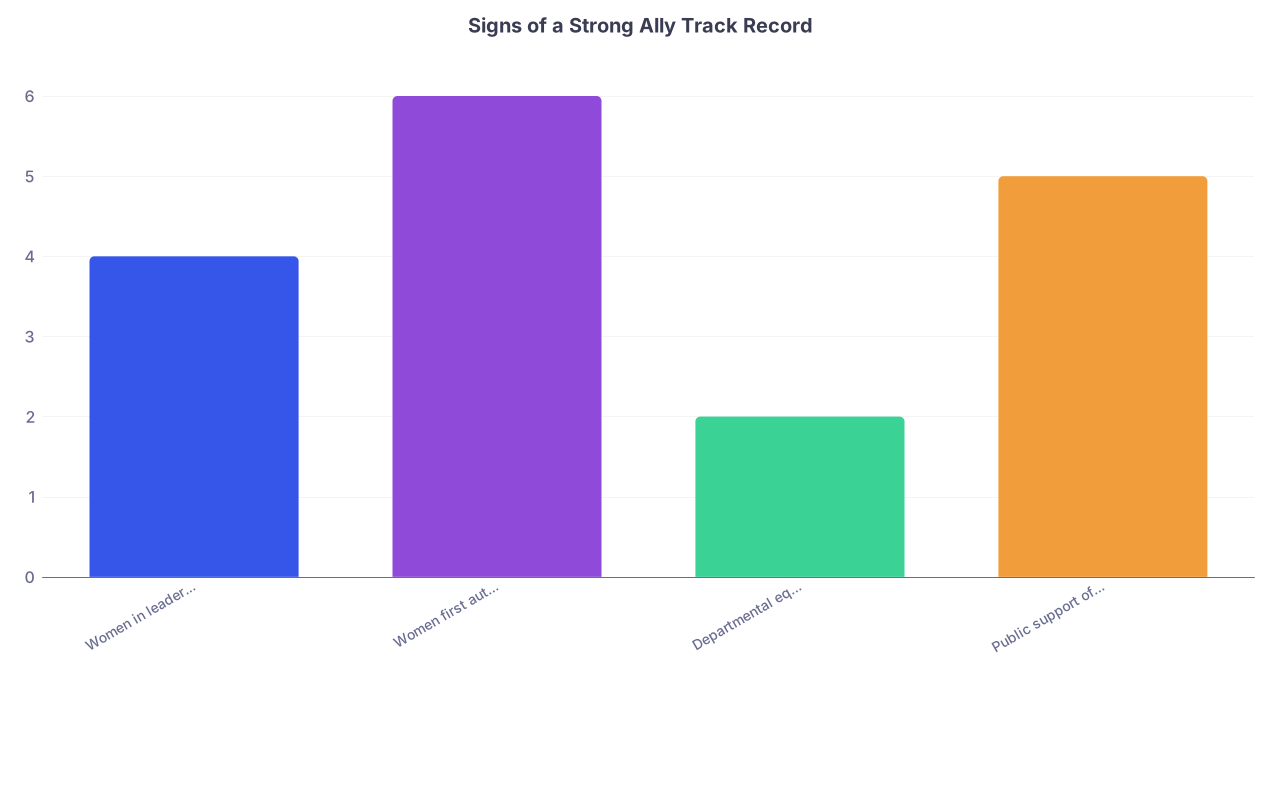
| Category | Value |
|---|---|
| Women in leadership roles from his group | 4 |
| Women first authors he has mentored | 6 |
| Departmental equity/professionalism roles | 2 |
| Public support of women trainees | 5 |
You do not need a saint. But if his CV and roles show zero involvement in anything that benefits women or improves culture, and the whispers aren’t great, that’s not a coincidence.
Step 6: Decide Your Risk Tolerance and Set Guardrails
Sometimes the calculus is messy. Maybe he’s the only one doing the niche research you care about. Maybe he runs the lab with all the grants. Maybe he has a mixed but survivable track record.
Then the question becomes: If you work with him, under what conditions do you keep yourself safe and your options open?
Guardrails I recommend to women in exactly this spot:
Avoid being his only or primary mentor
Set up a formal co-mentor—preferably a woman or known ally. Put it in writing in mentorship forms if your program has them.Keep meetings visible and time-limited
- Neutral location (conference room, open office with windows, not his home or hotel lobby at night).
- Calendar invites with clear titles: “Research meeting re: X project.”
- If there’s travel, build in group structure (others present, joint dinners, etc.).
Document work, not drama
- Keep emails summarizing agreed tasks, authorship expectations, and deadlines.
- Save copies of key praise/feedback for your records; these matter for letters and if things sour.
Maintain outside mentorship and sponsorship
Do not let your whole career pipeline, letters, and opportunities run through one man whose track record you only half-trust.

| Step | Description |
|---|---|
| Step 1 | You |
| Step 2 | Primary Safe Mentor |
| Step 3 | Higher Risk High Value Mentor |
| Step 4 | Program Director |
| Step 5 | Peer Support / Women Group |
| Step 6 | Specific Project Only |
If any of this feels like overkill, remember: men with poor histories almost always looked “fine” to someone early on. Until they didn’t.
Step 7: Watch How He Reacts to Your Boundaries
This is the real test. You don’t know who someone is as a mentor until you say “no” to something.
Simple boundary tests:
You say: “I’d prefer to meet in the conference room rather than your office.”
- Healthy response: “Of course, no problem.”
- Problem response: sighing, teasing, “You don’t trust me?” jokes.
You say: “I can’t take on another paper right now; I want to do excellent work on the current one.”
- Healthy: Works with you, maybe negotiates timeline.
- Problem: Guilt trips, threats to “lose opportunities,” or hints you’re not committed enough.
You say: “I’d like to clarify authorship expectations now that I’ve done X and Y.”
- Healthy: Has the conversation. Maybe tough, but fair.
- Problem: Dismisses you as “too focused on titles” or “not a team player.”
A male mentor’s track record with women is not just what he did 10 years ago. It’s how he responds when you assert that you’re a professional with rights, priorities, and limits.
Step 8: Pay Attention to Institutional Signals
Sometimes the institution quietly tells you what they think of him. You just have to bother to look.
Signals of concern:
- He’s mysteriously “not allowed” to be the sole supervisor for medical students anymore.
- He was quietly removed from a leadership role with vague language around “restructuring.”
- People refer to “history” or “issues a few years back” but become very vague when pressed.

If you hear about “professionalism incidents” or “boundary issues” that were “addressed,” treat that as a yellow light, not proof that everything is fixed. The question becomes: do you want to be part of the second-chance experiment?
Step 9: Have an Exit Strategy Before You Need It
Sometimes you’ll only see someone’s full pattern once you’re already tied to them. You are not stuck.
Before you commit, sketch answers to:
- If this goes badly, who can I go to first? (Name an actual person.)
- What is the smallest project I can start with to “test” this relationship?
- How can I frame a pivot as neutral (“new interests,” “aligning with X’s expertise”) rather than accusatory, if I need to move?
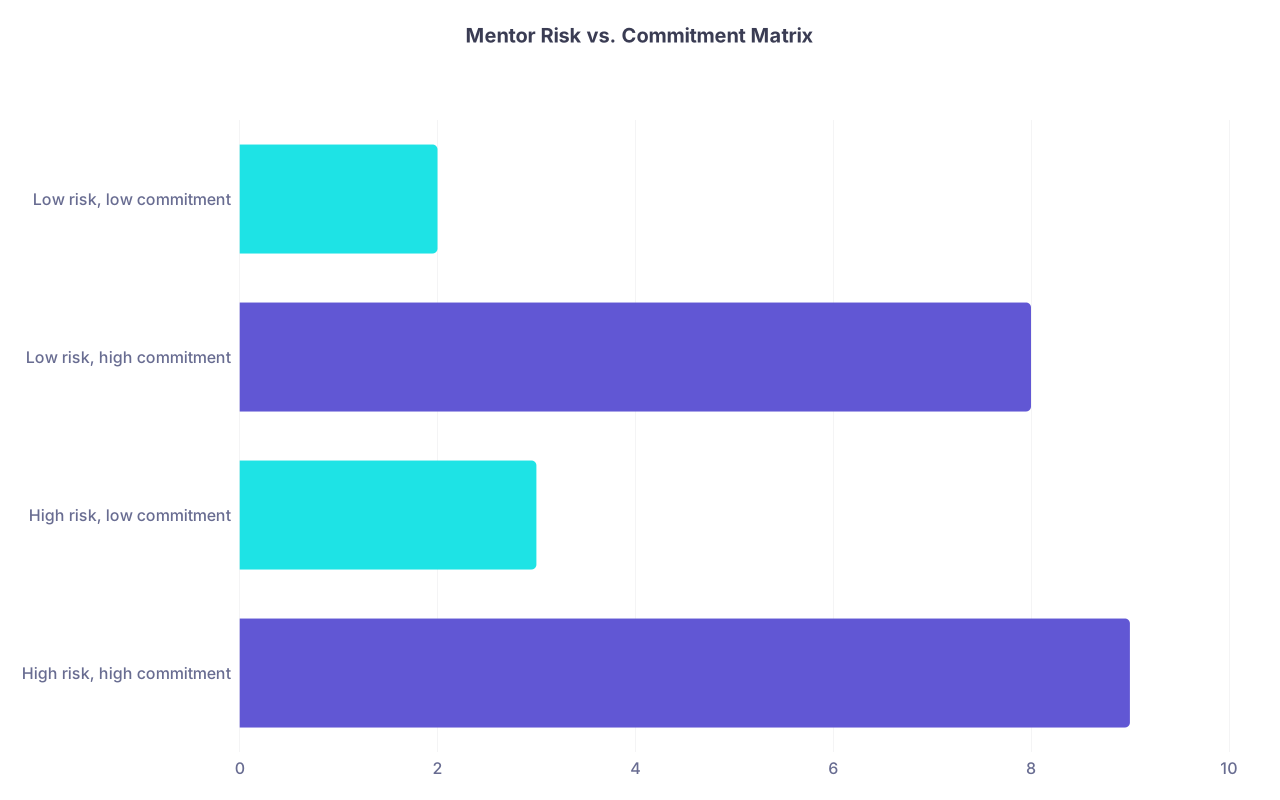
| Category | Value |
|---|---|
| High risk, high commitment | 9 |
| High risk, low commitment | 3 |
| Low risk, high commitment | 8 |
| Low risk, low commitment | 2 |
Aim for low commitment until risk feels low. Long-term, you want at least one mentor whose ethics and track record you don’t have to dissect like this.
Quick Reality Check
Let me be blunt.
- A male mentor with a strong, visible, positive history with women trainees is an asset. Use him.
- A man with no visible history with women, plus weird vibes, plus hedged comments from senior women—treat that like a medication with a black box warning.
- You’re not paranoid for asking these questions. You’re doing the same risk assessment you already do for complicated patients and high-risk procedures.
You are allowed to keep yourself safe and ambitious at the same time.

FAQ: Evaluating a Male Mentor’s Track Record With Women Trainees
Is it fair to “screen” male mentors like this?
Yes. You’re not accusing anyone; you’re assessing risk based on power, history, and patterns. Men with solid track records will pass this screen easily and often appreciate that you care about culture and safety.What if everyone says, “He’s great academically, but a little inappropriate sometimes”?
Translate “a little inappropriate” as: high output, higher personal risk. You can still work with him, but keep the relationship narrow (one project), add a co-mentor, and avoid social situations that blur lines. Or decide his benefits are not worth that cost.Should I confront him directly about rumors or concerns?
Generally, no. That rarely ends well for a junior trainee. Use behavior-based guardrails instead. If his conduct toward you crosses lines, that’s when you consider formal reporting pathways with support from a trusted senior or institutional office.What if there are no good female mentors in my field, only men with mixed records?
Then your strategy is diversification. Use one for research access, another for career advice, and bring in an external female mentor (even at another institution) for gender-specific and ethical guidance. You don’t need everything from one person.How do I avoid being labeled as “difficult” if I set firm boundaries?
You won’t avoid it with everyone. But you can protect yourself by being consistent, calm, and professional. Keep your boundaries behavior-based (“I prefer group meetings”) rather than accusatory, and overdeliver on the actual work. Documentation matters.If I already started with a mentor and now see red flags, what do I do?
Do not panic, and do not blow it up publicly unless there is active harm. Start by quietly adding more mentors, shifting new opportunities away from him, and limiting 1:1 time. Frame the pivot as “broadening my mentorship team” rather than “escaping you.”What if I misjudge someone and avoid a potentially great mentor?
You will not hit 100% accuracy. That’s fine. You’re balancing limited time, safety, and career growth. Missing one good mentor is less damaging than tying yourself tightly to someone with a history that might hurt you. You can always expand your circle later as you learn more.
Key points:
- Do not guess—evaluate a male mentor’s history with women using specific, observable data: past mentees, behavior, and institutional signals.
- If you choose to work with someone higher risk, do it with clear guardrails: co-mentors, documented expectations, public spaces, and an exit strategy.