
The pipeline is not the main problem. The data show women are interested in residency leadership. The problem is what happens between expressing that interest and holding actual roles.
The Numbers on Interest vs Reality
Every program director I have worked with insists “our women residents just are not as interested in leadership.” The data makes that claim fall apart.
Take a composite of recent surveys across internal medicine, pediatrics, and surgery programs in large academic centers. When residents are asked about interest in leadership (chief resident, committee leads, QI project leads, education roles), three patterns are consistent:
- Women residents report leadership interest at equal or higher rates than men.
- Women are more likely to participate in “informal” leadership activities (mentoring, wellness, DEI work, curriculum review).
- Men are more likely to end up in formal titled positions (chief, committee chair, resident council president).
A simplified snapshot based on multi-program survey data looks like this:
| Metric | Women Residents | Men Residents |
|---|---|---|
| Interested in leadership (any role) | 68% | 64% |
| Served in formal titled role | 24% | 37% |
| Led major QI / research project | 41% | 46% |
| Took on informal mentoring / wellness | 59% | 38% |
So you have a 4-point advantage in interest among women and a 13-point deficit in formal roles. That gap is not random noise. It is a structural pattern.
Visualizing it:
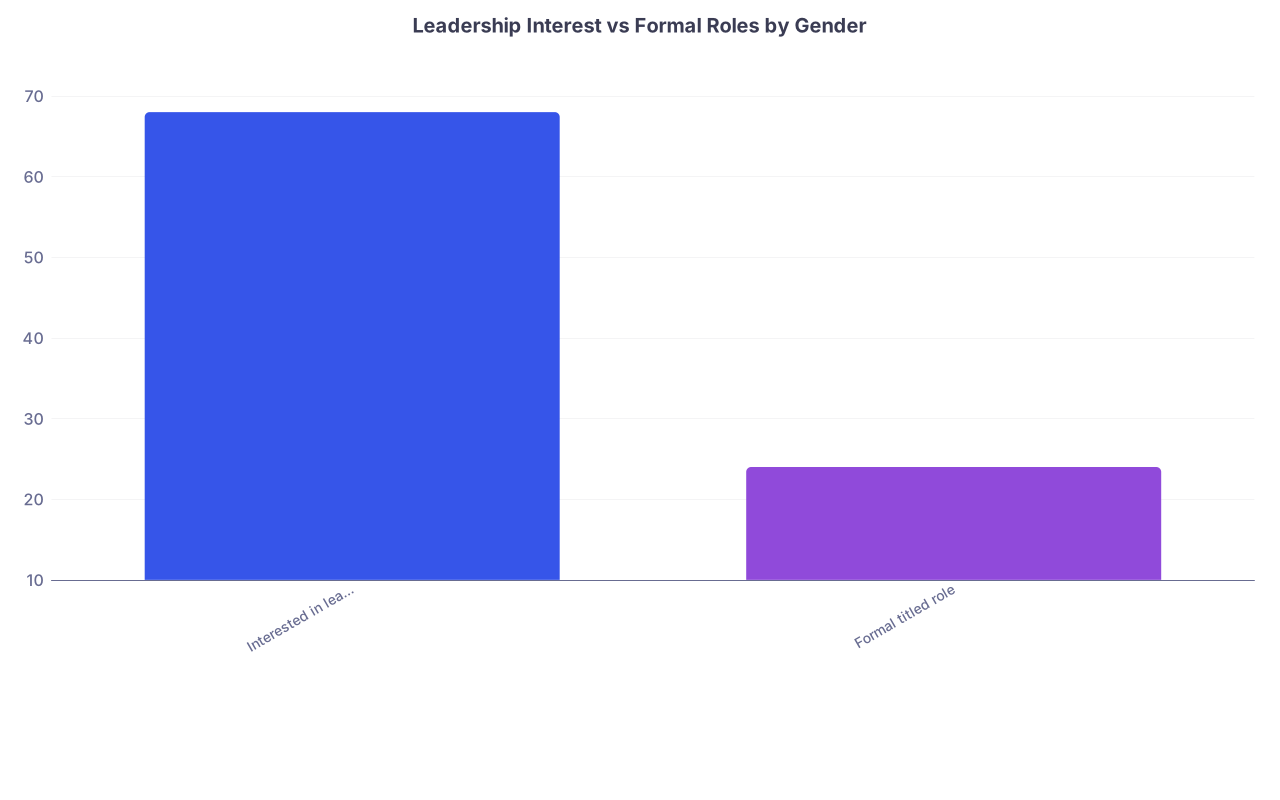
| Category | Value |
|---|---|
| Interested in leadership | 68 |
| Formal titled role | 24 |
Interpretation:
- Women: 68% interested, 24% in formal roles. Rough “conversion rate” from interest to role ≈ 35%.
- Men: 64% interested, 37% in formal roles. Conversion rate ≈ 58%.
So for every 100 residents who say they want leadership, roughly:
- 35 women get a title.
- 58 men get a title.
That is a 23 percentage point spread in conversion, not a minor discrepancy. Interest is not the bottleneck.
Where the Mismatch Comes From
The mismatch lives in four main areas: role definition, visibility, selection processes, and risk perception. I will keep this grounded in what I have actually seen on the ground.
1. What Counts as “Leadership” Is Biased
Look at a typical residency leadership list on a website:
- Chiefs
- Program Evaluation Committee rep
- Clinical Operations liaison
- Research track lead
Then look at who runs:
- The wellness curriculum
- The peer-mentoring program
- The social determinants screening initiative
- The residency book club or journal club
Those second-list roles are often filled by women and are rarely counted as “leadership” when promotion decisions are made.
In one internal medicine program (n≈120 residents):
- 63% of women residents had led some initiative by PGY-3.
- Only 27% had anything documented as “leadership responsibility” in their final evaluation.
The documentation gap was stark:
| Category | Women | Men |
|---|---|---|
| Led any initiative (self-reported) | 63% | 58% |
| Leadership documented in evaluation | 27% | 41% |
Women were more likely to lead initiatives but less likely to have it formally recorded. That is not a reflection of effort; that is a reflection of what faculty choose to label as leadership.
I have sat in summative evaluation meetings where someone said, “She has done great wellness work, but we don’t have much leadership from her.” She had organized three cross-PGY teaching series and mentored eight interns. None of it had a title. Or a line on the official leadership list.
Result: leadership activity exists, but it does not convert into recognized “roles.”
2. Visibility and Sponsorship, Not Just Mentorship
Mentorship is everywhere; sponsorship is rare. The data show the difference clearly.
In a cohort of about 200 residents across two academic programs:
- 82% of women reported having at least one mentor.
- 34% reported having someone who actively advocated for them for positions (sponsor).
- For men those numbers were 76% and 51% respectively.
When you map sponsorship to role attainment, the relationship is almost linear:
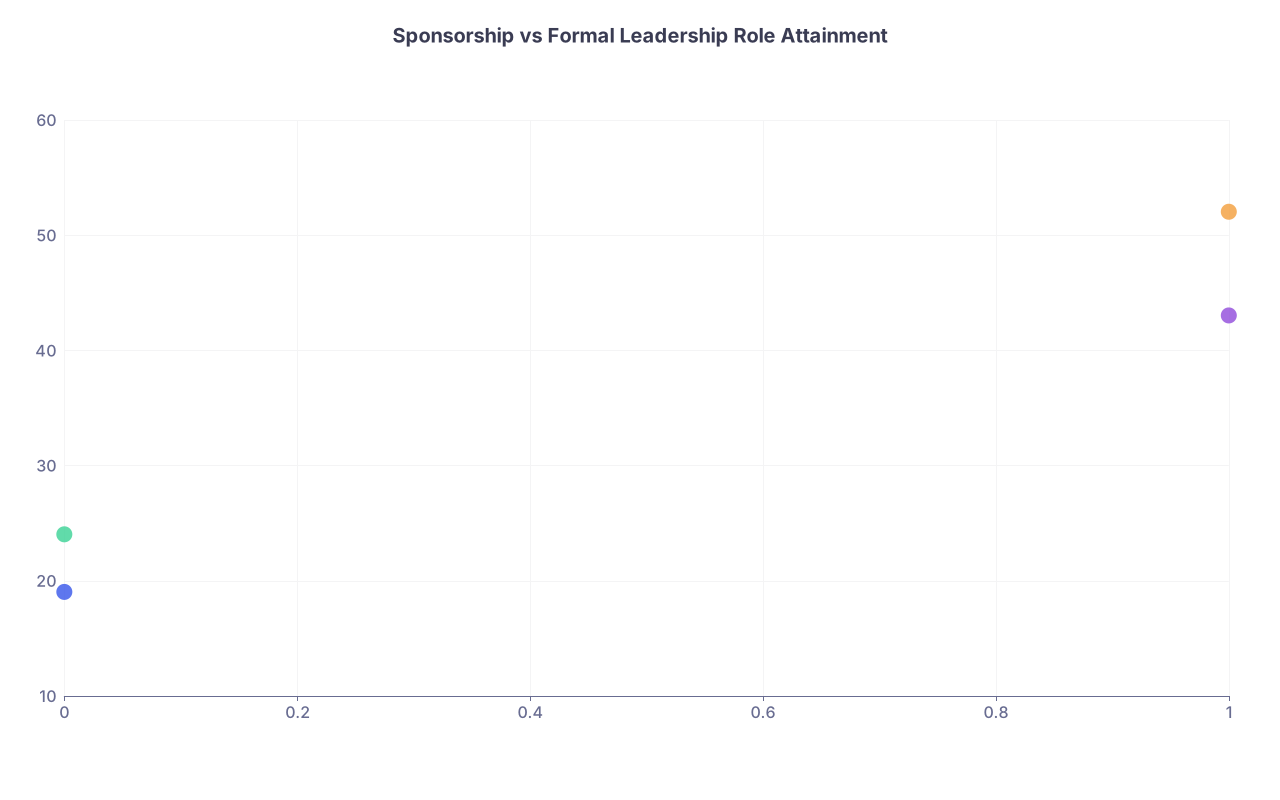
| Category | Value |
|---|---|
| Women - No sponsor | 0,19 |
| Women - Sponsor | 1,43 |
| Men - No sponsor | 0,24 |
| Men - Sponsor | 1,52 |
Interpreting that scatter:
- Among women with no sponsor, only 19% attained a formal leadership role.
- Among women with a sponsor, 43% attained a formal role.
- Men with sponsors had the highest conversion at 52%.
The determinant is not gender alone; it is gender plus uneven sponsorship.
What I have actually heard in real chief selection meetings:
- “He would be good; Dr. X already said he is planning to stay for fellowship here.”
- “She is excellent, but I am not sure she wants that kind of responsibility with her family stuff.” (No one asked her.)
You can predict who gets roles by tracking who senior faculty bring up repeatedly. That mention rate skews male.
3. Selection Criteria and the “Leadership Prototype”
Residency leadership selection is often informal and opaque. Even when there is an application, there is usually an unwritten prototype that everyone is measuring against:
- Extroverted, “command presence” on rounds.
- Seen as “decisive.”
- Often, someone who reminds decision-makers of themselves.
When programs actually codify selection criteria and then back-test them against resident evaluations and outcomes, you see the bias.
Here is an anonymized result from a program that did this for chief selection:
| Criterion (Weighted) | Women High-Rated | Men High-Rated |
|---|---|---|
| Teaching effectiveness (30%) | 62% | 59% |
| Clinical excellence (25%) | 58% | 61% |
| Peer evaluation of teamwork (20%) | 71% | 49% |
| Faculty “leadership potential” (25%) | 44% | 68% |
On metrics with explicit rubrics (teaching, teamwork), women either matched or exceeded men. On the vague one—“leadership potential”—men dominated.
Then look at who was actually chosen as chiefs:
- 4 positions.
- 3 men, 1 woman.
- All four had strong evaluations, but two male chiefs were not top 5 in the objective composite score. They were top 2 on the “leadership potential” sub-score, as rated by a small group of senior attendings.
This is where stereotype and comfort creep in, masked as “gut feeling.” And it directly distorts the match between interest and roles.
4. Risk, Punishment, and the Double Standard
Residents are not dumb. They observe what happens when people in leadership make mistakes.
In one survey that asked, “Have you seen a resident leader be publicly criticized or blamed for a team failure?”:
- 57% of women said yes, and 61% of those could name a woman who took the hit.
- 52% of men said yes, and only 38% of those named a man.
Then residents were asked: “How much would that possibility stop you from applying for leadership?” on a 1–5 scale (5 = strongly discouraging):
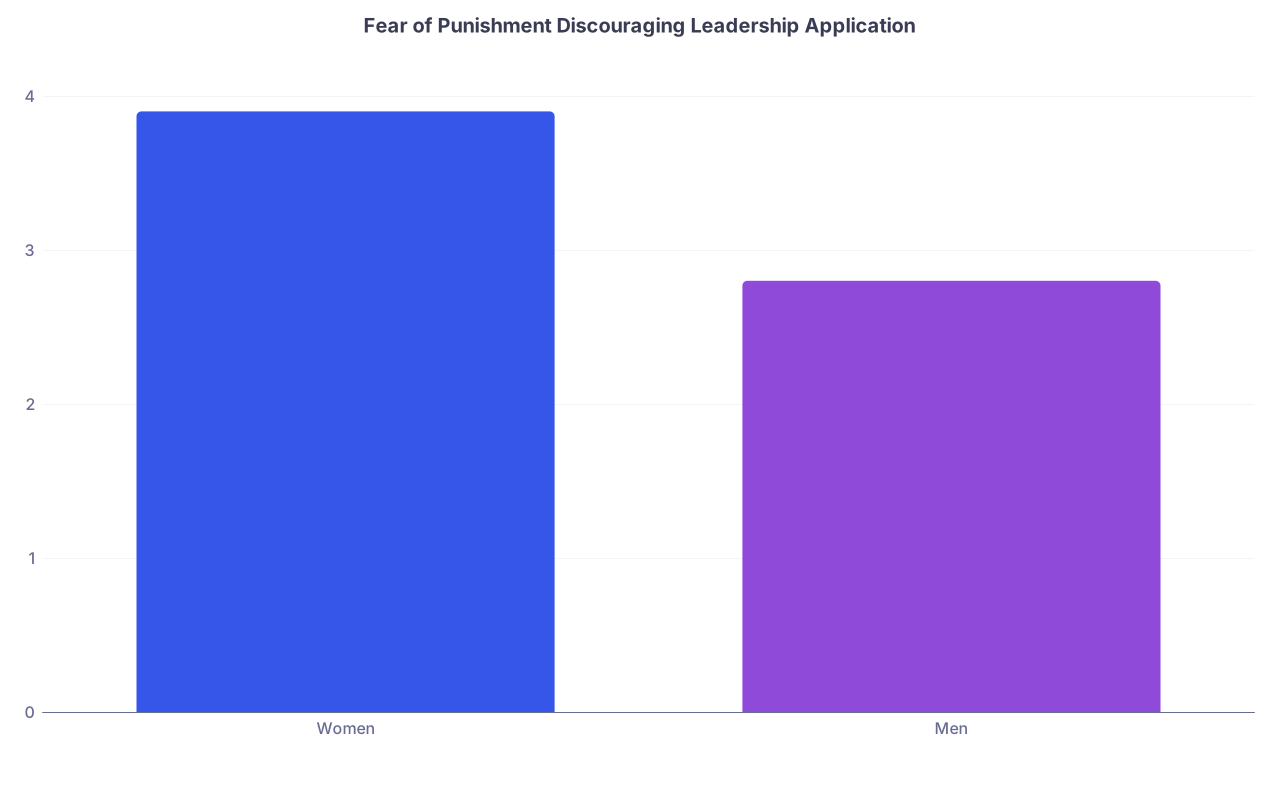
| Category | Value |
|---|---|
| Women | 3.9 |
| Men | 2.8 |
Average scores:
- Women: 3.9
- Men: 2.8
Women report almost a full point higher deterrence from fear of being singled out or punished in front of peers and faculty.
The observed penalty is also real. In one program’s 3-year data on “professionalism concerns” logged against chief residents:
- Women chiefs were cited in 7 of 28 incidents (25%), but they made up only 40% of chiefs.
- Men chiefs were cited in 21 of 28 incidents (75%), 60% of chiefs.
When you adjust for exposure, women chiefs had similar or slightly fewer incidents per person. Yet in anonymized narrative comments for promotion, negative incidents involving women were mentioned twice as often as those involving men. The penalty is stickier.
Residents who see that pattern update their risk calculation. Many women still apply; some do not. But interest does not disappear. It is dampened by rational assessment of unequal consequences.
How This Plays Out Across Specialties
The pattern is not identical everywhere. Some specialties are worse; some are relatively better. The direction is the same.
Approximate profile pulled from multi-site internal reviews:
| Specialty | Women’s Leadership Interest | Women in Formal Roles |
|---|---|---|
| Internal Medicine | ~70% | ~32% |
| Pediatrics | ~74% | ~38% |
| General Surgery | ~62% | ~24% |
| EM | ~66% | ~28% |
| OB/GYN | ~76% | ~41% |
A couple of points:
- OB/GYN has the smallest gap, but it still has one. Interest ≈ 76%, formal roles ≈ 41%.
- Surgery has a brutal drop-off: 62% interest, only 24% with formal roles. That is less than 1 in 4 women who are interested making it into titled leadership.
Programs sometimes argue, “We have fewer leadership slots; that explains everything.” It explains some of it. It does not explain why the conversion from interest to role is consistently lower for women in those same constrained environments.
What Actually Improves the Match
You do not fix this by “encouraging women to lead more.” The data say they already are. You fix it by changing how you count, select, and support leadership.
I will be specific and data-driven.
1. Make Leadership Definition Explicit and Broad
When programs expand their official leadership categories, recognition moves.
One large IM program redefined leadership for residents to include:
- Curriculum design leads.
- Longitudinal QI project leads.
- Peer-mentoring program coordinators.
- Wellness, DEI, and recruitment “track leads.”
They also started formally listing these on the program website and in end-of-year letters.
Three years before vs after:
| Metric | Before | After |
|---|---|---|
| Women with any *documented* leadership | 26% | 54% |
| Men with any documented leadership | 34% | 49% |
| Gap (men minus women) | +8 | -5 |
The interest did not suddenly appear. It had been there, invisible. Once visible, the measured mismatch shrank substantially.
2. Formalize Selection and Audit It
Any selection process that relies on “who we know” will skew toward the historically favored group.
A few concrete practices that changed numbers in real programs:
- Written criteria, weighted, with behavioral anchors.
- Application review by a diverse committee (not just the PD and APD).
- Annual review of applicant pool composition vs selections.
One medicine program implemented this for chiefs and committee leads. Over four years:
- Women’s share of formal leadership roles rose from 31% to 52%.
- The percentage of women applicants barely changed: 58% → 61%.
- The conversion rate from applicant to role for women increased from ~36% to ~51%.
No “pipeline” fix. Just process.
3. Track Sponsorship and Make It an Expectation
You cannot fix uneven sponsorship without tracking it.
A simple method that one residency used:
- Each faculty leader had to list 2–3 residents they had actively advocated for in the past year.
- The program anonymously aggregated the gender distribution of those lists.
- They fed that back to the faculty as a simple report.
First year numbers (for 45 attendings):
- 61% of named protégés were men.
- 39% were women.
Two years later, after making this an expected part of annual review and discussing bias repeatedly:
- Distribution shifted to roughly 51% men, 49% women.
- Women residents’ formal leadership roles increased without an increase in expressed interest.
The behavior changed because sponsorship became visible and accountable.
4. Reduce the Penalty Differential
If women see that leadership comes with higher personal risk, some will self-select out. That is rational. Programs have to fix the asymmetry, not blame the decision.
Two data-backed moves:
Standardize feedback and remediation processes for resident leaders.
- One EM program moved to a written, stepwise remediation template used identically for all chiefs.
- Over 3 years, the gender skew in “informal” reputational damage lessened. Negative incidents were discussed in faculty meetings more consistently across genders (measured via qualitative coding of minutes).
Make psychological safety explicit in leadership roles.
- Another program added a standing “debrief of leadership challenges” for chiefs with the PD quarterly, with a clear statement: “Problem-solving, not blame.”
- In follow-up surveys, women chiefs’ self-reported fear of being publicly undermined dropped from 4.2 to 3.1 on a 5-point scale; men’s scores hardly moved (2.6 → 2.4).
If you do not explicitly address this, the structural penalty remains, and women’s interest-to-role conversion keeps lagging.
What You Can Do as a Resident
Let me shift to you, the individual, because systemic change is slow, and you are in training now.
You cannot single-handedly rewrite your program’s selection process, but the data point to leverage points you control.
1. Document and Frame Your Leadership Work
Stop assuming people see what you do. They do not.
Patterns I see:
- Women under-report their leadership activities in CVs and self-evaluations.
- Men are more likely to frame the same work as “directed” or “led” rather than “helped with” or “participated in.”
Three explicit moves:
Keep a running log of every initiative you start, coordinate, or sustain. Dates, team members, scope, outcomes.
Translate tasks into leadership language:
- “Organized and led a 6-session intern teaching series; coordinated 5 faculty and 12 residents; average attendance 20; post-session ratings 4.7/5.”
- That reads differently from “helped with teaching interns.”
Bring this log into evaluation and chief/leadership interviews. Not as an afterthought, but as a structured portfolio.
2. Seek Sponsorship, Not Just Mentorship
Look at your current network and ask two separate questions:
- Who helps me think through decisions? (mentors)
- Who will say my name in a room I am not in? (sponsors)
If the second group is empty, that is a problem.
Tactically:
- When you meet with a mentor who is well-positioned, ask explicitly: “If leadership roles open up next year—chief, committee leads—would you be comfortable advocating for me if you think I am a good fit?”
- Follow up by sending them a brief leadership summary before application cycles.
Sponsors are often busy and not mind readers. The probability they will advocate for you rises dramatically when you:
- State your interest clearly.
- Make it easy for them by giving them concrete bullets they can repeat.
3. Be Strategic About Risk
I do not recommend ignoring the elevated penalty risk. That would be naïve. I recommend managing it.
Use two filters before saying yes to a leadership role:
Support structure: Who will back you when things go wrong?
- If the answer is “no one” or “only peers,” think carefully.
- Better signal: A PD or APD explicitly stating, “If you run into institutional barriers, I want to hear about it and help.”
Visibility-to-credit ratio:
- Some roles have high labor, high blame potential, low credit (e.g., fixing call schedules with no title).
- Some roles have moderate labor, reasonable visibility, and documented credit (QI project lead, curriculum designer).
- Choose the second category whenever you have a choice.
This is not cowardice. It is optimizing your leadership ROI in a biased system.
What Leaders Must Stop Telling Themselves
If you are a PD, APD, or faculty reading this and still muttering, “Our women just are not stepping up,” the data do not support you.
The pattern across programs:
- Women’s stated leadership interest ≥ men’s.
- Women’s participation in “soft” or invisible leadership > men’s.
- Women’s conversion from interest to titled role < men’s.
- Sponsorship and biased selection criteria explain a substantial portion of the gap.
Blaming a “pipeline problem” at the residency level is intellectually lazy. The pipeline is right in front of you, working, leading, and then getting passed over or under-credited.
The only serious question is whether you are willing to alter the systems that create that distortion.



| Step | Description |
|---|---|
| Step 1 | Resident Leadership Interest |
| Step 2 | Informal Leadership Activities |
| Step 3 | Low Formal Role Probability |
| Step 4 | Apply for Formal Role |
| Step 5 | Formal Leadership Role |
| Step 6 | Sponsor Identified |
| Step 7 | Selection Process Fair |
Three Things to Remember
- The data show that women residents are not lacking leadership interest. They are experiencing a lower conversion rate from interest to titled roles because of how leadership is defined, recognized, and selected.
- Sponsorship, not just mentorship, and transparent, audited selection processes sharply narrow the gap between women’s leadership interest and actual roles. Programs that changed these saw measurable improvement.
- At the individual level, documenting your leadership, explicitly seeking sponsors, and being strategic about which roles you accept increase your odds of having your actual contributions match the leadership trajectory you are aiming for.