Is Burnout Higher in Women Doctors Because They’re “Less Resilient”?
Why are women physicians burning out at higher rates than men even though they jump through more hoops to get into medicine, stay in medicine, and usually outperform their peers on every measurable metric?
Let me be blunt: the idea that women doctors burn out more because they’re “less resilient” is lazy, wrong, and convenient—for everyone except the women paying the price.
You do not select the “less resilient” people into a system with a 30–60% burnout rate and somehow end up with the ones who just happen to crumble more. That’s not how selection or reality works.
Let’s walk through what the data actually shows.
What The Numbers Actually Say (Not The Myths)
First, the headline everyone likes to throw around is true: burnout is higher among women physicians.
Take just a few examples:
- National Physician Burnout & Depression Report (Medscape, various years): women physicians consistently report burnout at rates about 8–12 percentage points higher than men.
- A 2020 JAMA Network Open study on US physicians found women had significantly higher odds of burnout even after adjusting for age, specialty, and hours worked.
So yes, the gap is real.
But people make a huge logic jump:
Higher burnout in women → therefore women must be less resilient.
No. That’s not a conclusion. That’s a bias dressed up as an explanation.
Look at what we know from the rest of the pipeline:
- Women now make up about 53–55% of US medical students.
- They consistently have equal or better academic performance, including board scores in several fields.
- They face more barriers (bias, harassment, family expectations) and still keep progressing.
That’s not a picture of “less resilient.” That’s a picture of: you’ve selected for extremely high resilience—and then you’re putting that group into a system that grinds them down faster.
If your first move is to blame individual resilience and not structure, you’re either not reading the data or you’re protecting the status quo.
The Resilience Illusion: Women Aren’t Weaker, The System Is Heavier
Here’s the key myth:
“Women burn out more because they can’t handle stress as well.”
Here’s what the research and real life show instead:
- Women and men in medicine report similar or higher levels of “resilience traits” among women (things like grit, perseverance, self-discipline).
- When you match for work hours and specialty, women still burn out more.
- When you control for resilience, the burnout gap doesn’t disappear.
So what’s going on? Different load on top of similar (or higher) resilience.
Think of it like this:
Two athletes run with the same VO₂ max. One is forced to run with a 20‑pound weight vest. Then you say, “Wow, she got tired sooner. Guess she’s less fit.”
That’s the “women are less resilient” narrative in medicine. It confuses higher load with lower capacity.
Let’s put some structure to that.
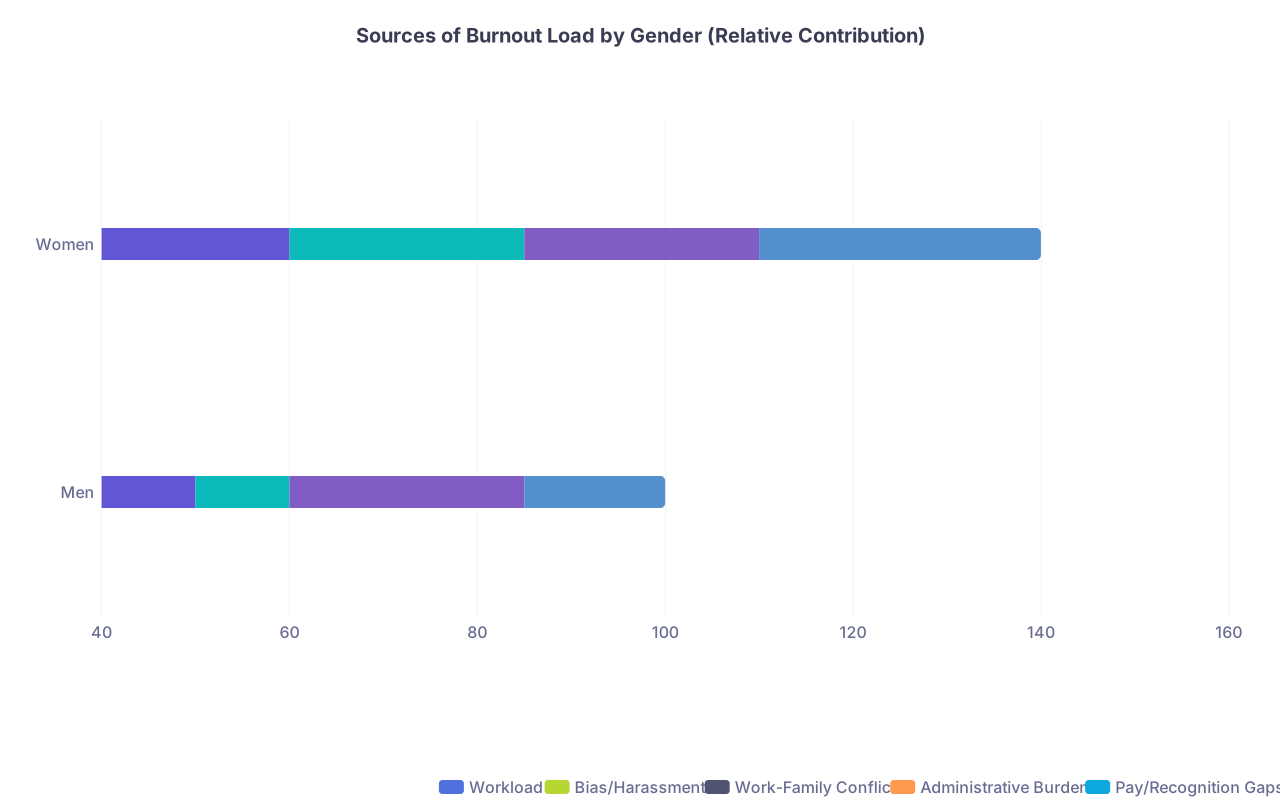
| Category | Workload | Bias/Harassment | Work-Family Conflict | Administrative Burden | Pay/Recognition Gaps |
|---|---|---|---|---|---|
| Men | 40 | 10 | 10 | 25 | 15 |
| Women | 40 | 20 | 25 | 25 | 30 |
The total system load is heavier for women, especially in these domains:
- Bias and harassment
- Work–family conflict
- Pay and recognition gaps
Same resilience. More weight.
Structural Factors People Pretend Are “Personal Problems”
Most burnout conversations in medicine still default to: “self-care,” “mindfulness,” “resilience workshops.” Stuff that assumes you are the problem.
Let’s walk through some of the actual drivers where the gender gap appears. These are not theoretical; I’ve seen people try to survive them on the wards and in clinics.
1. Work–Family Conflict Is Not Symmetrical
No matter how “modern” your institution pretends to be, women physicians still carry more unpaid labor at home.
Data from multiple countries shows:
- Women physicians are more likely to be primary parents or default caregivers.
- They report more sleep disruption from kids, more home organization, more emotional labor.
- They reduce hours for family reasons more often—and get penalized more for it.
This is not just anecdotal. A study in Annals of Internal Medicine found women physicians spent significantly more time on household and parenting tasks than male physicians with similar jobs, and this gap persisted even when both worked full time.
So the “same job” is not the same job.
Two 60‑hour workweeks:
- The male cardiologist goes home to someone who has handled 90% of the domestic chaos.
- The female cardiologist walks into round 2: homework, meals, planning, elder care, mental load.
Then when she feels burnt out, we tell her: “Have you tried a resilience app?”
2. Gendered Expectations Inside The Hospital
The hospital isn’t neutral territory either.
Women physicians are:
- More likely to be asked to do “teamwork glue”: planning parties, mentoring every female student, serving on diversity committees—often unpaid and uncredited.
- More likely to be interrupted, second-guessed, or addressed by first name while male colleagues get “Doctor.”
- More likely to be mistaken for nurses or support staff, especially in certain specialties or if they’re younger or from minoritized groups.
Each incident is small; the cumulative effect isn’t.
I’ve watched the same thing happen again and again:
Male resident gives an order on rounds. It’s accepted.
Female resident gives the same order. Nurse says, “Did the attending agree?” or calls to verify.
You think that doesn’t burn energy? You think that doesn’t slowly train people to detach?
3. Harassment And Microaggressions
Plenty of data here too, and it’s ugly:
- Women physicians report much higher rates of sexual harassment from colleagues, superiors, and patients.
- More derogatory comments about appearance, “tone,” family choices.
- More microaggressions—subtle digs that signal they don’t fully belong.
A 2018 National Academies report documented high rates of sexual harassment in academic medicine, disproportionately affecting women—especially women of color. Harassment is a known driver of burnout. You do not “self-care” your way out of that.
Resilience does not mean “tolerate abuse indefinitely without consequences.”
4. Pay Gaps And Recognition Gaps
Let’s talk money and status, because pretending those do not matter is dishonest.
Women physicians:
- Earn less than male colleagues even after adjusting for specialty, hours, and experience. Often $20k–$50k+ less per year.
- Are promoted more slowly to senior ranks and leadership roles.
- Are less likely to be first or senior authors despite similar or greater work input on projects.
You want a burnout recipe?
Work as hard or harder. Get paid less. Get promoted slower. Then get told you’re “too sensitive” when you point it out.
| Domain | Men Physicians (Typical) | Women Physicians (Typical) |
|---|---|---|
| Annual pay (same role) | Higher | Lower |
| Home labor share | Lower | Higher |
| Harassment exposure | Lower | Higher |
| Leadership representation | Higher | Lower |
| Assumed “office housework” | Lower | Higher |
Nothing in that table screams “women are weaker.” It screams “women are carrying more for less reward.”
The Weaponization Of “Resilience”
Here’s where this gets insidious.
Once you paint women as “less resilient,” you can:
- Blame them for burning out.
- Sell them wellness products and workshops.
- Avoid fixing the system that’s burning them.
I’ve literally heard variations of this in faculty meetings:
“We’re seeing higher burnout scores in our women residents; maybe we need targeted resilience training.”
No. You do not need “pink resilience bootcamps.” You need:
- Fair leave policies.
- Serious harassment consequences.
- Equitable pay.
- Reasonable staffing and workload.
Resilience talk becomes a shield. “We offered mindfulness. If you’re still struggling, that’s on you.”
Let’s be precise: resilience is useful for coping. It does not offset a structurally abusive or rigged environment. It just delays the crash.
So Are Women Actually Less Resilient?
Look at the full arc, not just the endpoint of burnout.
Women in medicine:
- Enter medical school after outperforming huge applicant pools.
- Persist in training despite more discrimination and higher domestic burdens.
- Often outperform on patient satisfaction, communication, and some quality metrics.
- Stay in the field despite all of the above.
There’s research suggesting women physicians may provide slightly better outcomes in some contexts (e.g., lower readmission or mortality rates in some internal medicine data). That’s not an argument that women are “better doctors,” but it absolutely undermines the idea that they’re fragile.
And still, they burn out more.
That pattern tells you something simple and uncomfortable:
The system is calibrated around the lives and experiences of men. Women are contorting themselves to fit it, and the cost shows up as burnout.
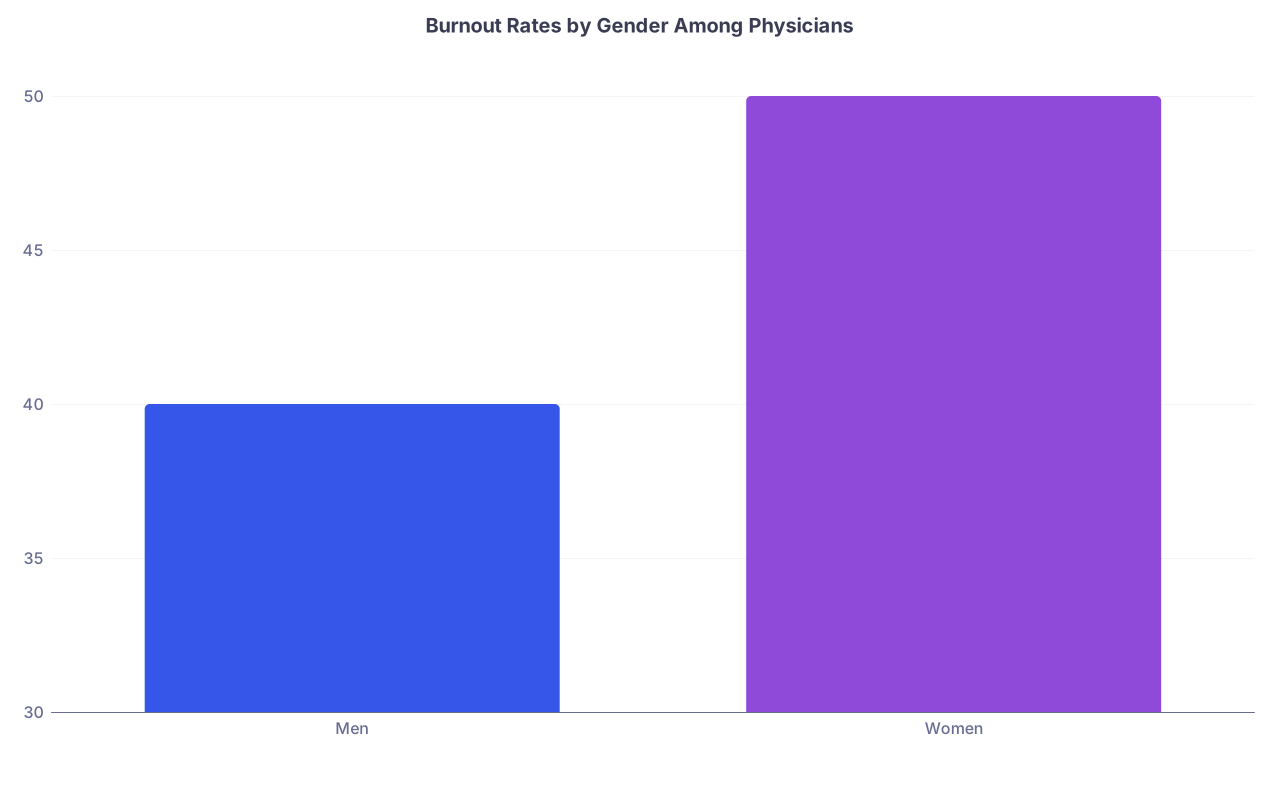
| Category | Value |
|---|---|
| Men | 40 |
| Women | 50 |
Interpret that bar chart correctly: not “women weaker,” but “women squeezed harder.”
What Actually Works Better Than “More Resilience”
If you’re a woman in medicine, you probably don’t need anyone to tell you to be tougher. You already are. So what helps?
Not magical thinking. Concrete leverage points.
1. Control What You Can: Job Design And Boundaries
No, you cannot fix healthcare alone. But there are levers:
- Job crafting: shifting some work toward what gives you energy (procedures, teaching, research, leadership). Even a 10–20% shift matters.
- Hard boundaries on “volunteer” service that doesn’t advance your goals: endless committees, token DEI roles with no power, emotional labor that never appears on your CV.
- Choosing environments that actually back up their rhetoric. Some programs and practices are empirically better on flexibility, parental leave, and harassment response. Do not underestimate that difference.
2. Stop Internalizing System Failure As Personal Failure
You’re not burned out because you personally failed to do enough yoga.
Burnout is a rational human response to chronic, unresolvable system-level stressors. Treating it as a personal flaw just layers shame on top of exhaustion.
I’ve watched residents visibly relax when someone finally says: “You are not the weak link; this setup would break anyone over time.”
That shift matters. It reduces self-blame and makes people more likely to push for structural fixes rather than collapsing in silence.
3. Collective Action Beats Lone Heroics
Individually, you are outgunned. Collectively, you’re not.
- Group negotiations for schedule flexibility or lactation space.
- Departmental pressure for transparent pay bands.
- Residents uniting to call out abusive behavior or unsafe workloads.
Is this easy? No. Does it carry risk? Yes. But the fantasy that you can individually out-resilience a bad system is worse.

| Step | Description |
|---|---|
| Step 1 | High burnout in women |
| Step 2 | More resilience talk |
| Step 3 | No structural change |
| Step 4 | Measure inequities |
| Step 5 | Redesign workload and policies |
| Step 6 | Lower burnout gap |
| Step 7 | Blame women or system |
The Ethical Layer Everyone Tiptoes Around
There’s a reason this belongs under “personal development and medical ethics,” not just “wellness.”
If an institution knows:
- Women physicians are burning out more,
- The drivers include harassment, inequitable workloads, and pay gaps,
- And the response is to offer “resilience workshops” instead of fixing those…
That’s not just inefficient. It is ethically suspect.
You are effectively saying: “We intend to keep the system as is; your job is to adapt to unfairness gracefully.”
That’s not professionalism. That’s complicity.
There is nothing unprofessional about naming structural harm. There is nothing “ungrateful” about refusing to silently absorb a disproportionate burden.
Bottom Line: What The Data Really Shows
Let’s answer the title question directly.
Is burnout higher in women doctors because they’re “less resilient”?
No.
Three takeaways that actually fit the evidence:
- Women physicians are at least as resilient as men—if not more—given the barriers they overcome just to be in the room. Higher burnout reflects higher load, not weaker people.
- The extra burnout in women tracks with structural issues: work–family conflict, bias, harassment, pay and recognition gaps, and “office housework,” not with some inherent psychological fragility.
- Treating this as a resilience deficit is a convenient distraction. The ethical move is not to train women to endure more; it is to reduce the inequitable weight the system loads onto them.