
Myth: Women Doctors Need a Female Mentor to Succeed in Academia
What if the “you just need a strong female mentor” advice that everyone keeps feeding women in medicine is actually part of what’s holding them back?
Because that phrase gets thrown around constantly. At faculty development workshops. In “Women in Medicine” panels. Whispered in hallways after another promotion list comes out skewed toward men. The script is always the same: “Find a female mentor. You need someone who looks like you.”
Nice sentiment. Bad strategy.
Let me be blunt: the data do not support the idea that women physicians need female mentors to succeed in academia. In fact, over-fixating on “matching” by gender can quietly reinforce the very inequities everyone claims they’re trying to fight.
You do not need a female mentor. You need effective mentors. Plural. Some of them will be men. If you let gender be the filter, you’ll walk right past people who could radically accelerate your career.
Let’s dismantle this one piece at a time.
What the Research Actually Shows About Mentor Gender
People love to invoke “data” on women in academia without ever citing anything specific. So let’s talk specific.
Large studies of academic medicine have looked at mentorship, productivity, and advancement. Here’s the pattern that shows up again and again:
- Having a mentor is associated with greater research productivity, higher promotion rates, better satisfaction.
- The quality and function of mentorship matter: sponsorship, feedback, access to networks, and concrete opportunities.
- The gender match between mentee and mentor is, at best, a weak and inconsistent predictor of outcomes.
Not the story most panels are selling.
A 2019 JAMA Internal Medicine study on research productivity, for example, found that women were less likely to have senior co-authors and sponsors connected to high-impact networks. The critical piece wasn’t that these sponsors were male or female. It was whether they were sufficiently senior, well-networked, and actively advocating.
You know what correlates with promotion in academic medicine?
- Publications with senior authors in powerful positions
- Inclusion in influential research groups
- Visible roles on committees, guidelines, and national talks
Those levers of advancement are still mostly controlled by men in many institutions. If you insist on a gender-matched mentor, you’re voluntarily cutting yourself off from a huge share of the people who control resources and opportunities.
That is not empowerment. That is self-sabotage disguised as solidarity.
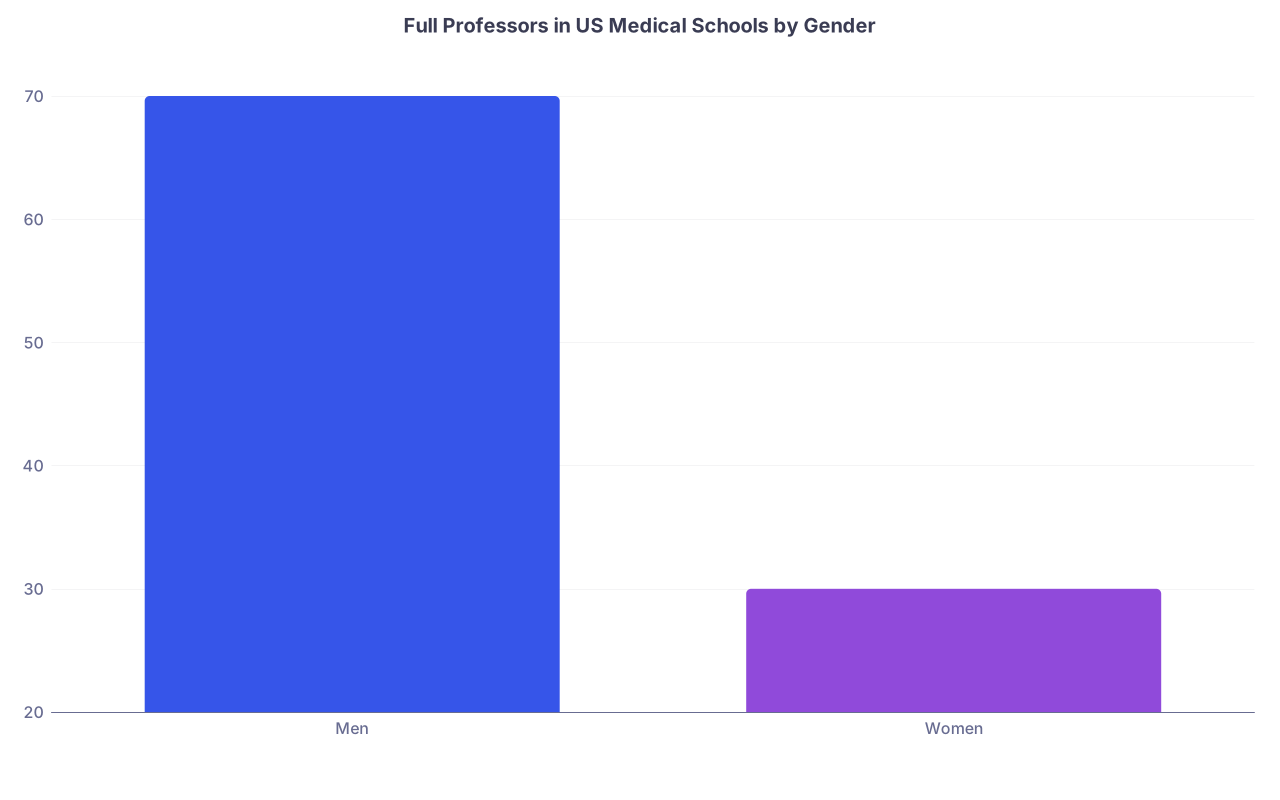
| Category | Value |
|---|---|
| Men | 70 |
| Women | 30 |
Most full professors and chairs are men. That’s slowly changing, but not fast enough to support this fantasy where every promising woman has a powerful female mentor waiting with open arms. The pipeline just does not exist in most places.
So when early-career women are told, explicitly or implicitly, that the “right” mentor must be a woman, you’re asking a small, overburdened group of senior women to somehow fix structural inequities by sheer force of personal generosity. That’s not mentorship. That’s unpaid institutional damage control.
The Hidden Problems With “You Need a Female Mentor”
The myth sounds supportive on the surface. Underneath, it has teeth.
1. It overloads senior women and dilutes mentorship quality
I’ve watched this happen in real departments. There are three senior women faculty and sixty-plus junior women. Every single junior woman is directed to the same three “role models.”
Result? Those three senior women are:
- Doing more mentoring, often unrecognized and unpaid
- Getting less protected time for their own research and promotion
- Expected to be therapist, advocate, strategist, and representative token all at once
And here’s the ugly part: when their CVs do not look like those of their male counterparts—because they have been emotionally and logistically underwriting the institution’s diversity problem—the narrative becomes, “See, women just don’t publish as much / push as hard.”
That’s not a talent gap. That’s martyrdom by policy.
2. It quietly lets men off the hook
If you frame women’s advancement as “a women’s space issue,” every male leader gets a free pass to be “supportive” while doing nothing direct.
They can say: “We really care about mentoring women. That’s why we started a women’s mentoring group” instead of: “Why are 90% of our high-value committee seats and first-author papers going to men, and what am I doing about it?”
Male faculty still hold a disproportionate share of leadership roles, grants, editorships, and departmental power. If they are not mentoring and sponsoring women, you will not fix equity with a side-channel “women mentoring women” program. You will create a parallel, softer track, and then pretend the main highway is open to all.
3. It encourages identity-matching over skill-matching
Good mentoring is about:
- Strategic thinking in your field
- Realistic, sometimes brutal feedback
- Concrete introductions and doors opened
- Protection from politics you do not see yet
I’ve seen brilliant junior women pass on excellent potential mentors (male) because they’re hanging on for the mythical “perfect” female mentor with the right subspecialty and personality and life story. By the time they admit that person does not exist at their institution, they’ve lost three or four prime years for career acceleration.
Identity can make it easier to build trust. That’s real. But similarity is not a substitute for competence or clout. Some of the worst “mentors” I’ve encountered were gender-matched, friendly, and absolutely useless when it came to actually moving a mentee’s career forward.
What Actually Predicts Mentorship Success (Spoiler: Not Gender)
Strip away the feel-good rhetoric and look at what actually moves the needle for women in academic medicine. The pattern is clear.
The most effective mentors and sponsors—male or female—share a few traits:
They are strategically placed.
They sit on promotion committees, editorial boards, guideline panels, or major study groups. They can pick up the phone and get you on a paper, a panel, or a working group. They don’t just “support you”; they alter your trajectory.
They are action-oriented, not just emotionally supportive.
You want someone who says: “Here are the three things you need for promotion in the next five years, and here’s how I’m going to help you get them,” not “I’m always here for you if you need to talk.”
They give honest, sometimes uncomfortable feedback.
Real mentors tell you when your talk was scattered or your aims page is weak. They protect you from wasting years on politically doomed projects. They tell you who in the department is dangerous to work with and why.
They understand the system you’re in.
Someone who has successfully navigated your institution’s rules (formal and informal) is more valuable than someone who just “gets you” on a personal level. The system determines promotion. Personality does not.
Now compare that to the vague advice: “Find a female mentor who understands work–life balance.” It sounds nurturing. It’s professionally anemic.
A male mentor who relentlessly pushes your papers through, nominates you for committees, and says your name in rooms you aren’t in will do more for your career than a female mentor who commiserates with you about childcare and says, “Hang in there, it’s hard for all of us.”
Best case? You get both. But if you have to choose, choose power and action, not demographic comfort.
How to Build a Mentor Network That Actually Works
The other problem with the “find a female mentor” myth is that it treats mentorship like a soulmate quest. One person. One relationship. One savior.
That’s not how careers work, especially not in academic medicine.
You need a network of mentors and sponsors, not a single perfect match.
Think in roles, not in identities:
- A research mentor who can sharpen your questions, your methods, your grants.
- A sponsor in leadership who will actively push you into visible roles.
- A process mentor who knows your institution’s promotion machinery inside out.
- A peer mentor circle that keeps you sane, shares intel, and normalizes your struggles.
- A values mentor (this is where gender or shared lived experience often matters more) who helps you think about ethics, boundaries, and how you want to show up as a physician.
Some of these might be women. Some should be men. If all your mentors are women in a system run by men, you’ve built yourself a very empathetic cul-de-sac.

Notice what’s not on that diagram: “Mentor must be female.”
When you’re choosing, ask harder questions:
- Does this person have time and a track record of actually developing junior people?
- Are they respected and connected in ways that map to what you want?
- Do they explicitly commit to advocacy, not just advice?
If the answers are yes, I do not care what gender they are. Neither should you.
Where Female Mentors Do Make a Difference
Now, let’s be clear: I’m not arguing that female mentors are irrelevant. I’m arguing they’re not a requirement, and certainly not a magic key.
There are real, evidence-based benefits to having at least some women in your mentor constellation.
Female mentors are more likely to:
- Recognize and name subtle gender bias in evaluations, committee decisions, and daily culture.
- Offer practical scripts for pushback that take into account gendered backlash (“When you’re assertive, here’s how they’re going to label you, and here’s how to deal with it.”)
- Normalize struggles with fertility timing, pregnancy, lactation, and caregiver load without trivializing them.
That last category sits right at the intersection of personal development and medical ethics. Because medicine is still built on the fiction of the unencumbered worker. Bodies that don’t get pregnant, don’t breastfeed, don’t go through menopause, don’t absorb the bulk of caregiving.
Female mentors can be powerful ethical mirrors: “You’re not failing. The system is exploiting you.” That matters.
But again—notice the function. They help you interpret and survive a biased system. They don’t replace the need for high-leverage sponsors, male or female, who can change your CV and your opportunities in concrete ways.
The danger is when institutions say, “We’ve solved support for women. We started a women’s mentorship brunch,” while the real decisions about power and promotion still happen in rooms where women are outnumbered and outvoiced.
Brunch is not equity. A buddy system for women is not structural reform.
The Ethical Trap: Turning Women Into the Solution for Sexism
There’s a deeper ethical problem with the “women need female mentors” myth that rarely gets called out.
It subtly assigns responsibility for fixing institutional sexism to… women.
You see it in emails: “We encourage our senior women to mentor junior women so we can improve our gender equity metrics.” Translation: you, the already disadvantaged group, must spend your limited time and political capital compensating for the biased structure we refuse to fundamentally change.
Senior men aren’t framed as responsible for equity. They’re celebrated when they do the bare minimum: “He’s such a strong ally; he has a female mentee.” The bar is on the floor.
If we’re serious about medical ethics—about justice, nonmaleficence, equity—then the obligation shifts:
- Senior men in power have a professional duty to mentor and sponsor women and other marginalized physicians.
- Departments have a duty to structurally value this work (promotion credit, protected time, funding), not just thank-you plaques at the diversity banquet.
- Early-career women have the right—not the burden—to demand access to high-level mentorship regardless of gender, without being shunted into the “ask a senior woman” queue.
You do not fix discrimination by asking the discriminated group to build extra ladders. You fix it by requiring the people at the top of the existing ladder to pull others up, and by redesigning the ladder in the first place.
So What Should You Actually Do?
Stripping away the myth, here’s the strategy that works in the real world of academic medicine:
Stop waiting for the perfect female mentor.
If one shows up and is effective—great. But don’t make that your condition for getting serious about mentorship.
Target power, not personality.
Look for mentors and sponsors with the right positions, connections, and track records. If that’s a man, so be it. Take the help and use it well.
Build a mixed-gender mentor portfolio.
Have at least one mentor who shares key identity or life experiences, and several who occupy strategic systemic roles. You’re not collecting friends; you’re assembling an advisory board.
Refuse the guilt narrative.
If senior women in your department are clearly overextended and not the best match for your goals, you don’t owe them your career in the name of solidarity. Real solidarity includes refusing to further overload them.
Hold men accountable as mentors.
When someone says, “Women need female mentors,” your response can be: “Women need effective mentors. That includes you.” Then ask directly for what you need.
Bottom Line
Three points, stripped of sentiment:
- Women doctors do not need female mentors to succeed in academia; they need effective, powerful, action-oriented mentors and sponsors—regardless of gender.
- Over-focusing on gender-matched mentorship overloads senior women, lets men in power off the hook, and often deprives women of access to the most influential allies in their field.
- The smart move is a mixed, strategic mentorship network: some mentors who share your lived experience, and several—often male—who control resources, opportunities, and rooms where your name needs to be spoken.