
The way patient satisfaction scores are used against women physicians is not just unfair; it is scientifically sloppy.
The Problem Everyone Pretends Is Objective
Let’s start bluntly: patient satisfaction scores are marketed as “objective quality metrics.” They are not. They’re noisy, biased, and heavily influenced by factors that have nothing to do with clinical quality or professionalism.
Now layer gender onto that mess.
Women physicians are disproportionately judged on “niceness,” emotional labor, and availability. Then administrators pretend the resulting scores are a neutral reflection of “performance.” They’re not. They’re a distorted mirror of patient expectations about how women should behave.
You feel this instinctively if you’re a woman in medicine. You say “no” to antibiotics or opioids and watch your scores drop. Your male colleague says the exact same words and walks away untouched. You’re not imagining it—and the data backs you up.
What Patient Satisfaction Scores Actually Measure
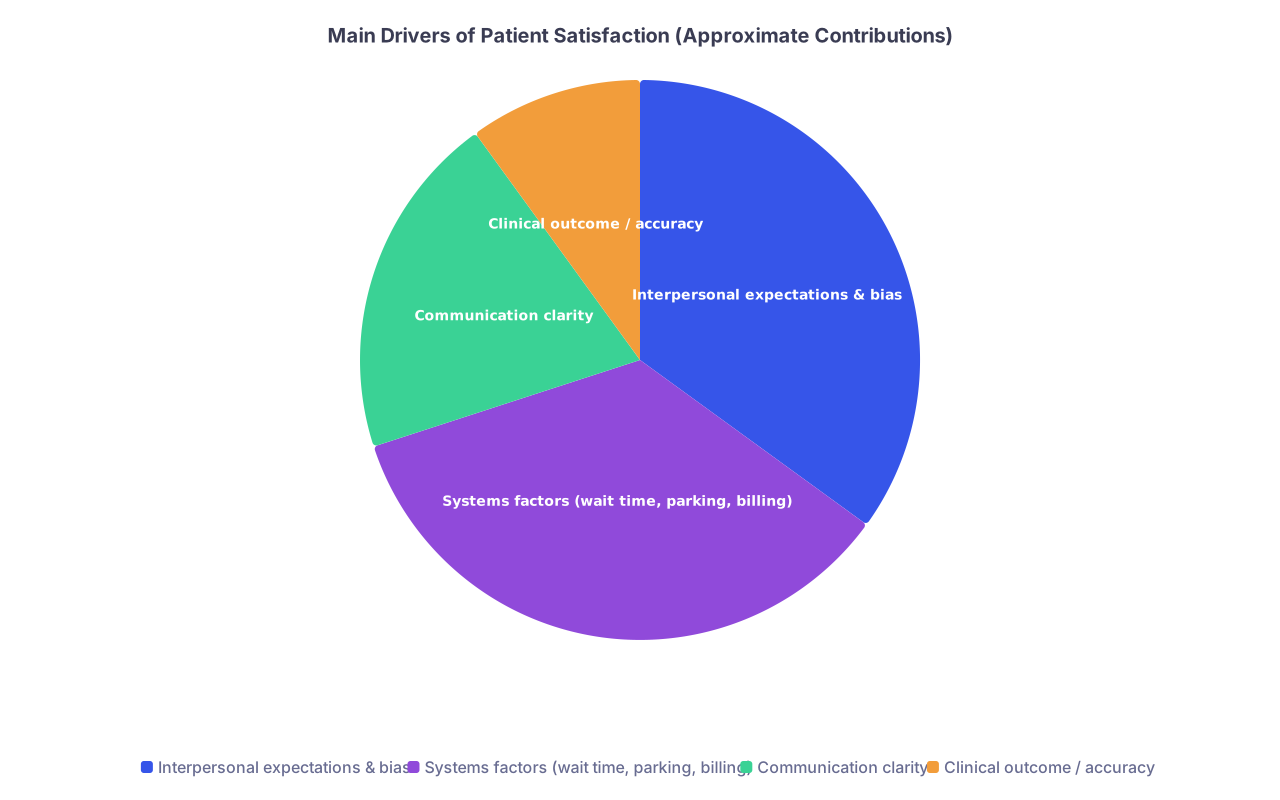
| Category | Value |
|---|---|
| Interpersonal expectations & bias | 35 |
| Systems factors (wait time, parking, billing) | 35 |
| Communication clarity | 20 |
| Clinical outcome / accuracy | 10 |
Strip the buzzwords and look at what the literature consistently finds: patient-reported “satisfaction” is driven far more by expectations and context than by actual quality of care.
Across multiple studies:
- Wait times, ease of parking, front-desk friendliness, and room comfort have a large impact on scores.
- How much time patients think you spent with them (even if it’s the same 12 minutes for everyone) shapes ratings.
- Whether they got what they wanted (antibiotics, imaging, pain meds, a specific test) usually matters more than whether they got what was medically appropriate.
Clinical accuracy, adherence to guidelines, and even mortality aren’t strong predictors of high satisfaction. In some studies, they’re inversely related: the safest care isn’t always the most “satisfying.”
So when a hospital ties your bonus, promotion, or even contract renewal to “satisfaction,” they’re effectively saying: “We’ll pay you more if you keep the customers happy, regardless of whether that’s good medicine.”
Women physicians get hit harder by that trade-off. Here’s why.
The Gender Penalty: Expectations, Not Performance

The research on gender bias in patient evaluations is depressingly consistent across professions: students, patients, and clients rate women lower for the same behavior, particularly when women enforce boundaries or say “no.”
In medicine, the pattern shows up in several ways:
- Women are expected to be more nurturing, more available, more emotionally attuned.
- When they act decisively, set limits, or prioritize efficiency, they’re labeled “cold,” “rude,” or “uncaring” more quickly than male peers.
- The exact same communication style that is “confident” or “authoritative” in a man is “abrasive” or “dismissive” in a woman.
I’ve seen it play out on the floor: a woman hospitalist explains gently but firmly why IV Dilaudid isn’t indicated. The patient gets visibly annoyed, and three hours later the comment appears in the satisfaction portal: “Doctor didn’t care about my pain.” Next day, a male hospitalist gives the same answer, same reasoning, shorter visit, and the patient shrugs and moves on.
The difference isn’t the medicine. It’s the expectation for emotional service.
Studies of resident and attending evaluations repeatedly show that women get more comments about personality and “tone,” while men get more comments about knowledge and decision-making. That same skew shows up in patient comments. When comments are analyzed:
- Women get more feedback on “kindness,” “attitude,” “being nice.”
- Men get more on “expertise,” “skills,” “confidence.”
So when hospitals import these biased perceptions into compensation formulas, they’re not just measuring “patient experience.” They’re amplifying gender bias and baking it into pay and promotion.
The Perverse Incentives No One Wants to Talk About
Let me be direct: tying physician income and evaluation heavily to patient satisfaction is bad policy. For anyone. But it’s especially dangerous for women physicians because it weaponizes pre-existing gender norms.
Here’s what the incentive structure quietly encourages:
- Overprescribing antibiotics “to keep them happy.”
- Ordering unnecessary scans and labs so no one complains they were “ignored.”
- Spending time on emotional appeasement instead of clinical priorities, because “bedside manner” is scored while diagnostic accuracy isn’t.
- Avoiding difficult conversations or firm boundaries if you suspect the patient is already annoyed.
When you add gender:
- Women are expected to do the extra emotional labor. And then they’re dinged harder when they don’t.
- A woman who pushes back on inappropriate requests is judged more harshly than a man who does the same.
- A woman who doesn’t have time to perform empathy theatrics in a 10-minute visit is rated as “uncaring” more readily than a man running just as behind.
So you essentially give women physicians a choice: practice strict evidence-based medicine and risk worse scores and pay, or bend to patient demands and risk over-treatment, burnout, and malpractice exposure.
That’s not “patient-centered care.” It’s customer service theater, subsidized by women’s emotional labor.
What the Data Shows About “Better” Outcomes
Defenders of satisfaction metrics will say: “But higher satisfaction is linked to better outcomes.” Sometimes. But the relationship is weak and inconsistent, and the causal direction isn’t clear.
There are studies showing:
- Patients at higher-satisfaction practices sometimes have higher costs and higher hospitalization rates.
- In at least one widely cited study, patients with the highest satisfaction had higher mortality than those with lower satisfaction, after adjustment.
Why? Because doing more—more tests, more meds, more “we’ll check just in case”—feels satisfying. It doesn’t always help.
Women physicians, by the way, often have equal or better clinical outcomes in some settings. There are studies showing lower mortality and readmission rates for patients treated by women internists compared to men, for example. Yet that performance advantage does not magically translate into better satisfaction scores, because the scores aren’t primarily about evidence-based care.
So when someone waves around patient satisfaction as a “quality proxy,” ask them which quality: comfort, expectations, or actual outcomes?
The Double Standard in Emotional Labor
| Domain | Expectation for Women | Expectation for Men |
|---|---|---|
| Time spent per visit | Longer, more listening | Efficient, on-time |
| Saying “no” | Gentle, apologetic | Brief, firm |
| Emotional support | Default responsibility | Optional “bonus” |
| Being liked by patients | Assumed requirement | Nice-to-have |
This is the quiet reality behind many “patient experience” initiatives: they assume an endless, invisible reserve of empathy and time—largely supplied by women.
I’ve watched this in committee meetings. A low patient satisfaction metric for “felt listened to” comes up. The immediate suggestions: “We should train physicians to sit more, make more eye contact, add validation phrases.” Not terrible ideas, on paper.
Then look who’s already doing those things, often to exhaustion: women. Look who is told to “improve communication” despite already doing twice the relational work: again, women.
And nobody says: “Maybe the schedule is unsafe. Maybe 15-minute visits for complex multimorbidity are inherently incompatible with deep listening. Maybe we should stop tying pay to a metric that punishes boundary-setting.”
No. It’s easier to ask women to smile more.
How This Warps Career Trajectories
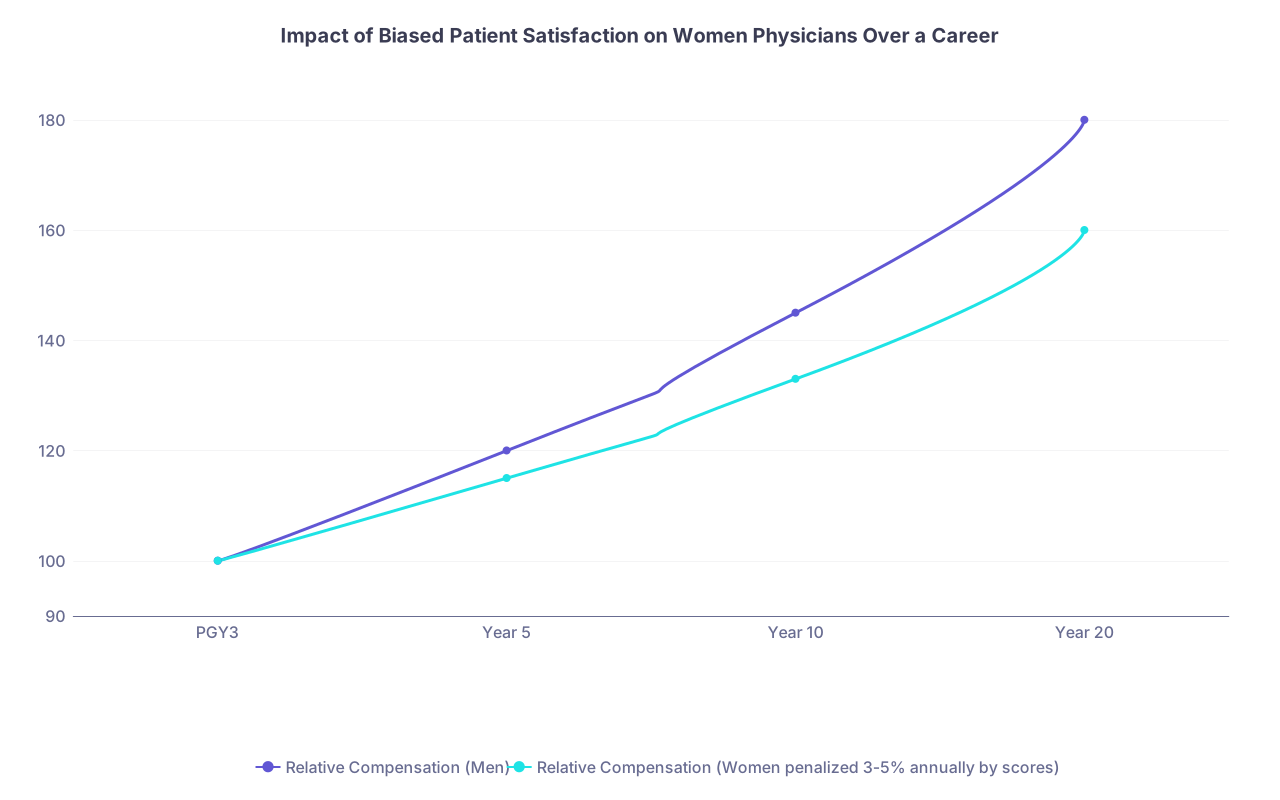
| Category | Relative Compensation (Men) | Relative Compensation (Women penalized 3-5% annually by scores) |
|---|---|---|
| PGY3 | 100 | 100 |
| Year 5 | 120 | 115 |
| Year 10 | 145 | 133 |
| Year 20 | 180 | 160 |
A 3–5% difference in bonus or raise tied to satisfaction scores doesn’t look like much on a single paycheck. Over a career, it’s huge.
Here’s the cascade I’ve seen:
Year 1–5: Women get slightly worse patient-satisfaction-linked bonuses despite same or better clinical outcomes. Explanations: “communication style,” “patient rapport,” “approachability.”
Year 5–10: Those “small differences” snowball into real money. They also show up in promotion discussions as coded language: “not as beloved by patients,” “a few comments about bedside manner,” “could work on patient connection.”
Year 10+: This becomes part of the narrative of who is “naturally” suited for certain roles. Men are nudged toward leadership positions where patients don’t rate them at all. Women are nudged into high-touch, high-emotional-labor roles—palliative care, certain outpatient clinics—but without commensurate recognition or protection from burnout.
The irony: the systems lean heavily on women to carry the “niceness” metrics, then use biased versions of those same metrics to hold them back professionally.
What You Can Actually Do About It
You are not going to fix the entire health system from your clinic room. But you’re not powerless either. There are three levels to think about: personal, group, and institutional.
At the personal level
No, I’m not going to tell you to just “communicate better.” That advice is usually code for “accept the bias and work harder.” But you can be strategic.
Know where you will not compromise: antibiotics when not indicated, opioids when unsafe, unnecessary imaging. Decide that in advance so one angry comment doesn’t tempt you into practice drift.
Then, in the 60–90 seconds you do control, make the trade explicit in language patients understand: “My job is to give you the safest care, not just the quickest fix. That’s why I’m not prescribing X today, even though I know it might be disappointing.”
You don’t have to be a doormat. You do have to be legible. There’s evidence that explaining your reasoning in plain language cushions dissatisfaction without changing the medical decision.
At the group level
Women physicians often suffer in isolation from these dynamics, thinking it’s “just me.” It’s almost never just you.
Compare notes with trusted colleagues—across gender. If you and the woman in the next office are getting hammered on scores for “rudeness” while a male colleague with the same style sails along, that’s data. Document it. Not in a ranty way, but in a “here’s a pattern over 12 months” way.
If you’re in a position to do so, push for peer review of satisfaction comments before they’re used in evaluations, to screen for overt or obvious bias (“too emotional,” “too young,” “too pretty,” “bossy,” etc.). Some institutions already do this; it’s not a radical ask.
At the institutional level
This is where the real fix has to live.
High-quality organizations are starting to move away from heavy reliance on raw patient satisfaction scores for individual compensation, especially once they confront the bias and noise. They’re shifting to:
- Team-level or service-line metrics rather than individual ones.
- Composite measures that heavily weight clinical quality and safety, with satisfaction as a minor balancing measure rather than the main event.
- Adjusting or at least auditing scores by demographic factors to identify systematic bias.
If your hospital insists on tying pay tightly to satisfaction, the minimum ethical standard is to prove they’ve assessed the scores for gender and racial bias. Most haven’t. They just assume “the numbers are the numbers.”
You’re not unreasonable for asking: “What’s our evidence that this metric is fair across gender and race before we hang people’s paychecks on it?”
The Ethical Bottom Line

| Step | Description |
|---|---|
| Step 1 | Use patient satisfaction scores |
| Step 2 | Potentially ethical |
| Step 3 | High risk of bias |
| Step 4 | Unethical use |
| Step 5 | Conditionally acceptable |
| Step 6 | How are they used |
| Step 7 | Bias analysis done |
Here’s the core ethical problem: using a biased, noisy, expectation-laden metric to judge individual clinicians—especially those from already disadvantaged groups—is indefensible.
Using patient feedback as one input among many, to improve communication norms or identify genuine outliers? Reasonable.
Using it as a major driver of pay, promotion, or contract renewal? That’s a choice to codify social bias and call it “data-driven.”
And when that choice hurts women physicians more than men—for practicing the same caliber of medicine—the system can’t hide behind “the patient is always right.”
Because in medicine, the patient isn’t always right. The patient is always a person, with preferences, expectations, and biases. Those are real and matter. But they are not a surrogate for clinical quality or professional worth.
The Truth, Stripped Down
Three points to keep:
Patient satisfaction scores primarily measure expectations, context, and bias—not pure clinical quality—and they’re especially warped by gendered expectations of women physicians.
Tying individual compensation and advancement tightly to those scores doesn’t make care safer or better; it incentivizes bad medicine and disproportionately punishes women who set appropriate clinical boundaries.
Ethically sound use of patient feedback means treating it as one limited, biased signal among many—not as a blunt instrument to reward or punish individual women physicians for failing to perform endless emotional labor on demand.