
The unspoken expectation that women doctors will be the note-takers and party planners is not “teamwork.” It is gendered labor, and you do not have to quietly accept it.
If you’re the only woman in your team and you keep getting pushed into taking minutes, ordering cake, sending Zoom links, organizing gifts, running the sign-in sheet, and planning social events—this is not random. This is a pattern. And you need a strategy, not just resentment.
I’m going to walk through exactly what to say, what to write, and how to decide when to push, when to document, and when to escalate. Think of this as the playbook you wish someone had handed you in MS3.
1. Name the Situation For What It Is
You are not “bad at saying no.” You’re operating inside a system that punishes women who say no.
Here’s the pattern I’ve seen dozens of times:
- Mixed-gender team meeting.
- “We should keep track of action items. Who wants to take notes?” Silence.
- Eyes drift, almost reflexively, to the only woman in the room.
“Maybe Sarah can do it?” - You say yes because it feels petty to say no. It’s “just notes.”
- Repeat this 20 times across rotations, plus “Can you organize the farewell party?” and “Can you handle the birthday card?”
- Suddenly you’re the “team mom” instead of the future chief or the budding proceduralist.
This matters for three reasons:
- Time cost. Every “small” admin task is time you’re not reading, prepping for cases, or doing research.
- Perception cost. People unconsciously associate you with support roles instead of leadership roles.
- Ethics. This is about fairness and respect inside a profession that claims to care about equity.
You’re not just annoyed; you’re bumping into a professional ethics problem: unequal distribution of invisible labor based on gender.
So: stop gaslighting yourself. This is real.
2. Decide Your Goal Before You React
Before you push back, be clear about your actual goal. It’s usually one (or more) of these:
- Reduce the number of gendered tasks you’re doing.
- Shift the habit so admin work is fairly distributed.
- Protect your evaluations and reputation while still setting boundaries.
- Create a paper trail in case you need to escalate later.
If you just fire off a snarky comment in the moment, you’ll feel great for 10 seconds and then pay for it on your eval.
You’re in a hierarchy. That doesn’t mean you have to be a doormat. It does mean you need tactics, not just principle.
3. Scripted Responses You Can Actually Use
Let’s get concrete. Different situations, different scripts.
A. In a meeting: “Can you take notes?”
Scenario: You’re in a team/committee/quality meeting. Organizer looks at you:
“Could you take the notes and send them out afterward?”
You have three basic options: deflect, redistribute, or accept strategically.
Option 1: Deflect back to the group
Use when this is becoming a pattern and you’ve already been defaulted to before.
- “I took notes last time—can we rotate this so others get a turn?”
- “Happy to take notes occasionally, but I’ve done it the last few meetings. Who’s up this time?”
Say it calmly, like you’re asking who’s on call. Not like you’re asking permission.
Option 2: Redistribute with a system
Use when you’re okay doing it sometimes, but not always.
- “Why don’t we set a rotation so this doesn’t fall on one person? I can do today if someone else takes next time.”
You’ve now put “fairness” on the table. If they ignore it, you’ve clocked something important about the culture.
Option 3: Conditional yes
Use when the power dynamics are severe (e.g., PD, chair, senior attending) and you don’t have the leverage to push in the moment.
- “Sure, I can do it today. Would it be possible for us to rotate this in future so it’s shared?”
This is the “I’ll eat this one, but I’m not signing up for a lifetime subscription” answer.
B. Social/Emotional Labor: “You’re so good at planning things”
Scenario: End of rotation / graduation / holiday. Someone says, “You’re great at organizing—you should plan the party!”
You do not owe spontaneous event-planning just because you have two X chromosomes.
If you want to say no directly:
- “I actually don’t have capacity to plan this, but I’m happy to contribute to whatever someone else organizes.”
- “I’m probably the wrong person to lead this—I’m maxed out with clinical and studying. Maybe we can see who’s interested and divide tasks?”
Notice you’re not apologizing. You’re also not offering a fake reason you’ll get trapped defending.
If you’re being railroaded (“We already told everyone you’d do it”):
- “I wish you had checked with me first. I can’t commit to planning the whole thing. I can help with one piece—like collecting RSVPs or ordering food—but someone else will need to take the lead.”
You’re allowed to correct people who volunteered you without consent.
C. The “Team Mom” Routine
Scenario: People default to you to:
- Bring snacks
- Remember birthdays
- Send reminder texts
- Smooth over conflicts
This is tricky because it often gets labeled as “her being so nice,” and saying no can make you look “cold.”
Try something like:
- “I’m noticing I’ve become the unofficial admin for everything. I’m going to step back a bit so this is more balanced.”
- “I’m happy to do this sometimes, but I don’t want to be the only one. Can we share these roles?”
Then follow through. When someone says, “Can you send out a reminder?”:
- “I sent the last few; can you handle this one?”
Short. Neutral. Repeated.
4. Use Systems, Not Just Willpower
Saying “no” over and over is exhausting. Better to build structures that take it off your shoulders.
Here are actual systems I’ve seen work:
| Situation | System to Propose |
|---|---|
| Standing meeting | Rotating scribe schedule |
| Residency social events | Social committee with sign-up sheet |
| Service coverage emails | Shared group template & rotation |
| Birthday/gift expectations | Group fund + shared calendar |
| Teaching conference tasks | Assigned roles rotated quarterly |
You don’t have to make it a gender conversation every time. You can make it a process conversation:
- “We keep scrambling for who takes notes. Can we set a simple rotation by alphabet?”
- “Instead of one person planning all the resident socials, why don’t we have 3 volunteers for the year and split events?”
That’s much harder to argue with.
5. Document Patterns Without Making Your Life a Memoir
You’re in medicine. Trainees get retaliated against—subtly—for “making trouble.” So if you’re in a toxic environment, you need a record that doesn’t consume your life.
What to track (briefly):
- Date
- Who was present
- What was asked/said
- What you answered
- Any fallout (comment in the hallway, eval comment, etc.)
Example note:
11/3 – QI meeting. Dr. Patel asked me (only woman in room) to take notes despite my having done so for previous 3 meetings. I said, “I took them last time; can we rotate?” He laughed, said “You’re just the best at it” and nobody else volunteered. I ended up taking notes.
Keep this in a private document, not on your work computer.
This does three things:
- If you ever go to GME, HR, or a ombudsperson, you have specifics.
- It helps you see if this is a pattern, not a one-off.
- It reminds you you’re not “imagining things” six months later.
6. Use the Right Ally, Not Just Any Ally
You do not have to fight this alone, and frankly, you shouldn’t.
But “ally” is not the same as “anyone who says they support women.” You want people willing to risk a tiny bit of their comfort to change the norm.
Target allies strategically:
- Senior residents who are respected and have some influence.
- Faculty who’ve shown prior interest in DEI or professionalism.
- Program leadership you trust not to dismiss you or retaliate.
When you talk to them, be concrete:
- “I’ve noticed that I’m always the one asked to take notes/plan socials. It’s impacting how I’m perceived and it feels gendered. Can you help intervene when you see it happening?”
Sometimes the best ally move is in the room, in real time. For example, another resident saying:
- “Hey, I think Maya took notes last time. I can do them today.”
That one sentence can reset the room more effectively than any long policy email.
7. When It’s Not Just Annoying—It’s an Ethics Problem
This isn’t only about your personal annoyance. It connects directly to professionalism and equity.
As a physician, you’re supposed to:
- Treat colleagues fairly.
- Avoid discrimination.
- Promote a respectful work environment.
Repeatedly assigning clerical and social labor to women because “they’re better at it” is gender discrimination in practice, even if nobody says the word “woman” out loud.
If you’re in a situation where:
- You get pushback or eye-rolling when you suggest fairness.
- Your evaluations include gendered language (“very sweet,” “great team player” without recognition of your clinical work).
- You’re subtly penalized (less OR time, fewer interesting cases, being left off projects) after setting boundaries.
You’ve moved from annoyance to an ethical red flag.
This is when you consider:
- Talking confidentially with a trusted faculty mentor.
- Using an ombudsperson if your institution has one.
- Checking whether your hospital has a professionalism, discrimination, or mistreatment reporting system.
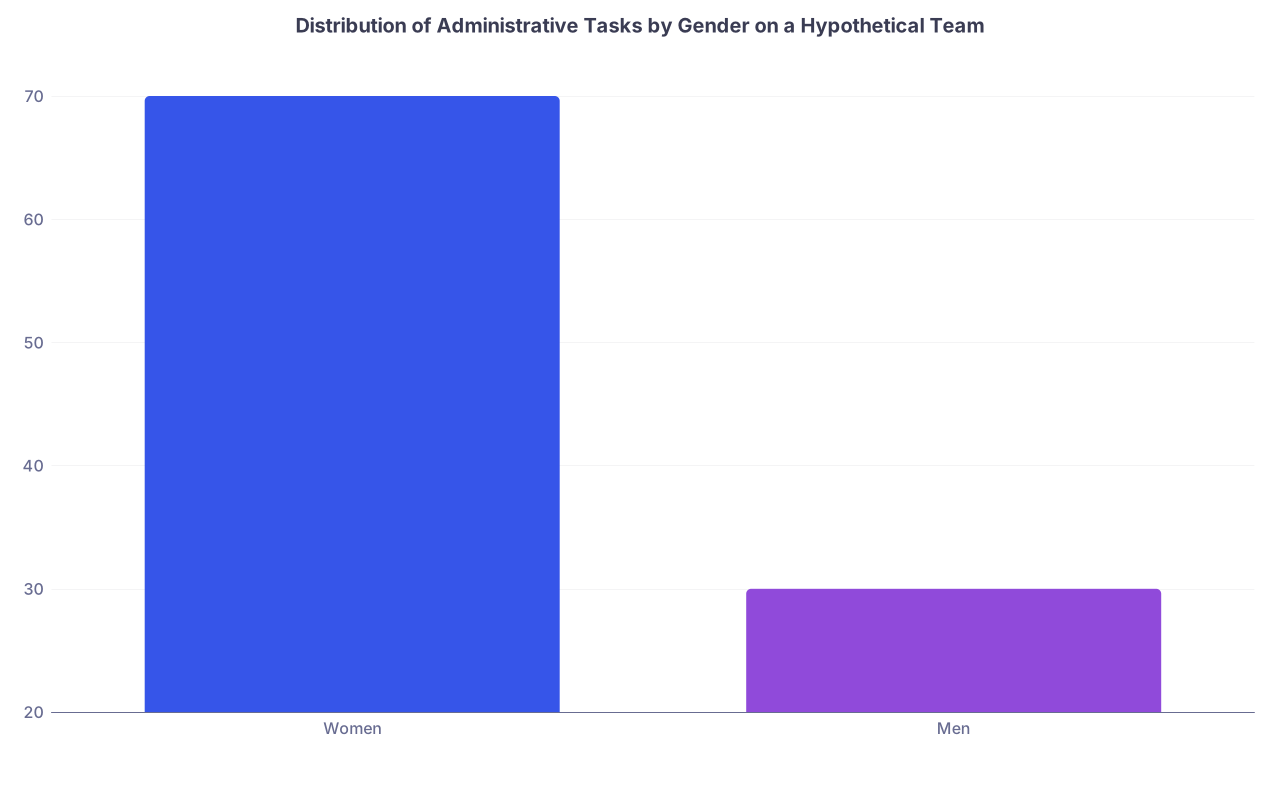
| Category | Value |
|---|---|
| Women | 70 |
| Men | 30 |
That kind of imbalance is not “personality.” It is structure.
8. Handling Blowback and Subtle Punishment
Yes, there can be blowback. Let’s not pretend otherwise.
Here’s what it can look like:
- “She’s difficult” whispered to others.
- Complaints that you’re “not a team player.”
- Being “forgotten” for opportunities.
- Sarcastic comments: “We have to be careful asking you to do anything now.”
How to handle it without self-destructing:
1. Stay factual, not emotional, in your responses.
If someone says, “Wow, you really hate helping out, huh?”:
- “I’m happy to help out. I’m just asking that these tasks be shared fairly.”
Repeat that line as often as you need. You’re not against helping; you’re against being defaulted.
2. Redirect to the system, not yourself.
- “This isn’t about me not wanting to help; it’s about not having support tasks fall on one person over and over.”
3. Ask for specifics if your evaluation feels gendered.
If you see something like “not a team player” after you stopped being the note-taker/party planner:
- “I’d like to understand this feedback about being ‘not a team player.’ Can you give me specific examples of behaviors and how I can improve?”
That forces people to either surface their real issue (you stopped doing free admin labor) or back off a vague critique.
9. Training Yourself Out of Over-Apologizing
Many women in medicine have been trained for decades to be “good girls”: agreeable, accommodating, extra helpful.
Unlearning that is a skill.
Practice these swaps:
Instead of: “Sorry, I just can’t, I’m so overwhelmed, I feel bad…”
Use: “I don’t have capacity to take that on.”Instead of: “If it’s okay, maybe someone else could…?”
Use: “I did it last time; someone else can take this one.”Instead of: “I hope this doesn’t come off the wrong way…”
Use: “I want to make sure these tasks are shared equitably.”
Say it in the mirror. Seriously. Your mouth needs to know how the words feel before you’re in a high-pressure moment.

10. Building a Different Culture On Teams You Lead
You’re not always going to be the most junior person in the room. Eventually you’ll be the senior resident, the chief, the attending.
You have a responsibility not to recreate the same nonsense.
On teams you lead:
- Assign admin tasks explicitly and rotationally.
“We’ll rotate note-taking by alphabetical order: this week A–C, next week D–F…” - Pay attention: are you asking women more often to do “behind the scenes” stuff?
- When someone defaults to a woman for admin work, step in:
“Let’s rotate this so it doesn’t always fall on the same person.”
And say it in front of juniors. They’re learning what’s normal from you.

| Step | Description |
|---|---|
| Step 1 | Asked to take notes or plan event |
| Step 2 | Decide if you want to help |
| Step 3 | Use rotation language |
| Step 4 | Suggest shared system or schedule |
| Step 5 | Monitor if pattern improves |
| Step 6 | Start documenting incidents |
| Step 7 | Seek ally or mentor input |
| Step 8 | Consider formal report or ombudsperson |
| Step 9 | Maintain boundaries and systems |
| Step 10 | Is this a one off? |
| Step 11 | Resistance or mocking? |
| Step 12 | Worsening or retaliation? |

11. A Few Realistic Micro-Scenarios and Responses
Let me walk you through a few typical situations so you can hear the words in your head.
Scenario 1: The “You’re just so organized” compliment-trap
Attending: “You’re so organized, can you send out a summary and action items after this?”
You: “Thank you. I’m happy to stay engaged, but I took minutes last time. Could we rotate that role so everyone shares it?”
If they push: “Given my other responsibilities, I can’t be the default scribe, but I’m happy to help develop a rotation.”
Scenario 2: The holiday party dump
Senior resident: “You’re great with this kind of thing—can you plan the holiday party for the team?”
You: “I can’t take on planning the whole thing. I can help with one piece if we divide the work—like arranging the venue—but someone else will need to coordinate food and RSVPs.”
They: “We really needed one point person.”
You: “Then we should ask who wants to be that person. I don’t have capacity to do it this year.”
Scenario 3: The retaliation-y evaluation comment
Written eval: “She sometimes seems less willing to help with team responsibilities.”
You in feedback meeting: “I saw a comment about not helping with team responsibilities. Can we talk through specific examples? I want to make sure there isn’t a confusion between shared admin tasks and overall teamwork, because I did step back from being the default note-taker after doing it multiple times.”
If they bring up your boundary: “I’m committed to being a strong team member. That’s why I raised sharing admin tasks more fairly. I want to make sure my willingness to question that pattern isn’t being interpreted as lack of teamwork.”
You’ve named the issue clearly. That alone can make people more careful.
| Category | Value |
|---|---|
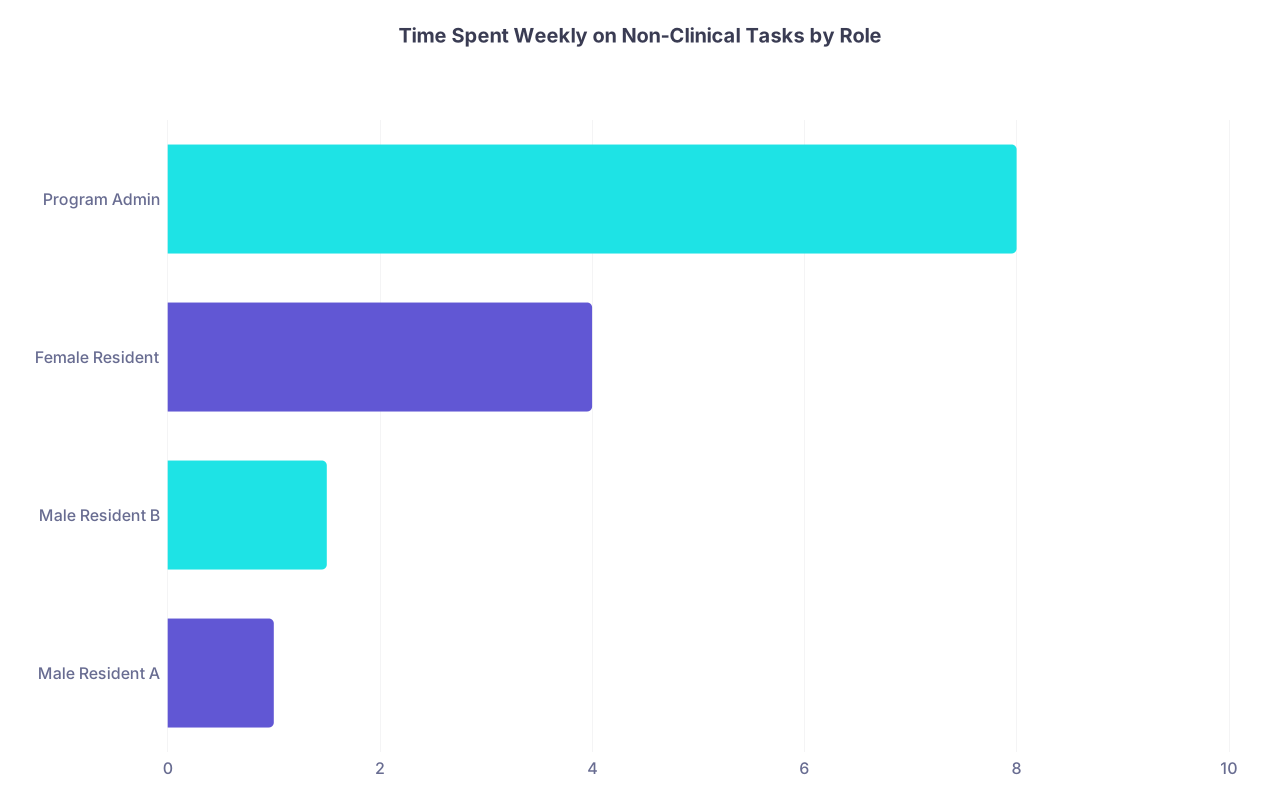
| Male Resident A | 1 |
| Male Resident B | 1.5 |
| Female Resident | 4 |
| Program Admin | 8 |
Those extra 2–3 hours you’re burning? That’s board study time. Sleep. Research. Not trivial.

12. The Bottom Line: You’re Not the Secretary
If you remember nothing else, hold on to these:
- Repeatedly being asked to take notes, plan parties, and handle “soft” tasks because you’re a woman is not harmless—it’s a professional ethics issue tied to gendered labor.
- You’re allowed to push back in small, concrete ways: suggest rotations, say “I did it last time,” and refuse to be the default. Use short, neutral language and protect your evaluations with documentation and specificity.
- You’re building habits now—for yourself and for the culture you’ll lead later. Do not become the senior who keeps dumping invisible labor on the next generation of women.
You’re a physician, not the office party committee. Act accordingly—and insist others treat you that way too.