
3–5% of hospitalized Medicare patients have lower 30‑day mortality when treated by women physicians in some of the highest‑quality studies we have.
That single number cuts straight through a lot of comfortable assumptions about “meritocracy,” “medicine is science so bias does not matter,” and the claim that physician gender is irrelevant to outcomes. The data disagree.
Let’s walk through what the strongest studies actually show, what the effect sizes really are, and how much of this is about gender itself versus systems, bias, and behavior patterns that track with gender.
The Canon: What The Big Studies Actually Found
Three large studies drive most of this debate. If you have opinions about “patient outcomes by physician gender” and you have not read or at least skimmed these, you are arguing from vibes, not data.
1. JAMA Internal Medicine 2017 – Yusuke Tsugawa et al.
Population: Medicare fee‑for‑service beneficiaries aged ≥65, hospitalized with common medical conditions between 2011–2014. Over 1.5 million hospitalizations. Roughly 58,000 physicians.
Outcome: 30‑day mortality and 30‑day readmissions.
Headline result: Patients treated by women internists had statistically significantly lower 30‑day mortality and readmission rates than those treated by men, after heavy risk adjustment and hospital fixed effects.
Numbers (adjusted):
30‑day mortality:
- Women physicians: 11.07%
- Men physicians: 11.49%
- Absolute difference: 0.42 percentage points
- Relative difference: about 3.7% lower mortality for patients of women physicians
30‑day readmissions:
- Women physicians: 15.02%
- Men physicians: 15.57%
- Absolute difference: 0.55 percentage points
- Relative difference: about 3.5% lower readmission risk
These numbers look small. But scale it to the U.S. Medicare population and you are suddenly talking about thousands of deaths and readmissions per year.
The authors sliced the data several ways:
- Within-hospital comparisons (hospital fixed effects) to control for institutional quality.
- Adjusted for patient demographics, comorbidities, DRGs, admission characteristics.
- Sensitivity analyses excluding low‑volume physicians, restricting to hospitalists, accounting for physician experience.
Effect persisted. Shrunk slightly with more controls, but did not disappear.
2. BMJ 2016 – Adina Roter et al. (Meta-analysis of communication patterns)
Different angle: not outcomes directly, but behavior that is plausibly linked to outcomes.
Data: Meta‑analysis of 58 studies on physician communication styles.
Findings (simplified):
- Women physicians spent more time with patients (effect size small to moderate).
- Used more patient‑centered, partnership‑building communication.
- Gave more psychosocial counseling.
- Asked more questions, used more emotionally focused statements.
Why does this matter? Because separate data show better communication is associated with:
- Higher adherence rates to medications and follow‑up.
- Better control of chronic conditions (A1c, BP, lipids).
- Higher patient satisfaction and trust.
No, this meta‑analysis does not prove causation from gender to mortality. It does, however, outline a plausible behavioral pathway: gender → communication style → adherence and follow‑up → outcomes.
3. JAMA Surgery 2017 / 2018 – Wallis et al. (Ontario data)
Population: 104,630 patients undergoing common surgeries in Ontario (Canada), treated by 3,314 surgeons.
Outcome: 30‑day mortality, complications, readmissions.
Key results (adjusted for patient, surgeon, and hospital factors):
30‑day mortality:
- Women surgeons: 2.4%
- Men surgeons: 2.6%
- Absolute difference: 0.2 percentage points
- Relative difference: about 8% lower mortality with women surgeons (because the baseline rate is low, the relative effect looks larger)
Complication and readmission rates: no large or consistent differences, but no advantage for men.
Again, we are talking small absolute percentages, but these are population‑level outcome differences that survive thorough adjustment.
To keep the core findings straight:
| Study / Year | Setting | Outcome | Result for Women Physicians |
|---|---|---|---|
| Tsugawa 2017 (JAMA IM) | US Medicare inpatients | 30-day mortality | ~3.7% relative reduction |
| Tsugawa 2017 (JAMA IM) | US Medicare inpatients | 30-day readmission | ~3.5% relative reduction |
| Wallis 2017 (JAMA Surg) | Ontario surgical patients | 30-day mortality | ~8% relative reduction |
| Roter 2016 (BMJ) | Various outpatient settings | Communication behaviors | More time, more counseling, more patient-centered |
| Various follow-ups | Multiple | Patient satisfaction | Slightly higher with women in many studies |
The pattern repeats: women physicians are at least as good on standard outcomes, often better by a few percentage points.
Effect Size: Small On Paper, Big In Reality
I hear the same dismissal all the time: “0.4%? That is trivial.” No, not in a system that handles tens of millions of encounters.
Let’s do some quick math.
Take Tsugawa’s 0.42 percentage point mortality gap.
Suppose 10 million Medicare admissions for conditions in that study group in a year. If all were treated by men physicians, expected deaths at 11.49% would be:
- 1,149,000 deaths.
If all were treated by women physicians at 11.07%:
- 1,107,000 deaths.
Difference: 42,000 deaths. That is not trivial noise. That is multiple full hospitals’ worth of patients.
Even if you assume:
- Only half of cases are realistically “switchable” between men and women physicians.
- Half the observed association is unmeasured confounding.
You still end up with several thousand avoidable deaths.
For a more intuitive view, think “Number Needed to Treat” (NNT), even though physician gender is not a treatment. Using the raw Tsugawa numbers:
- Absolute risk reduction = 0.42% = 0.0042
- NNT ≈ 1 / 0.0042 ≈ 238
Meaning: for every 238 hospitalized Medicare patients treated by women internists instead of men, one death is averted. Oncology drugs get approved on weaker absolute numbers.
Now look at the distribution visually.
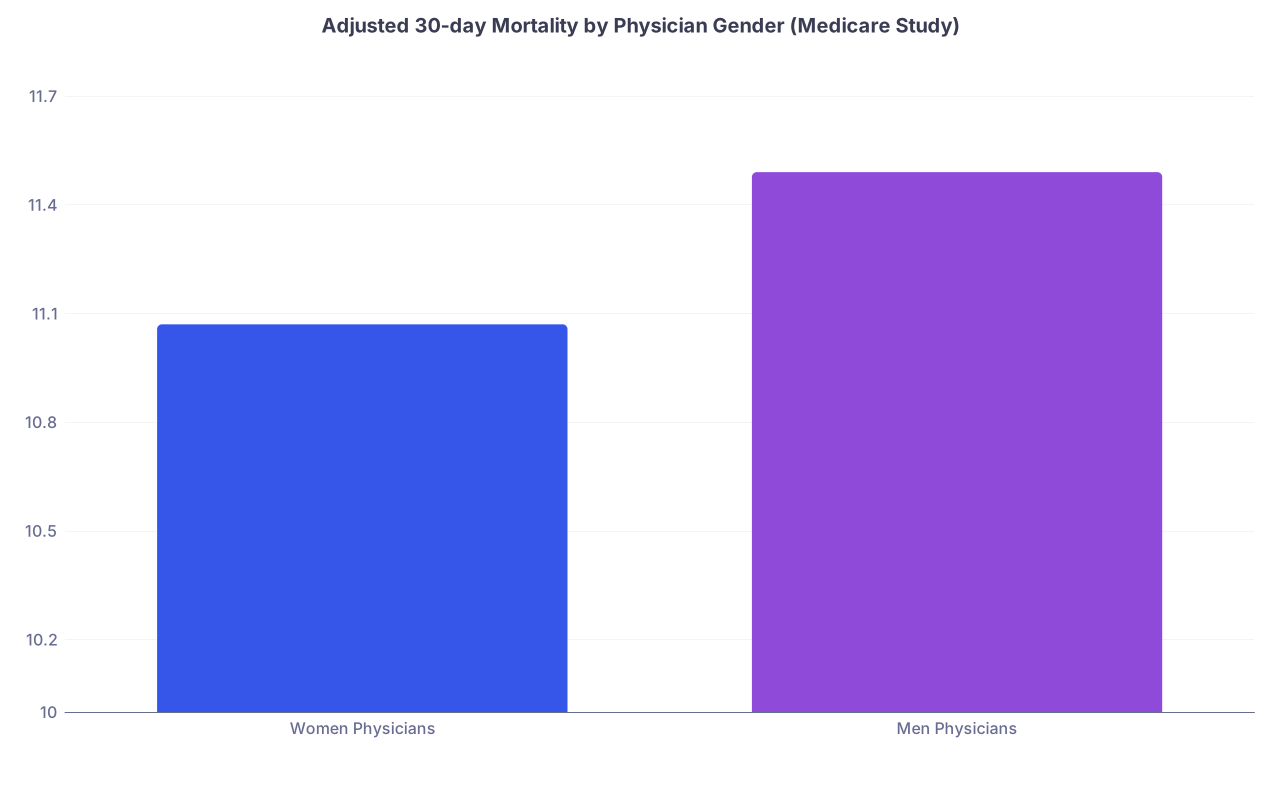
| Category | Value |
|---|---|
| Women Physicians | 11.07 |
| Men Physicians | 11.49 |
The bars almost overlap. But again, for a national health system, that gap is not trivial at all.
Mechanisms: What Might Be Driving the Difference?
If you want clean, single‑variable causation, you picked the wrong question. But the data point toward several consistent patterns.
1. Adherence to Guidelines and Evidence-Based Care
Multiple smaller but solid studies show that women physicians:
- Order recommended preventive services more frequently (mammography, Pap tests, etc.).
- Adhere slightly more strictly to guideline‑based chronic disease management.
- Are marginally more conservative with high‑risk procedures and medications when the benefit is uncertain.
This adds up.
In Tsugawa’s supplementary data, women physicians had slightly different practice patterns: more likely to use evidence‑based treatments for conditions like heart failure and pneumonia. The differences per case are small. Across many thousands of cases, they show up as mortality shifts.
2. Communication and Therapeutic Alliance
Tie in the Roter meta‑analysis here.
More time. More open‑ended questions. More psychosocial counseling. The data show these correlate with:
- Higher medication adherence.
- Better understanding of discharge instructions.
- Lower rates of return visits for the same issue.
The readmission difference (0.55 percentage points lower for women physicians in Tsugawa) lines up neatly with that mechanism.
3. Risk Tolerance and Decision Thresholds
Some data (especially in procedural and invasive specialties) suggest:
- Women physicians may have slightly higher thresholds to proceed with high‑risk interventions, especially in frail or multimorbid patients.
- Men physicians, on average, have higher procedure volumes and may be more aggressive.
In the Wallis surgical data, mortality was lower with women surgeons without an increase in complications or readmissions. One plausible explanation: different patient selection or intraoperative decision‑making thresholds.
Is that “better” medicine? The outcomes say yes, at least at the margin, for that dataset.
4. Systemic Bias Pushing Women to Overperform
There is an uncomfortably simple hypothesis: women physicians have to be better on average to achieve the same visible status and job security.
Evidence:
- Studies show women physicians are paid less for the same work, promoted less, and receive lower patient satisfaction scores for identical behaviors.
- They face harsher consequences for errors and more intense scrutiny; several qualitative studies document this across specialties.
You see the same pattern in other fields: underrepresented groups who survive intense selection and bias tend to be higher‑performing as a group because the system filters them harder.
So yes, “women physicians have better outcomes” can simply be the measurable residue of inequity. Not innate superiority. Just survival bias.
Objections, Rebuttals, and Where the Data Are Weak
I have heard every version of “these results must be wrong.” Some critiques are valid. Most are overconfident.
Objection 1: “Unmeasured confounding explains everything.”
Arguments: Sicker patients might see men; easier patients might get channeled to women. Or women may practice in different hospitals or teams that are simply better.
Response:
- Tsugawa used hospital fixed effects. Men and women in the same hospital compared against each other. That wipes out hospital‑level quality differences.
- They adjusted for a long list of patient factors: age, comorbidities, primary diagnosis, dual eligibility, prior utilization, etc.
- Sensitivity analyses restricted to hospitalists. Still saw an effect.
Unmeasured confounding is always there, but to entirely erase a 3–4% relative mortality gap, those unmeasured variables have to be both:
- strongly associated with mortality, and
- strongly and differentially distributed by physician gender,
all while somehow not being correlated with the many observed covariates already in the model.
Possible? Yes. Likely to fully explain the effect? No.
Objection 2: “Statistical significance with huge N is meaningless.”
True that huge datasets let tiny, clinically irrelevant differences reach p < 0.001. That is a legitimate concern.
That is why we keep returning to effect size. For mortality and readmission, we are talking 3–8% relative risk reductions. That is neither massive nor negligible. It is the scale at which health systems spend billions trying to move the needle.
If a quality program produced a 4% relative reduction in mortality across your service line, you would not call it meaningless.
Objection 3: “This is just Medicare. It does not apply to younger patients or other settings.”
Correct: the Tsugawa study is older, sicker Medicare inpatients. The Wallis study is surgery across all adults 18+. Outpatient primary care data are less clear and more mixed.
In ambulatory settings, the outcome differences by gender are smaller and sometimes non‑significant, especially when you look at hard outcomes (MI, stroke) rather than satisfaction or process measures.
So yes, the effect may be largest and easiest to detect in high‑risk, high‑acuity, older populations.
Objection 4: “If women have better outcomes, we should just replace men physicians.”
That is not what the data say, and it is also not how workforce planning works.
The realistic take is:
- Quality differences are modest at the individual level but important at scale.
- You do not fix this by sidelining half the workforce. You fix it by changing training, incentives, and culture so that high‑yield behaviors (often more common among women physicians) are adopted by everyone.
- You also stop penalizing the people who are already delivering those outcomes with lower pay and fewer promotions.
What This Means For You As A Trainee Or Young Physician
This is a women‑in‑medicine and ethics question, not just an epidemiology puzzle. The system you are entering is not gender‑neutral, and pretending otherwise is self‑deception.
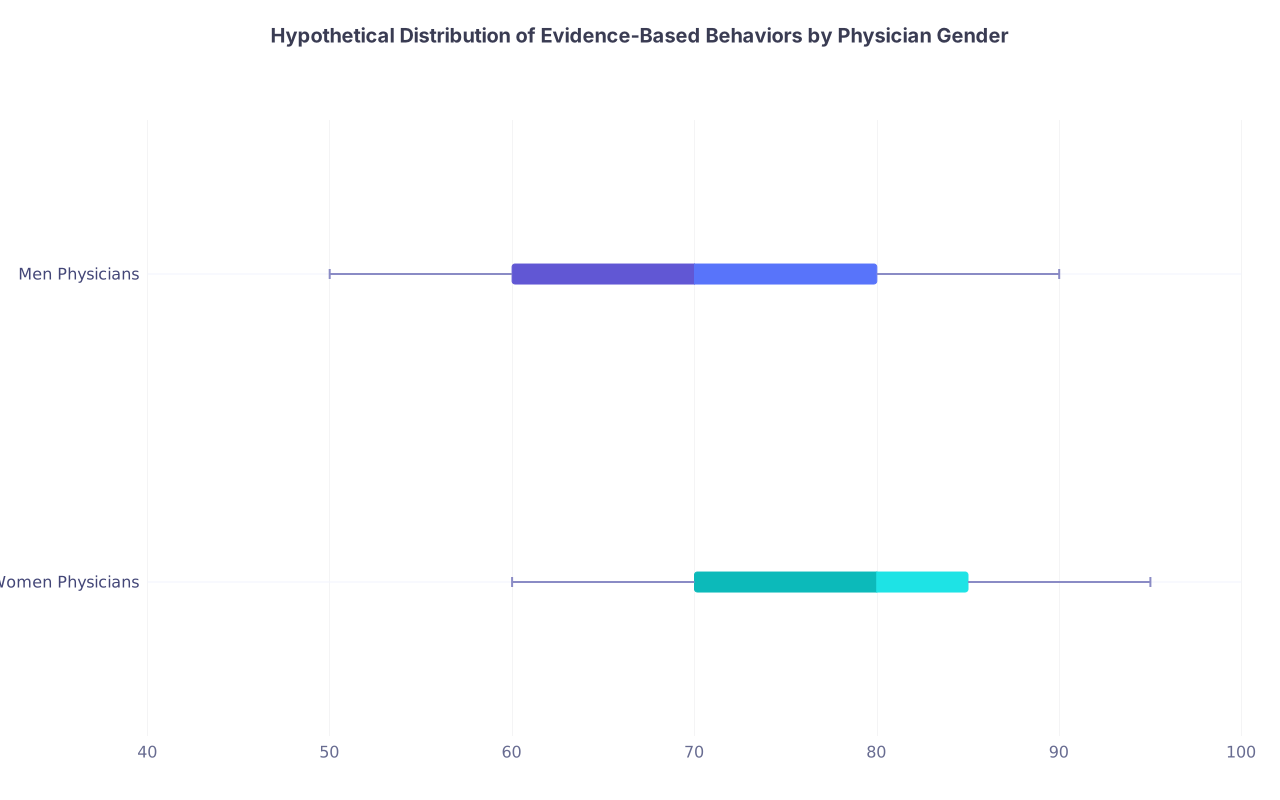
| Category | Min | Q1 | Median | Q3 | Max |
|---|---|---|---|---|---|
| Women Physicians | 60 | 70 | 80 | 85 | 95 |
| Men Physicians | 50 | 60 | 70 | 80 | 90 |
Think of that chart conceptually: overlapping distributions, not two species. Plenty of men physicians are excellent communicators and meticulous guideline followers. Plenty of women are not. But the central tendency is shifted.
If You Are A Woman In Medicine
The data say you are already delivering at least equal, often better, outcomes despite:
- Lower pay.
- More harassment and microaggressions.
- Less institutional support and mentorship.
- More unpaid emotional labor with patients and colleagues.
In other words, you are outperforming under worse conditions.
Three practical implications:
Do not let anyone sell you the “you are lucky to be here” narrative.
The numbers say the system benefits from your presence. Not the other way around.Protect your practice style.
The extra few minutes, the additional explanation, the more conservative threshold for risky procedures—that is part of what is moving the outcomes. Do not let RVU pressure bully you out of high‑yield behaviors.Use the data when negotiating.
When arguing for pay equity, leadership positions, or institutional support, hard numbers on outcomes and communication are more effective than abstract fairness arguments. You can literally say: “Patients of women physicians in large national datasets have lower mortality and readmissions. You benefit from that. Compensate accordingly.”
If You Are A Man In Medicine
You have two options when faced with this literature: get defensive or get better.
The data do not say you are unsafe or unqualified. They do say there is room to move your practice toward behaviors that correlate with better outcomes.
Three points to take seriously:
Study the high‑yield behaviors, not the headline.
Longer visits may not be feasible, but better structured visits are. More explicit discharge planning is. Shared decision‑making is. These are all learnable skills, not innate “female traits.”Stop trivializing sexism as a “feelings” issue.
When bias leads to lost leadership opportunities and burnout for women physicians who are outperforming on outcomes, that is not just unfair. That is system‑level harm to patients.Use your position to change norms.
When you see a woman colleague being dismissed as “too emotional” or “not aggressive enough” in a code or OR, remember the Wallis and Tsugawa data. Interrupt that narrative. Outcomes do not support the stereotype.
Ethical Questions You Should Actually Wrestle With
Strip away the discourse and you hit a few hard questions that matter if you care about medical ethics, not just PR statements.
1. Should outcomes by gender be monitored as a quality metric?
Argument for: If a group is consistently achieving better outcomes, we should examine and copy what they do. That requires measuring the gap.
Argument against: Risk of overinterpreting observational data and stigmatizing men physicians without adequate context.
My view: Track the data at the system level, anonymized. Use it to investigate practice patterns, not to punish individuals.
2. How do you design training that closes the gap without essentializing gender?
You do not create a “female communication skills” module. You do this instead:
- Integrate structured communication, teach‑back, and shared decision‑making into all curricula.
- Train everyone in bias recognition, especially around describing colleagues: “assertive” vs “aggressive,” “meticulous” vs “slow.”
- Give actual time and institutional incentives for behaviors that we know correlate with better outcomes, instead of rewarding only throughput and RVUs.
3. Are we ethically obligated to address inequities that create the performance gap?
If women physicians have better outcomes partly because they have to overachieve to survive, then you are benefiting from a discriminatory filter. Ethically, you cannot just say “great, they are better” and stop there.
The ethical response is:
- Fix pay gaps and promotion inequities.
- Address harassment and hostile work environments that push out high‑performing women.
- Recognize that “merit” has been systematically distorted, and actively correct for it.
Where Research Needs To Go Next
The current evidence base is good enough to establish: modest but consistent advantages in some outcomes for patients of women physicians.
It is not good enough yet on:
- Specialty‑specific effects outside internal medicine and general surgery.
- Longitudinal outcomes in outpatient care (A1c trends, CKD progression, etc.).
- Interactions between physician gender and patient gender (e.g., outcomes for women patients with women physicians vs men physicians).
If you are looking for a serious research career topic that intersects outcomes, gender, and ethics, this space is still under‑explored. Especially with:
- EHR data that can track process measures in granular detail.
- Natural language processing that can analyze clinical notes for communication patterns.
- Multi‑institutional registries that can link surgeon-level data to complications and functional outcomes.
Three Things To Remember
Large, well‑done studies consistently show small but meaningful advantages in mortality and readmissions for patients treated by women physicians, particularly in Medicare inpatient medicine and some surgical settings.
The most plausible drivers are differences in practice patterns—communication, guideline adherence, risk tolerance—shaped by both gendered socialization and systemic bias that forces women to overperform.
Ethically, the right response is not to weaponize these findings against men, but to protect and value the high‑yield behaviors more common among women physicians, fix the inequities that forced the gap to exist, and train everyone toward the practices the data support.