
Will Talking About Sexism in My Personal Statement Hurt My Chances?
What if the one honest thing you feel compelled to write about—sexism you’ve actually lived through—is exactly what gets your application quietly tossed into the “no” pile?
That’s the thought that keeps looping, right?
“I’m damned if I say nothing, and maybe damned if I tell the truth.”
Let’s walk through this like actual adults who know medicine is not some magical, bias‑free universe.
You’re not crazy to worry. Some readers will absolutely be uncomfortable with sexism as a topic. Some will roll their eyes. A few might punish you for it, even if they’d never admit that out loud.
But that doesn’t automatically mean: “Never talk about sexism.”
It means: “You have to be extremely smart about how you talk about it.”
The uncomfortable reality: bias is real (and it can hurt you if you’re careless)
Here’s the part nobody says explicitly on Reddit or in those cheerful premed webinars:
You are applying to a profession where:
- ER attendings still call women “dear” and men “doctor.”
- Female med students get mistaken for nurses daily.
- Surgical residents still get “Are you strong enough for this?” in 2026.
And the people reading your personal statement? Many trained in a time when overt sexism was just “how things are.” Some fought it. Some survived it by going silent. Some…perpetuated it.
So your fear—“If I talk about sexism, will they think I’m dramatic / political / a troublemaker / not a ‘team player’?”—is not paranoid. You’re picking up on something real.
The main risks when you write about sexism:
- They think you’re blaming instead of reflecting.
- They think you’re making your identity the only story.
- They feel accused and shut down emotionally.
- They think you’re focused on being wronged, not on what you’ll do for patients.
None of these are fair. But they are real possibilities.
The question is not “Is there risk?” The question is “Can I lower the risk enough that it’s worth telling this story?”
When talking about sexism hurts your chances
Let me be blunt: there are ways of writing about sexism that will tank you at some programs.
Red flags in a personal statement that make adcoms defensive:
Pure venting:
“Men in medicine don’t respect women like me. I’m tired of being dismissed, ignored, and silenced.”Vague accusations with no reflection:
“Throughout my life I’ve constantly faced sexism and discrimination, and it’s made everything harder for me.”Framing yourself as only a victim:
“Despite what they did to me, I am still here.”Making the reader the enemy (even implicitly):
“People like you in positions of power have turned a blind eye to the plight of women like me.”
Will some of that be emotionally true? Yeah. But your personal statement is not your diary. It’s a curated argument: “I belong in medicine, and you should trust me with patients, colleagues, and power.”
The adcom reader has, maybe, 5–7 minutes. They’re skimming through hundreds of essays that all say “I want to help people.” If your essay hits them as:
- Angry without direction
- Accusatory
- All about injustice, not patients
…they may label you “high drama” or “politicized” and move on. They shouldn’t. But they might.
And here’s the part that always feels like a punch to the gut: there are some programs where any mention of sexism, racism, or discrimination is mentally filed as “woke red flag.” If your dream is some very traditional, conservative environment, you do need to understand the water you’re swimming in.
But that’s not the whole story.
When talking about sexism helps your chances
There’s a second reality: some programs desperately want applicants who can see systems clearly and still function. Not people who pretend bias doesn’t exist. People who can confront it and still take care of patients.
At those places, a well‑written sexism story can actually be a strength:
- It shows resilience that’s not generic.
- It shows you understand power dynamics—hugely important in medicine.
- It can demonstrate advocacy grounded in real experience, not buzzwords.
- It sets you apart from the “I loved biology and volunteering at the hospital” crowd.
The key difference? How you frame it.
Strong sexism‑related essays tend to:
- Describe a specific incident or pattern.
- Show your internal processing (what you thought, questioned, realized).
- Demonstrate how your response was patient‑centered, professional, and thoughtful.
- End with what you do now because of that experience—how it shapes your ethics and behavior.
Let me give you two versions of the same core story.
Version that will probably hurt:
“As a woman shadowing in surgery, I was repeatedly talked over, ignored, and treated as less capable than male students. No matter how hard I worked, male residents received more teaching and support. This blatant sexism revealed how toxic surgery can be and made me wary of the culture of medicine.”
Now the stronger, still honest version:
“During a general surgery rotation, I noticed a pattern: male students were regularly invited to scrub in, while the two women, including me, were asked to ‘hold the iPad’ or manage paperwork. One day, after being sidelined again, I went home angry—at them, at myself for staying quiet, and at the thought of future patients losing out on good surgeons because some students never get a real chance.
The next week, I asked a female attending for advice. She encouraged me to be respectfully direct. Before the next case, I told the chief resident that I hoped to scrub in and had practiced the relevant anatomy. He paused, then nodded—and he did bring me in. It wasn’t a dramatic transformation, but it changed my approach: I learned I could name inequities, advocate for myself, and still preserve relationships.
That experience made me attentive to who gets included and who’s left out in clinical spaces. Now, as a volunteer tutor for first‑generation premeds, I make sure the quiet students get called on, too. I can’t fix sexism alone, but I can control whether the next woman in the room gets an actual chance, not just a view from the corner.”
Same sexism. Same emotion. But one version is “this field is toxic,” and the other is “this field has problems and here’s how I behave inside that reality.”
One shuts readers down. One gets nods of recognition and—at the right places—respect.

The big question: should you include sexism at all?
Here’s the part where I’m supposed to give The One Right Answer. There isn’t one. But I can give you a clear decision tree.
Ask yourself:
Is this truly one of the top 1–2 defining experiences that explains why I want to be a physician and how I’ll show up in medicine?
- If yes, it might belong.
- If it’s just one of many frustrating things you’ve faced, maybe it’s secondary essay material, not the centerpiece.
Can I write about it without:
- Naming people or institutions in a way that looks reckless?
- Sounding primarily angry or hopeless?
- Making my personal statement 80% about injustice and 20% about patients?
Do I have a concrete “because of this, now I…” outcome?
Things like:- Mentor others
- Speak up for patients
- Choose certain advocacy or QI projects
- Notice subtle inequities in care and act on them
Am I ready for someone on an interview day to push back on it?
As in:
“Do you think you might be over‑interpreting those experiences?”
or
“Some would say medicine has bigger problems than sexism. What do you think?”
If you have no idea how you’d answer those without crying or yelling internally, it might not be time to build it into your PS. Not because you’re weak. Because it’s still raw.
How to talk about sexism in a way that protects you
Let’s get really tactical. You want to minimize the risk but keep your integrity.
Use these principles:
Specific > vague
“During my second year, a male attending introduced my male classmate as ‘our future cardiologist’ and me as ‘the young lady helping us today.’”
hits harder (and feels more credible) than
“I have often been dismissed as a woman in medicine.”Impact > accusation
Focus on: How did it affect your thinking, your empathy, your understanding of power, your plans?
Not: How terrible they were.Agency > helplessness
Even if the “action” was internal—questioning your place, deciding not to internalize their view, seeking mentors—that’s still agency.Patients stay at the center
If your sexism story never touches how this shapes your care for patients, it starts to sound like a workplace rant. Tie it back: “Because I’ve seen what happens when some voices are ignored, I’m particularly careful to listen to…”Acknowledge complexity
“I still respect many of the people I’ve trained under. Some supported me deeply, others did not. Holding both truths has pushed me toward a version of medicine that’s honest about its flaws but still worth fighting for.”
That last line—honest but still in the arena—that’s the energy you want.
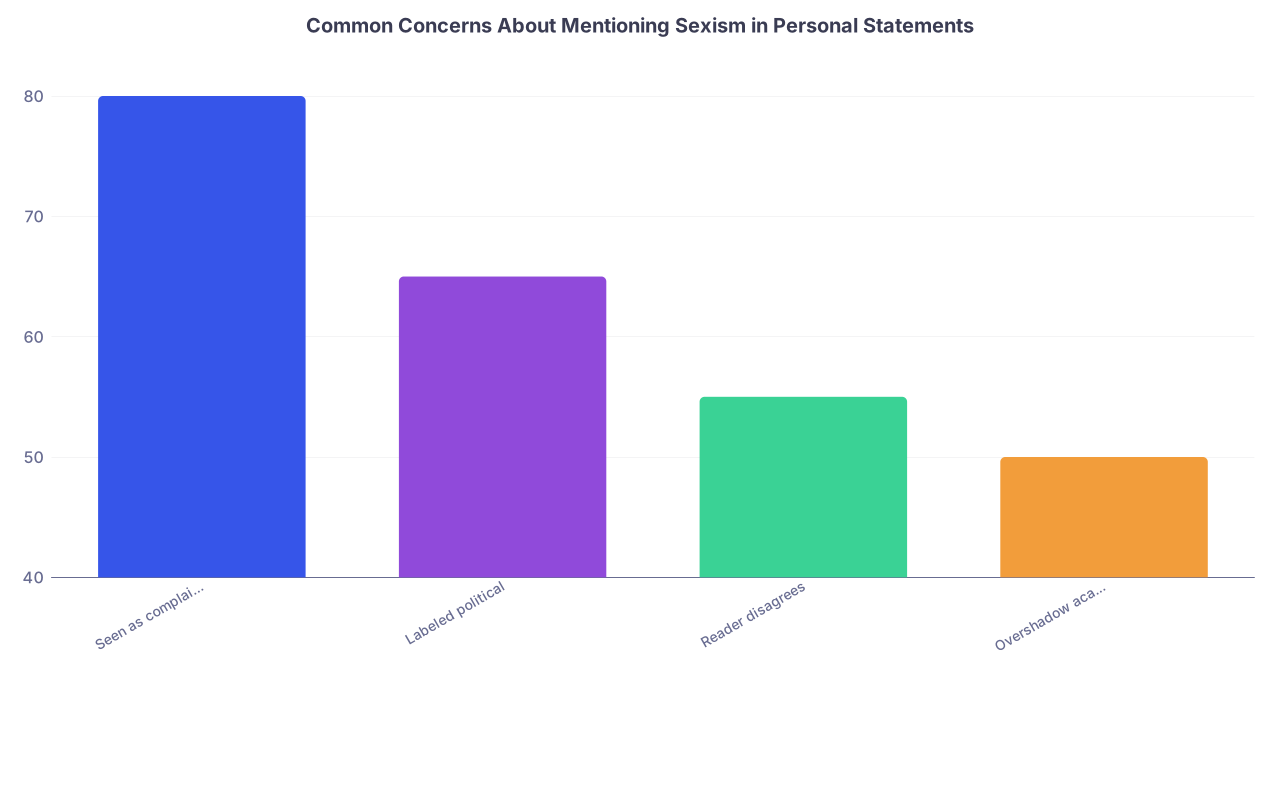
| Category | Value |
|---|---|
| Seen as complainer | 80 |
| Labeled political | 65 |
| Reader disagrees | 55 |
| Overshadow academics | 50 |
What about “codes” and dog whistles?
You’ve probably heard people say: “Don’t use words like ‘sexism’ or ‘patriarchy’ or ‘oppression’—they’ll think you’re political.”
Do you have to scrub all those words? No. But you should be intentional.
You can often describe the reality without using the buzziest term:
Instead of: “I faced sexism.”
Try: “I noticed a pattern where male students were consistently offered more opportunities in the OR than women.”Instead of: “The patriarchal culture of surgery…”
Try: “The hierarchy in this surgical department sometimes meant that trainees who didn’t fit the ‘typical surgeon’ mold—often women and smaller trainees—were sidelined.”
Is that fair that you have to code‑switch like this? No. Is it strategic? Yes.
The line I’d draw: Don’t gaslight yourself. Don’t pretend it wasn’t about gender if it clearly was. But you can choose language that focuses on observable behavior and your response rather than abstract ideology.

| Step | Description |
|---|---|
| Step 1 | Want to write about sexism |
| Step 2 | Save for secondary or interview |
| Step 3 | Journal first, then revisit later |
| Step 4 | Refine focus on patient impact |
| Step 5 | Include carefully in PS |
| Step 6 | Defining experience for you |
| Step 7 | Can you be specific and reflective |
| Step 8 | Can you connect to patients and your role |
Where to put it if not the main essay
You’re allowed to be strategic. Not everything has to go in the main personal statement.
Good alternate homes for sexism experiences:
- “Meaningful experiences” / AMCAS activities descriptions
- Secondaries about adversity, ethics, diversity, professionalism
- Interview answers about challenges, conflict, or observing unprofessional behavior
Sometimes the best move is:
Write the “full truth” version in your journal.
Then choose a smaller, more focused slice to put in the PS, with less of the emotional weight but enough substance to show who you are.
You’re not selling out by being selective. You’re playing a long game. You can do more to change the culture inside medicine than as an excluded applicant on the outside.
A quick reality check: who do you actually want to train you?
This is the part that stings but needs saying.
If a program is so allergic to any mention of sexism that a thoughtful, measured story about inequity automatically gets you screened out…do you really want to train there for 3–7 years?
You’re not just trying to get in somewhere. You’re choosing the environment that will shape:
- Your confidence
- Your tolerance for abuse disguised as “toughening you up”
- Your sense of what’s normal
There’s a trade‑off:
- Hyper‑sanitized essay: Safer across the board, but you might match at places that are a bad fit for your values.
- Honest‑but‑strategic essay: Slightly higher risk of rubbing the wrong people the wrong way AND higher chance of signaling to healthy programs that you’re their kind of applicant.
No one can make that decision for you. But pretending that “fit” doesn’t matter is how people end up miserable in training.
| Approach | Risk Level | When It Works Best |
|---|---|---|
| Main theme of PS | Medium–High | When it truly shaped your path to medicine |
| Single paragraph vignette | Low–Medium | As one of several defining experiences |
| Activity description only | Low | When it’s important but not central |
| Secondary essay focus | Medium | For schools with strong DEI commitments |
If you’re scared you’ll “do it wrong”
You’re not overreacting. This is a tightrope.
But here’s the pattern I’ve seen repeatedly: The more grounded and specific the story, the less risky it is.
If you’re writing about:
- A particular attending’s comment
- A pattern you noticed and how you responded
- A mentorship experience that changed your outlook
…you’re usually okay.
If you’re writing about:
- “Medicine as a fundamentally sexist institution” (in sweeping terms)
- “Men in power” as a monolith
- Your rage at the field as a whole
…you’re moving into much higher‑risk territory, at least for a primary personal statement.
You are allowed to be angry. You are not required to sand down your edges for their comfort. But your personal statement’s job is not to unload all your trauma; it’s to convince a group of imperfect humans you’re ready to join their profession and care for vulnerable people.
Sometimes that means you give them 70% of the story now, and you keep the other 30% for the book you write later.
FAQ (exactly 4 questions)
1. Will using the actual word “sexism” in my personal statement hurt me?
Not automatically. The word itself isn’t poison. What matters is how you use it. If you say something like, “This experience opened my eyes to sexism in clinical training and pushed me to…” and then show growth, many readers will be fine—or even appreciative. If you pepper the essay with loaded terms without specifics or reflection, you’ll lose people fast.
If you’re nervous, you can often describe the same reality without that exact label: describe actions, patterns, who got what opportunities. Let readers draw the obvious conclusion.
2. What if the worst‑case scenario happens and a program rejects me because I mentioned sexism?
Honestly? Then that program just told you who they are. Does it still suck? Yes. Could it slightly reduce your total interview count? Maybe. But there are also programs that will only really see you because you wrote something real. The risk is not zero, but neither is the upside. You’re choosing which group you’d rather self‑select with.
3. Can I mention harassment or assault, or is that always too heavy?
It’s not “always” too heavy, but it’s very high‑stakes. Talking about assault or severe harassment in a PS can quickly shift the focus from “future physician” to “trauma narrative” in the reader’s mind. If that experience is central to why you want to be a doctor and you can write about it with clear reflection, boundaries, and focus on your role now, it can work. But if it’s raw, graphic, or dominates the essay, it’s safer in a secondary or not at all. You don’t owe your deepest wounds to an admissions committee.
4. How can I test if my sexism story is “safe enough” for my personal statement?
Do a three‑person test. Show the draft (with context removed about “this is my PS”; just call it an essay) to:
- a woman in medicine if you know one,
- someone who’s blunt with you, and
- someone older or more traditional if possible.
Ask them specifically: “Do I sound angry or accusatory? Do I still sound like someone you’d trust as a doctor? Is there a clear takeaway about who I am now?” If two out of three say it feels balanced and mature, you’re probably in the safe zone.
Open your current personal statement draft and hit Ctrl+F (or Command+F) for any paragraph that touches sexism, bias, or discrimination. Ask yourself right now: “Is this about my growth and my patients—or mostly about what they did to me?” Rewrite just one sentence today to tilt it toward growth.