
It’s 6:45 a.m. You’re in the hospital, white coat on, stethoscope around your neck, ID badge clearly saying “Medical Student” or “Resident Physician.” You walk into a patient’s room, ready to present, or examine, or actually do something physician-y for once.
And then you get:
“Oh good, nurse, can I get some more blankets?”
Or worse: “Sweetie, when is the doctor coming?”
And you are the damn doctor. Or trying very hard to become one.
Your stomach drops a little. Again. You smile and correct them—maybe—or you just do the thing they asked for because it’s easier. Then you walk out of the room and the thought hits:
“Why does this keep happening? Is it because I don’t look like a doctor?
Do I not belong here?”
Let’s just sit in that for a second, because it’s brutal and persistent and you’re not the only one thinking it.
The Ugly Pattern: It’s Not Just You, and It’s Not Random
This is not “a quirky patient thing.” It’s a pattern. Especially if you’re:
- A woman in medicine
- Young
- Person of color
- Shorter, soft-spoken, or just not radiating “old white male surgeon energy”
You see your male classmate—same year, same badge, same hospital—walk into a room and get “Hi doctor” on the first try. Meanwhile you’re on your fifth “No, I’m the doctor” of the week and it starts to feel like death by a thousand paper cuts.
This is what’s messing with your head: the repetition. If it happened once you’d brush it off. But when it’s every week, every rotation, maybe multiple times a day on some services, your brain starts connecting it to your worth, not the system.
And I get the spiral:
“If everyone keeps seeing me as a nurse or assistant, maybe I’m not projecting enough confidence. Maybe I’m not smart enough. Maybe I really don’t fit the ‘doctor’ mold.”
Let me say this pretty bluntly:
The problem is not that you’re not “doctor enough.”
The problem is that medicine has trained society for decades to see “doctor” as one thing: older, male, usually white. Everyone else is optional.
You’re running into a stereotype that was built long before you were even born.
Why They Keep Calling You “Nurse” (Even When You’ve Introduced Yourself)
You can do everything “right” and still get misidentified. Introduce yourself clearly, wear your badge, hold a clipboard with “MD” written in neon. Doesn’t matter. You still get “nurse” or “tech” or “assistant.”
There are a few reasons, and none of them are a referendum on your belonging:
Patient mental shortcuts
Patients and families are scared, overwhelmed, in pain. Their brain runs on autopilot and uses whatever stereotype is the fastest: “Women in scrubs = nurse.” Their intention might not be malicious, but the impact on you is very real.Historical baggage
For decades, medicine looked like one thing at the top and something else in the support roles. Many older patients have literally never had a woman physician, or a woman of color as a physician, or a young-looking physician. Their brain doesn’t update quickly.How teams move
Often on rounds, the attending man walks in first, stands at the foot of the bed, talks the most, and everyone else hovers behind. Patients see this 400 times and learn “that one = doctor, everyone else = not doctor.” So when you walk in alone later, you get misfiled.Institutional signals
Some hospitals make nurse badges big and blue and physician badges tiny and unreadable. Some floors refer to all female staff as “girls” (yes, I’ve heard it). Even some attendings call all women “nurse” by default. You’re swimming in that water.
So the question isn’t “Does this mean I don’t belong?”
The question is “Why would my belonging be defined by a broken stereotype in the first place?”
But of course, that’s the rational answer. Your brain is not operating on rational only. It’s operating on accumulated micro-injuries.
The Emotional Fallout: It’s Not Just Annoying, It’s Identity-Level
Let’s be honest: this doesn’t just “bother” you. It eats at your identity.
You’re already juggling imposter syndrome:
Am I smart enough? Did I match well enough? Am I behind? Does my attending secretly think I’m useless?
Now layer on: “No one even recognizes I’m the doctor.”
That hits deep. Because you’ve probably sacrificed:
- Years of your life
- Friendships, sleep, relationships
- Wedding timelines, having kids, hobbies, actual joy
And after all that, they still look at you and see “support staff” by default.
And then the worst-case thinking starts:
“What if this keeps happening for my entire career?”
“What if I’m always fighting to be seen as legitimate?”
“What if patients don’t trust me because I’m a woman?”
“What if colleagues think I’m overreacting when I bring it up?”
Let me validate something: you’re not crazy for being this upset. It’s not oversensitive. This is about professional identity, respect, and basic recognition.
I’ve watched residents go from enthusiastic and proud to tired and numb about this. I’ve seen a PGY-3 say, “I just don’t correct them anymore. It’s not worth it.” And that made me more sad than anything.
Because underneath that resignation is: “I’ve stopped expecting to be seen.”
You deserve better than that.
Correcting Patients Without Feeling Like the “Difficult One”
Here’s where the anxiety really spikes: you want to correct them, but you’re terrified of sounding rude, making the patient uncomfortable, or being labeled “touchy” or “overly sensitive” by staff.
You shouldn’t need a script. But having one helps when your brain is screaming and your throat is dry.
You can play with tone, but something like:
- “Actually, I’m the doctor taking care of you today.”
- “I’m Dr. [Last Name]. I’m one of the physicians on your team.”
- “I’m your doctor, but I’m happy to grab your nurse for you too.”
If they keep doing it, you can add a little reinforcement without being hostile:
- “Just a reminder, I’m your doctor. I know it gets confusing with all the people in and out.”
You do not need to apologize for clarifying. You’re not doing something extra; you’re fixing an error.
Your fear might be: “What if they think I’m arrogant for insisting I’m the doctor?”
Reality: The majority either correct themselves quickly or genuinely didn’t realize. A small minority will bristle no matter what you do. That’s not on you.
The bigger problem is when staff and colleagues normalize it and never step in.
The Ethics Piece: Yes, This Is a Professional Problem, Not Just a Personal One
Since you mentioned “medical ethics” phase—let’s call this what it is: not just hurt feelings. This is about equity, professionalism, and justice.
A system where women physicians are constantly mistaken for nurses (and women nurses are routinely disrespected too, by the way) is sending a hierarchy message:
“Doctors look like X. Everyone else looks like Y.”
That affects:
- How seriously patients take your recommendations
- How families respond when you give bad news
- How your authority is perceived during emergencies
- How students and juniors see what “doctor” is supposed to look and sound like
It also piles on hidden labor: you’re spending mental and emotional energy just getting back to neutral—being seen correctly—while some of your colleagues start every encounter there by default.
That’s an equity issue.
And yes, it is absolutely fair to say institutions and attendings have an ethical obligation to help fix it.
I’ve seen the difference between:
Attending A: Says nothing when patients call the female resident “nurse.”
Attending B: Jumps in with, “Actually, this is Dr. Lee, she’s your doctor,” and then keeps going like it’s the most normal thing in the world.
Those tiny moments either reinforce or dismantle bias. Silence is not neutral.
Practical Things You Can Control (Without Selling Your Soul)
You can’t rewire the entire culture alone, but you’re not powerless. And no, I’m not going to tell you to “just be more confident” like that magically fixes misogyny.
Some things that actually help a bit:
Introduce yourself very deliberately at the start of every encounter.
Not mumbled, not rushed. Just clear:
“Hi, I’m Dr. [Last Name]. I’m one of the internal medicine residents taking care of you.”
Not “I’m part of the team.” Not “I’m with medicine.” Those vague phrases backfire.
If you’re a student:
“Hi, I’m [First Last], a medical student working with Dr. [Attending]. I’ll be part of your doctor team today.”

You can also use your badge strategically. Hold it at chest level when you introduce yourself so their eyes actually land on “Doctor” or “Resident Physician.” It feels silly, but it helps.
If you feel safe, you can quietly enlist help:
Ask your attending or senior resident: “When patients misidentify me as a nurse, it throws me off a lot. Could you help reinforce my role when you hear it?” The good ones will say yes immediately and actually follow through.
Is that your job? No. But it’s a way to survive while the system is still catching up.
And then there’s the emotional piece.
You’re going to have days where you correct it and still spend the next hour replaying it in your head and feeling small. “Did I sound mean? Did I overreact? Am I the only one who cares about this?”
You’re not. Talk to the other women on your team. I guarantee you have the same stories, sometimes worse:
- The attending woman mistaken for the nurse while her male med student is called “doctor”
- The Black woman resident assumed to be housekeeping.
- The pregnant physician constantly asked when her “maternity leave from nursing” starts.
When you hear those, something clicks:
“This isn’t about me failing to belong. This is about a system failing to update its mental picture.”
A Quick Reality Check: Are You Less of a Doctor Because They Don’t See It?
This is the fear at the root of all of this:
“If they don’t see me as a doctor, maybe I’m not actually good enough to be one.”
So let’s be brutally literal for a second.
Your belonging is based on:
- Passing exams
- Completing rotations, meeting competencies
- Getting into med school or residency or both
- Showing up at 5 a.m. post-call and still caring enough to double-check meds
- Learning, reflecting, improving
Your belonging is not based on:
- Whether a random patient conditioned by 50 years of stereotypes reads your badge correctly
- Whether an older surgeon who’s never adjusted to women in medicine calls you “young lady” on rounds
- Whether some family member who’s been awake for 48 hours says “nurse” out of habit
Does it still hurt? Yes.
Does it have anything to do with whether you’re meant to be here? No.
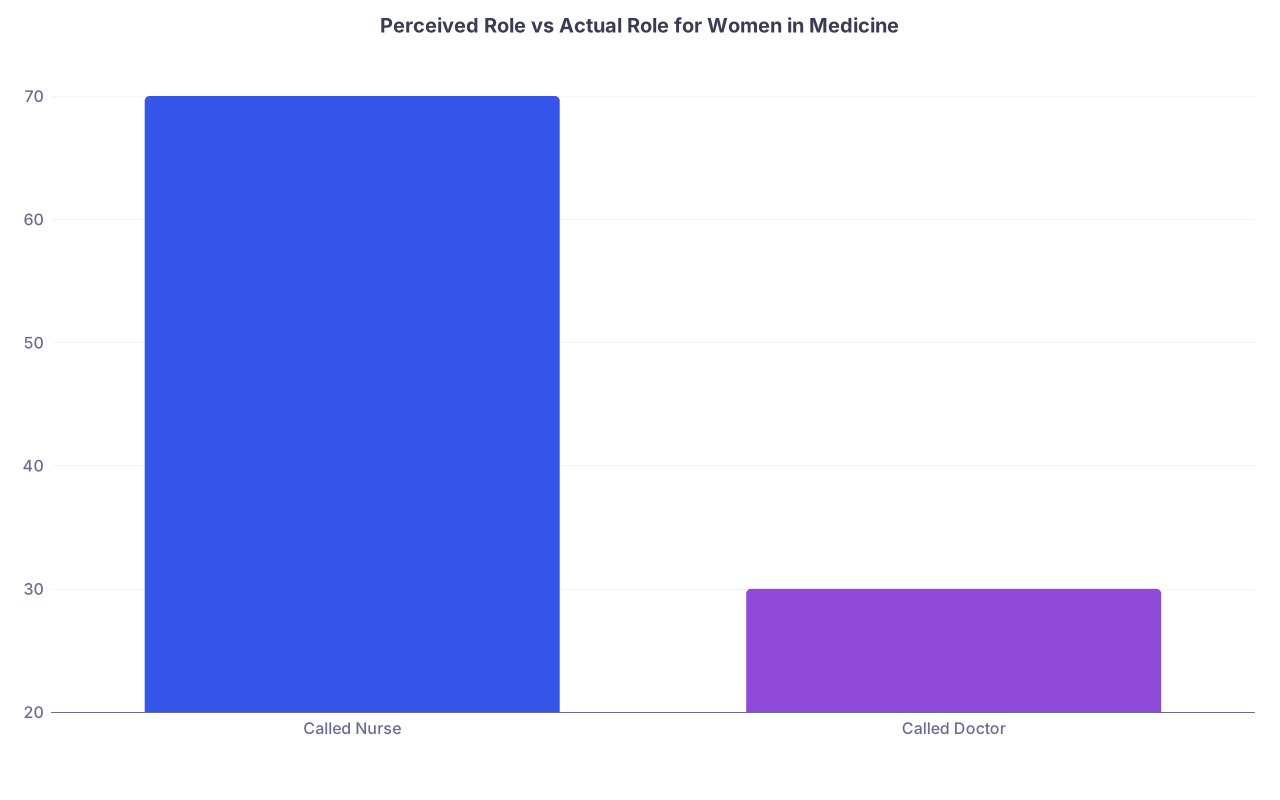
| Category | Value |
|---|---|
| Called Nurse | 70 |
| Called Doctor | 30 |
Think of it this way: if 70% of people called a cardiologist “the heart nurse,” the cardiologist is still a cardiologist. The mislabeling doesn’t cancel the training.
The only real danger is if you start believing the mislabel more than your own reality. That’s what I’m worried about for you.
You don’t have to like this. You don’t have to be “tougher.” But please don’t take their confusion as a verdict on your future.
What If This Never Gets Better?
Here’s the nightmare scenario your anxious brain probably goes to:
“I’ll be 20 years into practice and still getting called ‘nurse’ or ‘assistant’ or ‘sweetie.’ I’ll be exhausted, bitter, and invisible.”
Honestly? Some of this will follow you. Even attendings get it. It doesn’t magically stop when MD is stitched on your coat. That’s the depressing truth.
But.
It usually gets easier in a few ways:
- People in your own institution start to know you and back you up.
- Your voice changes—you sound more sure, even when you’re not. Patients pick up on that.
- You get better at quick, effortless correction that doesn’t drain you every time.
And the culture is shifting, slowly. More women physicians. More attendings who care about correcting patients. More patients under 40 who have grown up seeing women doctors as normal.
So no, you’re not signing up to be mistaken for a nurse until retirement every single day. But yes, you’re going to run into this for a while.
The question is: do you let that turn into “I don’t belong,” or do you treat it as one more broken thing in medicine that you’re allowed to hate…without letting it define you?
Because here’s the messed-up paradox:
The very fact that you’re this bothered by justice, respect, and identity? That’s the mindset I actually want in a physician.
You care. You see inequality. You want the system to be better.
That’s not proof you don’t belong. That’s proof you’re exactly the kind of person medicine needs and then burns out if we’re not careful.

| Step | Description |
|---|---|
| Step 1 | Patient calls you nurse |
| Step 2 | You correct or stay silent |
| Step 3 | You question your role |
| Step 4 | Imposter thoughts |
| Step 5 | Do I even belong here |
| Step 6 | Reality check - training and effort |
| Step 7 | Reframe - problem is bias not you |
| Step 8 | Decide response next time |
FAQ: Six Questions You’re Probably Too Tired to Ask Out Loud
1. Should I always correct patients when they call me “nurse”?
You don’t have to always correct them, but I’d strongly recommend you correct them most of the time, especially early in training. Not because your ego needs it, but because your professional identity does. A simple, calm “I’m actually your doctor” is enough. If you’re in a code or urgent situation, obviously you prioritize care over titles. You’re allowed to choose your battles, but choosing all “silence” is how this stuff slowly erodes you.
2. Am I disrespecting nurses by not wanting to be mistaken for one?
No. Wanting to be recognized for your role is not disrespect. Nurses have their own expertise and identity and also hate being mistaken for things they’re not. You’re not saying, “I’m better than a nurse.” You’re saying, “I’m not a nurse—I’m your doctor, with a different job and responsibilities.” Both can be respected without blurring them into one.
3. What if my co-residents or attendings tell me I’m overreacting?
Then they’re wrong. Full stop. You can explain once: “This happens to me constantly, and it impacts how patients perceive my role. It’s exhausting.” If they still blow it off, that’s about their blind spot, not your sensitivity. You can also look for allies—often other women, residents of color, or thoughtful attendings—who actually get it and will back you up.
4. Does how I dress or speak make this worse? Should I change myself?
You’ll be tempted to think, “If I just dress more formally / speak more loudly / act more aggressively, maybe they’ll see me as a doctor.” You can experiment with how you present yourself in ways that still feel authentic—clear introductions, firm voice, eye contact—but you do not owe the world a personality transplant to be recognized as a physician. Don’t contort yourself into some caricature of “doctor” just to chase respect.
5. Is it unprofessional to correct a patient’s family member in front of them?
No. It’s actually part of professionalism to clarify roles so they know who is making decisions and giving recommendations. You can keep it gentle: “Just so everyone’s clear, I’m Dr. [Last Name], the doctor taking care of [Patient].” That’s not shaming them; it’s orienting the room. If an attending is present, they should reinforce your role too. If they don’t, that’s on them.
6. How do I stop this from eating away at my confidence long-term?
You probably can’t stop it from stinging completely, but you can stop it from rewriting your story. Keep a mental—or literal—list of times you were clearly recognized as the doctor, when patients trusted you, when you made a good call, when an attending praised your judgment. Balance the noise of misidentification with evidence of your real impact. And talk about it with people who get it, not just people who shrug it off. You’re not overreacting. You’re reacting like a human being who’s worked incredibly hard to be where you are.
If you remember nothing else:
- Being mistaken for a nurse over and over is a symptom of bias, not proof that you don’t belong.
- You’re allowed to correct people and protect your identity as a physician without apologizing for it.
- Your legitimacy comes from the work you’ve done and the care you give—not from whether every patient’s mental image of “doctor” is finally updated to include you.