
Patient preference is not a verdict on your worth as a physician.
I need to start there, because I know how your brain is spinning this: “If patients keep refusing me because I’m a woman, maybe I don’t belong in medicine at all.”
I’ve heard that exact sentence. Out loud. In a conference room with a resident who looked like she hadn’t slept in three days and had just been told—for the third time that week—“I’d rather have a male doctor.”
You’re not overreacting. This isn’t just “part of the job.” It feels like a personal rejection every single time.
Let’s walk through what this actually looks like, what’s ethical, what’s not okay, and what you can do without selling your soul or your sanity.
The Fear: “What If This Keeps Happening And Everyone Thinks It’s My Fault?”
Here’s the nasty little thought spiral:
- A patient refuses care from you because you’re a woman.
- You feel embarrassed and exposed in front of the team.
- You worry the attending secretly agrees with the patient.
- You imagine word getting around: “Patients don’t like working with her.”
- You start questioning if you’re “too sensitive,” “too emotional,” “too something.”
I’ve watched women residents on OB/GYN, internal medicine, surgery, EM — literally every specialty — run into this. It’s not always blatant:
- “I just feel more comfortable with a man for this procedure.”
- “No offense, sweetheart, but is there a real doctor available?”
- “Can I have someone older? Maybe a male doctor?”
- Or the charming: “Women are too emotional to be surgeons.”
None of this is hypothetical. This is Tuesday.
The fear underneath all of it: What if this keeps happening? What if my evals suffer? What if I can’t get procedures? What if attendings stop assigning me things because it’s easier to just send a male colleague?
You’re not just worried about your feelings. You’re worried about your career.
Good. Because that’s actually the right question: How do we protect your training, your evaluations, and your dignity when patients refuse care based on gender?
What’s Actually Ethical Here? (Because “The Customer Is Always Right” Is Garbage In Healthcare)
Let me be blunt: Patients do not have unlimited rights to discriminate against you.
They do have rights about:
- Gender-concordant care for certain intimate exams or religious reasons (e.g., pelvic exams, breast exams, some Muslim or Orthodox Jewish patients).
- Trauma-informed care if a past assault makes certain provider genders triggering.
They do not have blanket permission to say:
- “I don’t want a woman doctor because women aren’t as smart.”
- “Women shouldn’t be surgeons.”
- “I only want a male for my heart because they’re stronger.”
- “I don’t want a woman touching me, period.”
Hospitals and training programs should have policies about this. Some are decent. Some are vague enough to be useless.
In practice, what should happen (in a semi-functioning system):
- If it’s about religion, modesty, or trauma history, people try to accommodate when feasible, without harming your training.
- If it’s about pure bias (“no women”), leadership should back you, not the bias. That might mean:
- Explaining to the patient: “Dr. X is the assigned physician; we don’t reassign based on gender.”
- Asking the patient if they want to transfer care elsewhere entirely, not within the team.
- Documenting discriminatory remarks.
Is that always what actually happens? No. Sometimes the attending shrugs and reassigns. Sometimes they say, “It’s not worth the fight, just switch.” And it feels like you lost.
But ethically? You are not obligated to accept that your gender disqualifies you from caring for someone.
What It Looks Like On The Ground (And How Much It Can Mess With Your Head)
Let me walk through a few very real scenarios and how they commonly play out.
Scenario 1: The Subtle “Preference”
You walk into a room with a male med student or junior resident. You introduce yourself as the doctor. The patient turns to the male student:
“So you’ll be my doctor then?”
You correct them. Politely. You feel yourself flushing anyway.
What usually happens:
- You laugh it off, correct them again.
- Someone maybe jokes: “She’s the boss here.”
- But inside, it lands. Because you know if you were a guy, this probably wouldn’t have happened three times today.
Impact on you:
- Hyper-awareness. You start rehearsing introductions in your head.
- You worry staff and patients see you as “less doctor-y.”
- You start questioning your presence every time a patient doesn’t make eye contact with you.
Scenario 2: The Flat-Out Refusal
You’re assigned to consent a patient for a procedure.
Patient: “Sorry honey, I’d rather have a man do this. No offense.”
You: “…Dr. Y and I will both be involved in your care.”
Patient: “No, I want a man doctor.”
What usually happens:
- You step out, feeling humiliated.
- You tell the senior or attending.
- If they’re decent, they look pissed on your behalf. But many will say something like, “It’s not about you; it’s just their preference. I’ll take this one.”
Impact:
- You lose a procedure.
- You lose experience.
- You lose dignity in front of your team.
- And you know if you complain too much, you become the difficult one.
Scenario 3: Repeated Pattern
This is what you’re afraid of: it doesn’t happen once, it happens a lot. ICU, ED, wards, clinic — some version of:
“I want a male doctor.”
“I want someone older.” (but they only say this to women)
“I just trust male doctors more.”
Over and over, it chips at you. You start thinking:
- Maybe patients really do feel safer with men.
- What if attendings quietly think that too?
- Will this affect my letters? My procedural numbers? My fellowship chances?
This is where people either burn out silently or start detaching so hard they stop caring. Neither is good.
What You Can Actually Do Without Getting Labeled “Difficult”
You’re trying to thread the stupidest needle: stand up for yourself and not get branded as dramatic, oversensitive, “not a team player.”
So, concrete strategies. Things I’ve watched actually work in real hospitals with real politics.
1. Decide What You Won’t Tolerate
You need a personal line. Not everything is worth a war, but some things are absolutely not okay.
Examples of reasonable lines:
- “I’m okay if a modesty-based gender request is honored for intimate exams.”
- “I am not okay with being repeatedly pulled from standard cases because someone casually prefers men.”
- “I am not okay with overtly sexist remarks going unaddressed in front of the team.”
If you don’t decide this ahead of time, in the moment you’ll freeze and then hate yourself later.
2. Script Your In-Room Response
You don’t have to improvise. Have a few phrases ready so your brain doesn’t short-circuit mid-awkward-conversation.
Something like:
- “I understand you might have preferences. I’m the physician on your team today, and I’m fully qualified to care for you.”
- “If this is about religious or modesty concerns, we can talk about options. If it’s just about gender, we don’t change assignments based on that.”
- “I hear your concern. All members of this team are trained to provide safe, high-quality care.”
You don’t have to win them over. You just have to not vanish silently.
3. Make Your Attending Say Something Out Loud
Here’s where a lot of women get steamrolled. The attending just quietly reassigns and moves on. You get nothing.
Push, politely but clearly:
- “This has happened a few times to me recently. I’m worried about losing out on training opportunities. How do you usually handle this?”
- “Can we document this as a patient preference due to bias so it doesn’t look like I backed out?”
- “Would you be willing to clarify to the patient that I’m the physician and that we don’t reassign based on gender unless there are religious or trauma-related reasons?”
If they’re decent, they’ll at least say something like: “Dr. X is fully qualified; she’s leading your care today.” Even if they later decide to switch for safety or practicality, you were defended. That matters.
4. Document Patterns (Quietly, For Yourself First)
If this becomes repeated and it’s genuinely affecting your training, you need data, not just vibes.
Keep a simple log:
| Date | Setting | What patient said | Impact on training |
|---|---|---|---|
| 8/5 | ICU | Wanted male doc | Lost central line |
| 8/12 | ED | Refused exam | Lost pelvic exam |
| 8/20 | OR | Wanted male surg | Scrubbed out |
Why? So when you go to your program director or clerkship director, you’re not saying, “It feels like this happens a lot.” You’re saying, “This has happened 6 times this month, I’ve lost X procedures, and it’s all explicitly about my gender.”
That’s harder to ignore.
What Schools and Programs Should Be Doing (And How To Push Them, Carefully)
You’re one person. You’re not going to single-handedly fix institutional sexism between rounds and night float. But you’re not powerless either.
There are three levels here:
- Policy – what’s written down
- Culture – what people actually do
- Protection – what happens when you complain
You care most about #3 because that’s where your career is on the line.
Start small and strategic:
- Ask in a non-accusatory way: “Are there guidelines on handling discriminatory patient requests for provider gender, race, etc.?”
- If something bad happens repeatedly, talk to someone you trust first: a chief, a friendly attending, a faculty mentor, the women in medicine group if your hospital has one.
If you go straight to full formal complaint without allies or support, you can be technically right and still end up isolated. I wish that weren’t true. But I’ve seen it.
Look for people who’ve already shown they “get it.” The attending who shut down a sexist joke. The PD who explicitly mentioned zero tolerance for discrimination during orientation. Those are your first stops.
How To Not Internalize This As “I’m The Problem”
This is the real damage: not the lost procedure, not the awkward moment, but the slow creeping belief that maybe they’re right.
So, you need counterweights. Deliberately.
1. Separate Signal From Noise
Patient says: “I’d rather have a man.”
Your brain translates: “You’re not good enough.”
Those are not the same thing.
Sometimes they’d say that to literally any woman who walked in. You, your brilliant co-resident, your attending with 20 years of experience. That’s not a reflection on you; it’s a reflection on their worldview.
You can still be hurt. But don’t add extra poison by agreeing with them.
2. Remember: Men Get “Preferences” Too — But It’s Framed Differently
No one says, “What if they keep refusing care from me because I’m a man?” Because when that happens (like on OB/GYN), the institution treats it as normal modesty.
The difference is: when your gender is the problem, you’re told to be “understanding.” When their gender is the problem, it’s just “patient comfort.”
Double standard? Yes. Are you imagining it? No.
3. Build A Quiet File Of Wins
Keep emails. Save nice eval comments. Write down specific compliments or feedback when attendings praise your work.
You’re going to need evidence to throw back at your own brain when it says, “Everyone secretly thinks I’m not good enough.”
Because your brain will lie to you under stress. Having receipts helps.
The Ugly Truth: You Can Do Everything Right And It Will Still Hurt
I’m not going to sugarcoat this: you can respond calmly, have perfect scripts, supportive attendings, clear policies…and still feel like someone punched you in the gut when a patient rejects you for being a woman.
That doesn’t mean you’re weak. It means you’re human.
This is what chronic, low-level, repeated bias does:
- You start bracing for it before it happens.
- You replay interactions after work, wondering what you “should have” said.
- You feel guilty for being upset because “other people have it worse.”
- You start considering specialties not based on what you love, but on where you think you’ll be discriminated against less.
If this is already you—before you’ve even started residency—you’re not broken. You’re just paying attention.
A Quick Reality Check: You’re Not Alone, And No, This Doesn’t Mean You Shouldn’t Go Into Medicine
Let’s look at this zoomed out.
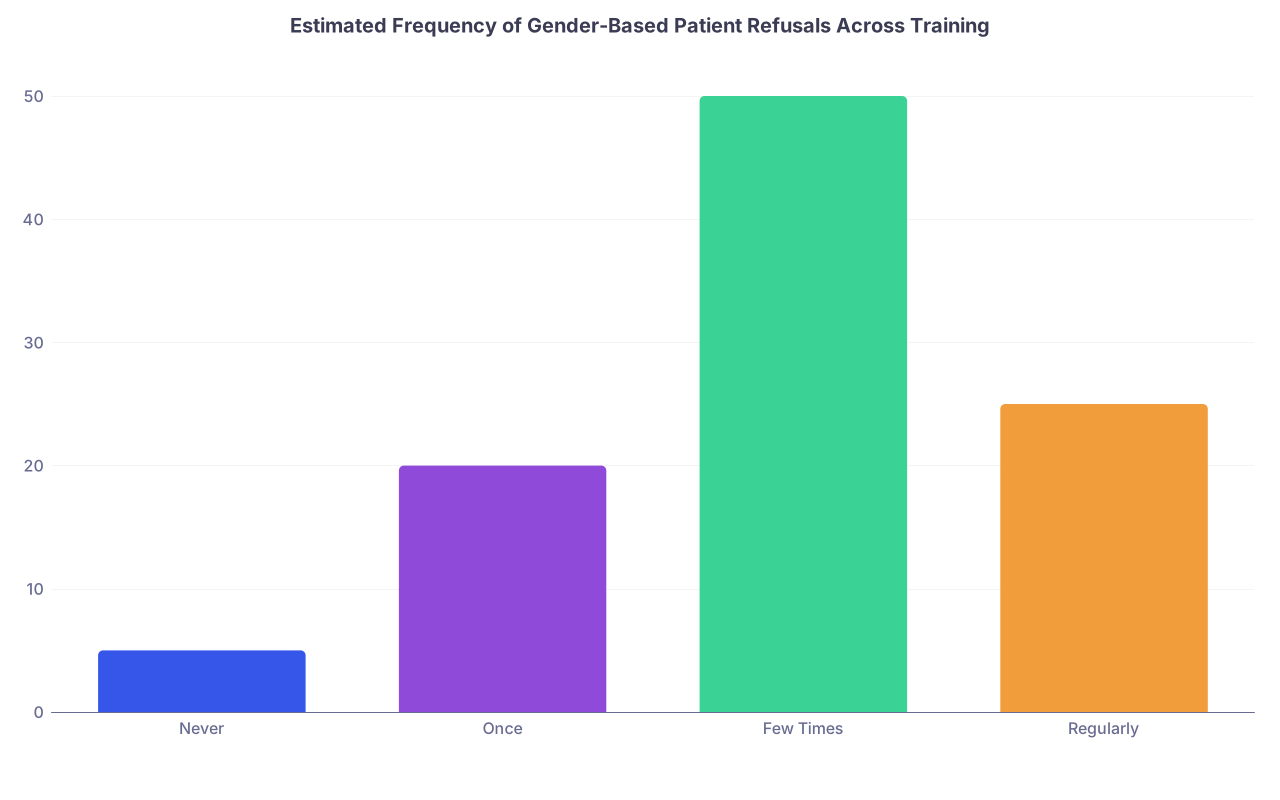
| Category | Value |
|---|---|
| Never | 5 |
| Once | 20 |
| Few Times | 50 |
| Regularly | 25 |
Is that hard data? No. But it matches what I’ve seen talking to women across multiple programs: most experience some version of this at least a few times; a depressing chunk experience it regularly.
And yet those same women:
- Match into competitive specialties.
- Become chiefs.
- Get stellar letters.
- Are beloved by patients who don’t care what their chromosomes are.
The refusals are loud in your memory because they’re painful. The hundreds of patients who don’t care you’re a woman? You barely remember them. That’s how human memory works.
If You’re Still Just Applying Or Early In Training
You might be thinking: I’m not even in med school or residency yet and I’m already anxious about this. Is that a sign I’m not cut out for this?
No.
If anything, it means you’re already thinking about ethics, power dynamics, and your own boundaries. That’s healthier than barreling in blind and then collapsing later.
If you want something practical to do now:
- Ask schools or programs on interview day: “How do you handle discriminatory patient requests for different providers?” Their answer will tell you a lot.
- Look for visible women in leadership. Program director. Clerkship director. Chiefs. If they exist and speak openly about gender bias, that’s a good sign.
- Reach out to current women students/residents off the record. Ask: “How often does this kind of thing happen? Do you feel supported when it does?”
You can’t choose a perfect place. But you can avoid the ones that pretend this doesn’t exist.

| Step | Description |
|---|---|
| Step 1 | Patient refuses care |
| Step 2 | Try to accommodate |
| Step 3 | Trauma informed plan |
| Step 4 | Set boundary |
| Step 5 | Attending supports you |
| Step 6 | Attending caves |
| Step 7 | Document pattern and impact |
| Step 8 | Maintain role if safe |
| Step 9 | Discuss with mentor or PD |
| Step 10 | Reason given |

FAQs
1. What if refusing me is framed as “religious” but feels like plain sexism?
This one is messy. Some patients genuinely have religious or cultural modesty norms. Others hide plain bias behind that language. You’re not the religion police; you can’t untangle their motives perfectly.
What you can do:
- Ask your attending or charge nurse: “Is this being documented as a religious/modesty preference?”
- Say privately: “I’m okay with modesty-based accommodations when they’re clearly defined, but I’m worried about losing cases every time this comes up.”
- Track how often this happens. If every refusal looks the same (“no women, for anything, ever”), that’s a pattern to bring to leadership.
You’re allowed to feel uneasy about it. You’re allowed to say, “I want to make sure my training isn’t being sacrificed every time someone says ‘religious’ and ends the conversation.”
2. Can I refuse to see a patient who is openly sexist toward me?
Ethically, this is tricky but not impossible. You can request to be reassigned if:
- The behavior is abusive, threatening, or clearly discriminatory.
- You’ve tried reasonable de-escalation.
- Staying on the case is affecting your ability to provide safe care.
You don’t say, “I refuse this patient because he’s sexist.” You say to your attending or chief: “Given the way he’s speaking to me and refusing to recognize my role, I don’t think I can care for him effectively. I’d like to be reassigned if possible.”
Sometimes they’ll say yes. Sometimes they’ll say no. But you’re not obligated to silently absorb abuse as a condition of training.
3. Will this kind of thing affect my evaluations or chances at competitive specialties?
It can, if:
- You get repeatedly removed from key procedures or responsibilities.
- Attendings misinterpret patient bias as you “failing” to connect or “lacking authority.”
- You start shrinking back from opportunities because you’re bracing for rejection.
That’s why documentation and allies matter. If you notice a pattern:
- Talk to a mentor early: “I’m worried this is impacting my experience.”
- Ask explicitly: “Is there anything in my performance I should work on, separate from patient preferences about gender?” That forces them to distinguish your skills from the bias.
- If necessary, ask for alternative ways to meet your numbers or learning goals.
You’re not paranoid for connecting the dots between bias and career impact. You’re just doing risk management.
4. How do I emotionally handle this without becoming completely numb?
You’re not a robot. If you try to “just shake it off” every single time, you’ll burn out or go cold.
What helps, concretely:
- Have at least one person (friend, co-resident, partner) you can text after it happens: “Another refusal. I’m pissed.” No fixing, just witnessing.
- Let yourself feel it for a bit after shift—write a quick note, rant in your journal, cry in your car. Then deliberately do something non-medical.
- Stay connected to patients who do appreciate you. Notice them on purpose. Keep their thank-you notes or comments somewhere visible.
- If this is eating at you daily, therapy is not overkill. This is chronic, identity-based stress. That’s exactly what therapy is for.
You don’t have to toughen up into stone. You just need to build enough support and perspective so these moments don’t define you.
Key points to walk away with:
- Patient refusals based on your gender are about their bias, not your competence.
- You’re allowed to set boundaries, ask attendings to back you, and protect your training.
- This will hurt sometimes, even if you handle it perfectly—and that pain doesn’t mean you’re not cut out for medicine.