
Last month, a third-year med student pulled me aside after rounds, eyes still glassy from holding it together. An attending had made a sexist joke about “women always wanting derm,” she spoke up in the most polite way imaginable… and now she swore he was freezing her out. Shorter feedback, fewer teaching moments, an eval that landed like a punch.
And all she could think was: “I should’ve just kept my mouth shut. Did I ruin my career over one comment?”
If you’re reading this, I’m guessing that’s the kind of loop your brain is stuck in right now too.
You spoke up. Or you’re about to. Or you stayed quiet once, hated yourself for it, and you’re terrified about what’ll happen the next time someone says something sexist on rounds.
Let me just say this bluntly: you’re not paranoid for worrying about retaliation. You’re not “too sensitive.” You’re reacting like a normal person in a very hierarchical, often dysfunctional system.
Let’s walk through this without pretending the system is better than it is—but also without convincing ourselves our lives are over because we pushed back on something wrong.
What actually happens when you call out sexism?
Here’s the thing nobody really tells you on day one: medicine runs on invisible politics.
You probably already know this on some level. The way some attendings rave about a student who laughs at all their jokes, the way others “forget” to offer procedures to the quiet woman on the team while the loud guy gets to do everything.
So when you speak up about a sexist comment, your brain immediately goes: I just broke the unspoken rule. The rule that says: “Smile, conform, survive.”
Sometimes, nothing huge happens. Sometimes the attending awkwardly apologizes, or tries to laugh it off, and you both move on. Sometimes they even respect you more. I’ve seen that, especially with attendings who think they’re progressive and realize they slipped.
But there are a few patterns that are common when things go badly, and I’m not going to sugarcoat them:
- Teaching suddenly dries up—less bedside teaching, fewer “what do you want to read about?” moments
- Your name stops coming up when cool opportunities appear
- Evaluations mention vague stuff like “not a team player,” “overly sensitive,” or “difficulty taking feedback”
- Micro-ignoring: not calling on you, not making eye contact, not involving you in the plan
The worst part? None of that is dramatic enough to prove retaliation. It’s deniable. “Oh, she just wasn’t as engaged.” “He must have misread my tone.” This is what makes it feel like you’re losing your mind.
You’re not. This is textbook power imbalance.
But here’s the piece your fear-center conveniently leaves out: most attendings do not want to get dragged into HR or a Title IX office because of a sexist comment. The culture is (slowly) shifting. And a lot of people—especially younger faculty—are actually mortified when someone points out they crossed a line.
So there’s real risk. And real possibility that nothing catastrophic happens.
Your brain just only knows how to scream: What if this attending ruins my career?
Worst‑case scenario thinking vs. reality
Let’s take your actual nightmare and say it out loud:
“Will attendings retaliate and make sure I never match because I spoke up about a sexist comment?”
Your fear is: one angry attending → bad eval → dean hears → whispers spread → PDs blacklist you → unmatched → failed career.
That’s a clean, satisfying horror story. But it’s not how this usually plays out.
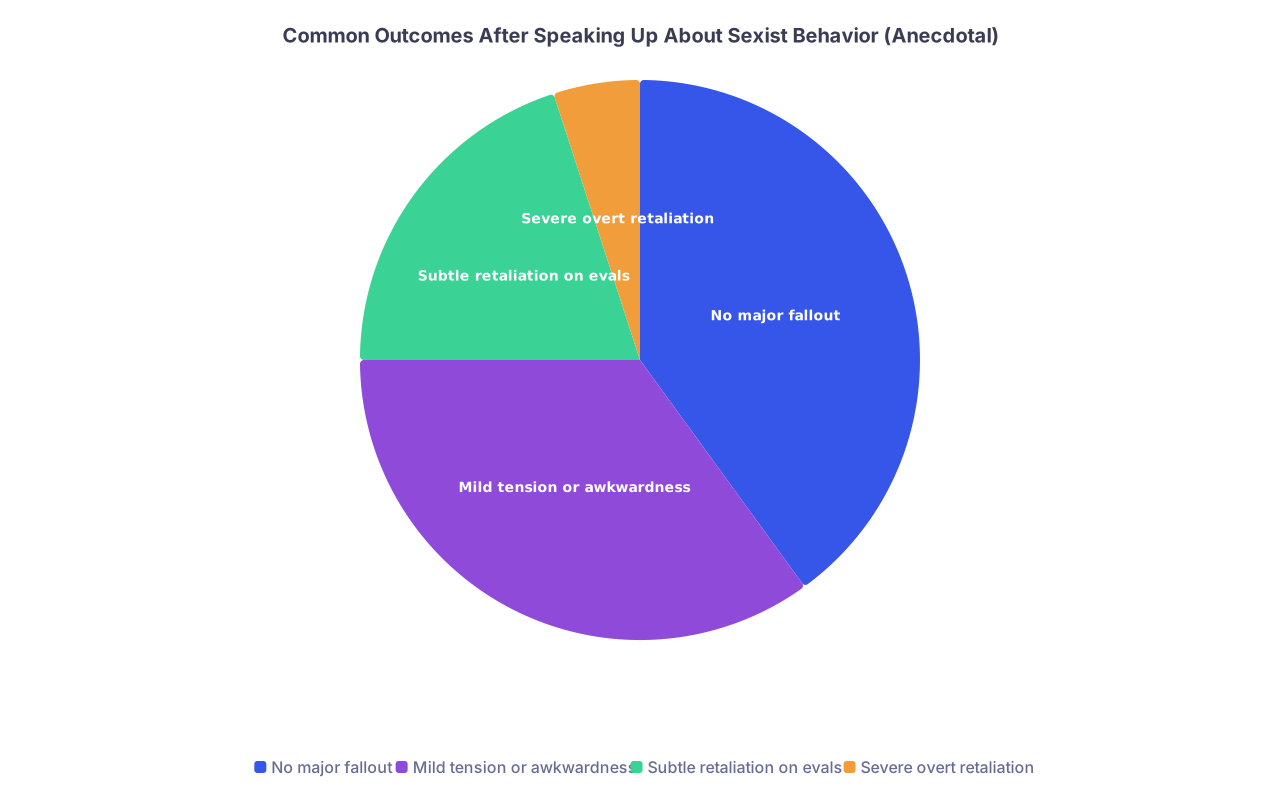
| Category | Value |
|---|---|
| No major fallout | 40 |
| Mild tension or awkwardness | 35 |
| Subtle retaliation on evals | 20 |
| Severe overt retaliation | 5 |
That’s not from a formal study; it’s basically what I’ve seen and heard across multiple schools and hospitals. But it tracks with reality:
Most often, it’s awkward. Maybe tense. Maybe you get a slightly cooler vibe. Sometimes a soft hit on an eval.
What you almost never see: a coordinated long‑term vendetta by multiple attendings across institutions. People are too busy, and your file isn’t that central to their world. Brutal, but also kind of freeing.
What can realistically happen?
- One rotation eval may be harsher than it would’ve been
- That attending might not go out of their way to advocate for you
- If they’re petty and powerful, they might bad-mouth you locally
That sucks. It’s unfair. It can absolutely affect your stress, confidence, and maybe a grade.
But it’s very different from: “I spoke up once, so I’ll never match.”
Residency programs look at a pattern. A whole application. Multiple rotations. Scores, narratives, letters, dean’s letter, interviews. One shaky eval in a sea of normal or strong ones doesn’t doom you. I’ve seen people match with a failed rotation. I’ve seen people match with documented professionalism “incidents” that were messy and complicated.
One sexist attending with fragile ego is not more powerful than your entire record.
How to reduce the risk after you’ve already spoken up
You can’t un‑say what you said. You already called it out, even if it was a small, “Hey, that didn’t sit right with me” in the hallway.
So now your brain is spinning: What do I do now to protect myself?
This is where you shift gears from pure panic to quiet, boring damage control.
First, document. I know that sounds formal, but you don’t need a legal brief. Just write:
- Date, time, location
- Who was present
- What was said (as close to verbatim as you can remember)
- How you responded
- Any change in behavior afterwards (less teaching, weird comments, bad eval excerpts)
You’re not documenting because you know you’ll file a complaint. You’re documenting so that if things start to feel off, you’re not gaslighting yourself.
Second, get a quiet, non‑dramatic read from someone safe. This is not your super‑gossipy classmate or the resident who worships this attending. Think: trusted resident who’s known as reasonable, a faculty advisor, the clerkship director you actually trust, the equity office if your school has one that’s actually functional.
You don’t need to go in breathing fire. You can literally say:
“I’m not looking to start formal trouble right now. But this thing happened, it felt sexist, I responded, and now I’m anxious that it might hurt my eval or future opportunities. Can I get your honest take?”
You’re not just asking for validation. You’re building a paper and human trail that you were concerned before any evaluations came out. If your eval later says “unprofessional” or “disruptive,” and you’ve already told someone, that discrepancy matters.
Third, over‑perform the basics. Not because you “owe” this attending perfect behavior, but because it makes petty retaliation easier to spot. Be on time. Be prepared. Show engagement. Make it painfully obvious that there’s no legitimate reason to tank you.
Then, if they still write something vindictive, it stands out more clearly as what it is.
What if the attending does retaliate?
Okay, let’s go there, because your brain already has.
Say the eval comes back and it’s ugly. “Difficult to work with,” “overly focused on social issues,” “disruptive to team cohesion.” The kind of coded language that makes you feel sick.
Now what?
First step: you don’t explode. You don’t email back in all caps. You don’t fire off a midnight novel to the clerkship director.
You take a breath. Sleep on it if you can. Then you respond with strategic calm.
You ask for a meeting. Email something like:
“Thank you for sharing my evaluation. I do have some concerns and would really appreciate the chance to discuss them in person to better understand the feedback and also to share my perspective.”
That’s it. You’re not accusing yet. You’re creating a record that you’re engaging in good faith.
In the meeting, you say something like:
“I was surprised to see phrases like ‘difficult to work with’ because I wasn’t given that feedback at any point during the rotation. The only time I can recall that might relate is when I raised a concern about a comment on rounds that felt gendered. I want to make sure that I’m not being penalized on my evaluation for speaking up about something I perceived as sexist.”
You’re not yelling “RETALIATION!” You’re putting the pieces on the table and making it really uncomfortable for them to pretend the two aren’t connected.
If the clerkship director is decent, they’ll at least pause. Maybe they’ll adjust the eval. Maybe they’ll add context in your MSPE. Maybe they’ll talk privately to the attending.
If they’re useless, you might get brushed off. That’s when you consider going to student affairs, Title IX, or the ombuds office with your documented dates, notes, and any prior conversations.
You are allowed to say, very plainly: “I’m worried I’m being retaliated against for raising a concern about sexism.”
And yes, that phrase matters. It’s a loaded word in institutional settings.
Balancing ethics and survival in training
Here’s the part that hurts: the system kind of forces you to choose, over and over, between sticking your neck out and protecting your evals.
You will see other women stay silent. Or laugh it off. Or change the subject. And you will see them rewarded for being “easy to work with.”
You will also see women—and some men—draw a line and say “no.” Sometimes they pay for it. Sometimes they’re fine. Sometimes they gain quiet respect from people who never say anything publicly but remember.
You don’t have to be a martyr on every single rotation. Calling out every off‑hand sexist comment from every crusty 65‑year‑old surgeon is not a realistic burden for one student.
But you’re also allowed to care about the kind of doctor you’re becoming.
There’s a middle path: being strategic without being complicit in your own erasure.
That might look like:
- Choosing your moments. Maybe you don’t confront mid‑code. Maybe you circle back later, one‑on‑one, when everyone’s calm.
- Calibrating your language: “I know you probably didn’t mean it this way, but when you said X about women residents, it landed pretty harshly.”
- Tag‑teaming when possible: backing up other women when they speak, or checking in after and saying, “If you want to say something formally, I’ll support you.”
You’re not weak if you sometimes let something go because you’re exhausted and terrified of another bad eval. That’s survival.
You’re not “too much” if you decide: I can’t keep swallowing this and still respect myself.
Both realities can exist.
Will this actually ruin my future?
Let’s zoom way out, because anxiety never does.
Think of someone you know—or know of—who’s a vocal feminist, a loud advocate, or the “troublemaker” who called out mistreatment in med school. Are they all unemployed and blacklisted?
No. Some of them are chiefs. Some are in competitive fellowships. Some are beloved by residents and a quiet headache for their institution because they keep pushing for change.
Residency programs care about three big things:
Can you do the work? Will you show up? Are you going to be a disaster?
Being the person who once spoke up about a sexist comment doesn’t answer “yes” to that last question. Being the person with six professionalism reports for screaming at nurses does.
You are allowed to be principled and employable.
If a specific attending hates you because you made them uncomfortable about their own bias, that says more about them than about your value as a future physician.
You might need to be intentional about who writes your letters. You might avoid asking this attending. You might have a quiet conversation with your dean to make sure your MSPE contextualizes any glaringly off‑tone evals. That’s strategy, not defeat.
I’ll be blunt: if a program outright doesn’t want you because you once stood up to sexist behavior, that program is not going to be kind to you as a resident either. It’s easy to say “I don’t want to train there anyway” when you have options, and a lot harder when you just need a spot. I get that. The fear isn’t irrational.
But there are many programs, many specialties, and many attendings who are tired of the old boys’ club and quietly rooting for people like you.

How to protect your peace right now
The hardest part isn’t the meeting with the director or the eval itself. It’s the weeks in between, where you’re replaying the moment on a loop and imagining your unmatched future.
A few things that actually help in that middle space:
Talk to at least one person outside your institution. Someone who won’t filter everything through “don’t rock the boat.” A friend at another school, a resident you know from before med school, even an online community of women in medicine (yes, some of those groups are toxic, but some are incredibly validating and practical).
Ground yourself in facts about your record. Literally list your strengths: Step scores, grades, research, volunteer work, strong letters lined up. Your brain keeps saying “one attending hates me → doomed.” Put that one attending in context.
And then decide: what line do you want?
Maybe it’s: “I will not confront every microaggression, but I will not ignore direct sexist comments about women patients or trainees.” Maybe it’s: “I won’t go formal this time, but if this pattern continues, I will file a report.” Maybe it’s: “I want this specialty badly enough that I’ll be more cautious on this rotation, and more vocal later when I have more power.”
You’re allowed to be strategic. You’re allowed to evolve that strategy over time. You’re allowed to regret not speaking up sooner—and still be proud of yourself for the time you finally did.

| Step | Description |
|---|---|
| Step 1 | Sexist comment occurs |
| Step 2 | You speak up |
| Step 3 | Awkward but no major fallout |
| Step 4 | Mild tension or distance |
| Step 5 | Possible negative eval |
| Step 6 | Meet with clerkship director |
| Step 7 | Eval adjusted or contextualized |
| Step 8 | No change - consider higher level |
| Step 9 | Student affairs or Title IX |
| Your Fear | More Likely Reality |
|---|---|
| I’ll never match anywhere | One rotation might be messy; rest of application still matters far more |
| Every attending will hear I’m “difficult” | A few local people may gossip; most programs won’t know or won’t care |
| This eval will define my dean’s letter | MSPE summarizes multiple rotations; one outlier is often explained or diluted |
| I should’ve stayed silent forever | You’re learning how to speak up strategically, not doomed by one moment |

So… did you just ruin everything?
No.
You might have made your own life a little harder for this one stretch of time. That’s the honest truth. You might get an awkward hallway interaction or a passive‑aggressive eval sentence that makes you want to scream.
But you did not detonate your future.
You did something medicine badly needs more of: you held a line. Imperfectly, anxiously, maybe shakily—but you held it.
Three things to remember:
- One petty attending does not control your entire career. Your full body of work will always matter more than a single rotation.
- You can protect yourself and your ethics at the same time—by documenting, seeking allies, and choosing your battles with intention, not fear.
- Speaking up now is part of becoming the kind of physician you actually want to be—the one your future students and residents will quietly thank you for being.
You’re scared because you care about your future. That’s normal.
Just don’t let that fear convince you that you’re powerless. You’re not.