
It’s 1:13 a.m. You’re sitting in the call room, scrolling through your co-residents’ group chat. One of the guys just got pulled into an “impromptu” late-night case with the big-name attending. Another male co-resident is “looped in” on a new research project. You weren’t asked. Again.
Your brain immediately goes there:
Is it me? Am I not good enough? Or is it because I’m a woman?
And the next thought hits even harder:
What if this never changes? What if my male co-residents keep getting the best opportunities and I just quietly fall behind?
Let’s talk about that fear. Not in the “rah-rah girlboss” way, but in the honest, slightly panicked, I-might-cry-in-the-bathroom kind of way.
You’re Not Imagining It: The Unequal Opportunity Thing Is Real
Let me just rip the band-aid off: no, you’re not crazy. And you’re not “too sensitive.”
There’s a pattern, and it’s been measured.
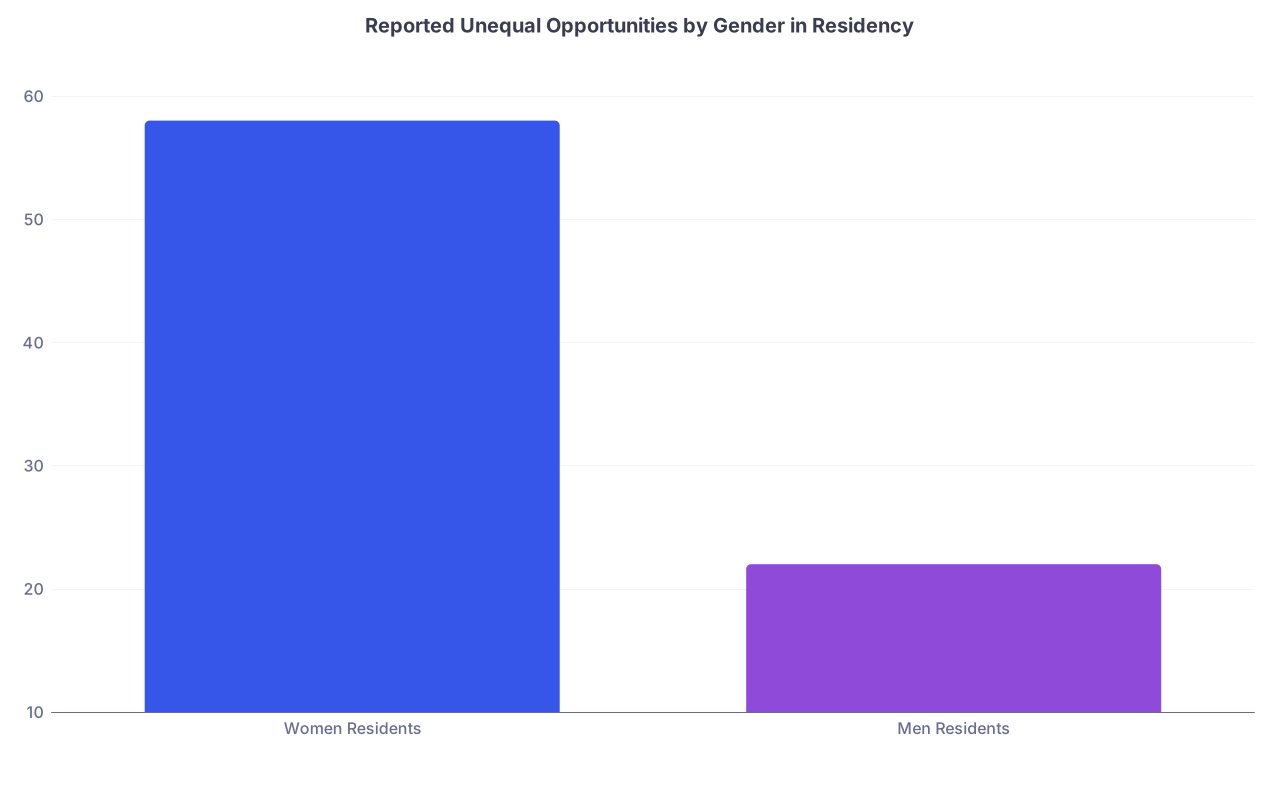
| Category | Value |
|---|---|
| Women Residents | 58 |
| Men Residents | 22 |
That’s the kind of discrepancy studies keep finding: women residents disproportionately report fewer high-yield opportunities, less autonomy, less operative time, less “informal” mentorship.
It doesn’t always look like cartoon-villain sexism. It often looks like:
- “Oh, I just grabbed whoever was nearby” – and somehow “whoever” is always a guy.
- “We thought you might be too busy / tired / have plans” – assumptions made for you, not with you.
- “He seems really interested in procedures” – as if you aren’t, despite you literally saying you are.
And then there’s the subtle stuff you feel more than you can prove:
The attending who remembers the guy’s name and not yours.
The research mentor who “naturally” gravitates toward the male resident for late-night data sessions.
The chief who “accidentally” texts the opportunity to only two people… both guys.
You start gaslighting yourself: Maybe it’s just bad luck. Maybe I’m just not aggressive enough. Maybe if I smile more? Or less?
Let me be blunt: the system is not neutral. You’re operating in a structure that regularly gives men advantages, especially when it comes to informal, high-impact opportunities. You didn’t cause this. You’re just stuck inside it.
So the fear that “my male co-residents might get better opportunities than I do” isn’t some wild, catastrophizing thought. It’s… rational. It happens.
The question is: what do you do with that?
Worst-Case Scenario Thinking: What You’re Really Afraid Of
Underneath the surface-level worry, there are usually a few deeper, uglier thoughts you’re not saying out loud. Let’s say them.
- “What if I end up a worse doctor because they got more hands-on time?”
- “What if fellowship directors think they’re stronger candidates than me, even if I work harder?”
- “What if I speak up and get labeled ‘difficult’ and that tanks my reputation?”
- “What if I never catch up?”
I’ve seen versions of all four happen. That’s the part that makes your chest tight. The possibility that this isn’t just about hurt feelings — it’s about long-term, career-defining consequences.
Here’s the uncomfortable truth: yes, unequal opportunities can snowball.
The resident who scrubs more complex cases gets better technically.
The one on every research paper gets the stronger CV.
The one the attendings “just click with” gets the best letters.
You’re not wrong to be scared of that. But you’re also not powerless. Not unless you decide you are.
Reality Check: Where You Actually Have Leverage (Even If It Doesn’t Feel Like It)
You can’t fix institutional sexism as a PGY-1 or PGY-2. That’s not your job, and it’s not realistic.
But you do have more control than it feels like at 1 a.m. on call.
Let’s break it down into three buckets where you do have leverage:
- Visibility
- Documentation
- Allies
1. Visibility: Saying Out Loud What Everyone Pretends Is Random
You hate “being that person.” I know. But staying quiet doesn’t magically make things fair.
You do not need to give a TED talk on gender equity. You can start very small and very specific.
For example, with a trusted attending:
“I’ve noticed I haven’t been pulled into as many complex cases as some of my co-residents. I really want to build my skills there. Can we make a plan so I get more of those opportunities?”
That’s not whining. That’s asking for training. That’s literally what you’re there for.
Or with your PD or APD:
“I’m concerned about equity in case distribution and project access. I want to make sure I’m as competitive for fellowship as my peers. Can I get feedback on whether I’m missing anything, and if we can track this more explicitly?”
You’re planting a flag:
I’m watching. I care. I’m not going to quietly disappear.
Is it fair that you have to say this when some guy just stands there and gets handed opportunities? No. But fair or not, this is a practical move.
2. Documentation: Stop Letting It All Live in Your Head
Here’s what usually happens: you feel like you’re getting fewer opportunities, but you don’t have anything concrete. So when someone asks, “Can you give examples?” your brain goes blank, and you walk away feeling stupid.
Fix that.
Start a simple, boring log. Nothing fancy. Just you, a spreadsheet or note, and facts.
| Date | Opportunity Type | Who Got It | Notes |
|---|---|---|---|
| 7/3 | Complex case | Male co-res | I was available, not invited |
| 7/10 | Research project | Male co-res | Discussed in workroom, I not included |
| 7/18 | Presentation | Male co-res | Offered directly to him |
This is for you first:
- To reality-check your impressions
- To see patterns over time
- To have something in hand if you do escalate
And yes, I’m going to say the scary part: if this becomes a real pattern, this log becomes evidence. For conversations with the PD. For GME. For the ombuds office. It moves things out of the “vibes” zone into the “pattern” zone.
Even if you never use it formally, documenting helps you stop spiraling in your head. You look at the log and think, “Okay, this isn’t all in my imagination” or “Actually, the last few weeks have been more balanced.”
Either way, you’re dealing with reality, not just fear.
3. Allies: You Cannot White-Knuckle This Alone
Trying to handle this completely solo is how people burn out and quit medicine or become permanently bitter.
You need at least one of each:
- A peer ally
- A faculty ally
- A non-evaluative ally (like GME / ombuds / institutional women-in-medicine group)
Peer ally: This might be another woman resident, or even one of the guys who actually “gets it.” Someone you can say, “Hey, did you notice X?” and get either validation or pushback from someone who sees the same world.
Faculty ally: Ideally a woman in your specialty (I know, not always available), or a man who has a track record of actually backing women, not just tweeting about it. Tell them what you’re seeing. Ask directly:
“If you ever hear about research, committees, or complex cases that need residents, can you think of me? I’m worried about falling behind my peers.”
Non-evaluative ally: Someone who doesn’t grade you. Often this is:
- GME office
- Ombuds office
- Women in Medicine committee
- Resident union rep, if you have one
You’re not filing a lawsuit. You’re doing a temperature check:
“I’m seeing a pattern with how opportunities are distributed among residents, especially between men and women. I’d like guidance. Is this something the institution tracks? What are my options?”
You don’t need to walk in with a polished case. You just need to not be alone in your head.

| Step | Description |
|---|---|
| Step 1 | Notice Pattern |
| Step 2 | Start Personal Log |
| Step 3 | Talk to Peer Ally |
| Step 4 | Talk to Faculty Ally |
| Step 5 | Meet PD or APD |
| Step 6 | Consult GME or Ombuds |
| Step 7 | Monitor and Reassess |
| Step 8 | Still Concerned? |
| Step 9 | Ongoing Issue? |
| Step 10 | No Change? |
The Terrifying Part: Speaking Up vs Staying Silent
The thing that keeps most women stuck is this awful double bind:
- If you stay quiet, you might get fewer opportunities.
- If you speak up, you might be labeled “difficult,” “overreacting,” “not a team player.”
You’re trying to choose which type of risk you can live with.
Here’s my blunt take: the quiet path feels safer short-term and is usually more damaging long-term.
I’ve seen this play out:
- Woman resident notices pattern, says nothing.
- Men rack up cases/pubs/face time.
- Fellowship season hits. Suddenly, there’s a gap that everyone treats as her “performance issue,” not the system’s issue.
And what does she tell herself? “I should’ve done more. I should’ve advocated earlier.” The self-blame is brutal.
Speaking up does have risk. Some PDs and attendings don’t handle it well. Some will quietly resent it. That’s real.
So your job isn’t to “be fearless.” Your job is to be strategic:
- Pick your timing (not mid-code, not post-night-float meltdown).
- Pick your person (start with the most reasonable, equity-aware person, not the worst dinosaur).
- Focus on training, not accusation.
Not: “You’re sexist.”
But: “I want to be as well-trained and competitive as my peers. Here’s what I’m worried about. How can we fix this?”
You shouldn’t have to do this. But also, your career is too important to silently hope someone notices you getting sidelined.
What If It Just… Doesn’t Get Better?
Here’s the really dark thought you probably haven’t said out loud:
“What if I do all the ‘right things’ — track, talk, advocate — and nothing changes? What then? Did I ruin my reputation for nothing?”
Sometimes, the culture is so calcified that your personal efforts barely scratch it. I wish I could tell you that every program responds brilliantly. They don’t.
So what then?
You start thinking more long-term and honestly a little ruthless.
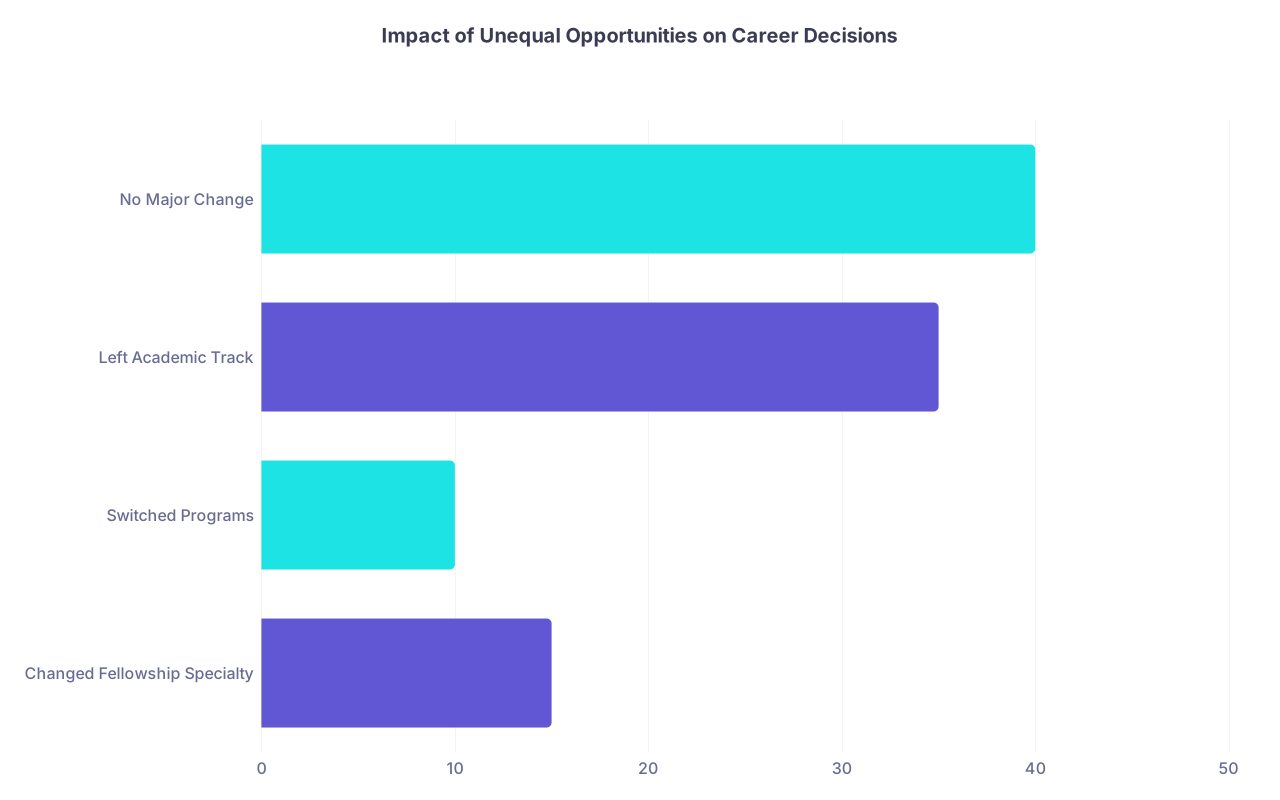
| Category | Value |
|---|---|
| Changed Fellowship Specialty | 15 |
| Switched Programs | 10 |
| Left Academic Track | 35 |
| No Major Change | 40 |
Do I think you should immediately transfer or give up academics because of this? No. But I do think you should:
- Stop romanticizing loyalty to a program that won’t invest in you.
- Start thinking like someone who will one day choose jobs, not just hope for them.
- Use this as data about which environments you’ll avoid later.
You cannot always fix your current program. But you can:
- Find external mentors (national women-in-medicine groups, specialty societies).
- Build a network outside your institution.
- Aim for fellowships / jobs in places known for actually backing women, not just putting them on brochures.
The goal isn’t to “win” against a bad system in residency. The goal is to survive it with enough skills, sanity, and reputation to choose better later.
What You Need to Hear (But No One Says Plainly)
You’re not behind because you’re less capable.
You’re behind — if you are — because you’re training in a system built without you in mind and often actively biased against you.
That doesn’t mean you’re doomed. But it does mean you’re playing a harder level.
You are allowed to:
- Be angry about that.
- Be strategic anyway.
- Advocate for yourself without apologizing for existing.
You are not required to:
- Be the saint who fixes sexism for your whole program.
- Sacrifice your mental health to “prove” you’re strong enough.
- Stay silent because you’re afraid of making waves.
You’re already doing something hard: just being a woman in medicine, watching male co-residents get things you know you could do just as well — or better.
You’re not weak for worrying about this. You’re paying attention.
FAQ (Exactly 5 Questions)
1. How do I know if it’s really bias and not just that I’m less assertive or less skilled?
Track it. If, over weeks to months, you see a consistent pattern where men with similar or less experience get more complex cases, projects, or mentorship, that’s not just “assertiveness.” Also, look at how opportunities are distributed — is it always through informal channels, “hey bro, wanna scrub in?” That’s usually not about merit.
2. I’m scared my PD will think I’m accusing them of sexism if I bring this up. How do I phrase it?
Anchor it to training and outcomes. For example:
“I want to be sure I’m getting enough operative time/research/leadership experiences to be competitive for fellowship. I’ve noticed I’m not in as many X situations as some of my co-residents, and I’m concerned I might fall behind. Can we talk about how to make this more balanced?”
You’re not litigating morality; you’re asking for equitable training.
3. What if the male co-residents are actually my friends? I don’t want to resent them.
You don’t have to turn this into a war. You can even enlist them. Something like:
“I really want more of those bigger cases too. If you hear about something or see an attending looking for someone, can you throw my name in too?”
Some of them will genuinely help. The ones who get defensive about sharing access? That tells you a lot.
4. Should I ever bring this to GME or ombuds, or is that too extreme?
It’s not extreme if you’ve:
a) Noticed a clear pattern over time,
b) Tried internal conversations (PD, chief, mentor) and nothing changed, and
c) You’re seeing real impact on your training or evaluations.
Those offices exist precisely for this. You’re not being dramatic for using resources that literally exist for resident mistreatment and inequity.
5. I’m just starting residency. Is there anything I can do early to prevent this?
Yes. Early on, be explicit with multiple attendings about your goals:
“I’m really interested in X and want to get as much experience as possible.”
Ask to be included on projects. Volunteer for teaching, QI, committee work that gets you visible. And start that boring little opportunity log now. It’s easier to prevent patterns from solidifying than to undo them later.
Today, do one small, concrete thing: open a note on your phone or laptop and start that opportunity log. Date, what the opportunity was, who got it, whether you were available.
Not to obsess. To have receipts.
Then, pick one attending or mentor’s name and write it under that: “Person I will talk to about this within 2 weeks.”