I Want to Do Surgery but Fear the Culture: Am I Being Naive?
What if you fight your way into surgery, survive all the exams, get the residency… and then realize the culture is exactly as toxic, sexist, and soul-crushing as everyone warned you?
That’s the loop that plays in my head.
You want to cut. You like the decisiveness, the anatomy, the immediate impact. But you’ve heard the stories: the screaming attendings, the “jokes,” the 4 a.m. rounds, the “are you sure you want kids?” comments, the unspoken expectation that you’ll be married to the hospital. And if you’re a woman, you’ve definitely heard at least one version of: “Surgery eats its young. Especially women.”
So you’re stuck between two nightmares:
- You go for surgery and it breaks you.
- You don’t go for surgery and you spend the rest of your life wondering if you walked away from your actual calling because you were scared.
Let’s pick this apart honestly, because the fake “you can do anything!!!” pep talks don’t help at 2 a.m. when you’re spiraling.
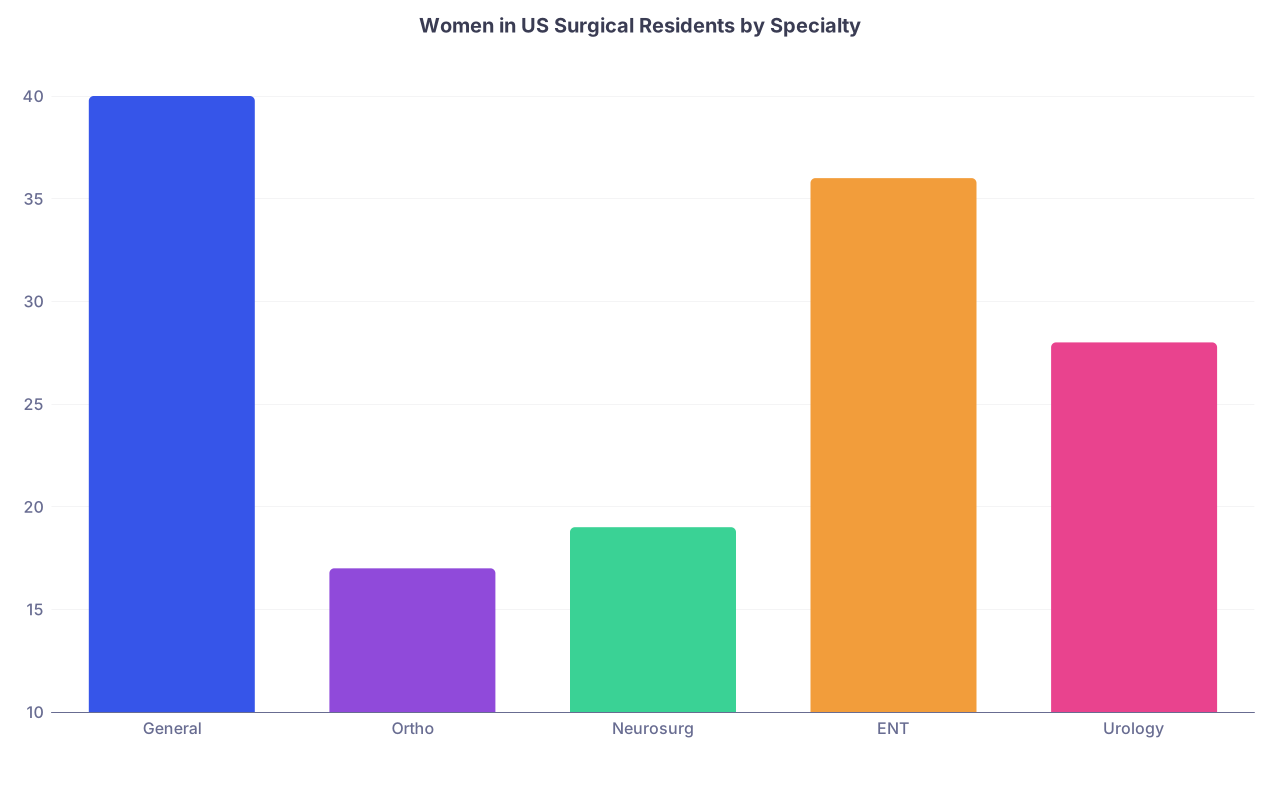
| Category | Value |
|---|---|
| General | 40 |
| Ortho | 17 |
| Neurosurg | 19 |
| ENT | 36 |
| Urology | 28 |
Is Surgical Culture Really That Bad, Or Are We All Exaggerating?
Short answer: it can be really that bad. And also not always. Both are true, which is what makes the decision so mentally awful.
I’ve watched female students on surgical rotations get:
- Called “nurse” three times in the same day while the male MS3 beside them is called “doctor”
- Told, “This specialty is brutal if you want a family” by an attending who has never once said that to a male resident
- Ignored at the OR table until the staff realized she could actually tie knots faster than the guy next to her
But I’ve also seen:
- Female chiefs who run a room with terrifying competence and zero screaming
- Male mentors who are more protective and fair than some of the female attendings
- Residents who text the med students: “Hey, today’s going to be rough. Bring snacks and we’ll debrief after.”
So no, you’re not being naive to worry. There’s a real pattern of:
- Hierarchy so steep it feels abusive
- Sexism, both overt and subtle
- Workload that doesn’t care if you’re a human being
But you’re also not naive if a part of you thinks: “Maybe I’d actually like this intensity. Maybe parts of this culture would fit me.” You’re allowed to want that without being a sellout.
The issue isn’t “is surgery bad” vs “is surgery fine.” The issue is: can you live with the worst parts for years, and are there ways to pick programs and people that won’t destroy you?

The Specifically Female Fears You Probably Haven’t Said Out Loud
Let’s skip the generic “surgery is hard” stuff. Here’s what keeps churning in the back of my mind—and probably yours too:
“Will they actually teach me, or just freeze me out?”
The horror scenario: you pick surgery, you show up as an intern, and you get:
- Less operative time than your male peers
- Fewer invitations to scrub
- Vibes that say “you’re not one of the boys, you’re extra work”
I’ve watched a female MS4 stand next to a male med student at the table. The attending looks up, pauses, and says to the guy: “You can come stand closer to the field.” She was already closer. She had better evals. Didn’t matter.
That stuff isn’t always dramatic. It’s death by a thousand small exclusions.
“Am I going to be punished for wanting a life or a family?”
This one is brutal because it sits exactly at the intersection of “real” and “weaponized.” You’ll hear:
- “People still judge women with pregnancy during training.”
- “Some PDs won’t say it, but they hate maternity leave timing.”
- “You can do it, but you’ll be exhausted like you can’t imagine.”
All of that has some truth. The part that messes with your head is this: would they be saying any of it if you were a guy who happened to want kids someday? Usually not.
“What if I become the person I hate just to survive?”
This one doesn’t get talked about enough. You’re not just worried about outer abuse. You’re worried about the inner shift.
You’ve probably met:
- The female chief who brags about never crying, ever
- The woman attending who’s harder on the women than the men, because “no one cut me slack, so I don’t cut anyone slack”
- The resident who jokes about “weak” med students but used to be gentle before training burned it out of her
The fear: that you’ll be so desperate to prove you’re not “soft” that you’ll swallow your own boundaries, ignore your mental health, and start perpetuating the very culture you hate.
You’re not overthinking this. That’s a legitimate ethical fear.
| Area | Red Flag Signals | Safer Signals |
|---|---|---|
| How they talk | “We work harder than everyone else, period” | “We work hard, but we protect our people” |
| Women in rank | No women faculty in leadership | Visible women attendings & chiefs |
| Residents | Look exhausted and guarded | Tired but open, willing to talk honestly |
| Leave/family | Vague answers about parental leave | Clear policies, recent residents with kids |
| Feedback vibe | “We break you down to build you up” | “We push hard, but we don’t humiliate” |
Are You Being Naive To Think You Could Be Happy In Surgery?
Let me flip this. There are actually two types of naivety here, and only one of them is dangerous.
Naive Version #1: “I’ll just be tough and power through anything.”
This one is dangerous. This sounds like:
- “I can handle being yelled at, no big deal.”
- “I don’t care if I sleep or eat or have a life.”
- “If I’m good enough, they’ll respect me and it’ll all be fine.”
Reality: you cannot “grit” your way out of a structurally abusive culture. I’ve seen residents who were strong, smart, resilient people get:
- Depressed
- Divorced
- Physically sick
- Completely detached from why they ever liked medicine
Thinking you’re too exceptional to be worn down? That’s naive.
Naive Version #2: “If the culture is toxic in some places, it must be toxic everywhere, so I should run.”
This is the flip side, and it also screws you. Because if you paint the entire field with one brush, you’ll walk away from something you might have actually loved.
Different programs have wildly different cultures. Same hours. Same cases. Totally different level of basic human decency.
I’ve heard this exact thing from a female PGY-3:
“At my top-choice ‘prestige’ program, I left interview day and cried in my car. At the place I ranked second, the residents were honest but not bitter. I picked the second one. Best decision I’ve ever made.”
You’re not naive for saying: “I want to operate, but not at the cost of my soul. I want to be a surgeon in a place that treats me like a person.”
That’s not naive. That’s the bare minimum.

| Step | Description |
|---|---|
| Step 1 | Interested in Surgery |
| Step 2 | Do 1st Surgical Rotation |
| Step 3 | Explore Other Fields |
| Step 4 | Do Another Surg SubI |
| Step 5 | Ask Residents Hard Questions |
| Step 6 | Identify Red and Green Flags |
| Step 7 | Choose Programs to Apply |
| Step 8 | Signal and Rotate at Better Fits |
| Step 9 | Rank Based on Culture and Support |
| Step 10 | Like the work? |
How To Vet Surgical Culture Without Gaslighting Yourself
You can’t fully predict what residency will be like. But you can stop going in completely blind.
Here’s how I’d actually pressure-test a program as a woman worried about culture.
1. Watch how they talk about the hardest stuff
On interviews, pre-interview dinners, away rotations—listen for how people talk about:
- Mistakes: Is it “we destroy people who mess up” or “we’re serious about safety, but we support each other”?
- Fatigue: Do they brag about staying until midnight “for the grind” or acknowledge limits like actual adults?
- Residents who left: Do they sneer (“couldn’t hack it”) or say “it wasn’t the right fit and we helped them transition”?
Programs that mock vulnerability will treat you like a problem when you’re human.
2. Look at women not just being there, but thriving
It’s not enough to count women.
Ask yourself:
- Are there women in leadership (PD, APDs, chiefs)?
- Do they seem… alive? Or hollowed out and angry?
- Can residents casually mention wanting kids or having kids without suddenly dropping eye contact and switching topics?
If the only women you see are PGY-1s and 2s and they vanish higher up, that’s a data point.
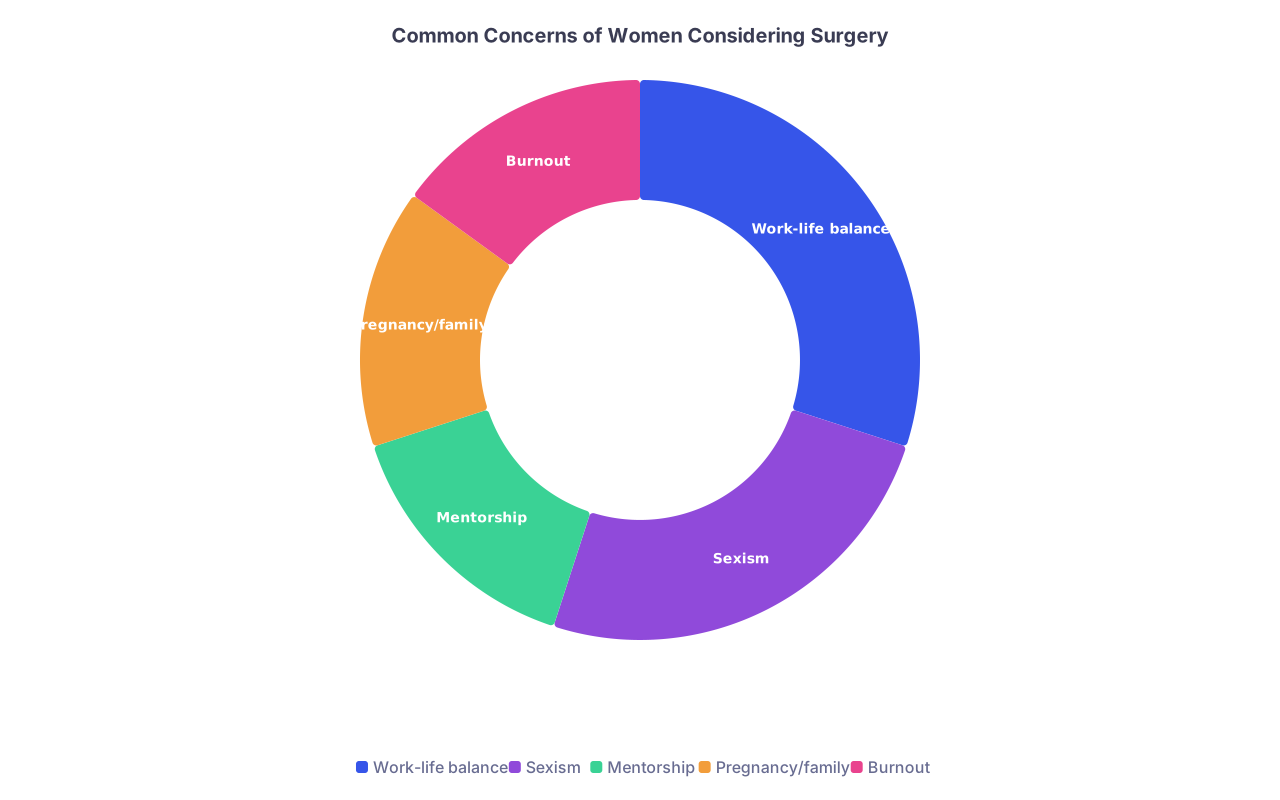
| Category | Value |
|---|---|
| Work-life balance | 30 |
| Sexism | 25 |
| Mentorship | 15 |
| Pregnancy/family | 15 |
| Burnout | 15 |
3. Corner residents away from faculty
You want the off-script version. When the attending disappears, ask:
- “What’s the last time someone was humiliated in the OR?”
- “If you had a daughter who loved surgery, would you want her to train here?”
- “How does your PD react when someone is struggling?”
The exact words matter less than the vibe. If they visibly hesitate before answering, that’s a sign. If they keep saying “it’s fine, it’s fine” but their face doesn’t match, believe the face.
4. Watch how med students are treated
Med students are at the bottom of the pile. However they treat you as a student is often how they treat their weakest resident on their worst day.
Pay attention to:
- Do they teach you anything, or just use you as a retractor?
- Are there jokes at your expense that are “just joking” but feel gross?
- Do they respect your time at all—letting you go study when cases are done, or do they gleefully keep you there until midnight for no reason?
You’re getting a preview.

What If You Pick Surgery And Regret It?
This is the nightmare version: you push aside your fears, you match, and then… it’s bad. Really bad. The culture is exactly what you were afraid of.
You’re not trapped.
People switch. People leave. People change specialties even from surgery. It’s hard and messy and painful, but it happens. I’ve seen:
- A prelim gen surg resident switch to anesthesiology and be 10x happier
- An ortho resident move to PM&R and finally sleep like a human
- A surgical trainee step away, do a non-clinical year, and reassess
Yes, there’s sunk cost. Pride. Fear of judgment. But the ethical disaster isn’t “I tried surgery and then changed my mind.” It’s “I knew this was wrong for me and I stayed anyway because I didn’t want to disappoint people.”
You are allowed to course-correct.
Here’s the part you don’t hear enough: regret goes both ways.
You can regret staying away from surgery out of fear. You can regret going into surgery and sacrificing things you didn’t actually want to lose. There is no zero-risk path. There is only: which risk are you more willing to live with?
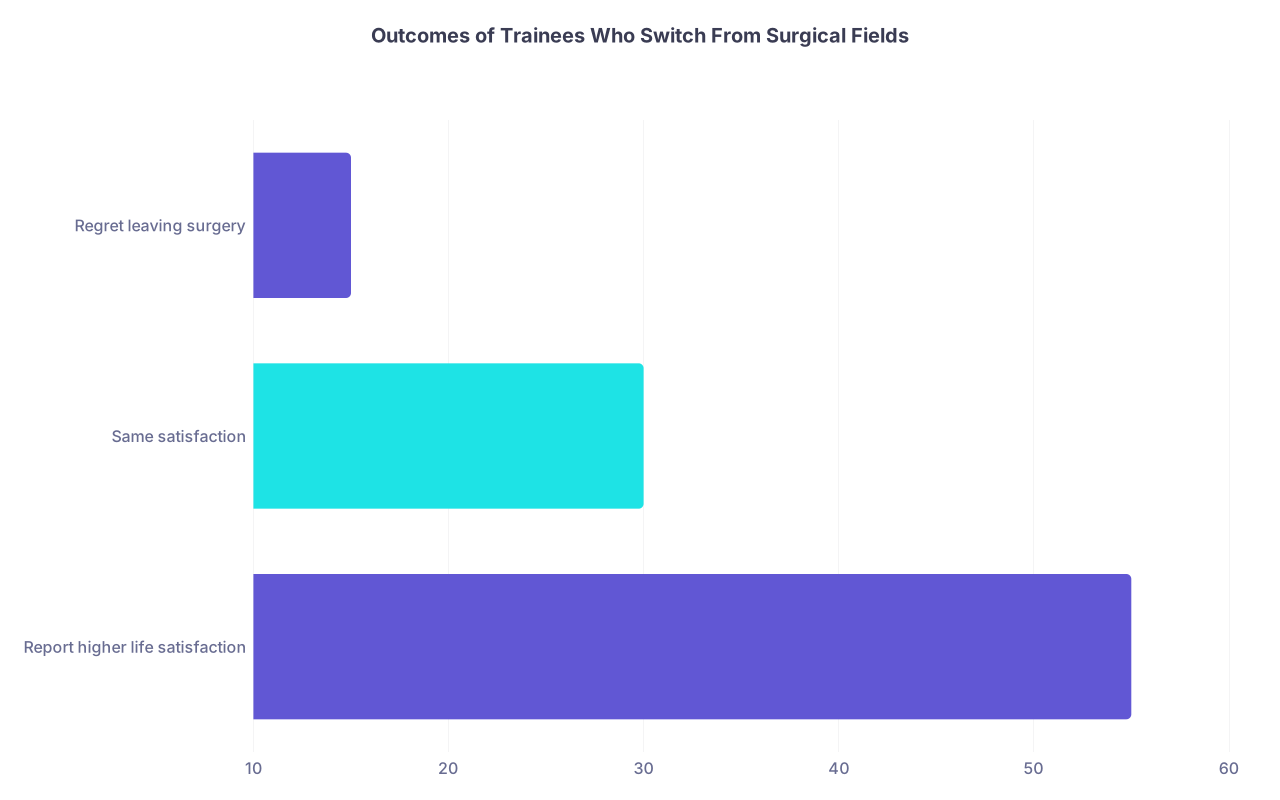
| Category | Value |
|---|---|
| Report higher life satisfaction | 55 |
| Same satisfaction | 30 |
| Regret leaving surgery | 15 |
How To Decide Without Lying To Yourself
If you’re still reading, it probably means surgery genuinely pulls at you. Not just the prestige. The work.
So here’s a blunt checklist I’d go through with myself:
- When I’m actually in the OR, scrubbed, focused—am I more alive or more dreadful?
- Do I like the process of learning technical skills, or just the idea of being a surgeon someday?
- When I picture myself as an attending in 15 years, is it in a clinic… or in an OR?
- Am I okay with:
- years of sleep deprivation,
- missing some holidays,
- being behind my non-med friends in “normal life” milestones
if the tradeoff is that I get to do work I actually love?
And then the big one:
- If the culture were magically fixed—no sexism, reasonable hours for a surgical field—would surgery be the obvious choice?
If the answer to #5 is “yes,” then your problem isn’t that you’re naive. Your problem is that you’re realistic in a system that’s still catching up to what it should be.
You’re not wrong to be scared. You’d be weird if you weren’t.
The goal isn’t to eliminate fear. It’s to decide whether surgery is important enough to you that it’s worth:
- Doing more homework on programs
- Advocating for yourself early
- Accepting that no specialty is perfectly “ethical” or “safe,” just differently flawed
You don’t have to be the martyr who “proves” women can make it work in the most toxic place. You just have to pick a path you can look in the mirror and live with.
FAQs
1. Am I “less committed” to surgery if culture is a huge factor in my decision?
No. You’re more thoughtful. The “I’ll go anywhere, I don’t care how they treat me” attitude isn’t commitment, it’s denial. Knowing you need a minimally sane environment doesn’t make you weak; it makes you realistic about being a human with limits.
2. Should I even bother doing away rotations if I’m already scared of the culture?
Yes—but use them as reconnaissance, not just auditions. Go in with a list of questions: How do attendings speak to residents? Who leaves the hospital last? Do residents support each other or snipe at each other? If you come home from an away rotation and feel dead inside, believe that.
3. Is it smarter to pick a “less intense” specialty just because I want a family someday?
“Smarter” depends on your actual values. Plenty of women have families in surgery. It’s harder logistically, but it’s not impossible. What is a problem is choosing, say, pediatrics purely because you’re scared, when your heart is in the OR. That’s when resentment builds. Family and surgery can coexist with the right program and support, but it won’t happen by accident—you’ll have to be intentional.
4. How do I handle sexist comments as a student or resident without being labeled “difficult”?
There’s no perfect answer. Sometimes you let small stuff go to protect your energy. Sometimes you respond with a calm, flat “I don’t find that funny.” Sometimes you document and go through official channels if it’s serious. What I wouldn’t do is gaslight yourself into thinking you imagined it. Quietly find allies—often senior residents or a trusted attending—who you can reality-check with.
5. What’s one concrete thing I can do now if I’m on the fence about surgery?
Right now, pick the next surgical rotation or shadowing opportunity and plan to treat it like a culture study. Make a one-page note on your phone with: “Things that energize me” and “Things that drain me” and fill it in honestly after each day. Don’t wait for some magical clarity—start gathering data from your actual experiences instead of just your fears.
Open your calendar for the next month and schedule one real OR day—shadowing, a rotation, anything you can get. After that day, sit somewhere quiet and write down, in brutal detail, how you felt in the work and how you felt in the culture. That’s your starting point.