
What if wanting kids during training is the one “unspoken sin” that silently kills your career before it even really starts?
Because that’s what it feels like sometimes, right?
You hear the comments:
- “Oh… you want kids? In residency?”
- “You’ll have time after fellowship.”
- “You know programs talk about that stuff.”
And now you’re sitting here wondering if just wanting a family while you’re a med student, resident, or fellow means you’re not serious enough, not ambitious enough, not “hardcore” enough for medicine.
Let me say the scary thought out loud:
You’re afraid that if you have kids in training, you’ll be punished for it for the rest of your career.
Let’s actually walk through this. Not in the Instagram “you can have it all!” way. In the real, messy, slightly terrifying, what-are-the-actual-consequences way.
The Fears You’re Probably Too Embarrassed to Say Out Loud
You’re not crazy. The fears are real. Let’s drag them into the light.
Here’s what I hear over and over from women in medicine:
- “Program directors will think I’m a liability if I mention wanting kids.”
- “I’ll be the one everyone secretly hates when I go on maternity leave.”
- “If I have a baby in residency, I’ll never catch up clinically.”
- “If I delay kids until after training, I might not be able to have them.”
- “Someone will always think I’m choosing ‘mom’ over ‘doctor’, and I’ll lose respect.”
None of this is theoretical. I’ve watched residents cry in call rooms because a co-resident said, “Must be nice to get a vacation for having a baby.”
I’ve heard an attending say quietly in the workroom, “We really can’t afford another pregnant resident next year.”
So yes, this is loaded. And yes, there is risk.
But is wanting kids in training the same as sabotaging your career?
No.
But you can sabotage yourself if you walk into this blind.
What Actually Happens When You Have Kids in Training
Let’s be blunt: the system was not built for pregnant residents or breastfeeding fellows or med students with daycare pickup. It was built for the mythical “always available, no life, no uterus-in-use” trainee.
Still, people do this every single year. And many of them do just fine. Some even thrive.
Here’s the messy reality.

1. Training takes longer. Emotionally and physically.
Not always in years, but in feel. Everyone else seems to sprint through; you’re doing an obstacle course with ankle weights.
- You’re tired in a way that coffee can’t fix.
- Pumping breaks. OB appointments. Sick kid calls.
All of that stacks up on top of notes, sign-outs, and QI projects.
Does that mean you’re worse? No.
But it does mean your bandwidth is different. You’ll say no to things you would’ve said yes to pre-kid. And that can sting when people around you are stacking CV lines like it’s a competition.
2. People will talk. Some will judge. Some will surprise you.
Worst-case-scenario brain says: “Everyone will hate me.”
Reality: it’s mixed.
- Some attendings become fierce advocates.
- Some co-residents step up, trade calls, bring you food postpartum.
- Some will be quietly resentful. A few will be openly awful.
I’ve seen both:
- Resident A: pregnant PGY-2 in IM, they shuffled some rotations, co-residents covered. She matched into GI. Nobody “blacklisted” her.
- Resident B: pregnant twice in a small surgical program, leadership was hostile, she got minimal support, barely any OR time during late pregnancy, letters were lukewarm. She still finished. She still practices. But it was traumatic.
This is why choosing the right environment matters more than pretending timing doesn’t.
Are You Hurting Your Career? The Honest Tradeoffs
Let me be surgical about this. Here’s where kids in training can realistically impact your career. Some of this is ugly, but pretending it doesn’t exist won’t help you.
| Area | Likely Impact |
|---|---|
| Residency schedule | Temporary disruption, schedule shifts |
| Exam timing | Possible delay or rescheduling |
| Research output | Often reduced for a period |
| Fellowship apps | Requires strategy, not impossible |
| Reputation locally | Depends heavily on program culture |
1. Exams and academic performance
Worst-case brain says: “I’ll fail boards because I had a baby.”
Reality:
- Your study time changes. It’s more protective, more fragmented.
- You might need to push Step 3, in-training exams, or subspecialty boards by a few months.
- You’ll need a plan before you’re in third-trimester brain fog trying to memorize esoteric guidelines.
I’ve watched residents take Step 3 during pregnancy, with a newborn, and later in PGY-3. The ones who did fine weren’t magical; they just had:
- A realistic schedule
- A partner/support system that actually understood “I need 3 hours alone, no baby, no interruptions”
- A program that didn’t flip out when they asked for protected time close to the exam
2. Research, leadership, and “extras”
This one hurts. Because this is where the CV comparison demon shows up.
Will you probably do fewer:
- Posters
- Unpaid committee things
- Late-night QI brainstorms
- “Sure, I’ll write that paper too” commitments
Yes. You probably will. At least for a bit.
But honestly? A lot of those “extras” are padding. Good to have, not mandatory to survive.
I’ve seen:
- One resident with 15 posters and 7 papers, no kids, no life.
- Another with 4 meaningful projects and a baby. Both matched into solid fellowships. The second one was better in the room. More grounded. Stronger advocate. Programs noticed.
You’re trading breadth of fluff for highly intentional work. That’s not sabotage. That’s triage.
3. Reputation and “being that resident”
This is the part everyone secretly obsesses over:
“What if I become the story they tell for the next 10 years: ‘Don’t be like her. She had a baby and ruined the call schedule.’”
Here’s the painful truth:
If your program is petty and toxic, you might become “that resident” to somebody no matter how hard you try.
But you do have some control over the narrative:
- Communicate early and clearly with chiefs and PD.
- Offer solutions, not just problems: suggest block swaps, plan ahead for call, be proactive.
- When you’re there, be fully there. Work hard. Be kind. Don’t disappear constantly.
You can’t stop every eye roll. But you can make it very hard for reasonable people to say you’re not pulling your weight when you’re actually present.
The Thing Everyone Whispers About: Fertility and “Waiting”
There’s an ethical layer here that’s not talked about enough.
You’re being told, implicitly or explicitly:
“Delay your life for medicine. Your future kids can wait.”
But what if they can’t?
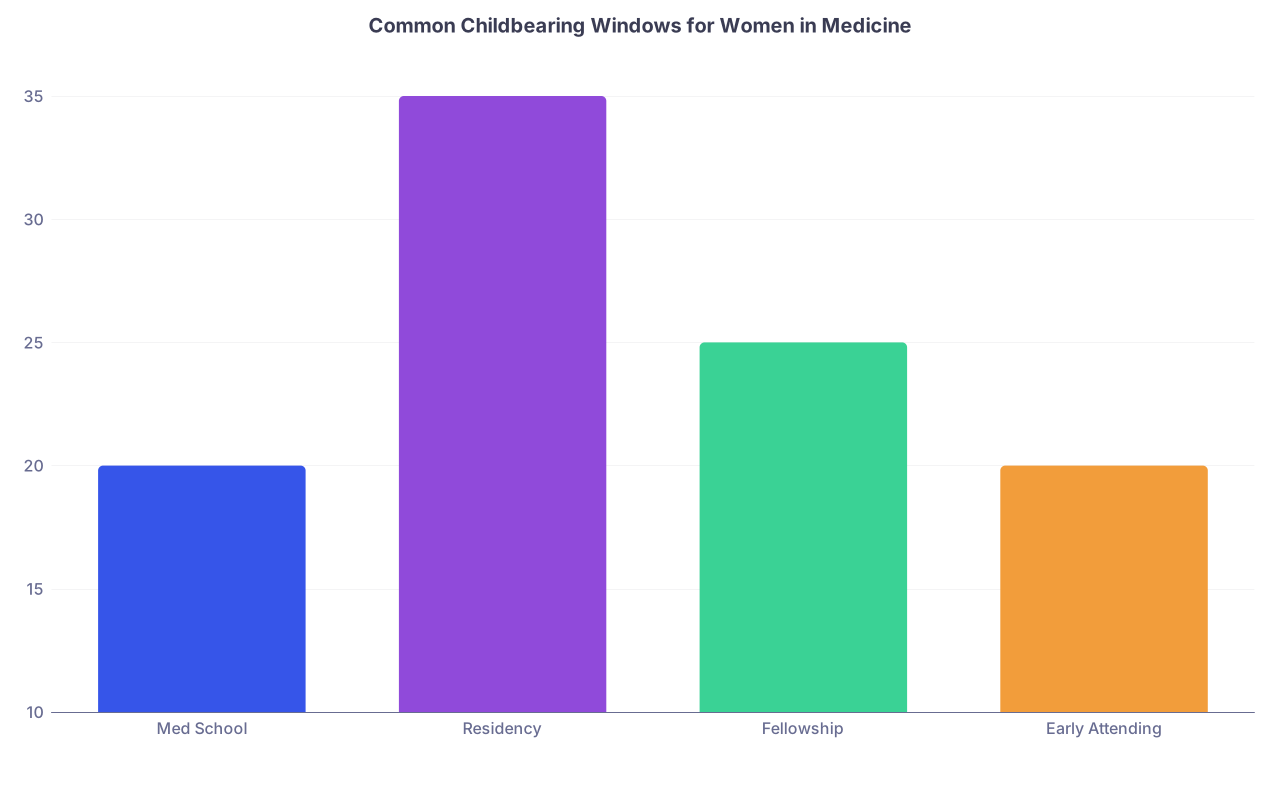
| Category | Value |
|---|---|
| Med School | 20 |
| Residency | 35 |
| Fellowship | 25 |
| Early Attending | 20 |
Those numbers aren’t perfect science; they just illustrate a reality:
A huge chunk of women in medicine either:
- Have kids in training
- Or bump into fertility issues later
- Or end up regretting waiting because the “perfect time” never shows up
Is it ethical—for you, personally—to sacrifice your family-building timeline to make your PD’s life easier? That’s a serious question.
Your patients are not entitled to your uterus’s schedule.
There’s no morally superior choice here, but pretending that “just wait until after training” is neutral? It’s not. It carries real risk—fertility, relationship strain, even your own mental health.
So… Is It Career Suicide or Not?
Let me put it like this:
Wanting kids in training is not career suicide.
Walking into it without a plan in a hostile environment? That can be career self-harm.
You need three things more than anything else:
- A realistic picture of your specialty
- A program culture that isn’t garbage
- A personal line in the sand about what you’re willing to sacrifice
1. Some specialties are objectively worse for this
I’m not going to sugarcoat it.
| Specialty | Relative Family-Friendliness |
|---|---|
| Pediatrics | Higher |
| Family Medicine | Higher |
| Psychiatry | Higher |
| Internal Medicine | Moderate |
| OB/GYN | Moderate–Lower |
| General Surgery | Lower |
These are broad generalizations. There are family-friendly surgeons and nightmare pediatrics programs. But trends exist.
If you’re in a malignant surgical program with 3 residents per class and one OR running 24/7, being pregnant might trigger a full institutional meltdown. IM at a large academic center with backup coverage and a female PD? Totally different story.
2. Program culture is not “soft stuff.” It’s survival.
Before you commit to a place, you want signals:
- How many women residents/faculty have had kids there?
- How do they talk about pregnancy and leave? As a burden or as a norm?
- Does your PD respond to “I may want kids in training” with panic or with logistics?
If every story you hear about pregnant residents includes phrases like “we were all so screwed” and “honestly, it wasn’t fair to the rest of us”… believe them. That’s your red flag.
3. You need to know what you actually want more
You can’t outsource this decision to “what will look best on paper.”
Brutal but necessary questions:
- If you had to choose between a slightly shinier fellowship and trying for kids at your preferred time, which loss would hurt longer?
- If fertility treatments, egg freezing, or adoption become your reality because you delayed, will you feel at peace with that tradeoff?
- If your career is a little smaller on paper, but your life feels fuller, is that actually a failure?
There is no version of this where you get 100% of everything. Something gets traded. The question is: do you do it consciously, or do you let fear and other people’s expectations decide for you?
Practical Ways to Not Completely Wreck Yourself
Let’s get tactical for a second. You’re anxious; you want levers you can actually pull.
Timing within training
Not perfection, just strategy:
- Some people aim for lighter rotations or clinic blocks in pregnancy and postpartum.
- Frontload demanding rotations if you can.
- If possible, don’t schedule major board exams for the exact weeks around delivery. (Sounds obvious. You’d be shocked how often this gets missed.)
Know your rights (even if you hate reading policies)
You don’t have to become a legal scholar, but at least know:
- Your program’s parental leave policy (and if it actually matches what’s written)
- ABMS/your board’s maximum allowed time off without extending training
- Options like using vacation + sick days + institutional leave to patch together something survivable
Sometimes programs “forget” what’s allowed until you show them their own documents.
Build your personal support system like it’s part of your training
If you do this, you can’t rely on vibes.
You’ll need:
- One or two attendings who know your situation and are pro-you
- Co-residents who you’ve treated well and who would actually trade calls with you
- A partner/family/friend structure that understands: medicine doesn’t slow down because daycare closed
If you go into this isolated, yes, it will feel like sabotage.
No, Wanting a Family Does Not Make You Less of a Physician
This is the part that makes me quietly furious.
There’s an unspoken belief in medicine that “real” commitment means:
- Being endlessly available
- Treating your body like a machine
- Acting as if your only purpose is your training
And then we wonder why burnout is astronomical and why women leave academics in droves.
Wanting kids in training doesn’t make you weak. It doesn’t make you less serious. It doesn’t mean you love medicine less.
It means you refuse to offer your entire life, body, and fertility as a sacrifice to a system that will replace you in 24 hours if you get hit by a bus.
That’s not sabotage. That’s self-respect.
FAQ (Exactly 5 Questions)
1. Should I tell programs during interviews that I want kids in training?
No. Don’t. This isn’t about being dishonest; it’s about not handing people ammunition they’re not supposed to use but sometimes will anyway. Use interviews to assess them: look at their track record with pregnant residents, ask neutral questions about parental leave and schedule flexibility, and talk to current residents privately.
2. Will having a baby in residency ruin my fellowship chances?
Not automatically. If you completely fall apart academically, have repeated unexcused absences, or become chronically unreliable, that will hurt you—baby or not. But plenty of people match into competitive fellowships after having kids in training. You may have fewer publications or leadership roles, so you’ll need strong letters and a clear story about your interests and strengths. It’s a handicap, not a death sentence.
3. What if my program is openly hostile to pregnancy?
First, document everything. Second, find allies—chiefs, faculty, GME office, maybe even legal counsel if it gets egregious. Third, protect your sanity: therapy, peer support, whatever it takes. As a longer-term move, you can consider transferring programs or pivoting your career trajectory. You are not obligated to martyr yourself for a toxic institution.
4. Should I freeze my eggs instead and wait until after training?
Egg freezing can be a smart backup plan, not a guaranteed solution. It’s expensive, physically demanding, and doesn’t guarantee a baby. If doing it would give you peace of mind and you have access and resources, it’s a reasonable consideration. But don’t let people sell it to you as a perfect fix that allows programs to own your fertile years guilt-free.
5. How do I know if I’m being “selfish” by having kids during training?
You’re not. You’re allowed to be a whole person with a life outside of medicine. The line is not “don’t inconvenience anyone” (because everyone in medicine inconveniences someone at some point—illness, family deaths, mental health, whatever). The real line is: are you doing your best to communicate, plan, and work hard when you are there? If yes, that’s being responsible—not selfish.
Key points to keep in your head when the anxiety spikes:
- Wanting kids in training is not career sabotage. Doing it blindly in a toxic environment can be.
- You will trade something—time, research, energy, or possibly fertility—no matter when you have kids. Choose consciously.
- The goal isn’t to be the perfect trainee. The goal is to finish training with a career you can live with and a life you actually want.