
It’s 6:15 a.m. You’re in a chilly workroom, clutching coffee, flipping through patient lists. You look around and it hits you: everyone else is a guy. Senior, intern, med students, even the fellow. You’re the only woman on this team for the next four weeks.
And your brain immediately goes there:
What if they all bond and I’m just… extra? What if they think I’m weak if I ask for help? What if I say no to something and suddenly I’m “difficult”? What if one creepy comment happens and no one backs me up?
You’re not just worried about fitting in socially. You’re worried about evaluations. Letters. Your reputation. Your safety. Your sanity.
Let’s walk through this like we’re sitting in the call room, door half-shut, both of us exhausted and overthinking everything.
First: You’re Not Crazy for Worrying About This
You’re picking up on real things:
- Men tend to outnumber women in many teams (especially surgery, ortho, EM, cards).
- Gender dynamics absolutely affect who gets teaching, procedures, and credit.
- Women get labeled “aggressive” for behavior that men get praised for.
You’re not being dramatic. You’re reading the room correctly.
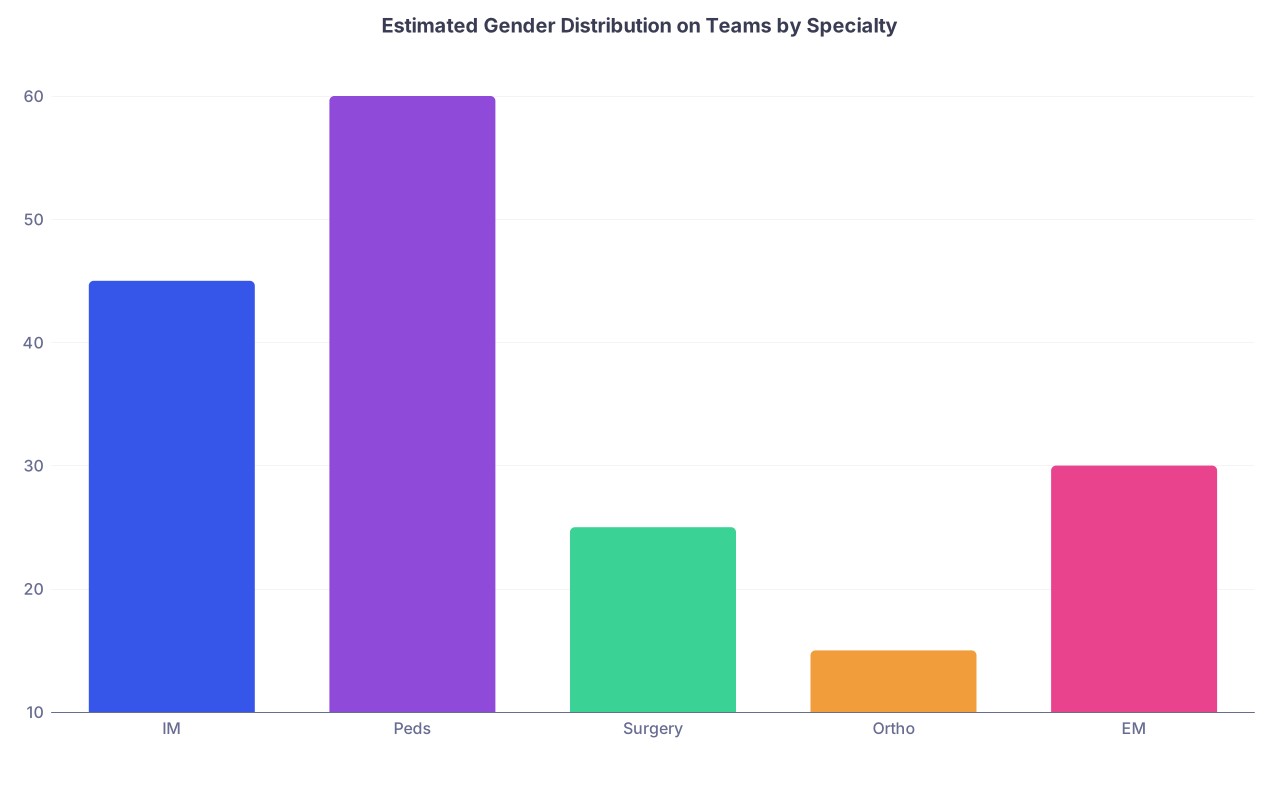
| Category | Value |
|---|---|
| IM | 45 |
| Peds | 60 |
| Surgery | 25 |
| Ortho | 15 |
| EM | 30 |
That said, “I’m doomed to be isolated and overlooked” is your anxiety talking, not reality. I’ve seen women be the only one on the team and:
- End up the attending’s favorite learner
- Quietly become the informal leader
- Build one or two solid allies and feel totally different by week 2
So the goal isn’t “make everyone love you” (honestly impossible). The goal is:
- Don’t get sidelined or forgotten
- Protect your boundaries and sanity
- Build just enough connection that you’re not isolated and unsafe
How Do I Actually Not Get Left Out?
Let’s be blunt: some teams are lazy. They’ll default to whoever is loudest, closest, or easiest. On an all-male team, that often means the guys bond faster. You don’t have to become the loudest. But you do need to make yourself visible and “on the radar.”
1. Front-load professionalism (so they stop testing you)
The first few days are when they subconsciously “slot” you. Soft-spoken woman? They may assume passive. They shouldn’t. But they do.
So for day 1–3, slightly overdo:
- Preparedness: “I prepped all the labs and imaging for our patients; here’s the update on Mr. X if you want it before rounds.”
- Initiative: “I’d like to do more procedures this month—if an opportunity comes up, could you keep me in mind?”
- Clarity: “I’m comfortable with X, less experienced with Y, but I want to practice it this rotation.”
You’re sending a clear message: I’m here, I’m engaged, I’m not a background character.
2. Use “micro-bids” for connection
You don’t need to become best friends with everyone. You just need to break the “stranger” barrier.
Small, low-risk moves:
- Before rounds: “Hey, which patient are you most worried about today?”
- On the elevator: “Where did you do your intern year?”
- After a teaching moment: “That explanation helped a lot—do you have a go-to resource for that topic?”
If there’s another med student or the most approachable person (often the junior resident), put slightly more energy there. One ally can change the whole vibe.
3. Ask for inclusion… in a way that still feels like you
Sometimes the isolation isn’t malicious. It’s just obliviousness. No one “means” to keep giving procedures to one learner. They just do.
You can nudge without sounding needy:
- “I’d really like to do the next paracentesis—can I be first up when we have one?”
- “Can I run the next admission and present on rounds?”
- “If there’s any teaching on X today, I’d love to join, even if I’m off in another room.”
You’re not begging. You’re reminding them you exist and you care.
The Gendered Crap You’re Afraid Of (And What To Do)
Here’s the stuff that actually keeps you up at night.
1. Being talked over or ignored
You say something, no one reacts. Two minutes later, male colleague repeats it and suddenly it’s brilliant.
Awful, but common.
Tools that don’t wreck your evaluation:
- Reclaim briefly: “Yes, that’s what I was thinking when I mentioned checking a D-dimer.” Then stop. Don’t over-explain.
- Enlist an ally (if you have one): quietly say, “Sometimes I feel like my comments get lost—if you notice it, can you back me up once in a while?”
- Use structure: “I have two quick points on this patient…” People tend to listen more once they know there’s a finite structure.
If an attending constantly ignores you and not others, that’s a pattern worth documenting. Dates, comments, examples. Not for drama—for self-protection if evals are bizarrely harsh.
2. Being asked to do “pink tasks”
The “can you take notes,” “can you call the family,” “can you organize the schedule” that magically find their way to the only woman.
You don’t have to eat that silently.
Try:
- “I’m happy to call the family this time—let’s rotate that so we all practice?”
- “I can take notes today if someone else takes it tomorrow; I really want to focus on the exam on Patient X right now.”
If they still funnel it all to you, that’s a red flag. It’s gendered labor. You’re allowed to notice.
3. Inappropriate jokes / borderline comments
The nightmare scenario. The off-color “joke” about nurses. The “you’re too pretty for night shift” nonsense. The sexual innuendo.
Your brain immediately splits: If I say something, I’m “sensitive.” If I don’t, this keeps happening.
You have options, and none of them have to be perfect:
- The neutral boundary:
“Let’s keep it professional,” said once, flat tone, then silence. - The confused look:
Just stare for a beat and change subject. Social discomfort can do the work for you. - The redirect:
“Anyway, about that CT scan…”
For repeated or severe behavior, you’re not overreacting if you:
- Tell a trusted resident or chief: “This happened, it made me uncomfortable, I’m not sure what to do.”
- Email yourself a brief note with date, time, what was said, who was there.
- Use formal reporting if it crosses into harassment. You’re not “ruining someone’s career” by not tolerating harassment. They’re doing that themselves.
You might not feel safe confronting in the moment. That’s okay. You can still ask for help later.
Protecting Your Reputation Without Playing Small
You’re stuck in a double bind:
Be quiet → invisible → mediocre evals
Be assertive → “abrasive,” “not a team player,” “difficult”
I won’t sugarcoat it: women walk this tightrope all the time. But there is middle ground.
1. Use “relational assertiveness”
You can be clear and still sound like a team player.
Instead of:
“I never get to do procedures. This isn’t fair.”
Try:
“I’m trying to get more hands-on this month—could we plan for me to do the next central line?”
Instead of:
“That’s not my job.”
Try:
“I can help with that today, but I’ll need time to finish X for my patients.”
You’re advocating for yourself while acknowledging the team’s needs.
2. Decide what hill you’ll die on (and what you won’t)
You can’t fight every battle. You’ll burn out and they’ll tune you out. Pick your non-negotiables:
- Patient safety
- Personal safety and dignity
- Fair access to learning / procedures (within reason)
Mildly annoying stuff? Sometimes you let it go. Systemic disrespect or boundary crossing? That’s when you push.
Building Support Outside the Team (So You Don’t Lose Your Mind)
The worst isolation isn’t just on rounds. It’s walking home thinking, “Is it me? Am I the problem?”
You need at least one person outside the team who knows what’s going on.
1. Find a woman a few steps ahead
Could be:
- A senior resident who is known to be decent
- A woman attending on another service
- A chief resident who has a reputation for being fair
Send a short message:
“Hey Dr. X, I’m on [rotation] this month and I’m the only woman on the team. I’d love to get your advice on how to make the most of it and not get sidelined.”
I’ve watched attendings go out of their way to:
- Ask specifically about your experience
- Quietly adjust schedules or expectations
- Step in if something is off
But they need to know you’re struggling. They’re not mind readers.
2. Use formal structures, even if they feel awkward
Your school / program probably has:
- A women in medicine group
- A wellness office
- A DEI person
- A student affairs dean
I know, I know. It feels dramatic to go to them because your team “just feels off.” But informal venting with friends only gets you so far. Sometimes you need someone with power and perspective to say, “No, that’s not normal,” or “Here’s exactly what you say to your PD.”
Planning for the Worst While Hoping for “Meh”
Your brain is probably doing the thing: “What if this rotation tanks my career?”
Let’s walk out the extreme scenarios.

| Step | Description |
|---|---|
| Step 1 | Only woman on team |
| Step 2 | Good teaching and evals |
| Step 3 | Uneventful, fine evals |
| Step 4 | Document issues |
| Step 5 | Seek ally or mentor |
| Step 6 | Escalate if needed |
| Step 7 | Team culture |
Worst-case 1: You get a mediocre or unfair eval
Reality check:
- One bad or “meh” eval almost never kills a career.
- The story around it matters. If you told someone during the rotation, that context can help.
If it happens:
- Request a meeting: “I was surprised by some of the feedback; can we talk through specific examples and how I can improve?”
- If it’s wildly off base and you have documentation or witnesses, talk to student affairs / PD. Quietly. Carefully. Not a rant—a factual report.
Worst-case 2: Someone crosses a serious line
If it’s harassment, discrimination, or clearly unethical:
- You are not overreacting by involving:
- Student affairs
- GME office
- Title IX / HR, if needed
- Write everything down while it’s fresh: date, time, exact words, who else was present.
Does that feel terrifying? Yes. You’re afraid you’ll be labeled “trouble.” But I’ve seen the opposite: people in power quietly move a student off a team, flag an attending, or shield the student in future rotations—because they actually want to protect you, they just need a trigger to act.
Tiny Things That Make a Big Difference Day-to-Day
These sound small but actually change how isolated you feel.
- Physical positioning: Don’t stand in the back of the pack on rounds every time. Rotate toward the front. People teach the person in front of them.
- Pre-round 2-minute check-ins: “Anything specific you’d like me to focus on today?” Makes them aware you exist, sets you up for feedback.
- Lunch / coffee: You don’t have to join every bro-y lunch, but accepting once or twice often softens the social barrier.
- One “script” ready for awkward moments: Decide ahead of time what you’ll say when someone makes you uncomfortable. It reduces that frozen “uhhhh” moment.

A Quick Reality Check
You’re not going to perfectly engineer this rotation. Some teams will be amazing. Some will be tolerable. Some will be subtly sexist and infuriating.
But being the only woman does not mean:
- You’re automatically doomed to be ignored
- You’re obligated to absorb everyone’s crap
- You have to become some superhuman “cool girl who never complains” to survive
You’re allowed to want:
- Fair teaching
- Respect
- Basic psychological safety
And you’re allowed to say something when you’re not getting those.
| Type | Example |
|---|---|
| Green | Attending rotates chances fairly |
| Green | Residents ask your input on plans |
| Green | Jokes stop when you look uneasy |
| Red | You are always given scut work |
| Red | Comments about your gender/looks |
| Red | You are consistently talked over |
FAQ (Exactly 6 Questions)
1. What if I try to be more visible and they still ignore me?
Then you stop blaming yourself. Do your job well, keep your standards high, and loop in someone outside the team. “I’ve tried asking for more responsibility and I’m still not getting any. Can you help me think about next steps?” Sometimes the fix is a quiet word from a chief or course director, not more contortions from you.
2. How do I handle “you’re too sensitive, it was just a joke”?
Don’t argue about whether it was a joke. That’s a trap. You can say, “Joke or not, it made me uncomfortable, so I’d rather keep things professional.” Repeat if needed. If they double down or mock you, that’s documentation territory and possibly a conversation with someone in authority.
3. Won’t speaking up hurt my evals?
It might, on a bad team. But staying silent on a truly toxic team can hurt you more—less teaching, fewer opportunities, constant stress that tanks your performance. The trick is being strategic: address small stuff directly if you can; escalate serious stuff with support and documentation. Don’t white-knuckle your way through abuse to “protect” an eval.
4. How do I avoid being seen as “the angry feminist”?
You don’t need to argue theory or call out every microaggression. Focus on concrete behavior and its impact. “When I’m repeatedly asked to do only family calls, I miss out on exams and procedures. I’d like a more balanced mix.” That’s not ideology; that’s a fair request about work and learning.
5. What if there are no women in my program I feel comfortable going to?
Then look slightly wider: another department, another hospital in the system, an alum, a women-in-medicine or specialty society mentorship program. Email feels awkward, but people are generally kinder than you expect when you say, “I’m a trainee, I’m the only woman on my team, and I’d really value your perspective.”
6. Is it a sign I’m not cut out for this if being the only woman really bothers me?
No. It’s a sign you’re human and you can tell when a situation is unbalanced. Feeling lonely or uneasy in that setting doesn’t mean you’re weak; it means you have a working radar. Lots of excellent physicians still hate that isolated feeling years into practice. You can be tough, competent, and still crave not being the only one.
Key points to walk away with:
- Being the only woman on the team doesn’t mean you have to be invisible; small, deliberate actions can keep you in the mix without selling your soul.
- You’re allowed to set boundaries and ask for fair opportunities, and you’re not “overreacting” if you document and seek help when things cross the line.
- One ally—a senior, a mentor, a dean—can make a huge difference; you don’t have to white-knuckle this alone.