People will absolutely judge you on your face. Pretending they won’t is dishonest.
The real question is: will wearing makeup or not wearing it actually change how you’re evaluated as a student, applicant, or physician? Or are we just spiraling in front of the mirror for nothing?
Let’s be blunt: as a woman in medicine, you’re stuck in a completely unwinnable double standard. Look “too done” and you’re vain, unserious, “not like a real surgeon.” Look “too plain” or “tired” and suddenly people wonder if you’re unwell, unprofessional, or not sharp enough to be in charge.
So yeah, your anxiety about this isn’t made up. But it is probably miscalibrated. The things you’re obsessing over are almost never the things that actually hurt you.
I’m going to walk through the ugly reality and then narrow it down to what’s actually safe, what’s risky, and what you can stop losing sleep over.
The Harsh Truth: Appearance Does Affect Evaluation (But Not How You Think)
Here’s the part everyone wants to deny: attendings, residents, patients, and interviewers are human. Humans judge. Fast.
And medicine is very visual:
- Your face is constantly on display
- People glance at you for 1 second, then decide “competent/not competent,” “approachable/not approachable,” “together/not together”
But here’s the twist: they’re not counting layers of mascara. They’re making a quick gut call on three things:
- Do you look clean?
- Do you look awake/present?
- Do you look appropriate for this setting?
Makeup can help or hurt those three. But there is no universal “you must wear makeup” or “you must be bare-faced” rule that magically boosts your evaluation. That’s not how this works.
Think of it this way: people notice extremes. They don’t really care about the middle.
The “Too Much / Too Little” Trap
This is the tightrope you’re terrified of. Too colorful, too glam, too bold, too “done”… vs too tired, too casual, too “you didn’t try at all.”
Let’s split it into two extremes, because this is where most anxiety lives.
1. “Too Much” Makeup (a.k.a. “Will they think I’m not serious?”)
You know the fear:
If I wear:
- Bold lashes
- Glittery eyeshadow
- Strong contour
- Bright red lips at 6:30 a.m. pre-rounds
…will they think I care more about beauty than medicine?
Yes. Some people absolutely will. Especially in:
- Surgery
- EM
- Critical care
- Old-school IM programs
Is that fair? No. Does it still happen? Constantly.
The questions that go through an attending’s head (I’ve literally heard some of these):
- “How did she have time to do that at 4 a.m.?”
- “Is she here to work or for a photoshoot?”
- “Is this really the place for that look?”
Is it sexist? Yes. Is it still your problem? Unfortunately, also yes.
That doesn’t mean you can’t wear makeup. It means:
- Heavy glam at 5 a.m. reads as misaligned with the culture of most rotations
- Super bright lipstick, big fake lashes, intense contour → these draw attention to your appearance instead of your work
People in medicine are weirdly suspicious of visible effort in how you look. They don’t want to think you tried. They want “effortless professionalism” — which of course takes effort.
2. “Too Little” Makeup (a.k.a. “Will they think I look tired/sloppy?”)
Flip side:
What if you wear no makeup at all?
Fears:
- “Will they think I look sick or exhausted?”
- “Will they think I didn’t ‘put myself together’?”
- “Will patients not trust me because I look too young / too tired?”
Reality:
- A bare face is totally fine in medicine. Tons of women physicians wear zero makeup every day.
- Where it becomes a problem is when your overall appearance looks disorganized:
- Hair greasy or unkempt
- Scrubs stained or wrinkled
- White coat messy
- Poor hygiene
No one is going to write in your evaluation: “Student wears no makeup.”
They might write: “Student appears disheveled” if the whole picture looks like you rolled out of bed.
If your face is bare but:
- Hair is neat
- Clothes are clean and fit properly
- You look awake and engaged
You’re fine. Truly.
What Actually Matters To Evaluators vs What You’re Obsessing Over
Let me separate your brain’s disaster scenarios from reality.
| Your Spiral Thoughts | What They Actually Clock |
|---|---|
| Is my eyeliner too thick? | Do they look tired or awake? |
| Is lip balm enough or do I need lipstick? | Do they look clean and prepared? |
| Does mascara make me seem shallow? | Do they look like they care at all? |
| Will two pimples ruin my interview? | Are they professional and focused? |
| Is my blush too pink? | Is anything distracting or extreme? |
Half the time, your evaluator is:
- Post-call
- Starving
- Behind on notes
They are not analyzing your brow routine.
They do react to:
- Strong smells (heavy perfume is a real problem)
- Very dramatic looks that don’t match the context
- Visible lack of hygiene
- Outfits or styling that clearly push boundaries (club makeup, huge lashes, neon lipstick with patients)
So the anxiety is valid — yes, people judge — but it’s misdirected at micro-details that don’t actually show up in your evaluation.
Patients, Attendings, and Peers: They All Read You Differently
Different people, different biases.
Patients
- Warmth
- Cleanliness
- Calm, steady presence
Most don’t care if you’re wearing eyeliner. They notice:
- If you look very tired or sick
- If your makeup is so intense it feels “fake” or out of place
- If your appearance makes you feel unapproachable
Elderly patients might have more conservative expectations:
- Very heavy glam can feel “odd” or “unprofessional” to them
- But soft, natural makeup or no makeup at all is usually fine
Attendings and Residents
They’re looking at:
- Your work ethic
- Reliability
- Professionalism
Makeup becomes a problem when it sends an unintended message:
- Extreme glam → “Is this person aligned with the culture here?”
- Smudged eyeliner, day-3 hair, messy clothes → “Are they overwhelmed? Not taking this seriously?”
Most female attendings I’ve seen personally:
- Range from zero makeup to light, natural, “no-makeup makeup”
- Even the ones who wear full makeup often tone it down for rounds vs social events
Peers
Honestly? Your peers will notice your makeup the most.
They:
- Compare
- Comment (“Wow, you look so put together, I could never do that”)
- Sometimes project their own insecurity
But they don’t write your evaluations. They just live rent-free in your head.
Safe Zone vs Risk Zone: Practical Guidelines (Without Policing Your Face)
Let’s actually talk specifics, since that’s probably what you’re spiraling about.
“Safe Zone” for Most Medical Settings
This works for:
- Clinical rotations
- Rounds
- Most interviews
- Shadowing
- Volunteering
Think:
- Skin: light foundation/BB cream or none at all; concealer if you want
- Eyes:
- Mascara or none
- Subtle liner or none
- Neutral eyeshadow if you like it, but you don’t need it
- Brows: lightly filled or natural
- Cheeks: soft blush, nothing too intense
- Lips: balm, nude/soft pink, or a muted shade that doesn’t distract
Or, bare face + moisturized skin + neat hair = 100% acceptable.
The key is this: would someone describe your look as:
- “Clean”
- “Professional”
- “Low-drama”
If yes, you’re fine.
“Risk Zone” — Not Always Wrong, But Can Backfire
These don’t automatically doom you, but they can invite unnecessary judgment:
- Heavy contour and highlight that’s obvious in hospital lighting
- Thick, dramatic false lashes for day shifts
- Glittery or neon eyeshadow
- Very dark, matte lipstick or loud colors in conservative settings
- Overlined lips that are clearly stylized
- Super strong brows that draw all the focus
Again: is it fair that women get scrutinized like this? No.
But if the decision is between looking “boring” and unnecessarily fighting stereotypes, I’d rather you save your battles for something that matters more than your highlighter.
Interviews: Does Makeup Change Your Chances?
This is probably your biggest fear:
“If I wear makeup / if I don’t wear makeup — will I not match? Not get in?”
Here’s the honest answer:
Your makeup, as long as it’s not extreme, is not going to swing your application outcome.
What actually tanks interview impressions:
- Awkward social skills
- Low energy / seeming uninterested
- Inability to answer basic questions about your application
- Arrogance or defensiveness
- Appearing disorganized or late
Makeup is background noise unless:
- It’s extremely distracting
- It reads as wildly mismatched with the setting (full glam for a 7 a.m. pre-round interview breakfast)
For interviews, I like framing it this way:
- Pick the version of your face that makes you feel most like a competent adult
- If that’s full face → tone it down one notch
- If that’s bare face → maybe add one thing (tinted moisturizer, a bit of mascara, grooming brows) if it boosts your confidence, but you truly don’t have to
Interviewers want you to look:
- Rested (ish)
- Put together
- Like you understand that this is a professional meeting
That can be with or without makeup.
How to Decide What You Should Do (Without Standing Frozen at the Mirror)
If you’re stuck in decision paralysis, use this quick mental algorithm.

| Step | Description |
|---|---|
| Step 1 | Look in the mirror |
| Step 2 | Fix hygiene, hair, clothes first |
| Step 3 | Tone it down one level |
| Step 4 | Add or remove one small thing |
| Step 5 | Leave it and go to work |
| Step 6 | Do I feel clean and awake? |
| Step 7 | Is anything on my face very bold or distracting? |
| Step 8 | Do I feel like myself in a professional way? |
Your goal is not “perfect.” Your goal is:
“I look like a functional, competent version of myself who belongs here.”
And then — you stop touching it. You go.
The Gendered Double Standard You’re Sensing? It’s Real.
Let’s not gaslight you:
- Men can roll in half-shaved with dark circles and no one writes “unprofessional”
- Women with the same face get “tired,” “stressed,” “overwhelmed” coded onto them
So your worry isn’t irrational. It’s just not fully actionable.
Here’s what you can control:
- Don’t give them easy ammunition: avoid extremes that feed stereotypes (too “sexy,” too “party,” too “messy”)
- Align your look with your actual goals: you’re there to be trusted with people’s lives, not to impress TikTok
- Protect your energy: if doing a full face drains you at 4 a.m., it’s not worth it
You are allowed to:
- Be a serious physician who loves makeup
- Be a serious physician who never wears it
- Change depending on your mood, your rotation, your sleep
Consistency helps, though. If you’re full glam one day and totally undone the next, people may read that as “something’s off” rather than “personal style.”
Concrete Examples (Because Vague Advice Doesn’t Help Anxiety)
Picture these scenarios:
-
- Hair: pulled back, away from face
- Face: bare or light tinted moisturizer, maybe mascara
- Lips: balm
Reaction: “Looks awake, ready to scrub.” No one cares about lack of eyeliner.
Medicine interview day
- Hair: neat, down or half-up
- Face: light foundation/BB cream, concealer, soft blush, mascara, very subtle eyeliner
- Lips: neutral lipstick or tinted balm
Reaction: “Polished, appropriate.” No one is counting layers.
Night shift in the ED
- Hair: practical
- Face: whatever survived your day; maybe you don’t touch it up at all
Reaction: Everyone looks dead at 3 a.m. No one is evaluating your makeup.
Clinic with older, conservative patient population
- Face: bare or very minimal, nothing flashy
- Lips: neutral
Reaction: Seen as sensible and trustworthy.
Clinic in a younger, urban, diverse setting
- Face: you wearing your normal low-to-moderate daytime look (liner, brows, etc.)
Reaction: Normal. Relatable. No problem.
- Face: you wearing your normal low-to-moderate daytime look (liner, brows, etc.)
Your look has to be calibrated to the culture of that room, not some imaginary universal standard.
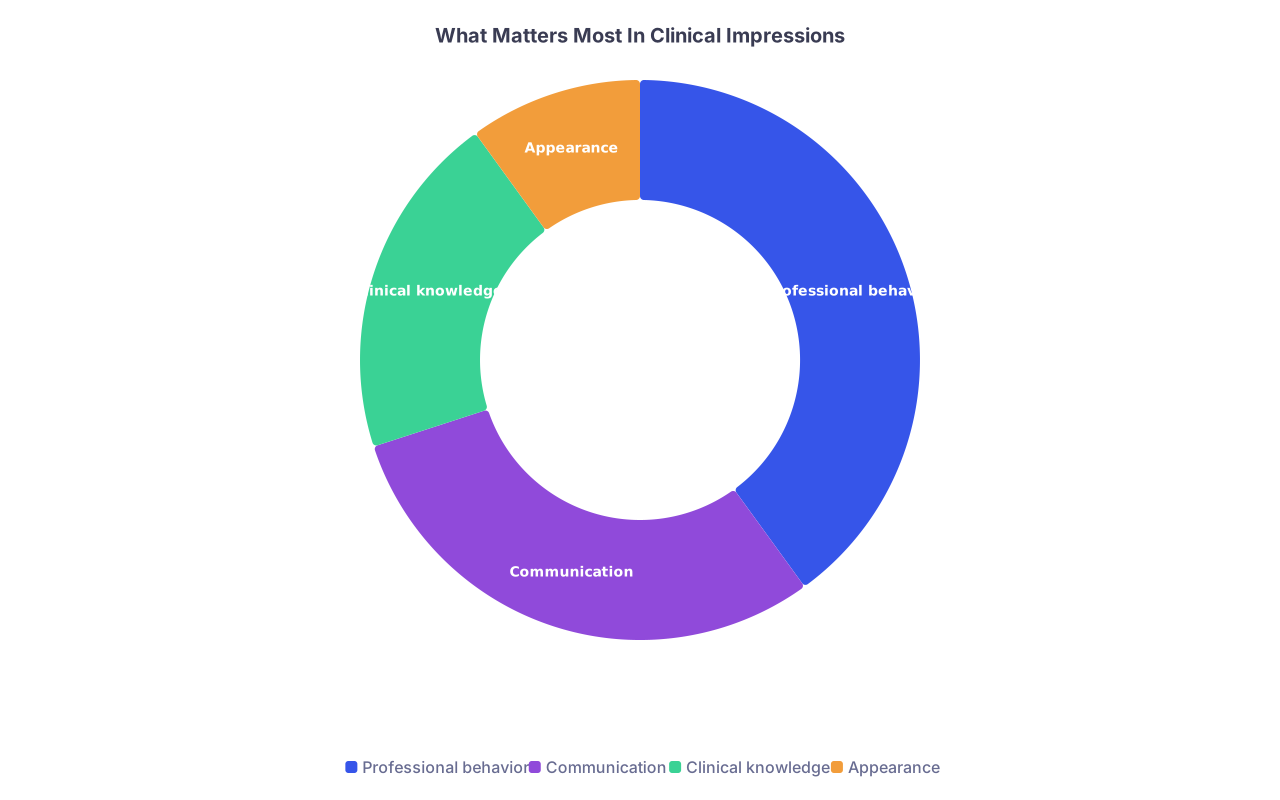
| Category | Value |
|---|---|
| Professional behavior | 40 |
| Communication | 30 |
| Clinical knowledge | 20 |
| Appearance | 10 |
The chart above is basically how most attendings operate, whether they’ll admit it or not. Appearance matters. But it’s not the main show.
Quick sanity checks before you walk out the door
You don’t need a 20-minute analysis every morning. Try these:
- Would anyone reasonably describe this as “distracting”?
- Do I look like I could walk into a courtroom or important meeting without embarrassment?
- If my attending suddenly asked me to talk to an upset family, would my appearance help or be neutral?
If the answer isn’t an immediate “uh oh,” you’re done. Stop overthinking.
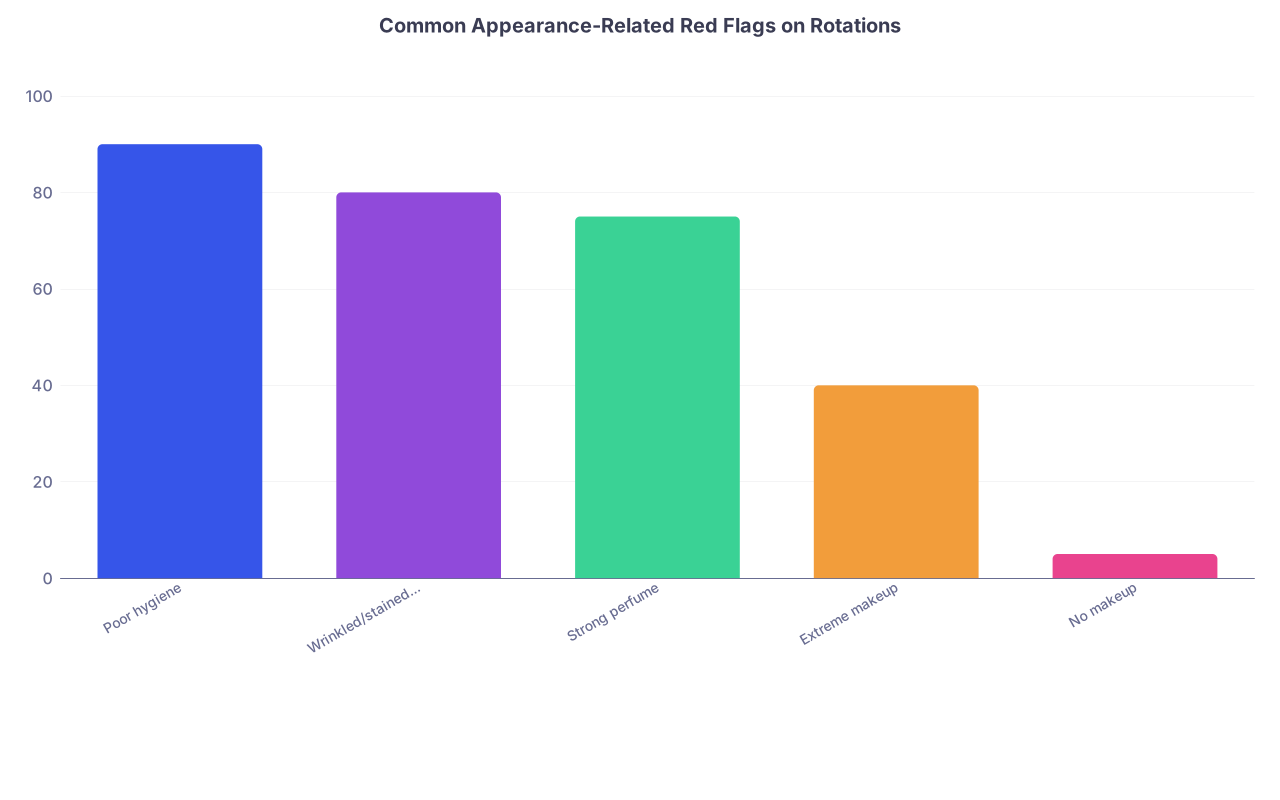
| Category | Value |
|---|---|
| Poor hygiene | 90 |
| Wrinkled/stained clothes | 80 |
| Strong perfume | 75 |
| Extreme makeup | 40 |
| No makeup | 5 |
Look at that last bar in your head: “no makeup” barely even registers. This is what I want you to remember.
FAQ (Exactly 6 Questions)
1. Will not wearing any makeup hurt my chances on rotations or interviews?
No, not if the rest of your appearance is clean and professional. Plenty of excellent female physicians and residents wear zero makeup daily and are highly respected. What hurts is looking disheveled or unkempt, not having a bare face. Bare face + neat hair + clean clothes is absolutely acceptable everywhere.
2. Can wearing “too much” makeup actually show up in my evaluation?
It can, but usually indirectly. You might see comments like “seems overly focused on appearance” or “does not fully match professional culture” if your look is dramatically out of sync with the environment (heavy lashes, intense contour, bold lips at 5 a.m. on surgery). Most attendings won’t write “too much makeup,” but it can color their overall impression if it’s very distracting.
3. Are bold lip colors always a bad idea?
Not always, but they’re higher risk in conservative or high-stakes settings like early-morning rounds, interviews, or older-patient clinics. A bold lip can work fine in some clinics or academic days if the rest of your look is toned down and you know the local culture. If you’re anxious and unsure, stick to softer, neutral tones for anything evaluative or high pressure.
4. Do I need to “fix” acne, dark circles, or scars with makeup so I look more professional?
No. You’re not required to erase signs of being human to be seen as professional. If concealer or foundation makes you feel more confident, use it. But no one competent is docking you points for visible acne or dark circles as long as you look clean, awake, and engaged. The bigger issue is your emotional energy: if covering everything perfectly is stressing you out, it’s not worth it.
5. Is there a difference in expectations between specialties?
Yes, there usually is. Surgical fields, EM, and ICU tend to be more conservative about anything that feels like “extra” — bold makeup, statement jewelry, etc. Outpatient specialties like pediatrics, family med, psych, or derm may tolerate or even embrace a bit more personality in appearance. But even there, the same rule applies: clean, not distracting, aligned with the setting. Extremes are risky anywhere.
6. What’s the safest approach if I’m really anxious about this and don’t want to guess wrong?
Pick a simple baseline look you can repeat without thinking: neat hair, clean clothes, and either (a) bare face with maybe lip balm, or (b) very light “no-makeup makeup” (tinted moisturizer, light blush, mascara, neutral lip). Use that as your default for rotations and interviews. Once you’re more comfortable in a given environment and know the culture, you can adjust slightly. But you never have to in order to be taken seriously.
Key takeaways:
- You’re judged way more on cleanliness, professionalism, and behavior than on whether you wear makeup.
- Extremes and distractions — not “no makeup” — are what actually cause problems.
- Aim for “competent, clean version of myself,” then stop adjusting and go do the job.