
What does it say about a program when every single name on the leadership slide is male… and you’re supposed to imagine yourself thriving there?
Because that moment—sitting in the pre-interview Zoom, they flash the “Program Leadership” slide, and it’s just a checkerboard of male faces—is the exact point my stomach usually drops. You start thinking: do they actually support women, or am I signing up to be “the girl resident” for three years?
Let’s pull this apart, because this isn’t just a vibes question. It’s about safety, mentorship, advancement, and whether you’ll spend the next chunk of your life subtly fighting the current.
First: No, You’re Not “Overreacting”
I’m going to say this flat out: noticing an all-male leadership slide is not being petty, dramatic, or “too sensitive.” It’s pattern recognition.
You’re thinking:
- If there are no women in leadership, how do women advance here?
- If something sexist happens, who’s going to get it without me having to explain every layer?
- If I want kids, or have them already, is anyone in power going to understand what that actually costs me physically and emotionally?
Those aren’t hypotheticals. They’re daily-life issues in residency.
You’re not just choosing where you’ll train. You’re choosing:
- Who signs off on your promotions
- Who controls your schedule and leave
- Who shapes the “culture” everyone keeps bragging about
So no, it’s not shallow to care that everyone in charge is male. It’s actually one of the most rational red flags you can pick up on.
Does All-Male Leadership Automatically Mean “Don’t Rank”?
Short answer: no. But it does mean “look way deeper before you put them high.”
I’ve seen three basic types of all-male leadership situations:
The Dinosaur Culture
- Leadership all male, senior, been there 20–30 years
- They “joke” about work-life balance being “for later”
- They say things like “we treat everyone the same here” but can’t name a single concrete policy that actually supports women
- Women residents are present but quiet, careful, and vaguely tired-looking
The Transitional Program
- Leadership all male right now, but you see:
- Younger male APDs who explicitly talk about equity and mentorship
- Clear pipeline of women in mid-career faculty, chief positions, major committees
- They openly bring up the gender gap and seem… mildly embarrassed by it
- You sense movement, not stagnation
- Leadership all male right now, but you see:
The “Looks Bad On Paper, Feels… Weirdly Okay?” Program
- Yes, the official leadership pictures are all male
- But:
- Women are chief residents
- Women run high-yield rotations (ICU, ED, subspecialty services)
- Residents—especially women—speak up easily on interview day
- They can name female mentors even if they’re not titled “Program Director”
The first type? I’d be very cautious about ranking them high if you have other options. The other two? You don’t have to drop them automatically, but you absolutely need to interrogate things more.
How To Tell If It’s a Dangerous Red Flag vs. Ugly Optics
You can’t change the fact that everyone on the leadership slide is male. But you can figure out what that actually means for your day-to-day life as a woman in medicine.
Here’s where I’d be ruthless.
1. Look at who actually has power over residents
Not just the PD and Chair. Who runs your life?
- Chief residents
- Rotation directors
- Clinic directors
- Wellness/education committee leads
If none of those people are women, that’s not just a coincidence. That’s a system.

2. Watch how they talk about “diversity” and “wellness”
Programs with real awareness don’t only say “we value diversity.” They can tell you:
- How many women are in each class, roughly
- How many women are chiefs
- Actual policies for parental leave, lactation, illness, pregnancy call accommodations
If you ask a direct question like, “How does the program support women residents, especially around pregnancy or caregiving?” and they:
- Deflect
- Get visibly uncomfortable
- Say “we treat everyone the same”
- Or worse, chuckle and say “we’ve never really had to deal with that”
That’s not neutral. That’s your answer.
3. Listen to the women who are already there
This matters more than anything else.
On interview/socials, notice:
Do women speak freely? Or only after a man does?
Do they look like they actually like each other?
Do they talk about:
- Being supported to do fellowship
- Protected time pumping
- Taking time for doctor’s appointments without drama
- Being shielded from abusive faculty/patients
Ask specific questions, not vague ones like “How is the culture?”
Try:
- “If a male attending made inappropriate comments about appearance or pregnancy, who would you actually go to, and would anything realistically happen?”
- “Have you seen women get supported into leadership roles—chief, committees, QI projects?”
- “Are there any attendings you quietly warn interns about?”
You’re not fishing for gossip. You’re checking for survival strategies.
Hard Reality: Gender-Balanced Leadership Is Still Rare In Many Places
Let me throw some numbers at the anxiety, just so you know you’re not alone in noticing this.
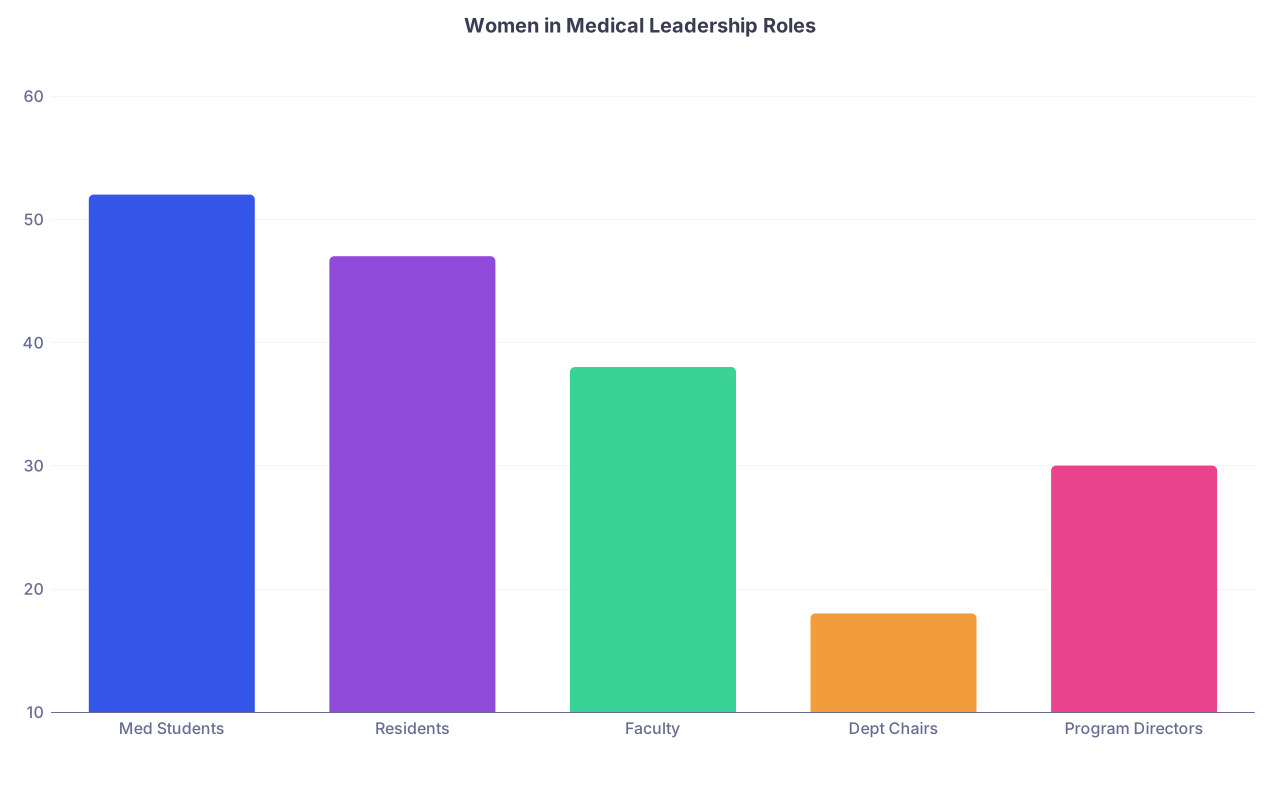
| Category | Value |
|---|---|
| Med Students | 52 |
| Residents | 47 |
| Faculty | 38 |
| Dept Chairs | 18 |
| Program Directors | 30 |
This is roughly the pattern in many specialties right now:
- You start pretty close to 50/50 in med school
- It drops at residency
- It tanks at department chair and high-level leadership
So if you go in saying, “I will only rank programs with 50% women in leadership,” you might literally run out of options, especially in more male-dominated fields (ortho, EM, surgery, some IM subspecialties).
Is that fair? No. Is it your fault? Also no.
So you’re stuck balancing:
- Your safety and values
- The reality of the field as it currently exists
- The fact that you still need to match somewhere
You’re not wrong for wanting a place that reflects your values. You’re also not wrong if, in the end, you rank a program high even though their leadership slide looks like a golf club membership photo.
Both can be true: the system is broken, and you’re just trying to get through it.
How To Evaluate An All-Male Leadership Program Before Ranking
Think of it as a quick triage. You’re asking: “Is this survivable and potentially growth-supportive for me as a woman, or is this a slow bleed I’m signing up for?”
Here’s one way to frame it.
| Factor | Green-ish Light | Yellow Flag | Red Flag |
|---|---|---|---|
| Women residents/fellows | Many, visible, engaged | A few, quieter | Very few, isolated |
| Women chiefs | Yes, regularly | Occasionally | Almost never |
| Women faculty mentors | Several named by current residents | One or two, not very visible | Residents struggle to name anyone |
| Response to sexism questions | Specific policies, clear examples | Vague “we support everyone” | Defensive, dismissive, uncomfortable |
| Parental leave/pregnancy | Clear policies, residents used them | Policy exists but rarely used | Confusing, “case-by-case,” or discouraged |
If most of what you’re seeing falls in the red column, ranking them high is a real risk, especially if you have other viable options.
If it’s more green/yellow, then you’re in that annoying gray area where you have to decide how much compromise you can live with.
Concrete Questions You Should Ask (Even If You’re Scared To)
I know the fear: “If I ask this, will they think I’m a problem?” I’ve watched people (especially women) swallow real concerns because they don’t want to be “that applicant.”
But here’s the brutal truth: if asking these questions makes them think you’re a problem, they’ve done you a favor by revealing themselves.
Try questions like:
- “I noticed leadership is currently all male. Are there any ongoing efforts to promote women into leadership roles or committees?”
- “Who are some of the women faculty that residents go to for mentorship?”
- “Can you walk me through how parental leave has worked for previous residents—how their call was covered, and how they were supported coming back?”
- “Have residents ever had issues with harassment or discrimination, and how was that handled by leadership?”
Watch how quickly and concretely they answer. Long awkward pauses are… informative.

| Step | Description |
|---|---|
| Step 1 | All male leadership |
| Step 2 | Rank low if possible |
| Step 3 | Consider lower but not off list |
| Step 4 | Rank based on other priorities |
| Step 5 | Women residents seem supported? |
| Step 6 | Women faculty mentors exist? |
| Step 7 | Policies for leave and safety clear? |
What If It’s Your Dream Program… But All The Leaders Are Men?
This is the really nasty scenario, right? The “perfect” program clinically, location-wise, reputation-wise—except every leadership picture is a guy in a jacket and tie.
So then the spiral starts:
- Am I betraying women in medicine by ranking them high?
- Am I setting myself up to be miserable?
- Am I supposed to sacrifice my dream because they haven’t figured out gender equity yet?
Here’s how I’d think through it:
Check for non-negotiables
- Harassment ignored? Gaslighting when you ask about support? No women in visible roles anywhere?
- That’s not “imperfect.” That’s unsafe. I wouldn’t call that a dream program.
Look at the pipeline
- Are there multiple mid-career women faculty?
- Are women getting fellowships, leadership-track projects, chief roles?
- If yes, it might be in that transitional phase, where you can both benefit and help accelerate the change—without having to martyr yourself.
Consider your personal bandwidth
- Are you in a place mentally/emotionally where you can handle being one of relatively few women in a male-heavy leadership environment?
- Burned out already? Coming back from a tough situation? Then maybe you don’t choose the “change agent” role right now. That’s allowed.
You are not obligated to sacrifice your own psychological safety to “fix” a program. You’re one person trying to get through residency, not an equity consulting firm.

If You Do Rank Them High Anyway, Protect Yourself
Let’s say after all this, you decide: yeah, I’m still going to rank this all-male leadership program near the top.
That doesn’t mean you’re helpless. It means you go in with your eyes open and a plan.
A few survival strategies:
Find women mentors early—even outside your department
- Women in EM if you’re in surgery
- Women in OB, pediatrics, hospital medicine
- Sometimes your best advocate is not in your specialty at all
Document everything
- Any sketchy interactions
- Repeated inappropriate comments
- Times you asked for support and were denied
- Not to be paranoid—just to keep your reality from being rewritten later
Build a peer support network
- Group chats with other women residents
- Residents from neighboring programs
- Online communities (not to gossip, but to sanity-check your experiences)
Know your institutional policies cold
- Harassment reporting channels
- Title IX
- Union (if you have one)
- GME office resources
You deserve to feel like you’re training, not constantly defending your right to exist there.
Quick Reality Check: You’re Not “Too Picky”
Let me say this as clearly as possible:
You are not asking for the moon by wanting:
- Leadership that includes women
- Policies that don’t punish pregnancy
- Mentors who actually understand what it’s like to be a woman in medicine
- A program where “we support women” means more than a slide with stock photos
That is baseline, not luxury.
If your brain is telling you, “Everyone else seems fine with this, maybe I’m overreacting,” remember: a lot of people just give up and decide it’s easier to go along. That doesn’t mean they’re fine. It means they’re tired.
You’re allowed to look at an all-male leadership slide and feel uneasy. That feeling is data.

FAQs
1. If leadership is all male but residents (including women) seem genuinely happy, is that enough?
It’s a good sign, but not “case closed.” Happy residents mean the culture might be better than the leadership slide suggests. Still ask:
- Are women actually advancing—chief roles, fellowships, academic projects?
- Do women feel safe reporting issues?
- Are there women faculty they trust?
If yes, I’d feel more comfortable ranking them reasonably high. If women residents seem happy but also oddly careful when talking about leadership, I’d be more cautious.
2. Is it fair to “penalize” a program on my rank list because they don’t have women in leadership?
Yes. Your rank list is about where you can thrive, not where you can perform a social experiment. You are not obligated to “give them a chance to improve” at the cost of your own experience. Programs get judged on their priorities all the time—research output, prestige, fellowship placement. Wanting gender representation is just as legitimate.
3. What if all my top programs have mostly male leadership—do I have to settle?
You don’t have to “settle,” but you might have to compromise. Try to prioritize:
- Programs with strong informal women leadership (chiefs, key faculty)
- Places where women residents speak openly and seem supported
- Clear, written policies backing up what they’re claiming
If no program checks every box (many won’t), choose the one where you feel the least tension in your gut after talking to actual women there.
4. How high is “too high” to rank an all-male leadership program I’m nervous about?
There’s no universal cutoff, but here’s how I’d think about it: if you matched there tomorrow, would your first reaction be relief with some worries or dread with some rationalizations? If it’s closer to dread, that program probably shouldn’t be in your top few unless you’re severely constrained by geography or specialty competitiveness. Your gut isn’t random—it’s collecting a lot of data your brain is trying to talk you out of.
Key takeaways:
- All-male leadership isn’t an automatic no, but it is a serious yellow flag that needs deeper investigation—especially around safety, mentorship, and advancement for women.
- Listen less to glossy “we support everyone” language and more to specific policies, actual women residents, and the presence (or absence) of women in real positions of influence.
- You’re not “too picky” for caring about this. You’re doing what any rational person would do: asking whether the place you spend the next 3–7 years will see you as a full human being, not just a warm body on the call schedule.