
The biggest myth about Health Economics and Outcomes Research (HEOR) physicians is that they “just crunch numbers.” They do not. They decide which medicine, device, or care model the world will actually pay for.
Let me break this down specifically.
What HEOR Actually Is (And Why It Exists)
HEOR is the part of medicine that answers three blunt questions:
- Does this intervention work in the real world, outside of pristine trials?
- Is the value worth the cost, from the payer’s perspective?
- How do we prove that, rigorously enough for regulators, payers, and health systems to buy it?
Clinical trials tell you efficacy under ideal conditions. HEOR lives in the messy world: polypharmacy, comorbidities, claims data, fragmented EMRs, nonadherence, regional variability, and constrained budgets.
If you are a physician in HEOR, you sit at the intersection of:
- Medicine (you understand the disease, endpoints, real clinical trade-offs)
- Data (you understand what can actually be measured at scale)
- Money and policy (you understand that “clinically great” is irrelevant if nobody will reimburse it)
You are not a statistician. You are not a med affairs MSL. You are the person who can say, with a straight face, “This drug is worth $X per year in this line of therapy, for this population, and here is the evidence that backs it up.”
The Core Jobs a Physician in HEOR Really Does
Forget the vague job descriptions. Here is what the work looks like on a Tuesday afternoon.
1. Designing Studies That Actually Matter to Payers
RCTs are usually done by the time HEOR gets involved. Your job: define and generate additional evidence that will convince health systems and payers.
That means you:
Define the decision problem:
“Should a national payer list this drug as preferred for moderate-to-severe ulcerative colitis after failure of anti-TNF therapy?”Translate that into endpoints and study designs:
Hospitalization rates, steroid-free remission, surgery avoidance, work productivity, quality-adjusted life years (QALYs), time to treatment escalation.Decide what kind of study is actually feasible:
Claims-based retrospective cohort, prospective registry, pragmatic RCT, cost-effectiveness model, budget impact analysis.
You sit in meetings where a commercial lead wants “real-world evidence to support market access” and the biostatistician wants a clean dataset. You are the one who says: “Here’s the population definition that is clinically credible and observable in claims/EMR data. Here’s which confounders we must adjust for. Here’s an endpoint we might actually capture reliably.”
This is not theoretical. You will literally tweak ICD codes, inclusion criteria, and follow-up windows because you know what a real COPD exacerbation or HF hospitalization looks like vs billing noise.
2. Interpreting Real-World Data (RWD) Without Lying to Yourself
Everyone loves to say “real-world evidence.” Very few understand its limitations. The HEOR physician must.
On any given project, you might be looking at:
- U.S. claims data (Optum, MarketScan, Medicare)
- EMR data from a network like Flatiron Health or IQVIA
- National registries in Europe or Asia
- Internal company registries or post-marketing surveillance cohorts
Your job is not to run the models. Your job is to:
Ask: “Does this outcome make clinical sense?”
Catch nonsense before it escapes: mortality dropping after a drug launch in a way incompatible with trial data; bizarre adherence rates; impossible age–diagnosis combinations.
Decide what is interpretable:
“Our adjusted analysis shows a 15% relative risk reduction in HF hospitalization. Given confounding by severity and channeling bias, I believe a plausible ‘true’ effect is ~10–20%. That is still clinically relevant and supports a high-value position in NYHA II–III, not IV.”
You become the translator between statistical output and clinical reality.
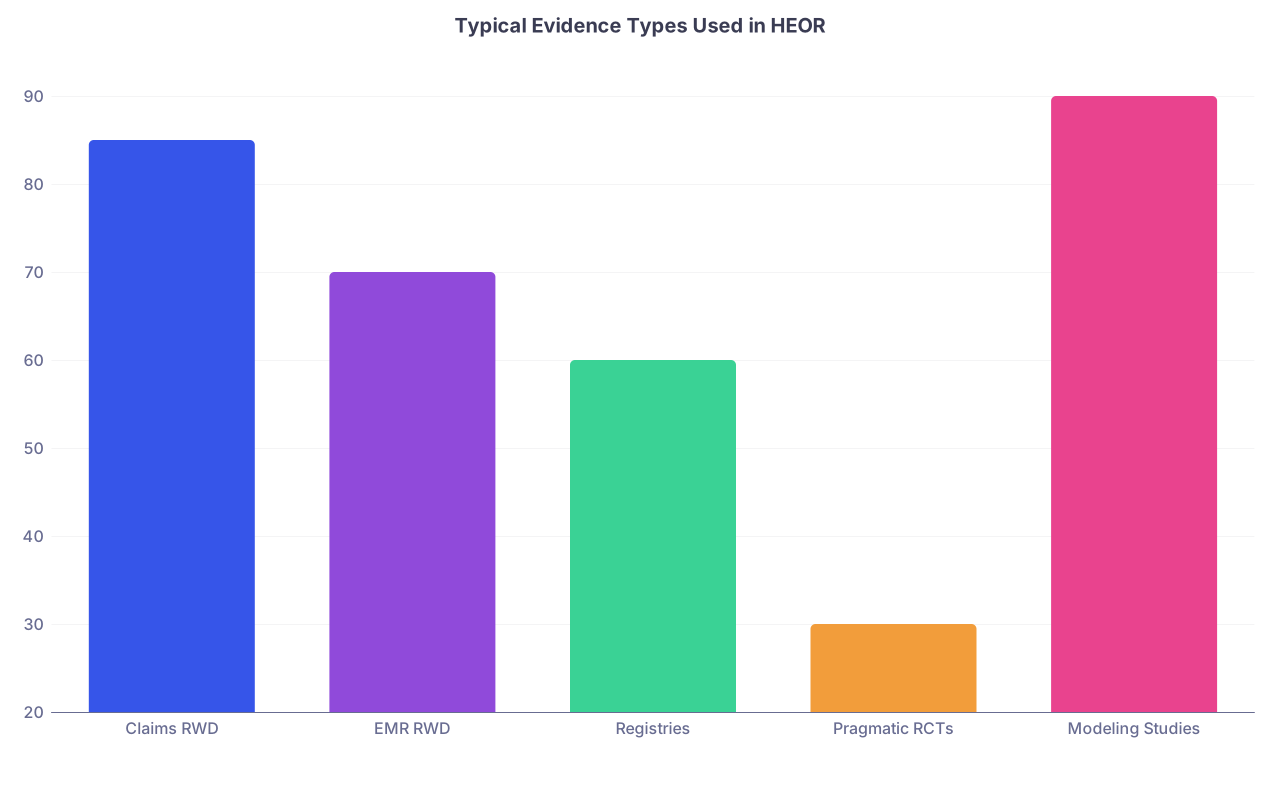
| Category | Value |
|---|---|
| Claims RWD | 85 |
| EMR RWD | 70 |
| Registries | 60 |
| Pragmatic RCTs | 30 |
| Modeling Studies | 90 |
Those percentages are roughly how frequently you will see these in an active HEOR portfolio at a mid- to large-size biopharma company.
3. Building and Defending Economic Models
This is the part most clinicians underestimate.
You are often responsible (with health economists and modelers) for cost-effectiveness and budget impact models that will be scrutinized by HTA bodies like:
- NICE (UK)
- CADTH (Canada)
- HAS (France)
- IQWiG/G-BA (Germany)
Your fingerprints are all over:
- The structure of the model: Markov states, treatment sequences, time horizon, cycle length
- Clinical inputs: transition probabilities, discontinuation rates, AE rates, long-term outcomes
- Utility values: mapping quality of life from trial PROs to QALYs
- Realistic comparators: which drugs are actually used in that country, line of therapy, and patient subgroup
The economist sets up the math. You decide whether the math describes the disease credibly.
Example: metastatic NSCLC model
You argue that:
- OS extrapolation using an exponential curve is absurd when there is a tail of long-term survivors. You push for flexible hazard models or mixture-cure models.
- Progression state utilities should not be a single static number for all lines. Post-3L treatment QoL is not remotely the same as 1L post-progression.
Then you go sit in a meeting with an HTA body (or a national payer) and defend those choices. Line by line.
If you are good, you are not a passive participant. You are the one saying, “If you force us to use this comparator and this time horizon, the ICER will look worse, but that scenario does not reflect clinical practice in 2026.”
4. Guiding Market Access and Pricing Decisions
This is where the money talks.
HEOR physicians in industry often work hand-in-glove with:
- Global pricing and market access teams
- Country-level market access leads
- Value and access strategy teams
You help answer:
- At what price does this product remain cost-effective vs current standard-of-care in major markets?
- How should we position it in the treatment pathway to maximize both patient benefit and payer acceptance?
- What evidence must we have at launch to avoid being locked into a low-price, low-access tier?
You will see (and influence) scenarios like:
- Pricing higher but restricted to biomarker-positive or high-risk subgroups where the value is clearly superior
- Accepting a lower price but aiming for broad first-line reimbursement
- Sequencing strategies: e.g., launching in second-line while collecting RWD to support future first-line expansion
You are the reality check when someone in marketing wants to claim “transformational value” for a drug that offers a 3% absolute risk reduction in MACE with marginal QoL benefits and a huge acquisition cost.
5. Writing and Owning HEOR Evidence Packages
There is a lot of writing. Not fluff. Dense, technical writing that will be picked apart by hostile experts.
You will be involved in:
- Global value dossiers (GVDs)
- AMCP dossiers (for US payers)
- HTA submissions (NICE, CADTH, etc.)
- Peer-reviewed manuscripts from RWD and economics studies
- Conference abstracts and posters (ISPOR, ASCO, ESC, etc.)
Your role:
- Ensure clinical accuracy and plausibility in every claim and assumption
- Align the HEOR narrative with clinical trial data, safety profile, and label
- Anticipate payer/HTA objections and preemptively address them in the evidence package
You might be revising a 300-page HTA submission and arguing over a single phrase like “clinically meaningful.” Because that phrase will determine whether an ICER threshold is seen as justified.
6. Internal Education and Strategy
Inside a company, the HEOR physician is often the person explaining to other physicians why “great clinical data” is not enough.
You will:
Educate clinical development teams:
“If you do not collect robust PROs or resource utilization in Phase 3, we will have a nightmare building credible economic models. Add them now.”Push commercial teams toward reality:
“U.S. payers will not pay $X for a drug with no mortality benefit, a modest QoL gain, and frequent lab monitoring. Unless we show strong hospitalization reductions in RWD.”Influence pipeline decisions:
You review early assets and say bluntly: “This mechanism is interesting, but the incremental value over generics will be impossible to justify in most markets. Unless it has a very specific niche population or a strong adherence advantage.”
You become that irritating but necessary voice that keeps the entire organization grounded in actual value, not just hype.
Daily Workflows: What Your Week Actually Looks Like
Let’s get concrete.

| Step | Description |
|---|---|
| Step 1 | Clinical Question |
| Step 2 | Study Concept |
| Step 3 | Protocol and Model Design |
| Step 4 | Data Analysis and Modeling |
| Step 5 | Interpretation and Story |
| Step 6 | Manuscripts and Dossiers |
| Step 7 | Payer and HTA Engagement |
A typical week for a physician in HEOR (industry setting) might involve:
Monday
Global HEOR strategy call for a new oncology asset. Debate: which countries need dedicated cost-effectiveness models vs scenario analyses only. You push for a registry in Germany due to unique practice patterns.Tuesday
Review of RWD study outputs from a claims-based adherence analysis. You spot a clearly wrong age distribution in the “pediatric” subset. You send it back, explaining which ICD codes are misclassifying congenital vs acquired disease.Wednesday
Half-day workshop with pricing and market access. You walk through 3 pricing scenarios and explain how each would affect adoption in high-volume health systems. You argue for slightly lower list price with strong outcomes-based contract potential in Italy and Spain.Thursday
Co-author manuscript on a budget impact model for a rare disease therapy. You fix the language describing “natural history” because the economist wrote something that would make any neurologist cringe.Friday
Prep for a NICE scientific advice meeting. You and the economist rehearse your defense of a partitioned survival model vs a Markov model and your chosen comparators.
You are not in clinic. You are not admitting patients. But your decisions indirectly affect thousands of treatment decisions per month.
Where HEOR Physicians Work (And How Roles Differ)
There are three main ecosystems.
| Setting | Primary Focus | Typical Title |
|---|---|---|
| Pharma/Biotech | Product value & access | Director/Medical Director HEOR |
| Consulting (HEOR/RWE) | Project-based evidence | HEOR Consultant/Principal |
| Payers/HTA/Systems | Coverage & policy | Medical Director, Outcomes/Policy |
Pharma/Biotech
This is where most HEOR physician roles live.
- You own HEOR strategy for one or more products or a therapeutic area.
- You interact with clinical development, medical affairs, market access, and commercial.
- Your impact is broad but tied to the success of specific assets.
Pros: strong compensation, clear career ladder (Associate Director → Director → Senior Director → VP), stable.
Cons: politics, slow decision cycles, you are always tethered to the company’s pipeline and portfolio priorities.
Specialized HEOR / RWE Consulting
Think outfits like RTI Health Solutions, Cytel, IQVIA, various boutique HEOR firms.
- You work project-by-project for multiple clients.
- You may be more hands-on with study design and publications.
- Broader exposure, less internal politics of a single company.
Pros: variety of therapeutic areas, quicker cycles, consultative influence.
Cons: billable hours, client-facing pressure, potentially less strategic ownership of any one product.
Payers / HTA / Health Systems
Working for:
- National HTA agencies
- Large insurers
- Integrated delivery systems / ACOs
You are on the receiving end of HEOR evidence.
- You critically evaluate company submissions.
- You design coverage policies and value-based contracts.
- You may run internal outcomes studies on real-world performance of therapies.
Pros: direct policy impact, intellectually honest environment (less commercial spin), interesting debates.
Cons: lower compensation than industry, sometimes slower academic/bureaucratic pace, less control over the evidence you receive.
Skills You Actually Need (Beyond “Being a Doctor”)
A medical degree alone does not make you useful in HEOR. It just opens the door. Here is what makes you effective once you walk in.
1. Comfort with Data and Methods
You do not need to write multilevel models from scratch. You do need to:
- Understand confounding, selection bias, immortal time bias, time-varying covariates, propensity scores, instrumental variables, etc.
- Read a claims-based cohort study and instantly see if their definition of “treatment exposure” makes sense.
- Know when a hazard ratio is clinically plausible, or when someone tortured the data.
Basic competence with R, SAS, or Python is a plus, but physicians in senior HEOR roles often spend more time reviewing and guiding than coding. You must still speak the language.
2. Health Economics Fundamentals
You must understand:
- Incremental cost-effectiveness ratios (ICERs)
- QALYs and utilities
- Discounting and time horizons
- Budget impact vs cost-effectiveness
- Different willingness-to-pay thresholds by country
You do not get to say “I’m not an economist” every time a model assumption comes up. You are expected to know why a lifetime horizon matters for chronic diseases, and when a shorter horizon is defensible.
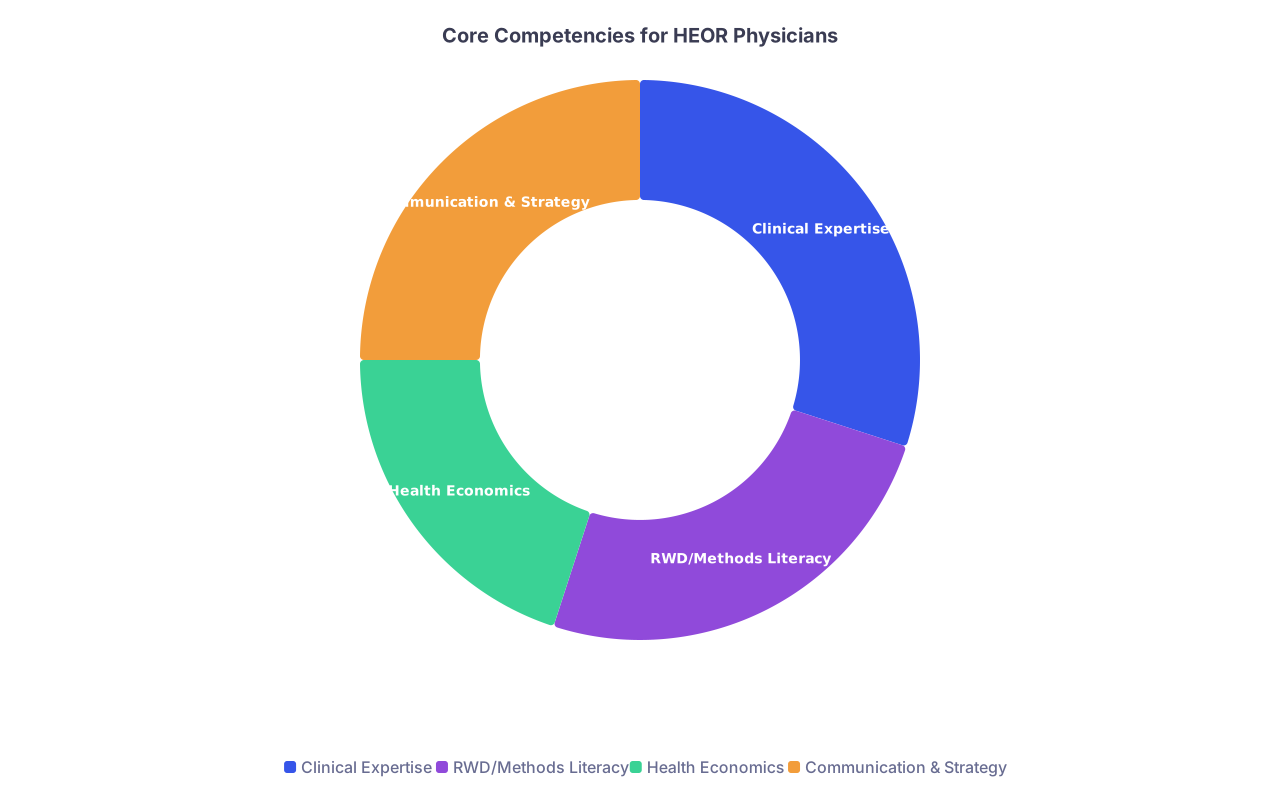
| Category | Value |
|---|---|
| Clinical Expertise | 30 |
| RWD/Methods Literacy | 25 |
| Health Economics | 20 |
| Communication & Strategy | 25 |
3. Communication Under Scrutiny
A huge amount of your impact is how you explain things:
- To internal executives with limited patience
- To external HTA bodies who assume you are biased
- To clinicians who do not trust “economic” arguments
You must be able to say, succinctly:
- “The ICER is favorable in high-risk patients but borderline in low-risk; we should target reimbursement accordingly.”
- “The real-world adherence in these claims data is worse than in trials, which reduces the practical effectiveness and thus real-world value. We should be honest about that.”
If you cannot explain your own models and RWE in English, you are not useful.
4. Tolerance for Ambiguity and Trade-offs
This is not a field for people who need black-and-white answers.
You will spend your career living in “probably good enough to support this decision” territory.
And you will face ethical friction:
- High-value drug, very high cost, budget-constrained health systems.
- Uneven global access despite strong evidence.
- Situations where the best strategy for the company is not the ideal strategy for every individual patient.
You must have a spine. And a clear internal line you will not cross in how you present and interpret evidence.
Who Is a Good Fit? (And Who Will Hate This)
You will likely do well in HEOR as a physician if:
- You genuinely enjoy population-level thinking more than individual-case heroics.
- You find yourself questioning resource use and marginal benefit on rounds.
- You like reading not just NEJM RCTs but also the supplemental economic analyses and value frameworks.
- You do not need the emotional gratification of direct patient care day-to-day.
You will probably hate HEOR if:
- You despise spreadsheets, models, or any abstraction away from individual patients.
- You need immediate feedback and “thank you doctor” interactions.
- You have zero patience for long strategy meetings or cross-functional compromise.
- You think economics contaminates “pure” medicine. HEOR is unapologetically about constrained resources.
Training Pathways Into HEOR for Physicians
There is no single required path, but there are patterns that work.
Common backgrounds:
- Internal medicine, oncology, cardiology, neurology, psychiatry, primary care, public health
- Some with residency + board certification, some who stopped after internship, some with dual MD/PhD in outcomes or epidemiology
Useful add-ons:
- MPH with concentration in epidemiology or health policy
- MSc in health economics, outcomes research, or pharmacoepidemiology
- Postdoc or fellowship in outcomes research (e.g., at an academic center partnered with a health system or payer)
- Industry fellowships (pharma HEOR or RWE)
The physicians who transition smoothly typically:
- Have at least some research output in RWE or health services research
- Can talk through a paper using administrative data without getting lost
- Can articulate how a health system or payer actually decides coverage
Where HEOR Is Going (And What That Means for You)
HEOR is not a side niche anymore. It is central to how modern medicine gets paid for.
You will see:
- Explosion of RWD: More EMR-linked datasets, registries, and digital health data. The noise will increase; good HEOR physicians will be those who can separate signal from garbage.
- Outcomes-based contracts: More deals tying payment to outcomes; HEOR physicians will design the metrics and the evaluation frameworks.
- Personalized pricing and indication-specific value: One product, multiple prices and reimbursement rules across indications and lines of therapy. Hypercomplex. Very HEOR-heavy.
- Global pressure on drug prices: As budgets tighten, HEOR will be weaponized on all sides. If you are in the field, you will be in the line of fire.
This is not a fading backwater. It is moving closer to the core of how care gets financed and delivered.
FAQ (Exactly 5 Questions)
1. Do you need to complete a full residency to work in HEOR as a physician?
No. A completed residency and board certification help, especially for credibility with clinicians and payers, but they are not strictly required. Many successful HEOR physicians finished internship and then did an MPH or outcomes research fellowship. What matters more is your grasp of methods, your ability to think at population level, and evidence that you can contribute meaningfully to HEOR work.
2. How is HEOR different from “medical affairs” in pharma?
Medical affairs focuses on communicating clinical and scientific data to clinicians, opinion leaders, and sometimes payers—disease education, field MSL support, advisory boards. HEOR is about quantifying value: cost-effectiveness, real-world outcomes, impact on resource use, and formal payer/HTA evidence. There is overlap, and you will collaborate, but HEOR is more methodologically and economically driven.
3. Is HEOR mostly statistics and coding all day?
For physicians, no. You need to understand the methods and be able to critique analyses, but you are usually not the primary programmer. Biostatisticians and data scientists handle the heavy coding. Your main contributions are in framing clinical questions, defining meaningful outcomes and cohorts, ensuring clinical plausibility, and defending the evidence to decision-makers.
4. Can you return to clinical practice after working in HEOR?
It is possible, but the longer you are out, the harder it gets—in terms of credentialing, skills, and licensing requirements. Some physicians maintain part-time clinical work while in HEOR; others accept that their clinical career is essentially over after several years in industry or policy roles. If preserving the option to return is important to you, keep at least some connection to patient care early on.
5. What is the earning potential for a physician in HEOR?
In large pharma, physicians in HEOR often earn compensation comparable to or exceeding many non-procedural specialties, especially at Director and above levels. Exact numbers vary by geography, company, seniority, and whether you are in a leadership track. Consulting and payer roles may pay less than big pharma but still provide solid income, especially with experience and leadership responsibilities.
Key takeaways:
- A physician in HEOR is not just “doing stats”; they are shaping which interventions the system will actually fund, based on real-world outcomes and economic value.
- The core of the role is translating messy data and complex models into defensible, clinically grounded arguments that payers and HTA bodies will accept.
- For physicians who think in populations and care about how medicine is paid for—not just how it is practiced—HEOR is one of the most consequential nonclinical careers you can choose.