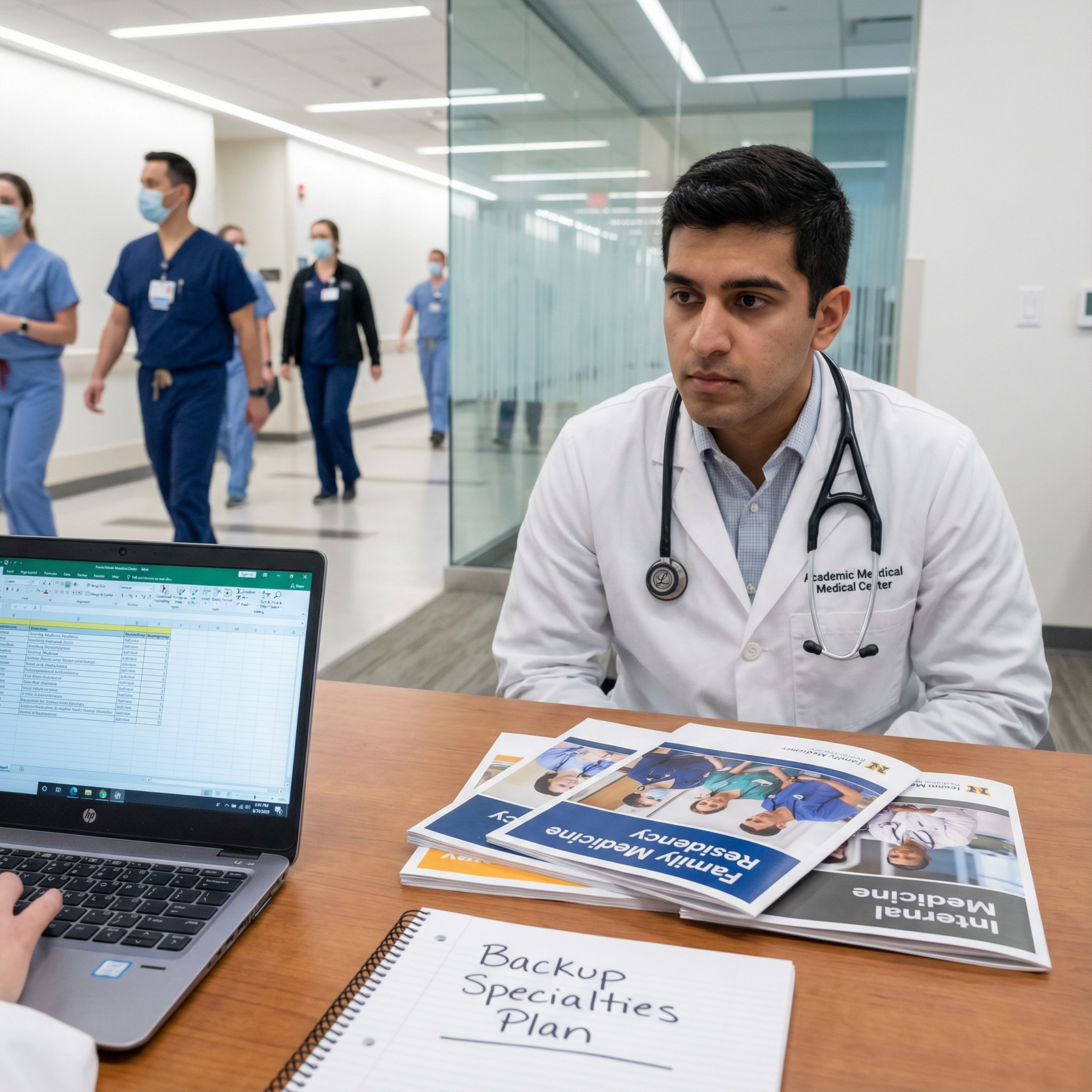
Choosing backup specialties is one of the most strategic—and often underappreciated—parts of residency career planning. For many medical students, the primary specialty choice (dermatology, orthopedic surgery, radiology, etc.) receives most of the attention, while backup plans are rushed, vague, or based on wishful thinking. In today’s highly competitive Residency Match environment, that approach can be costly.
Thoughtful Backup Specialty Strategies can dramatically improve your chances of a successful Residency Match while still keeping you on track for a satisfying long‑term career in medicine. This guide walks through the most common pitfalls students encounter when choosing backup specialties and offers practical, step‑by‑step strategies to avoid them.
Understanding Why Backup Specialties Matter in Residency Planning
Backup specialties are not simply “second-best” options—they are an integral part of smart Healthcare Careers planning.
The Reality of Competition in Medical Specialties
Some Medical Specialties are far more competitive than others due to limited positions, high applicant interest, or both. Examples include:
- Dermatology
- Plastic surgery
- Orthopedic surgery
- Neurosurgery
- Otolaryngology (ENT)
- Interventional radiology
- Certain road specialties in competitive markets (e.g., certain anesthesiology or radiology programs)
Even highly qualified applicants can go unmatched in these fields. Data from the NRMP (National Resident Matching Program) consistently show that:
- A non-trivial percentage of U.S. seniors go unmatched each year.
- Unmatched rates are significantly higher in certain specialties.
- Many applicants to very competitive fields submit applications to backup specialties but do so in ways that are poorly aligned or rushed.
Having a realistic, well-thought-out backup plan:
- Increases your overall chances of matching.
- Gives you more psychological peace during application season.
- Helps you avoid last-minute, chaotic decisions in the SOAP (Supplemental Offer and Acceptance Program).
How Backup Specialties Broaden Skills and Career Options
Backup specialties can also expand your clinical skills and long-term career flexibility:
- Clinical exposure: Rotating through different fields deepens your understanding of patient care and systems-based practice.
- Skill diversity: For example, a student interested in orthopedics may gain strong musculoskeletal exam skills through a physical medicine & rehabilitation (PM&R) backup.
- Future transitions: Physicians sometimes change directions later in their careers (e.g., internal medicine to palliative care, surgery to wound care or hospital administration). A broad early skill set supports those transitions.
When integrated thoughtfully into Career Planning, backup specialties are not a sign of lack of commitment—they are a sign of strategic thinking.
Job Security and the Changing Healthcare Landscape
The healthcare system is evolving rapidly:
- Shifts in reimbursement models
- Increased emphasis on outpatient and preventive care
- Changes in subspecialty demand based on population needs
- Telemedicine expansion and regional job market differences
Certain fields—such as primary care, hospitalist medicine, psychiatry, and some outpatient specialties—often offer robust job markets in many regions. Including such options in your backup Specialty Strategies can:
- Improve post-residency employment prospects
- Increase geographical flexibility
- Reduce the risk of graduating into a saturated job market in a very narrow field
Laying the Foundation: Key Considerations Before You Choose Backups
Before diving into specific pitfalls, it’s important to clarify your own priorities and constraints.
Clarify Your Primary Specialty and Commitment Level
Ask yourself:
- How competitive is my primary specialty historically and at my Step scores / academic metrics?
- Have I realistically assessed my competitiveness (with mentors, not just peers)?
- Am I 100% committed to this path, or do I already have doubts?
Your answers will influence the strength and structure of your backup strategy:
- Ultra-competitive specialty applicants (e.g., derm, plastics, ortho) often need a robust, clearly defined backup plan early (end of MS3 or beginning of MS4).
- Moderately competitive specialty applicants (e.g., EM, OB/GYN, anesthesiology in some regions) may create more targeted or region-based backup plans.
- Applicants to less competitive specialties may still benefit from backups based on geography or program type.
Understand Your Non-Negotiables
Reflect on what matters most to you in a Healthcare Career:
- Lifestyle and work hours
- Patient population (adult vs pediatric vs mixed)
- Level of procedural work
- Long-term subspecialty options
- Geographic flexibility
- Academic vs community practice
Once you understand your non-negotiables, you can better judge whether potential backup specialties are truly viable for you—or just “panic picks” you wouldn’t actually enjoy.

Common Pitfalls in Choosing Backup Specialties—and How to Avoid Them
1. Narrow Thinking: Choosing Backups Too Similar to Your Primary Specialty
A frequent error is creating a backup list that looks just like your primary choice in terms of competitiveness, workload, or training path.
Examples:
- Applying to orthopedic surgery as primary and neurosurgery or plastic surgery as backups.
- Applying to dermatology and “backing up” with ophthalmology or radiology without acknowledging that all are highly competitive.
- Only choosing subspecialties within the same highly competitive umbrella.
If your backups are equally competitive—or require very similar metrics, research, and letters—you may not be improving your Match odds at all.
How to Avoid This Pitfall
Segment your choices by competitiveness:
- Tier 1: Very competitive (e.g., derm, plastics, ortho)
- Tier 2: Moderately competitive (e.g., EM, radiology, ENT in some markets, anesthesiology)
- Tier 3: Less competitive, high-demand areas (e.g., family medicine, internal medicine, psychiatry, pediatrics)
Include at least one specialty in a lower competitiveness tier that you can genuinely see yourself practicing.
Think in terms of roles, not labels:
- Love procedures and critical care? Consider anesthesiology, EM, or surgery-based fields.
- Prefer continuity and long-term relationships? Consider family med, internal med with outpatient focus, or pediatrics.
A balanced list may look like:
- Primary: Orthopedic Surgery
- Backup 1: PM&R (similar patient population, MSK focus, more attainable)
- Backup 2: Internal Medicine with plan for sports medicine fellowship
This shifts you from “all-or-nothing” to a layered approach where every step is still purposeful.
2. Overemphasizing Passion While Ignoring Reality
Passion is vital—but it is not sufficient on its own. Some students choose backup specialties solely because they “like” them, without considering:
- Actual job market needs
- Geographic distribution of jobs
- Lifestyle sustainability over decades
- Burnout rates and satisfaction data
- Compensation relative to training length and responsibilities
For example, “I love the OR” might lead you to list several surgical specialties as backups, but if you haven’t considered call schedules or long-term physical demands, you may be overlooking deal-breakers.
How to Balance Passion with Practicality
Study objective data:
- AAMC Careers in Medicine specialty profiles
- NRMP Program Director survey results
- Medscape Physician Compensation and Lifestyle Reports
- State workforce reports for physician shortages
Ask targeted questions when you shadow or rotate:
- “How has your work-life balance changed over time?”
- “What are job prospects like for new grads in your field?”
- “If you were choosing again, would you pick this specialty?”
Consider your long-term life goals:
- Family planning, caregiving responsibilities, or desire to live in certain regions may make some specialties more or less practical as long-term careers.
Optimizing Residency Match outcomes means balancing what excites you with what is realistically sustainable.
3. Superficial or Incomplete Research on Backup Specialties
Another common pitfall is assuming you “know” a specialty based on:
- A single rotation
- A charismatic attending
- Television portrayals or secondhand anecdotes
- A brief shadowing experience
This can result in choosing a backup that feels appealing on the surface but doesn’t actually fit your day-to-day preferences or values.
How to Deepen Your Research
Multiple types of exposure:
- Core rotation (if available)
- Sub-internship or elective in that field
- Shadowing in both academic and community settings
- Participation in the specialty’s interest group
Deliberate observation:
- Track what percentage of time physicians spend on documentation, procedures, patient interaction, and team coordination.
- Notice how the team handles emergencies, conflict, and work overflow.
Use professional resources:
- Specialty society websites (e.g., American College of Physicians, American Academy of Family Physicians)
- AAMC Careers in Medicine for in-depth specialty descriptions
- Local or national specialty conferences—many have special tracks or discounts for students.
The more realistic your understanding, the less likely you are to regret your backup choice after Match Day.
4. Ignoring Your Own Personality, Strengths, and Limitations
Liking a specialty does not guarantee you will thrive in it. Misalignment between your personal attributes and a specialty’s core demands is a major cause of burnout and dissatisfaction.
Consider:
- Tolerance for uncertainty vs desire for definitive answers
- Need for hands-on procedures vs preference for cognitive problem-solving
- Energy level and comfort with long or irregular hours
- Communication style and comfort with difficult conversations
Tools and Strategies for Self-Assessment
Formal tools (as starting points, not absolutes):
- Myers-Briggs Type Indicator (MBTI)
- Holland Code (RIASEC) career interests
- CliftonStrengths (formerly StrengthsFinder)
Informal reflection:
- Journaling after rotations: When did you feel most energized vs drained?
- Noting team environments where you felt you “fit in” naturally.
- Asking trusted peers and mentors: “In what types of situations do you see me at my best?”
Matching Traits to Specialty Demands
Enjoy calm, detailed cognitive work, pattern recognition, and less patient-facing time?
- Consider radiology or pathology as potential backups.
Thrive in high-acuity, fast-paced environments with frequent decisions under pressure?
- Emergency medicine, certain surgical specialties, or critical care-focused careers may fit.
Value continuity, communication, and longitudinal relationships?
- Family medicine, general internal medicine, or pediatrics could align well.
By aligning backups with your authentic strengths, you protect yourself from trading one mismatch for another.
5. Underestimating Lifestyle and Wellness Implications
Lifestyle is not a dirty word—it is a legitimate and important part of Career Planning. Different Medical Specialties have very different profiles when it comes to:
- Call schedules and night shift frequency
- Weekend and holiday coverage
- Outpatient vs inpatient workloads
- Control over schedule and clinic volume
- Flexibility for part-time work or nonclinical interests
Some students choose backup specialties that look attractive on paper but would clash sharply with their long-term wellness needs.
How to Accurately Assess Lifestyle
Ask specific, not generic, questions:
- “How many nights per month are you on call, on average?”
- “How much of your charting do you complete at home?”
- “What percentage of your colleagues work part-time or have flexible schedules?”
Use aggregate data:
- Medscape Lifestyle & Happiness Reports
- Specialty satisfaction and burnout statistics from professional societies
Visualize your future:
- Where do you see yourself 10–15 years out?
- What non-work commitments do you anticipate (family, hobbies, community roles)?
- Does the backup specialty allow realistic space for those priorities?
Lifestyle should not be the only factor, but ignoring it almost always leads to regret.
6. Overlooking Geography and Location-Based Career Factors
Demand for certain specialties can vary dramatically by region and practice setting:
- Rural areas may urgently need primary care, general surgery, anesthesia, and psychiatry.
- Urban academic centers may have saturated markets in some subspecialties.
- Some states or regions offer loan repayment or bonus incentives for specific fields.
If you have strong geographic preferences (near family, specific cities, or regions), location should influence your Backup Specialty Strategies.
How to Incorporate Location into Your Backup Planning
Review workforce and Match data:
- AAMC and state workforce reports on specialty shortages
- NRMP data on Match outcomes by region or state
- Program websites for information on where graduates practice
Consider rural vs urban fit:
- Some specialties offer broader scopes and leadership opportunities in rural settings.
- Others may be concentrated in large academic hospitals.
Think in “regional tiers”:
- If you are geographically flexible, your backup strategy may be broader and more forgiving.
- If you’re tied to a narrow region, you may need to incorporate less-competitive specialties to preserve your chance of matching where you want to live.
Location is not just about where you train, but where you can realistically see yourself practicing and thriving long term.
7. Failing to Seek Mentorship and Honest Feedback
One of the biggest mistakes in Residency Match planning is trying to design your specialty and backup strategy in isolation.
Common issues when mentorship is missing:
- Overestimating or underestimating your competitiveness
- Not recognizing which experiences or letters are strongest
- Misaligning your backup specialty with your actual track record and application narrative
- Missing “hidden” pathways (e.g., preliminary years, combined programs, or long-term fellowship paths that align with your goals)
Building a Strong Mentorship Network
Identify at least two to three mentors:
- One in your primary specialty
- One in a potential backup specialty
- One general advisor (e.g., dean’s office, career advisor, or trusted faculty member)
Prepare for meetings:
- Bring an updated CV and a draft of your specialty interests.
- Ask directly: “Based on my record, what do you think about my competitiveness for X? What backup options would you realistically recommend?”
Seek specialty-specific guidance:
- Some specialties have known “pairings” for backups (e.g., EM with internal medicine, ortho with PM&R). Mentors can clarify which options are realistic for you.
Revisit your plan periodically:
- Early MS4 (or equivalent) is often a key pivot point where performance on away rotations, sub-Is, and new exam scores may affect strategy.
Mentorship transforms your plan from theoretical to realistic.

Putting It All Together: Building a Coherent Backup Specialty Strategy
A well-designed backup strategy should be:
- Aligned with your skills, values, and life goals
- Realistic based on your academic profile and clinical performance
- Structured with clear tiers and priorities
- Intentional rather than last-minute or random
Practical Steps to Design Your Backup Plan
Assess your primary specialty competitiveness
- Review board scores, clerkship grades, research, and letters with a mentor.
- Compare with recent Match data for your specialty.
Define 1–3 plausible backup specialties
- Ensure at least one is meaningfully less competitive than your primary choice.
- Confirm you could envision a satisfying long-term career in each.
Tailor your experiences
- Schedule at least one elective or sub-I in your top backup specialty if possible.
- Seek at least one strong letter from faculty in that backup field.
Adjust your application strategy
- Craft personal statements that are authentic and specific to each specialty.
- Apply broadly enough in both your primary and backup specialties, considering program tiers and geography.
Maintain flexibility
- Be open to revisiting your plan as you receive feedback from away rotations, mentors, and interview invitations.
- Have a realistic SOAP plan in mind in case Match outcomes are not as expected.
Frequently Asked Questions About Choosing Backup Specialties
1. How many backup specialties should I consider?
Most students do well with one carefully chosen primary backup specialty, and occasionally a second if:
- Their primary specialty is extremely competitive, and
- They are geographically limited or have significant academic concerns.
What matters more than the exact number is that each specialty:
- Is one you can genuinely see yourself practicing.
- Represents a different competitiveness and/or practice profile than your primary choice.
- Is supported by at least some targeted experiences (rotation, letter, or research if possible).
2. Can I change my backup specialty choices late in the process?
You can adjust your strategy, but late changes have trade-offs:
- Pros: Reflects new insights, improved self-knowledge, or updated performance.
- Cons: Less time to gain exposure, secure strong letters, or craft a compelling application.
Ideally, you should:
- Narrow your short list of primary and backup specialties by the end of core clinical rotations.
- Finalize your backup strategy before ERAS opens, leaving room for minor adjustments only.
If you do pivot late, prioritize talking with mentors and honestly assessing what you can still realistically accomplish.
3. How can I explore multiple specialties without overloading my schedule?
You can be strategic rather than exhaustive:
- Use core clerkships to actively compare and contrast specialties.
- Choose electives that “double count” toward both primary and backup interests (e.g., ICU for EM and anesthesia; MSK or sports med electives for ortho and PM&R).
- Attend lunchtime talks, interest group events, and panels from several fields early in MS2 and MS3.
- Shadow for half-days rather than full weeks when exploring a new area.
The goal is informed sampling, not trying to fully experience every option.
4. Should I let my friends’ choices influence my backup specialties?
Peer input can be helpful for emotional support or discovering new fields, but:
- Do not choose a backup solely to be near friends or match into the same programs.
- Your values, strengths, and personal circumstances may differ dramatically from your peers’.
- A specialty that excites your classmate might be a poor fit for your personality or long-term goals.
Use peers as sounding boards—not as templates—for your own decisions.
5. What if I don’t feel strongly drawn to any specialty, even as a backup?
Many students feel uncertain longer than they admit. If you don’t have a clear passion:
- Focus on fit rather than “love at first sight”: Which specialties feel most sustainable and least draining day-to-day?
- Prioritize broad-based fields (e.g., internal medicine, family medicine, pediatrics) that allow future subspecialization.
- Work closely with career advisors and mentors to reflect on your clinical experiences.
- Consider your non-negotiables: schedule, patient population, geography, and tolerance for uncertainty.
Remember: many physicians grow into their specialties over time. It is more important to choose a field that aligns reasonably well with your strengths and values than to wait for a perfect “calling.”
Thoughtful backup planning is an essential part of modern Residency Match and Career Planning. By avoiding narrow thinking, grounding your decisions in realistic data, aligning choices with your authentic strengths and lifestyle needs, and actively leveraging mentorship, you can build Backup Specialty Strategies that protect your Match odds without sacrificing long-term satisfaction in your Healthcare Career.