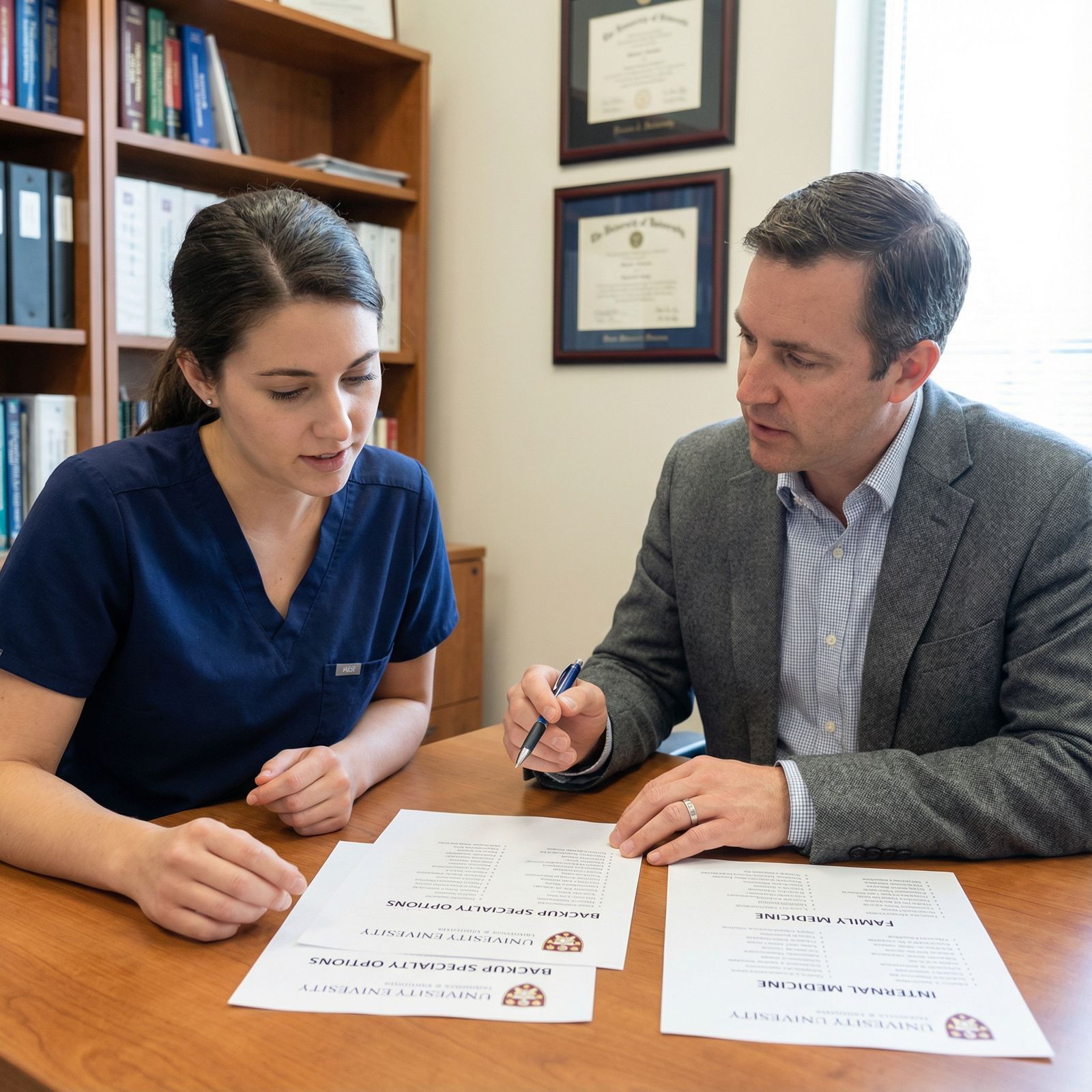
Understanding the Landscape: Urology Match as a Caribbean IMG
For a Caribbean IMG aiming for urology, backup specialty planning is not a sign of pessimism—it’s strategic risk management.
Urology is:
- Small (limited number of positions nationwide)
- Competitive (strong applicants, many with research and home‑program advocacy)
- Less IMG‑friendly than many core specialties
As a Caribbean graduate, you face additional barriers:
- Perception issues around Caribbean medical school residency applicants (concerns about clinical exposure, grading rigor, and exam preparation)
- Less access to home academic urology departments
- Fewer built‑in research and networking opportunities
This doesn’t mean you can’t match. Every year, SGU residency match data and other Caribbean medical school residency reports show successful matches into urology and other competitive fields. But the numbers are small and the margin for error is thin.
That’s why you should think in two parallel tracks from day one of planning:
- Primary Track: Maximize your competitiveness for the urology residency match.
- Backup Track: Intentionally prepare a credible, coherent backup specialty (or two) through dual applying residency strategies.
Your goal is not to “give up” on urology but to ensure that, no matter what happens on Match Day, you land in a specialty where you can build a satisfying career.
Step 1: Clarify Your Risk Profile and Goals
Before you select a backup specialty, you need a clear-eyed view of your competitiveness and your priorities.
Key Factors to Assess
USMLE Performance
- Step 1 (Pass/Fail): Passing on first attempt is now a basic gatekeeper. Any failure will significantly hurt urology prospects.
- Step 2 CK: For urology, you generally want a strong score (often > 240 is considered competitive, though there is no magic cutoff).
Action: Compare your score to recent urology match data and IMG match statistics (AUA and NRMP reports).
Clinical Performance and Letters
- Honors or high passes in surgery and surgery subspecialty rotations help.
- Strong letters from urologists—ideally from US academic or large community programs—are almost mandatory.
- As a Caribbean IMG, letters that specifically endorse your ability to perform at the level of US grads hold extra weight.
Research and Scholarly Activity
- Urology is research‑heavy. Publications, posters, and QI projects in urology (or at least surgery) can move the needle.
- From Caribbean schools, SGU residency match and similar data suggest that those IMGs who match urology often have robust research exposure.
Geographic Flexibility
- Are you willing to go anywhere in the US?
- Limiting yourself to a few cities or states drastically increases your risk in a small specialty like urology.
Personal Constraints
- Visa needs (J‑1 vs H‑1B), family ties, financial obligation to match quickly, need for a shorter vs longer training path.
Use This to Define Your Match Strategy
Ask yourself:
- “If I were a US PD looking at my file, would I view myself as a strong, moderate, or high‑risk urology applicant?”
- “If I don’t match urology this year, what are my realistic options—and am I okay with reapplying vs moving forward in another field?”
Your honest answers will guide:
- How aggressively you pursue urology programs.
- How broad and serious your dual applying residency plan must be.
- Whether you aim for a surgical plan B specialty, a medical specialty, or a more IMG‑friendly field.
Step 2: Choosing the Right Backup Specialty (Plan B)
Your backup specialty should not be random. As a Caribbean IMG pursuing urology, your plan B specialty must:
- Be realistically attainable for your profile.
- Align with your skills and interests (so you’re not miserable if you end up there).
- Tell a coherent story that still makes sense given your urology‑focused background.
Common Plan B Options for Urology Applicants
Below are frequently considered backup specialties and how they fit the Caribbean IMG urology applicant.
1. General Surgery
Why it fits:
- Overlapping skillset: operating room, anatomy, procedural focus.
- Your urology‑targeted experiences (surgery sub‑internships, urology rotations, surgical research) look highly relevant.
- From general surgery, you might later apply for urology again (very uncommon, but pathways exist via prelim years or reapplications).
Pros:
- Clear alignment: you can credibly say, “I love operating and surgical problem‑solving.”
- PDs see you as someone already oriented towards surgical training.
- Some programs are more receptive to Caribbean graduates, especially community‑based.
Cons:
- Also competitive and can be stressful (long hours, high attrition).
- Not a guaranteed match as a Caribbean IMG, especially if you have weak scores or red flags.
- If you fail to match both urology and general surgery, you’re in a very tight spot.
Best for: Caribbean IMG with strong Step 2 CK, solid surgery letters, and genuine enthusiasm for a surgical career even outside urology.
2. Internal Medicine
Why it fits:
- Broad, relatively IMG‑friendly; many Caribbean medical school residency outcomes show IM as a common successful destination.
- Many positions nationwide, including institutions with urology departments (useful if you consider future reapplying or research).
Pros:
- Higher probability of matching with decent scores and no major red flags.
- Tremendous flexibility for fellowships (e.g., nephrology, oncology, hospital medicine, critical care).
- Easier to reconcile in your narrative by emphasizing “interest in genitourinary diseases, systemic illness, and long‑term patient care.”
Cons:
- Less procedural than urology; may not scratch your surgical itch.
- Some IM programs might question why a “surgical type” is dual applying; you must answer this convincingly.
Best for: Applicants who want a safer plan B with strong job security and are open to a non-surgical yet intellectually challenging career.
3. Transitional Year (TY) or Preliminary Surgery
Why it fits:
- Used by many urology applicants; urology is an early match with a separate supplemental process.
- If unmatched, you might still secure a TY or prelim spot and try to reapply later.
Pros:
- Keeps you close to surgical fields.
- Buys you time in the US system, where you can earn new letters, research, and exposure.
- Some prelim surgery years have solid pathways into categorical general surgery or other fields.
Cons:
- No guarantee of a categorical slot after that year.
- Highly stressful if you still end the year without a next step.
- As a Caribbean IMG, landing a desirable prelim or TY can still be competitive.
Best for: Highly driven applicants who are willing to accept uncertainty for another year to chase urology or another surgical field.
4. Other Surgical Subspecialties (ENT, Ortho, Plastics, Neurosurgery)
For a Caribbean IMG in urology, these are generally not recommended as a realistic backup specialty. They are typically:
- Even more competitive than urology
- Less IMG‑friendly
- Very small in numbers
They cannot be considered a true “plan B specialty” if they don’t materially decrease your risk of going unmatched.
5. More IMG-Friendly Specialties (FM, Psych, Peds, Path, etc.)
Depending on your profile and interests, you might consider:
- Family Medicine or Internal Medicine: broad, flexible, high IMG match rates.
- Psychiatry: growing field, procedurally light, good lifestyle, relatively IMG‑friendly in many regions.
- Pediatrics: if your urology interest is pediatric‑leaning, this can be aligned.
Your urology portfolio may not perfectly map onto these, but you can frame:
- Exposure to complex patient communication (pre‑op, post‑op counseling).
- Interest in longitudinal care (stone disease, cancer survivorship follow‑up).
- Desk‑based scholarly work (research, QI, outcomes projects).
How Many Backup Specialties Are Reasonable?
For most Caribbean IMGs targeting urology:
- One serious plan B specialty is usually ideal (e.g., urology + internal medicine).
- A second backup is sometimes added (e.g., urology + general surgery + internal medicine) if risk is high, but this complicates your narrative.
Your application must feel coherent, not scattered. If you dual apply to multiple non‑aligned fields, PDs may perceive you as unfocused or desperate.

Step 3: Building a Coherent Narrative for Dual Applying
Dual applying residency requires that each of your applications tells a unified story tailored to that specialty, even if the core content (grades, CV) is the same.
Separate Personal Statements
You must have:
- A urology‑specific personal statement focused on:
- Preclinical and clinical experiences in urology
- Exposure to surgery and the OR
- Your interest in urinary tract disease, oncology, reconstructive work, or endourology.
- A backup‑specialty personal statement (e.g., internal medicine, general surgery) that:
- Uses overlapping experiences but reframes them.
- Clearly articulates why you are genuinely committed to that specialty if you land there.
Example reframing for internal medicine:
- Urology PS:
“I was drawn to the technical precision of endoscopic procedures and the chance to offer life‑changing interventions in a single operation.” - IM PS:
“Working with patients with advanced prostate cancer showed me the importance of managing systemic disease, co‑morbidities, and long‑term treatment toxicities, which led me to appreciate the complexity and continuity of internal medicine.”
Same patients, different lesson emphasized.
Tailored Letters of Recommendation
Optimal structure for a Caribbean IMG dual applying to urology:
Urology application:
- 2–3 letters from urologists (at least one U.S. academic or major community).
- 1 letter from a surgeon or internal medicine attending who can attest to clinical excellence.
Backup application:
- 1–2 letters from attendings in the backup specialty (e.g., IM faculty).
- 1 letter from a urologist (especially if they highlight your clinical maturity and work ethic, not just surgical skills).
Ask your letter writers in advance if they’re comfortable tailoring the letter to a given specialty and if they’d mind if you use the letter for more than one field.
CV and Experience Framing
On ERAS, you can’t have completely different CVs, but you can:
- Order experiences strategically.
- Emphasize different bullet points when describing each activity.
- Use the “most meaningful experiences” section differently for each application (via specialty‑specific ERAS submissions if available).
Example:
- For urology: highlight OR exposure, surgical call, urology research.
- For IM: emphasize complex inpatient management, interdisciplinary care, longitudinal clinic follow‑up.
Step 4: Application Strategy – How to Balance Urology and Backup
As a Caribbean IMG, you must realistically control your risk of going unmatched. This is where numbers and timelines matter.
How Many Programs to Apply To?
Exact numbers depend on your profile, but typical ballparks:
Urology residency (early match):
- Caribbean IMG with competitive profile: often 40–80 programs.
- If weaker metrics: apply as broadly as financially feasible.
Backup specialty (NRMP match, e.g., Internal Medicine):
- Caribbean IMG: often 60–120+ programs depending on scores, geography, visa needs.
Discuss specific numbers with your advisors, but the trend is clear: you will likely need to over‑apply, especially in backup specialties.
Timeline Coordination
Urology participates in the AUA match, which ends before the main NRMP Match. Typical sequence:
Early Season:
- Submit ERAS.
- Start urology interviews.
- Keep preparing backup materials simultaneously (letters, PS, program list).
AUA Match Day:
- If you match urology: backup applications and interviews become irrelevant.
- If you don’t match urology: pivot fully to your backup specialty for the NRMP match.
NRMP Match:
- Ensure all documents, interviews, and rank lists for the backup specialty are ready well before the AUA results; don’t wait until you get bad news to start.
Ranking Strategy
For urology:
- Rank every program where you’d be willing to train.
- As a Caribbean IMG, geographic or prestige snobbery is risky; a solid community‑based urology program can give you an excellent career.
For backup specialty:
- Similarly, rank widely and realistically.
- Don’t over‑concentrate in ultra‑competitive cities or academic‑heavy regions unless your profile supports it.
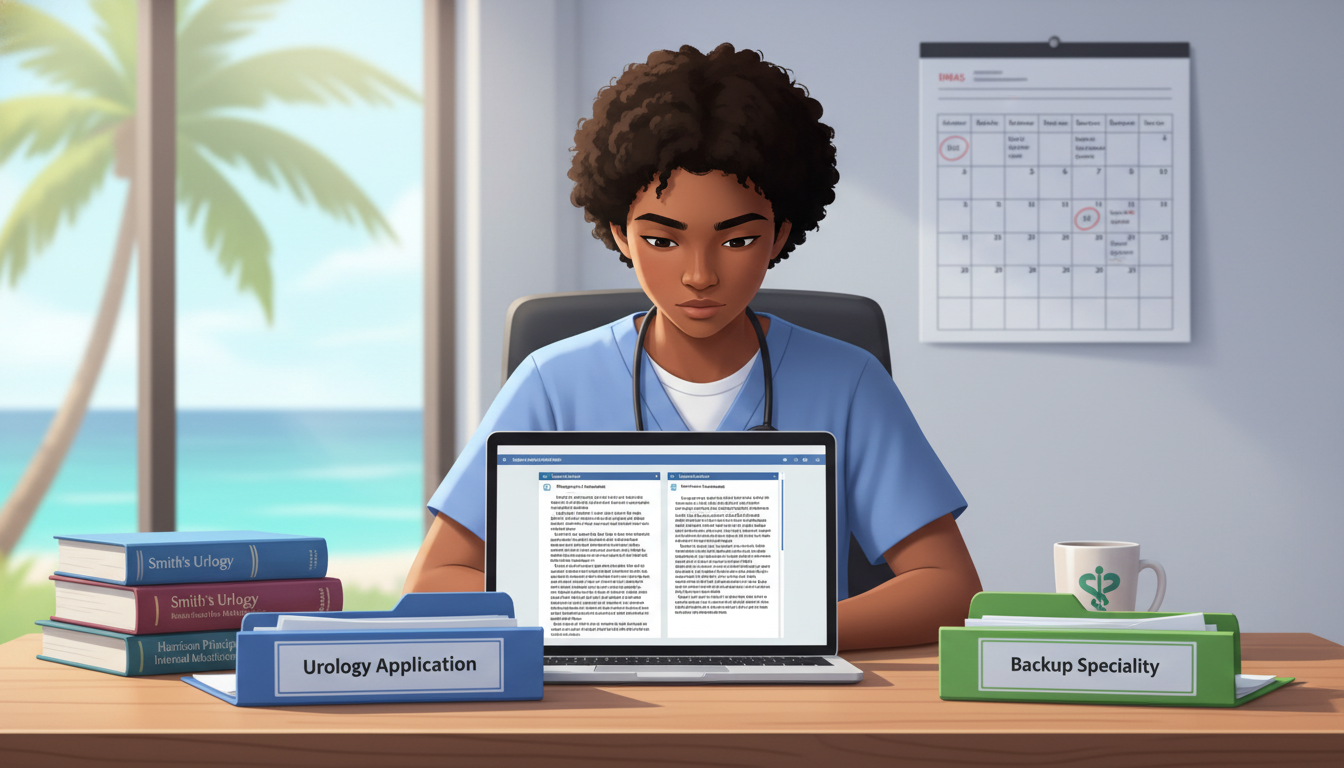
Step 5: Practical Tactics to Strengthen Both Urology and Backup Plans
1. Optimize Rotations and Away Electives
As a Caribbean IMG, elective time in the US is your lifeline.
For Urology:
- Aim for at least 1–2 urology sub‑internships at US hospitals with residency programs.
- Treat them as month‑long interviews:
- Show up early, stay late, volunteer for cases.
- Know patients in detail and present clearly.
- Seek feedback, correct errors quickly.
For Backup Specialty:
- Try to schedule at least 1 core rotation in your backup field at a US site (e.g., inpatient medicine month, IM sub‑I).
- Ask early for letters if you click with an attending.
2. Intensify Research Strategically
Focus on:
- Urology research if possible—outcomes, QI, chart review projects.
- If you can’t access urology research, engage in surgery or IM research where your role is meaningful (data collection, analysis, writing).
Research helps in three ways:
- Shows academic curiosity and persistence.
- Builds relationships with faculty who can advocate for you.
- Strengthens both your urology and backup narratives.
3. Address Caribbean School Bias Proactively
Program directors may have concerns about:
- Variable clinical exposure.
- Preparedness for high‑acuity US hospitals.
- Test performance.
You can counter these by:
- Strong Step 2 CK and (if applicable) Step 3 performance.
- Excellent clinical evaluations from US rotations.
- Clear, professional communication in interviews.
- Demonstrated resilience and maturity—own your path without defensiveness.
Consider how SGU residency match and other Caribbean school match data emphasize consistent patterns: IMGs who match competitive fields usually bring superior preparation and clear evidence they can thrive in a US residency.
4. Prepare for Interviews in Both Fields
You’ll face variants of three key questions:
“Why Urology?” / “Why Internal Medicine (or Surgery)?”
- Prepare distinct, specific answers for each, grounded in experiences.
- Avoid generic clichés (“I like to work with my hands”) without concrete examples.
“Are you applying to other specialties?”
- Be honest but strategic:
- In urology interviews, you can say you are fully committed to urology but have a prudent backup in IM if they ask directly.
- In backup specialty interviews, you can acknowledge your earlier urology interest but clearly explain why you would be happy and fulfilled in their field.
- Be honest but strategic:
“Why should we take a chance on a Caribbean IMG?”
- Emphasize your adaptability, rigorous self‑study skills, and proven performance in US clinical settings.
- Highlight concrete stories showing initiative, teamwork, and patient‑centered care.
Step 6: Emotional and Practical Contingency Planning
Backup specialty planning is not just technical—it’s emotional.
Be Mentally Prepared for All Outcomes
Possibilities:
- Match urology: Ideal outcome. Plan B is simply unused insurance.
- No urology match, but match backup specialty: Lean into your new field; you can still build a great career.
- Unmatched in both: Hardest reality. You may:
- Pursue a research year (especially with a urology or IM department).
- Seek a prelim or TY spot in SOAP or post‑Match.
- Reassess your long‑term goals.
Recognize the emotional swing: from early focus on a dream specialty to considering plan B or even plan C. Having mentors and peers to talk to (especially other Caribbean graduates who’ve been through it) can keep you grounded.
Financial and Logistical Planning
Dual applying is expensive:
- Multiple specialty ERAS applications
- Interview travel or virtual setup costs
- Exam and transcript fees
Budget early:
- Prioritize applications to programs more likely to consider Caribbean IMGs.
- Leverage virtual interviews to reduce cost while still presenting professionally.
FAQs: Backup Specialty Planning for Caribbean IMGs in Urology
1. As a Caribbean IMG, is urology realistic for me or should I focus only on a backup specialty?
Urology is possible but high‑risk. If you have:
- Strong Step 2 CK, no exam failures
- Excellent clinical performance and strong letters, including from US urologists
- Some urology‑related research or scholarly work
…then a targeted urology application makes sense, provided you simultaneously develop a serious plan B specialty. If your metrics are significantly below average or you have major red flags, it may be wiser to recalibrate expectations and prioritize a more IMG‑friendly field from the start.
2. What is the best backup specialty for a Caribbean IMG applying to urology?
There is no single best answer. Common and strategic options include:
- General Surgery if you love the OR and can tolerate another competitive field.
- Internal Medicine if you want a safer, flexible plan B with broad opportunities.
- Transitional Year or Preliminary Surgery if you’re willing to keep pursuing urology or surgery with some risk.
The right plan B specialty is one where:
- You are realistically competitive.
- You can articulate genuine interest.
- You’d be satisfied training if urology doesn’t work out.
3. Will program directors hold it against me that I have a backup plan?
Most PDs understand that dual applying residency is common in competitive fields. Problems arise only if:
- Your story sounds disingenuous or scattered.
- Faculty sense you view their field as an inferior consolation prize.
If you can clearly and respectfully articulate why you’d be genuinely happy and engaged in their specialty—and your application is tailored and thoughtful—having a plan B specialty is seen as mature, not disloyal.
4. If I don’t match urology but match my backup, can I try to switch to urology later?
It’s rare and difficult, but not impossible. Realistically:
- You should enter your backup specialty assuming it will be your long‑term career.
- After you start, if you still feel strongly about urology, you can:
- Build relationships with your institution’s urology department.
- Engage in urology research.
- Explore internal transfer or re‑application, understanding that spots are extremely limited.
However, you must be ready to fully commit to your backup field if no transfer is feasible. Choosing a backup specialty that you can truly see yourself in is essential.
Planning a backup specialty as a Caribbean IMG in urology is not about lowering your ambition—it’s about protecting your future. By understanding the competitiveness of the urology match, choosing a realistic and aligned plan B specialty, and crafting coherent, specialty‑specific applications, you give yourself the best chance to both pursue your dream and secure a rewarding medical career, whatever the Match outcome.