Understanding Why Backup Specialty Planning Matters for US Citizen IMGs
For a US citizen IMG (American studying abroad), pursuing cardiothoracic surgery residency is one of the most ambitious pathways in medicine. It combines the competitiveness of surgery, the prestige of a highly specialized field, and significant structural limitations: there are very few integrated cardiothoracic surgery (I-6) positions nationwide, and traditional general surgery–to–fellowship pathways are intensely selective.
Because of that, having a serious, well-thought-out backup specialty (and sometimes multiple) is not a sign of doubt or weakness. It is a critical strategic step to:
- Protect yourself from going unmatched
- Maintain a path into heart surgery training, even if it is indirect
- Align your career with your interests and skills if your primary route is blocked
- Reduce anxiety and make more rational decisions about where to apply and interview
This is especially important for the US citizen IMG who may have additional hurdles: perceived training differences, limited home institutional support, fewer US-based mentors, and visa questions for some programs even if you hold US citizenship (e.g., confusion in applications, need for ECFMG certification timelines, etc.).
Throughout this article, we will discuss:
- How cardiothoracic surgery training is structured in the US
- Why dual applying (and smart “Plan B” specialty choice) is often essential for American students studying abroad
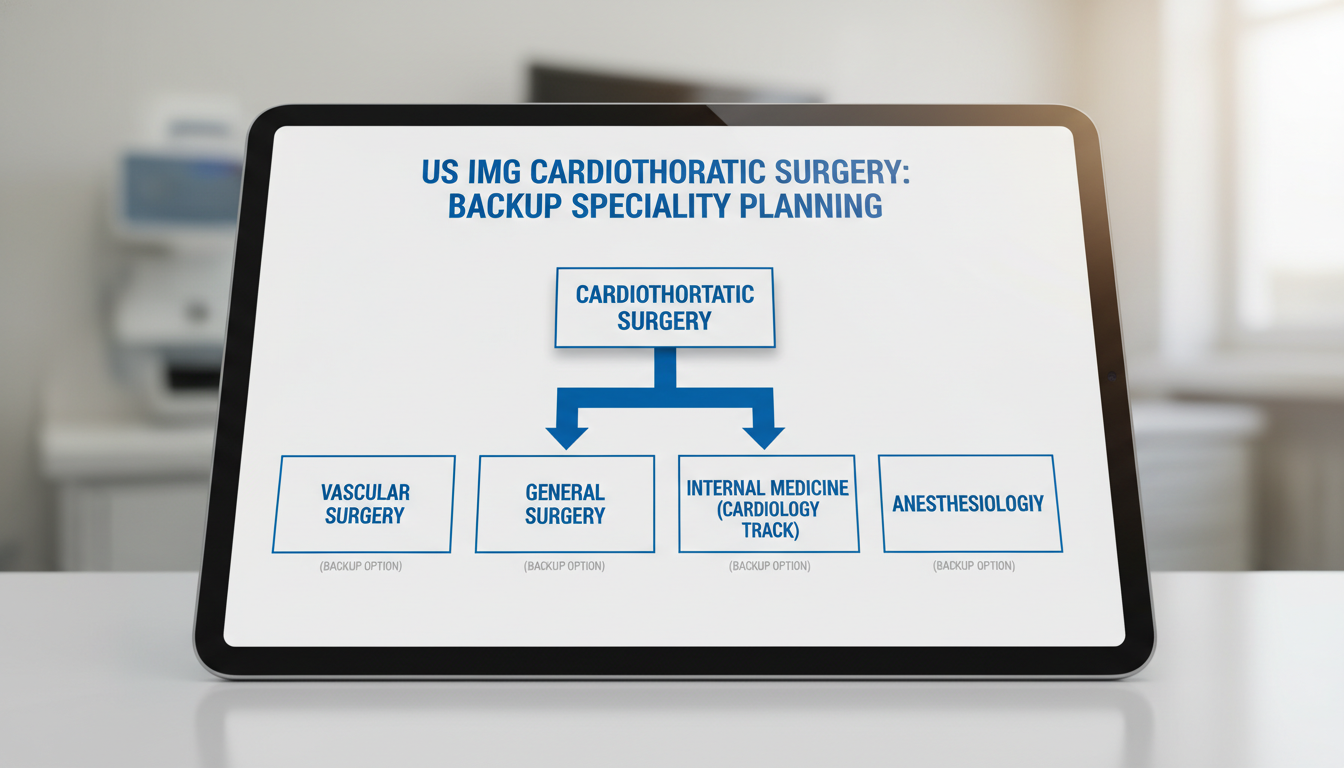
- Which backup specialties realistically keep you close to CT surgery
- How to decide whether to dual apply vs. commit to a single specialty
- Concrete application strategies, timelines, and messaging
- Common FAQs from US citizen IMGs eyeing cardiothoracic surgery
The Training Landscape: How Cardiothoracic Surgery Works in the US
Before you can design a realistic plan B specialty, you need a clear sense of how cardiothoracic surgery residency (and related training) is structured.
Two Main Routes to a Career in Cardiothoracic Surgery
Integrated Cardiothoracic Surgery (I-6 Programs)
- 6-year residency starting directly from medical school
- Combines general surgery and thoracic/cardiac surgery training
- Extremely limited number of positions (often fewer than 40 programs, many with only 1–2 spots/year)
- Exceptionally competitive, often with:
- Stellar Step scores (or equivalent)
- Strong research portfolios in cardiac or thoracic topics
- Letters from well-known CT surgeons
- Home institution advantage (less accessible to IMGs)
Traditional Route: General Surgery → Cardiothoracic Fellowship
- 5–7 years of general surgery residency (depending on research years, program length)
- Followed by 2–3 years of CT surgery fellowship
- More pathways and programs than I-6, but still highly competitive at the fellowship stage
- Performance during general surgery residency (evaluations, case logs, recommendations) becomes your major selection factor for fellowship
Why This Matters for Backup Planning
Because the pipeline is narrow at multiple stages—especially for US citizen IMGs—your backup planning should consider:
- Immediate goal: Matching into a residency that:
- Gives you operative exposure
- Allows robust research
- Connects you with CT or cardiology faculty
- Long-term goal: Remaining competitive for:
- CT fellowship
- Vascular surgery
- Cardiology/Interventional cardiology
- Intensive care/pulmonology
- Or a fulfilling alternative specialty if surgical entry proves unworkable
Your backup specialty isn’t just about avoiding an unmatched status; it should be an intentional choice that keeps as many of your long-term options open as possible.
Strategic Framework: How to Think About Backup Specialties
For a US citizen IMG targeting cardiothoracic surgery residency, it helps to categorize potential backup options into three broad domains:
- Directly Allied Surgical Fields
- Indirect Pathways to Cardiothoracic-Related Work
- Diversified Plan B: Fulfillment Outside of CT-Adjacent Areas
1. Directly Allied Surgical Fields
These are specialties that still keep you in surgical practice and often position you close to the cardiothoracic world:
- General Surgery (Categorical)
- Vascular Surgery (Integrated or Traditional)
- Thoracic Surgery (where separate from cardiac)
- Surgery-Heavy Preliminary Spots (with specific long-term strategy)
General Surgery (categorical) is the most classic and realistic backup for someone targeting CT:
- It is a prerequisite for the traditional CT fellowship.
- It gives you wide operative exposure and ICU management experience.
- You can position yourself for:
- Cardiothoracic fellowship
- Vascular surgery fellowship
- Transplant surgery
- Surgical critical care / ECMO-heavy roles
For an American studying abroad, categorical general surgery may be substantially more attainable than an I-6 CT spot, while still keeping heart surgery on the table.
Vascular Surgery (Integrated I-5 or Traditional):
- Shares many technical and physiological domains with cardiac:
- Large vessel anastomoses
- Endovascular skills
- Complex, high-acuity patients with cardiovascular disease
- Can serve as a deeply satisfying primary career or as a close “cousin” field to CT.
- Very competitive, but slightly more accessible than I-6 CT in some cases.
2. Indirect Pathways to Cardiothoracic-Related Work
These specialties may not be pure surgery but keep you close to cardiac pathology, physiology, and advanced interventions:
- Internal Medicine → Cardiology → Interventional Cardiology or Structural Heart
- Anesthesiology → Cardiothoracic Anesthesiology
- Internal Medicine or Emergency Medicine → Critical Care / Cardiac ICU
- Radiology → Cardiac Imaging / Interventional Radiology
- Pulmonary/Critical Care with strong cardiothoracic ICU exposure
For example:
- If you love hemodynamics, cath lab, and valves, then a route via Internal Medicine → Cardiology → Interventional/Structural Heart can position you at the core of structural cardiac procedures alongside CT surgeons.
- If you enjoy perioperative physiology and acute care, Anesthesiology → CT Anesthesia offers extremely close collaboration with heart surgery teams and ECMO/MEP management.
These pathways can be excellent plan B specialties if you are open to a non-surgeon identity but still want an intense, procedural, cardiovascular career.
3. Diversified Plan B: Fulfillment Outside of CT-Adjacent Areas
For some, the healthiest backup strategy acknowledges that:
- The probability of landing in pure cardiothoracic surgery is small.
- Well-chosen alternatives may be more compatible with desired lifestyle, family plans, or personal constraints.
Potential diversified backups include:
- Emergency Medicine
- Internal Medicine (broad, with many fellowship options)
- Diagnostic Radiology
- Anesthesiology (even without CT fellowship)
- PM&R or Neurology for those who enjoy function/restoration but want better lifestyle balance.
Your backup specialty doesn’t need to be merely “tolerable”; ideally, it should be something you can see yourself doing happily if CT or vascular or general surgery do not work out.
Choosing the Right Backup: Practical Criteria for US Citizen IMGs
When you’re a US citizen IMG targeting cardiothoracic surgery, you cannot simply pick a backup because “someone said it’s less competitive.” You need a structured approach.
Step 1: Clarify Your Non-Negotiables
Ask yourself:
- Do you need surgery to feel fulfilled? Or can you see yourself in a non-surgical but procedural field (e.g., interventional cardiology, IR)?
- How do you feel about:
- Long, irregular hours and extended training?
- High-acuity, high-stress environments?
- Research requirements and academic pressures?
If you are absolutely committed to a surgical identity, then your backup specialty should probably be:
- General surgery (categorical)
- Vascular surgery
- Possibly surgical prelim as a highly calculated short-term move (but not a long-term plan on its own)
If you are open to a broader range, you can build dual applying residency plans that include:
- One surgical pathway (e.g., I-6 CT or general surgery)
- One medical or anesthesiology pathway (e.g., internal medicine or anesthesiology with cardiac focus)
Step 2: Assess Your Objective Competitiveness
Be brutally honest about your profile:
- USMLE/COMLEX scores or Step pass/fail context
- Number and quality of US clinical experiences (USCE), especially in surgery
- Research output, particularly in CT, cardiac, thoracic, or vascular topics
- Strength and US-recognition of your letters of recommendation
- Evidence of biomedical leadership, quality improvement, or serious scholarly effort
- Academic performance (class rank, honors, remediation or leaves of absence)
If you are a US citizen IMG with:
- Strong scores
- Multiple US rotations including surgery or CT surgery
- At least some research exposure
- Polished application materials
…you may reasonably dual apply to:
- I-6 CT surgery (reach)
- Categorical General Surgery (realistic)
- Possibly Vascular Surgery (selectively)
- And a non-surgical “safety net” if your risk tolerance is low (e.g., Internal Medicine)
If your profile is moderate or weaker (average grades, limited research, late Step 2, etc.), you might prioritize:
- General surgery categorical as your top realistic surgical goal
- Broadly applying to Internal Medicine or Anesthesiology as a true backup
- Minimizing “fantasy” applications (e.g., dozens of I-6 programs when your stats are clearly below typical matches)
Step 3: Map Each Backup to Your Long-Term Vision
Don’t just ask: “Can I match here?” Also ask: “Where does this actually lead me?”
Some examples:
You: “I care about doing operations and working in the OR, even if not on the heart.”
- Strong backups: General surgery, vascular surgery, possibly trauma/acute care, or orthopedic surgery (if realistic).
You: “I love cardiovascular physiology and imaging but am okay not operating.”
- Strong backups: Internal Medicine → Cardiology; Radiology → Cardiac Imaging; Anesthesiology → CT Anesthesiology.
You: “I value lifestyle and flexibility, but still like acute care.”
- Consider: Emergency Medicine, Anesthesiology, or certain IM-based subspecialties.
For a US citizen IMG, backup specialty planning should be integrated with your life planning: location preferences, family obligations, and financial constraints.
Step 4: Decide on Dual Applying vs. Single-Track Strategy
Dual applying residency means submitting ERAS applications to two different specialties simultaneously (e.g., I-6 CT + General Surgery, or General Surgery + Internal Medicine).
Pros:
- Higher chances of matching overall
- Flexibility if your interview yield is lower than expected in your dream specialty
- Psychological reassurance
Cons:
- More expensive (additional application fees, travel if in-person)
- More complex to manage: tailored personal statements, interviews, and letters
- Risk of sending a mixed message if not carefully framed
As a US citizen IMG specifically, dual applying is often reasonable when:
- Your CT or surgery pathway is high risk (e.g., few I-6 interviews, limited USCE)
- You want to ensure you match in the US in your first try
- You can genuinely see yourself happy in either specialty
But dual applying demands disciplined messaging:
- Each specialty gets its own personal statement
- Letters are specialty-appropriate (surgery letters for surgery applications, etc.)
- At interviews, you clearly communicate enthusiasm and commitment to that specialty, not as a “consolation prize”
Concrete Backup Strategies for US Citizen IMG Targeting CT Surgery
Let’s translate this into real-world, actionable plans.
Strategy A: Primary Goal I-6 CT, Backup General Surgery (Surgery-Only Plan)
Best for: Highly competitive US citizen IMG with strong US rotations, research, and CT exposure who is committed to a surgical life.
Applications:
- Apply to all feasible I-6 CT programs (assuming reasonable metrics).
- Apply broadly to categorical General Surgery programs, especially:
- University or academic centers with CT fellowships
- Programs known to send residents to CT or vascular fellowships
- Consider a small number of vascular surgery programs if your profile is strong enough.
Rationale:
- If you match I-6: you go directly into heart surgery training.
- If you match General Surgery: you still have a realistic pathway into CT or a related surgical fellowship.
- If you don’t match either: you can consider SOAP for prelim surgery or transitional year (but this is a high-risk outcome).
Strategy B: Primary Goal General Surgery (Stepping-Stone), Backup Internal Medicine or Anesthesiology
Best for: Moderately competitive US citizen IMG who still wants CT as a long-term possibility but recognizes the risk.
Applications:
- Apply broadly to categorical General Surgery (including community and university-affiliated).
- Concurrently apply to Internal Medicine or Anesthesiology programs that:
- Have strong CCU or CVICU experiences
- Are affiliated with heart centers or CT programs
Rationale:
- General Surgery remains your route to CT fellowship or vascular surgery.
- If you fail to get enough surgery interviews or have limited rank options, you can pivot to ranking more IM/Anesthesiology programs higher for security.
- Long-term, you may still align with cardiology, CT anesthesia, or critical care—remaining within the cardiothoracic ecosystem.
Strategy C: Cardiothoracic Adjacency: IM → Cardiology or Anesthesiology → CT Anesthesia as Co-Primary Goals
Best for: US citizen IMG who loves heart/cardiac physiology and complex care, but is flexible about whether they become a surgeon.
Applications:
- Decide if you want to dual apply:
- I-6 CT plus Anesthesiology, or
- General Surgery plus Internal Medicine
- Apply broadly to one surgical and one medical/anesthesia specialty, focusing on big heart centers.
Rationale:
- You’re not treating IM or Anesthesiology as a “fallback,” but as parallel, valuable outcomes.
- You protect yourself from the all-or-nothing nature of surgical matching.
- In the long term, you can become:
- Structural interventional cardiologist
- EP cardiologist
- CT anesthesiologist
- Critical care intensivist in a cardiac ICU
This can be a genuinely satisfying career even if you never operate.

Application Tactics: Making Your Backup Plan Work in Practice
Tailoring Your ERAS Application
To support both a primary and a plan B specialty, you’ll need to structure your application wisely:
Personal Statements
- Write separate statements for each specialty.
- For cardiothoracic or general surgery: emphasize operative interests, perseverance, and acute care.
- For IM or Anesthesiology (if applicable): emphasize physiology, teamwork, critical thinking, and longitudinal care (for IM) or perioperative management (for Anesthesia).
Experiences Section
- Highlight CT-related rotations, research, and leadership.
- For non-surgical specialties, downplay the “only want to operate” language and lean into broader skills: critical care, communication, multidisciplinary collaboration.
Letters of Recommendation
- At least three letters aligned with the specialty:
- For surgery: letters from US surgeons, ideally one from CT/vascular, plus general surgeons.
- For IM or Anesthesia: at least one letter from a physician in that specialty.
- You can assign different letters to different programs within ERAS.
- At least three letters aligned with the specialty:
Managing Interviews When Dual Applying
When you are on a surgery interview:
- Speak genuinely about your commitment to surgery and your long-term goals (e.g., CT, vascular, trauma).
- Avoid mentioning that you are using another specialty as a “backup.” You can say:
- “I am exploring a range of cardiothoracic-related training options, but I’m firmly committed to a surgical career and would be honored to train here.”
When you are on an IM or Anesthesiology interview:
- Emphasize your genuine interest in their field:
- Discuss patient-centered care, physiology, and teamwork.
- Talk about how your OR/ICU experience made you appreciate the specialty.
- You do not need to volunteer that you are also applying to surgery, unless asked directly. If asked:
- Be honest but clear that you are sincerely considering their specialty and can see yourself thriving in it.
Ranking Strategy
When the rank list window opens:
- Review your interview outcomes—especially in surgery.
- Ask: “Where would I be happiest if I only got one match?”
- Common patterns:
- If you have strong surgery interviews (especially categorical general surgery at good programs), you might rank all surgery positions first, then IM/Anesthesia.
- If surgery interviews were sparse or mostly prelims, and you have solid IM/Anesthesia categorical interviews, you may rank those higher for security.
Remember: going unmatched carries real emotional and practical costs. For many US citizen IMGs, a secure, excellent training position in a CT-adjacent field may be better than reapplying after a gap year.
FAQ: Backup Specialty Planning for US Citizen IMG in Cardiothoracic Surgery
1. As a US citizen IMG, is integrated cardiothoracic surgery (I-6) realistic for me?
It is possible but statistically challenging. I-6 positions are extremely limited and heavily favor:
- US graduates from institutions with established CT surgery departments
- Applicants with strong CT-specific research and mentorship
- Very strong academic metrics
As a US citizen IMG, you should treat I-6 as a reach and not your sole plan. Most IMG applicants with CT goals pursue categorical general surgery as their main pathway and target I-6 selectively, while having a solid backup such as general surgery or a CT-adjacent specialty.
2. What is the best backup specialty if I absolutely want to end up in heart surgery training?
Your best backup, if your primary dream is CT, is:
- Categorical General Surgery at a program with:
- An affiliated CT surgery fellowship or robust CT service
- Strong ICU training
- Demonstrated history of sending residents into CT or vascular fellowships
This keeps the door open to cardiothoracic surgery residency (via fellowship) and other cardiovascular surgical subspecialties. Vascular surgery is another strong option if you are open to operating on the peripheral vasculature rather than the heart itself.
3. Is dual applying looked down upon by programs?
Programs know that competitive fields like CT, dermatology, or plastics naturally lead to dual applications. It is not inherently negative as long as:
- Your application to each specialty is coherent and specific.
- You do not send generic or obviously mismatched personal statements.
- In the interview, you convey genuine interest and a plausible long-term vision in their specialty.
Dual applying becomes a problem only when you appear unfocused, ambivalent, or insincere. With careful planning, it can be a smart risk-management strategy, especially for a US citizen IMG.
4. If I match my backup specialty, is my dream of doing cardiothoracic surgery over?
Not necessarily; it depends on the backup:
- If you match General Surgery: CT fellowship remains a realistic option, especially if you:
- Excel clinically
- Seek out CT mentors
- Engage in CT or vascular research
- Build a strong case log and reputation
- If you match Internal Medicine: You may pivot to Cardiology, then Interventional or Structural Heart, staying close to CT practice without operating.
- If you match Anesthesiology: You can subspecialize in Cardiothoracic Anesthesiology, working side by side with CT surgeons in the OR and ICU.
Your original dream might evolve, but you can still build a deeply satisfying cardiothoracic-focused career through multiple pathways.
Thoughtful backup specialty planning is a hallmark of maturity, not a lack of ambition. As a US citizen IMG aiming for cardiothoracic surgery, a realistic, flexible strategy that includes a well-chosen plan B specialty or dual applying residency approach can protect your future while still honoring your passion for heart surgery and high-acuity care.