Why Every MD Graduate Aiming for Diagnostic Radiology Needs a Backup Plan
If you’re an MD graduate targeting a diagnostic radiology residency, you’re aiming for a specialty that is highly desirable and increasingly competitive. Even with a strong application, the allopathic medical school match can be unpredictable. That’s why thoughtful backup specialty planning is not pessimism—it’s risk management.
For many applicants, the question isn’t, “Should I have a Plan B specialty?” but rather, “How do I create a smart, strategic backup without sabotaging my primary goal?”
This guide walks you, as an MD graduate, through how to:
- Decide if you should dual apply or single-apply with a safety strategy
- Choose the right backup specialty that fits your profile and interests
- Build an application portfolio that supports both radiology and a backup
- Strategically build your rank list to protect your long-term career goals
- Avoid common mistakes that hurt both your radiology and backup chances
The goal is to help you maximize your chances of a diagnostic radiology match while protecting yourself from going unmatched.
Understanding Your Risk: How Likely Are You to Match in Diagnostic Radiology?
Before you can design a backup plan, you need an honest sense of your radiology residency competitiveness. This is not about self-doubt; it’s about informed planning.
Key Factors That Drive Risk in Radiology
Consider your status honestly in these areas:
USMLE/COMLEX Scores (if applicable)
- For MD graduates, Step 1 is now Pass/Fail, so Step 2 CK carries more weight.
- If your Step 2 is close to or below the national mean, especially for MD grads, you’re at higher risk.
- Very low or failed attempts (even if passed on retake) significantly increase risk.
Clinical Performance and MSPE
- Honors in core clerkships (especially medicine and surgery) help your case.
- Multiple marginal passes, professionalism flags, or leave-of-absence entries increase risk.
- A neutral or lukewarm MSPE summary can also hurt in a competitive field.
Radiology-Specific Experiences
- Radiology electives and sub-internships (ideally at home and/or away)
- Radiology research or quality improvement projects
- Strong radiology letters from known faculty or program directors
Red Flags
- Exam failures, professionalism concerns, gaps in training, or major career changes
- Switching late into radiology from another specialty with minimal radiology exposure
- Limited geographic flexibility (e.g., must stay in one metro area only)
Application Strategy
- Applying to too few programs
- Overly narrow geographic limits
- Overly ambitious list (mostly top-tier or big-name academic programs)
The combination of these factors—not any single data point—should drive your backup strategy.
Rough Risk Categories (For MD Graduates)
These are broad, non-official categories to help you think about risk:
Low-Risk Radiology Applicant
- Strong Step 2 CK (clearly above national mean)
- Solid clinical grades, no red flags
- Radiology research or strong specialty exposure
- At least 2 strong radiology letters
- Broad geographic flexibility, adequate number of applications
Moderate-Risk Radiology Applicant
- Step 2 around national mean or slightly below
- Few weaker clerkship grades or minor academic concerns
- Limited or late radiology exposure
- Mixed strength in letters or limited home program resources
High-Risk Radiology Applicant
- Below-average Step 2, any exam failure
- Red flags on MSPE or professionalism concerns
- Very limited radiology exposure or late switch
- Geographic constraints or low application volume
Where you fall in these categories shapes whether a dual applying residency strategy (radiology + backup specialty) is advisable.
Should You Dual Apply? When a Backup Specialty Makes Sense
Dual applying means you simultaneously apply to diagnostic radiology and at least one plan B specialty in the same application cycle. It is not the right choice for everyone.
When Dual Applying Is Strongly Recommended
MD graduates in these situations should seriously consider a dual strategy:
- Step 2 CK significantly below average, or any exam failure
- Significant geographic constraints (family, visas, personal reasons)
- Late switch into radiology (mid-M4 or late M3) with limited radiology exposure
- Noticeable red flags in your record
- Weak access to radiology mentors, letters, or home program support
- Prior unmatched cycle in radiology
In these cases, putting all your hopes on an allopathic medical school match in radiology is risky. A sensible backup specialty can protect your long-term training trajectory.
When Dual Applying Is Reasonable but Optional
You might consider a backup, but it’s not mandatory if:
- You’re a moderate-risk applicant
- Your metrics are okay but not standout
- You’re flexible geographically and willing to apply broadly
- You’re uncertain whether radiology is your permanent choice
Here, dual applying can reduce anxiety and increase options, but it will require extra work, more applications, and a carefully balanced narrative.
When Dual Applying May Not Be Necessary
For low-risk MD graduates, especially those with:
- Strong Step 2 CK
- Excellent clinical performance
- Multiple radiology experiences and strong letters
- No red flags, wide geographic flexibility
Dual applying can dilute your efforts and confuse your story. A single, focused radiology application with a well-thought-out rank list and a backup plan involving prelim/transitional years may be enough.
Remember: “No backup specialty” does not mean “no backup plan.” You can still have a safety strategy (e.g., broad application list, mix of program types, realistic self-assessment) without dual applying.
Choosing a Backup Specialty: Aligning with Radiology and Your Future
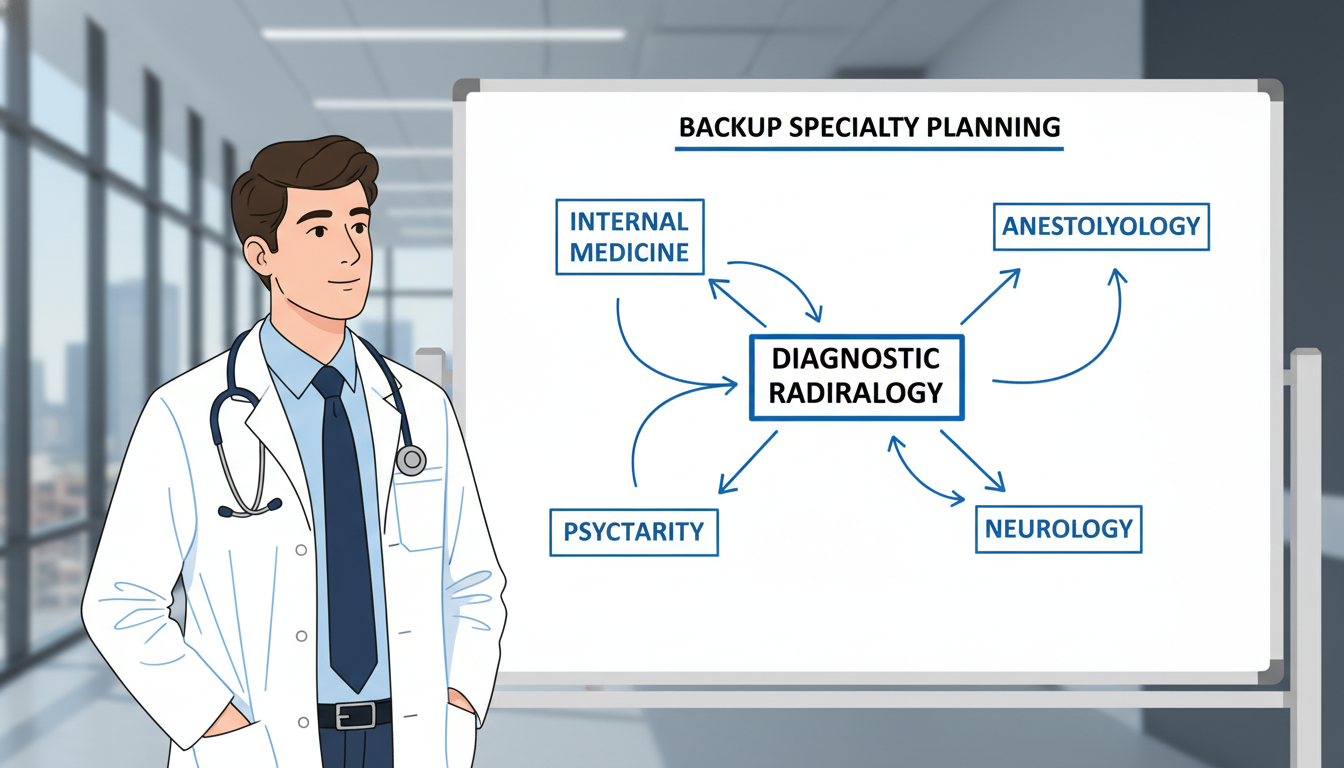
If you decide to dual apply, the next step is selecting the best plan B specialty. This isn’t just “pick the easiest thing to match”—it’s about choosing something that:
- You can live with doing if you never transfer to radiology
- Is reasonably attainable based on your credentials
- Has some intellectual/clinical overlap with radiology
- Won’t obviously conflict with your personal narrative
Common Backup Specialties for Diagnostic Radiology Applicants
Below are frequently chosen options, with pros and cons for an MD graduate leaning toward imaging:
1. Internal Medicine (IM)
Why it’s popular:
- Large number of positions, including community and university programs
- Good fit for strong thinkers who like diagnostics and complex cases
- Clear pathways into fellowships (cardiology, GI, heme/onc, etc.) if you later commit to IM
How it relates to radiology:
- Heavy reliance on radiologic imaging for patient management
- Strong internal medicine training is valuable for radiologists who want deep clinical context
- You can engage in imaging-related QI or research even within IM residency
Downsides:
- Very different day-to-day than radiology: more patient-facing, inpatient workload, call nights
- If your heart is 100% set on radiology, you must be emotionally prepared to be satisfied with IM if you never switch
Best for:
MD graduates with decent clinical skills who can see themselves enjoying longitudinal patient care and complex problem-solving.
2. Transitional Year (TY) or Preliminary Medicine/Surgery
Why people consider it:
- Some applicants think: “I’ll do a prelim year and then re-apply radiology next cycle.”
- Transitional year can be broad, lighter in some programs, and good for re-positioning.
Caution:
- A prelim/TY alone is not a true backup specialty—you still must match into a categorical residency later.
- You’re at risk of being in limbo after PGY-1 if you don’t secure a categorical spot.
When this works:
- Best for those who:
- Are moderately competitive and just need one more year of time/experience
- Have strong advisor support and a realistic plan to re-apply to radiology or another categorical specialty
3. Anesthesiology
Why it’s often considered:
- Historically a “procedural and cerebral” specialty that attracts similar personality types as radiology
- Mix of physiology, pharmacology, and technology-heavy practice
- Time in the OR with close collaboration with surgeons and perioperative teams
Overlap with radiology:
- Similar emphasis on monitoring, interpretation of data, and indirect patient interaction
- Both are high-responsibility, high-tech fields
Considerations:
- Competitiveness can fluctuate; it’s not always a “safe” backup
- Requires comfort with acute care and procedural work
- Letters should still align with either anesthesia or radiology; avoid totally disjointed narratives
4. Neurology
Why it makes sense:
- Neuroimaging is central to diagnosis and management
- Neurology residents and attendings rely heavily on MRI, CT, and advanced imaging
- Intellectually appealing for those who enjoy pathophysiology and localization
Pros:
- Overlap in content: you’ll become very skilled at clinical-neuro correlations, helpful if you ever practice neuroradiology
- Many neurology programs are open to radiology-leaning applicants who show genuine interest
Cons:
- Lifestyle, patient population, and responsibilities differ significantly from radiology
- Must be okay managing chronic neurologic disease, inpatient strokes, and complex cases long-term
5. Psychiatry
Why some radiology applicants pick it:
- Often more accessible than ultra-competitive specialties
- Can appeal to those who value cognitive work, less procedure-intensive care, and controlled schedules
Overlap/fit:
- Less direct technical overlap with radiology, but both are highly cognitive fields
- Some radiologists later look back and consider psych as a lifestyle comparator
Considerations:
- Narrative must be believable: why psychiatry and radiology, not just “anything I can match into”?
- Interviewers in psychiatry can detect if you are not genuinely interested in their field
6. Family Medicine, Pediatrics, or Other Broad Primary Care Fields
These can be viable backup specialties if:
- You have a genuine interest in continuity care and broad-spectrum medicine
- You’re prepared to build a long-term career there if radiology never returns as an option
They are not ideal if:
- You have no real appeal for primary care and cannot convincingly explain why you chose them
- You treat them solely as an easier way to secure any residency
How to Pick the Right Backup Specialty for You
Ask yourself the following:
- Could I realistically be happy in this specialty long-term if radiology doesn’t work out?
- Do my prior experiences give me any foundation in this specialty (rotations, mentors, research)?
- Does the backup specialty’s competitiveness match my application strength?
- Can I craft a believable narrative that connects radiology with this backup field?
If your answer to #1 is “no,” look for a different backup or rethink dual applying altogether. You might be better off improving your radiology application and reapplying than committing to a field you’ll resent.

Application Strategy: How to Execute a Dual Applying Plan
Once you decide on a backup specialty, you need a structured plan for ERAS, letters, experiences, and interviews.
1. Letters of Recommendation: Balancing Radiology and Backup
Aim for a mix that supports both paths:
Radiology letters (2–3):
- At least one from a radiologist (preferably program director or senior faculty)
- Highlight your imaging aptitude, analytical thinking, work ethic
Backup specialty letters (1–2):
- From faculty in your backup field (IM, neuro, psych, etc.)
- Emphasize attributes relevant to their discipline (clinical judgment, communication, bedside manner)
Practical tips:
- Use ERAS’s flexibility: you can assign different sets of letters to different programs.
- For radiology programs, prioritize radiology letters plus 1 strong clinical letter.
- For backup programs, include at least one letter from that specialty.
2. Personal Statements: Separate, Clear, and Honest
Write two distinct personal statements:
Radiology personal statement
- Focused on your motivation for imaging, pattern recognition, tech, teaching, or research
- Include relevant experiences: imaging electives, radiology projects, case-based learning
Backup specialty personal statement
- Genuinely explain what draws you to that field
- You can briefly mention your interest in diagnostics and how that complements your chosen specialty, but avoid framing the backup as second best.
Never submit a personal statement that reads like the specialty is your “plan B.” Each program should feel you are sincerely interested in their field.
3. ERAS Application Content
You don’t have to completely split your experiences, but you can shape emphasis:
Experience descriptions:
- For radiology roles/projects, highlight imaging interpretation, research methodology, and tech familiarity.
- For backup-related roles, emphasize clinical care, communication, teamwork, or procedural comfort, depending on specialty.
Activities section:
- Organize most impactful experiences toward the top.
- If you have one or two key projects strongly aligned with your backup field, feature them prominently when assigning to those programs.
4. Managing Interviews and Scheduling
Dual applying in radiology and a backup specialty can mean many interviews if things go well. Plan ahead:
- Track invitations in a spreadsheet: date, type (radiology vs backup), location/time zone, and priority level.
- Prioritize: If radiology is your top choice, give those interviews first priority in scheduling.
- Be consistent in your messaging:
- On radiology interviews, be clear that radiology is your primary passion.
- On backup interviews, demonstrate serious interest; avoid phrases like “If I don’t get radiology…” or “Plan B.”
Residency programs understand that some applicants dual apply—but they are primarily seeking residents who truly want their specialty.
Rank List Strategy: Protecting Yourself Without Sabotaging Your Goals
By the time you create your NRMP rank list, you will have more clarity about where you stand.
How to Think About Your Rank Order List
Key principles:
Rank programs in your true order of preference.
- The Match algorithm favors the applicant’s preferences.
- Never rank a program higher just because you think it’s “more likely” if you truly prefer a lower-ranked program.
Keep radiology at the top if that is your real first choice.
- Rank all radiology programs where you’d genuinely be willing to train, in order of preference.
- Don’t rank radiology programs you absolutely would not attend (rare, but possible).
Then rank your backup specialty programs.
- After your last radiology program, list categorical programs in your plan B specialty, again in genuine order of preference.
Example Rank Strategy for a Dual Applicant
For an MD graduate focused on diagnostic radiology with internal medicine as a backup:
- Diagnostic Radiology – Program A
- Diagnostic Radiology – Program B
- Diagnostic Radiology – Program C
- Diagnostic Radiology – Program D
- Internal Medicine – Program E
- Internal Medicine – Program F
- Internal Medicine – Program G
If the algorithm can’t match you into A–D for radiology, it will then attempt to match you into Internal Medicine E–G, honoring your preferences.
What If You Have a Prelim/TY and Categorical Mix?
Some radiology programs are advanced positions (PGY-2), requiring a separate prelim/TY year:
- Rank your integrated or categorical radiology programs first.
- Then consider combinations (advanced DR + prelim programs) if applicable.
- Finally, rank categorical backup specialty programs.
If you’re not confident in radiology match chances, it’s usually safer to prioritize categorical backup programs over ending up with just a prelim year and no clear next step.
Common Mistakes to Avoid in Backup Specialty Planning
Choosing a backup you would hate doing long-term
- This is one of the fastest routes to burnout. A backup must be truly acceptable as a life path.
Being obviously disingenuous on backup interviews
- Saying (or signaling) that the specialty is second-best will drastically hurt your chances.
Under-applying to radiology because you have a backup
- If radiology is your true goal, do not use the backup as an excuse to apply to too few radiology programs.
Not getting specialty-specific letters for your backup
- Programs expect at least one strong letter from their field, not just radiology letters recycled.
Forgetting to adjust your ERAS assignments
- Accidentally sending a radiology personal statement to a psychiatry program (or vice versa) is a red flag.
Overconstraining geography
- “I only want to be in one region” can make even a backup specialty risky. Backups are more effective when you’re geographically flexible.
Relying solely on a prelim year as ‘backup’
- A prelim/TY gives you time but not a final destination; plan concretely how you’ll pivot afterward.
Final Thoughts: Building a Resilient Career Path
As an MD graduate in the diagnostic radiology match, you’re navigating a high-demand specialty with real competition. Thoughtful backup specialty planning doesn’t mean abandoning your dreams; it means protecting your future.
A strong plan includes:
- Honest risk assessment
- Clear decision on whether to dual apply
- Careful selection of a plan B specialty you can embrace if needed
- Intentionally crafted letters, personal statements, and interview strategy
- A rank list that reflects your genuine priorities
If you approach this with clarity and integrity, you’ll come out of the allopathic medical school match with not only a training position, but a path you can respect—whether that’s a radiology residency or a well-chosen, fulfilling backup specialty.
FAQ: Backup Specialty Planning for MD Graduates in Diagnostic Radiology
1. Do radiology programs look down on applicants who dual apply with a backup specialty?
Not inherently. Programs expect some applicants to dual apply, especially in competitive fields. What concerns them is the perception that you are not genuinely committed to radiology. If your application, personal statement, and interviews clearly convey authentic interest and prior engagement with radiology, dual applying itself is not disqualifying.
2. What is the best backup specialty for someone who wants diagnostic radiology?
There is no universal “best” backup. For many MD graduates, internal medicine, neurology, or anesthesiology are pragmatic choices because they attract similar thinkers and offer fulfilling careers in their own right. The best backup is the one that:
- You could see yourself enjoying if radiology doesn’t work out
- Fits your competitiveness profile
- Aligns with your prior experiences and interests
3. Should I aim for a transitional year or prelim medicine as my only backup?
A transitional year or prelim medicine is not a true backup specialty. It can be a useful bridge if you plan to reapply to radiology or another specialty, but it doesn’t solve the long-term problem of where you’ll train. Unless you have a well-supported reapplication strategy, it’s safer to rank at least some categorical backup specialty programs.
4. If I don’t match into radiology, can I switch into it later from another specialty?
It’s possible but not guaranteed. Some residents transfer from internal medicine, neurology, or prelim years into radiology when PGY-2 spots open. Success depends on:
- Availability of positions
- Strong evaluations in your current program
- Continued engagement with radiology (electives, mentorship, research)
However, you should choose a backup specialty assuming you may spend your whole career in it. A potential later transition to radiology should be viewed as a bonus opportunity, not a guarantee.