Understanding Backup Specialty Planning as a DO Applicant in ENT
Applying to otolaryngology (ENT) as a DO graduate is ambitious, exciting—and statistically risky. ENT is among the most competitive specialties in the NRMP, and DO applicants historically match at lower rates than their MD counterparts. That doesn’t mean it’s impossible; many DO graduates match successfully into otolaryngology. It does mean you need a smart, proactive strategy that includes a realistic backup specialty plan.
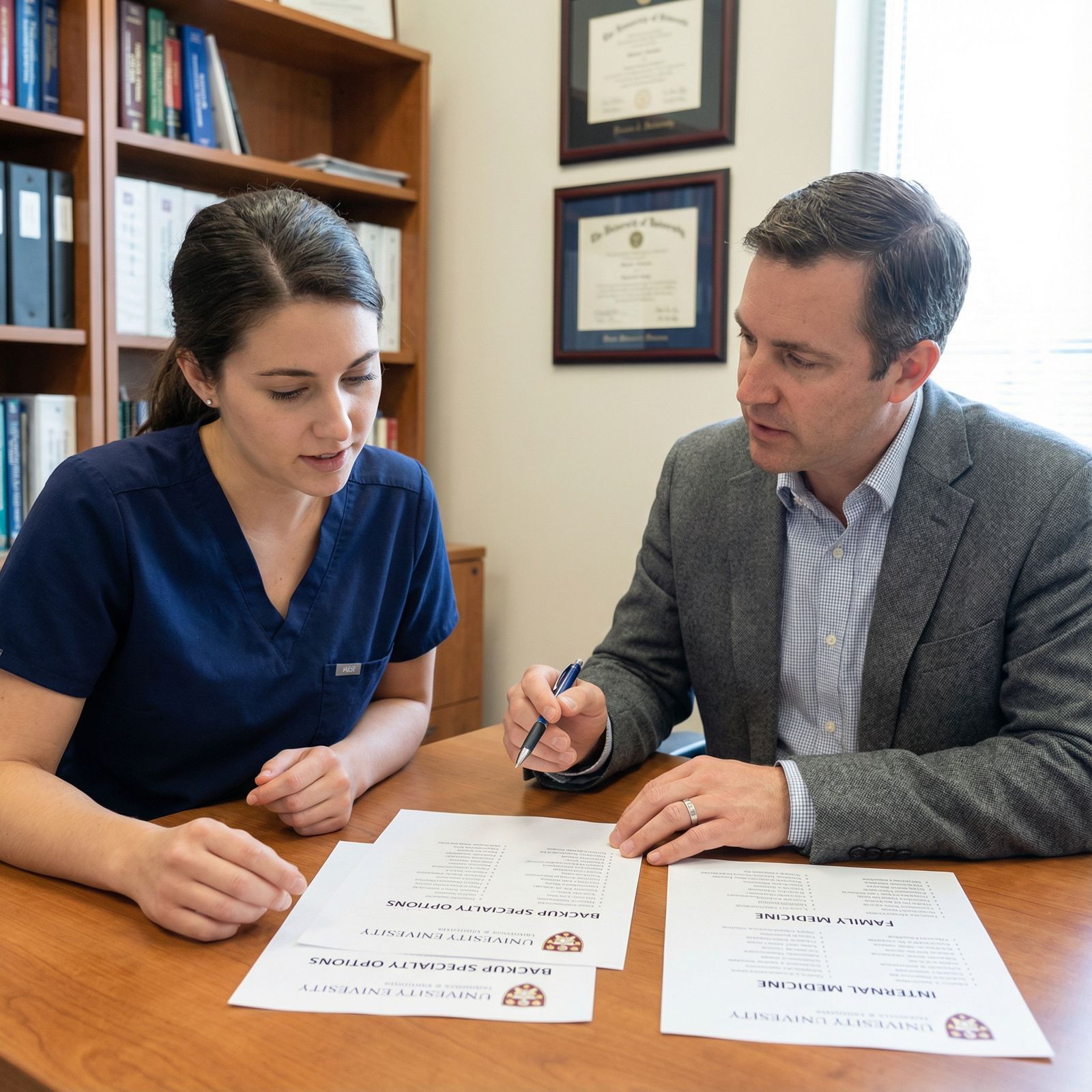
Backup specialty planning is not about giving up on ENT; it’s about protecting your future. You can still push hard for the otolaryngology match, but you should do it with a structured Plan B that fits your skills, interests, and long‑term goals.
In this guide, you’ll learn:
- Why backup planning is particularly important for a DO graduate in ENT
- How to interpret your competitiveness for the otolaryngology match
- How to pick smart backup specialties aligned with ENT
- When and how to consider dual applying residency strategies
- Practical steps to implement your plan, including timelines and red-flag scenarios
Throughout, we’ll focus on the specific realities and opportunities facing DO graduates in the osteopathic residency match era and the single ACGME accreditation system.
Why DO Graduates in ENT Need a Thoughtful Backup Plan
1. ENT Is Highly Competitive—And Data Reflect That
Otolaryngology (ENT) is consistently one of the most competitive specialties:
- High board score thresholds
- Limited number of residency positions
- Programs often favor applicants with:
- Strong research portfolios
- ENT-specific letters of recommendation
- Away rotations at academic centers
Even with the unified ACGME system, the osteopathic residency match data show that DO applicants continue to face:
- Fewer interview invites on average
- Program preferences for applicants from institutions with strong research or home ENT departments
- Less exposure to ENT research infrastructure at some osteopathic schools
This does not preclude success; it simply underscores the need for risk management in your application strategy.
2. Being a DO Adds Unique Challenges—and Unique Opportunities
For a DO graduate:
- Some ENT programs remain less familiar with DO training, even post-merger.
- Historically, DO applicants were underrepresented in ENT academic programs.
- However, DOs may have:
- Stronger clinical skills and patient interaction experience
- Exposure to OMM/OMT, which can be an asset in fields related to musculoskeletal complaints, primary care, and some surgical subspecialties.
Because of this, the DO graduate residency journey into ENT benefits from a backup specialty plan that:
- Honors your commitment to ENT-related skills
- Acknowledges structural barriers
- Minimizes the chance of going unmatched altogether
3. The Cost of Going Unmatched
Going unmatched in ENT without a backup specialty plan can result in:
- Loss of a training year or scrambling into a poor fit position
- Need for a research year that you did not plan financially or psychologically
- Visa/financial/loan repayment complications
- Emotional burnout and identity crisis
A well-constructed plan B specialty increases your chance of:
- Matching into a field you can be satisfied with
- Keeping open doors to future ENT-relevant fellowships or lateral moves
- Maintaining income and momentum in your career

Assessing Your Competitiveness for the Otolaryngology Match
Before designing a backup specialty plan, you need a clear, honest assessment of your ENT residency competitiveness. This drives whether you:
- Apply ENT only
- Dual apply residency (ENT + backup)
- Pivot primarily to a backup specialty early
1. Objective Metrics to Review
Key factors for ENT competitiveness:
USMLE and COMLEX Scores
- ENT programs typically value strong USMLE Step 2 CK scores, even for DO applicants.
- COMLEX scores matter, but most academic ENT programs implicitly compare USMLE benchmarks.
- Ask:
- Are your scores near or above reported ENT match averages?
- Any failures or large score discrepancies?
Clinical Grades and Rotation Performance
- Honors in surgery, ENT electives, and core clerkships indicate strong clinical ability.
- Subpar clinical evaluations at key sites can raise concerns.
Research and ENT Exposure
- ENT or head & neck–related research projects
- Publications, presentations, posters
- ENT-focused extracurricular or leadership roles
- Lack of ENT-specific research is not a hard stop, but in a competitive field, it matters.
Letters of Recommendation (LORs)
- ENT-specific letters from known faculty carry significant weight.
- A strong general surgery letter can also help.
- As a DO, a mix of ACGME-linked faculty LORs can mitigate institutional bias.
Program Fit and School Background
- Does your medical school have a home ENT program?
- Any previous DO graduates from your school who matched ENT?
- Do you have geographic or personal connections to programs?
2. Subjective Factors and Red Flags
Even with decent numbers, these are concerning:
- No ENT away rotation at an academic center
- Weak or generic letters that lack strong advocacy
- Major professionalism issues or remediation history
- Late conversion to ENT with minimal documented interest
These don’t automatically end your ENT ambitions, but they shift you closer to needing an assertive backup strategy.
3. How to Use This Assessment
Once you have a realistic profile, consider three broad categories:
Highly competitive ENT candidate (even as a DO)
- Strong scores (Step 2 CK above typical ENT averages)
- Robust ENT research, home or away rotations
- Enthusiastic ENT letters
- In this case, backup specialty planning is still wise, but ENT-first is reasonable.
Middle-of-the-road ENT candidate
- Decent scores, perhaps slightly below ENT average
- Some ENT exposure but limited research
- One or two good ENT letters
- Here, dual applying residency is strongly recommended.
High-risk ENT applicant
- Borderline or low scores
- Minimal ENT exposure or research
- No strong ENT letter
- In this scenario, your Plan B specialty may become your primary, with ENT as a reach or reserved for a future application cycle after strengthening your profile.
Choosing a Backup Specialty: Strategy for DO ENT Applicants
Backup specialty planning should be deliberate, not random. You want a plan B specialty that is:
- Realistically attainable
- Genuinely acceptable for you long term
- Logistically compatible with ENT applications
1. Core Principles for Selecting a Backup Specialty
When evaluating potential backup fields, ask:
Alignment with Your Interests
- What do you like about ENT?
- Procedures and surgery?
- Anatomy of the head and neck?
- Outpatient clinic variety?
- Cancer care and reconstruction?
- Choose a backup that preserves some of those appealing elements.
- What do you like about ENT?
Competitiveness Level
- Your backup should be less competitive than ENT.
- It should be a specialty where your current metrics make you a strong or at least solid candidate.
Training Structure
- Does the specialty overlap with ENT in prelim or transitional years?
- Does it allow future fellowships that mimic aspects of ENT?
Lifestyle and Career Satisfaction
- Consider schedule, call intensity, procedural volume, and your own life goals.
- Backup does not mean low quality of life; it means alternate path to a fulfilling career.
2. Top Logical Backup Specialties for ENT-Oriented DO Applicants
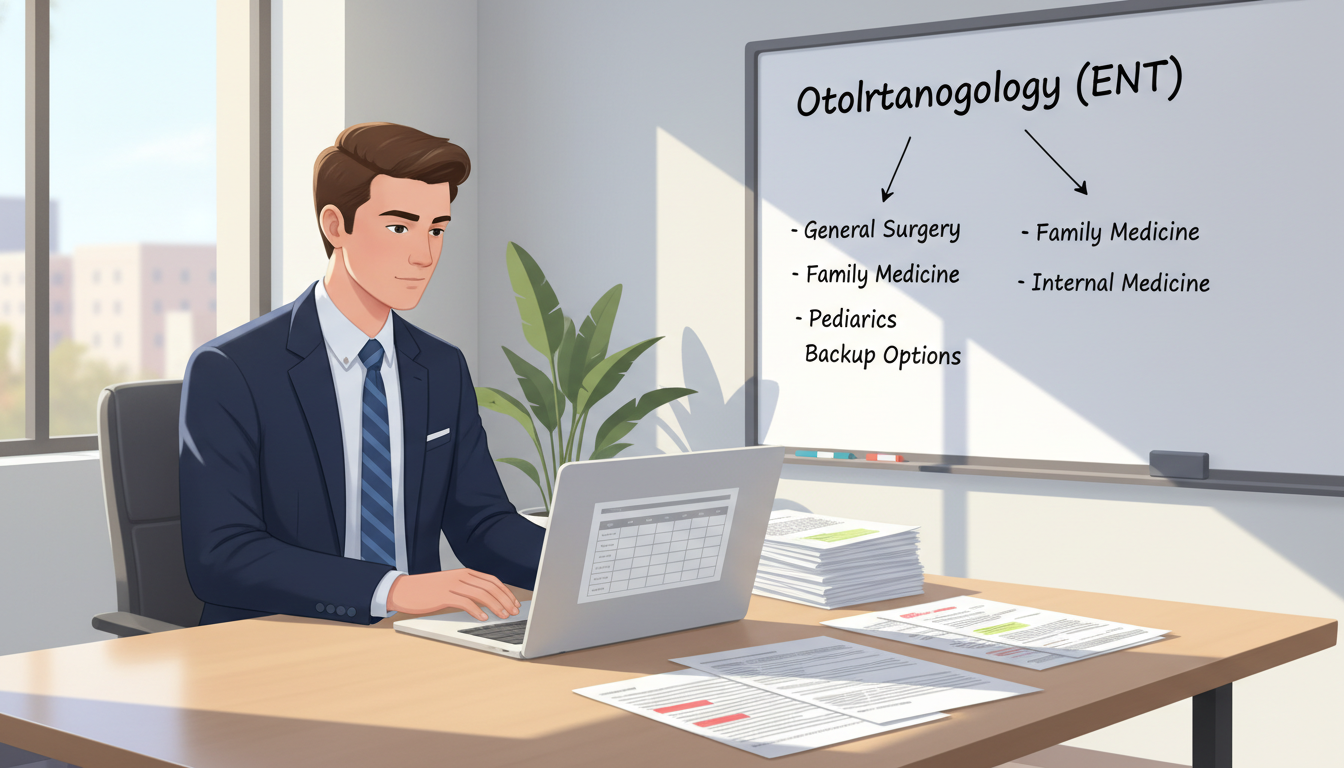
Here are common backup options for DO applicants pursuing ENT, with pros and cons:
A. General Surgery
Why it fits:
- Overlaps heavily with operative skills and anatomy
- Provides exposure to head & neck surgery in some programs
- Some ENT applicants later transition or reapply from a prelim surgery year
Pros:
- Strong surgical foundation if you later reapply ENT
- Broad career options: acute care, trauma, colorectal, surgical critical care
- Procedural intensity similar to ENT
Cons:
- Still competitive at better programs; not a "safe" backup everywhere
- Long and demanding training (5+ years)
- If you remain in general surgery, your day-to-day practice differs significantly from ENT
Best for: Applicants deeply committed to operating who would be satisfied with a career as a general surgeon if ENT does not work out.
B. Internal Medicine → Allergy/Immunology, Rheumatology, or Pulmonology
Why it fits:
- ENT often deals with allergy, chronic sinus disease, immunologic issues, airway pathology.
- Internal medicine is more accessible than ENT, with numerous DO-friendly programs.
Pros:
- High match rates for DOs in many IM programs
- Future fellowships can provide niche focus (e.g., airway disease, allergy)
- Flexible career paths, outpatient-heavy if desired
Cons:
- Less procedural than ENT (except some pulm/critical care or interventional fields)
- Different culture and pace compared to surgical subspecialties
- Requires openness to more cognitive and longitudinal chronic disease management
Best for: Applicants who enjoy pathophysiology, chronic disease management, and can see themselves in subspecialty clinic-based practice.
C. Family Medicine → Sports Medicine / Procedural Focus / ENT-leaning
Why it fits:
- Family medicine offers high DO match rates and wide program availability.
- You can develop ENT-relevant skills (ear exams, minor procedures, office-based interventions, primary care of ENT complaints).
Pros:
- Very DO-friendly; high probability of matching
- Flexibility to practice broad outpatient medicine with procedures
- Later fellowships (sports medicine, geriatrics, etc.) can add a procedural or niche focus
Cons:
- Much less operative than ENT
- Requires enthusiasm for broad-spectrum primary care
- Income and prestige perceptions differ from surgical subspecialties (should not be your sole consideration, but it matters for some applicants)
Best for: Applicants who enjoy continuity of care, broad patient populations, and can derive satisfaction from being a community-based clinical leader.
D. Emergency Medicine
Why it fits:
- ENT exposure to airway management and emergent situations can parallel some EM work.
- EM has historically been open to DO applicants (although recent match cycles have seen volatility and some oversupply concerns).
Pros:
- High acuity, procedures, shift-based schedule
- Short residency (3–4 years)
Cons:
- Recent workforce and job market concerns in EM
- Lifestyle can be challenging with nights/weekends
- Different culture from surgical subspecialties; no long-term operative cases
Best for: Applicants who love acute care, fast-paced decisions, and procedural work, and who have carefully researched the EM job market.
E. Anesthesiology
Why it fits:
- Shared focus on airway, head and neck anatomy, and perioperative medicine.
- Many DO-friendly programs.
Pros:
- Strong job market in many regions
- Procedural, physiology-heavy specialty
- Exposure to ENT and other surgical services
Cons:
- Less direct patient continuity
- Risk of overspecializing in OR-based practice if you prefer clinic relationships
Best for: Applicants drawn to OR environment, physiology, and procedural work, with less interest in clinic-based long-term follow-up.
3. Less Ideal Backup Choices and Why
Some specialties look tempting but are poor backup choices from a risk perspective:
- Dermatology, plastic surgery, ophthalmology
- Also very competitive; they do not function as realistic backup specialties for most DO ENT applicants.
- Radiology or pathology
- While more accessible, they diverge significantly from the clinical and procedural feel of ENT. They may be appropriate for some, but you must truly be okay with their daily work.
The key is: backup should lower your overall match risk, not maintain or increase it.

How to Execute a Dual Application Strategy (ENT + Backup)
For many DO graduates, the best approach is dual applying residency: applying to ENT and one chosen backup specialty simultaneously.
1. When Dual Applying Makes Sense
Dual applying is usually indicated if:
- Your ENT metrics are average or slightly below typical match levels.
- You lack a home ENT program or robust ENT research.
- You are geographically limited (e.g., family or visa constraints).
- Faculty advisors and ENT mentors express concern about your match odds.
If multiple red flags exist (e.g., low scores + late interest + no ENT research), your ENT application becomes more of a reach, and your backup specialty becomes your probable match destination.
2. Timeline Considerations
A typical dual apply timeline:
Late MS3 / Early MS4:
- Decide on ENT as primary interest.
- Identify potential backup specialty (e.g., general surgery, internal medicine).
- Arrange rotations: 1–2 ENT aways + 1 rotation in your backup field if possible.
- Start research if time allows.
Summer / Early Fall MS4:
- Take Step 2 CK early enough to include in your application.
- Request letters of recommendation for ENT and backup specialty.
- Draft two versions of your personal statement:
- ENT-focused
- Backup specialty–focused (e.g., IM, surgery)
ERAS Opening:
- Build two tailored program lists:
- ENT: cast a wide, realistic net including DO-friendly and smaller programs.
- Backup: more robust list aiming for a high probability of interviews.
Interview Season:
- Be honest but strategic when asked about your interests.
- For ENT interviews: focus 100% on ENT.
- For backup specialty interviews: emphasize genuine interest without implying you see them purely as a backup, but you do not need to volunteer that you are applying ENT unless directly asked.
3. Personal Statements and Letters: Avoiding Pitfalls
Personal Statements:
- Never submit an ENT-focused statement to a backup specialty program.
- Your backup PS should be sincere; do not write it as if you are settling. Focus on:
- What you enjoy in that field
- Relevant experiences
- Long-term goals you could see yourself pursuing there
Letters of Recommendation:
- ENT programs: Aim for 2–3 ENT letters (including away rotations) + 1 additional surgical/clinical letter.
- Backup specialty: Secure at least 2 letters from that field.
- Keep track carefully so you assign the correct letters to the correct programs.
4. Interview Strategy and Honesty
When asked directly in a backup specialty interview whether you are applying elsewhere:
- Use a measured honesty approach:
- Acknowledge your broad interest early in the process.
- Emphasize that you have done significant reflection and would be happy and committed if you matched in their specialty.
- Example response for an IM backup:
- “Earlier in medical school I explored several fields, including otolaryngology, because I enjoy procedural work and head and neck pathology. As I progressed, I recognized how well internal medicine aligns with my strengths in complex problem-solving and longitudinal patient care. I’m applying in a focused way to programs where I could see myself long-term, and I would be fully committed to building my career in internal medicine if I match here.”
Never imply you would jump ship or reapply to ENT from their program during the interview—that is a major red flag.
If ENT Doesn’t Work Out: Protecting Your Future and Finding Satisfaction
Even with meticulous planning, some DO graduates will not match ENT. Your actions after that outcome will shape your career more than the initial result.
1. Four Common Post–ENT Non-Match Paths
Accept Match in Backup Specialty
- Most common and often healthiest path.
- Fully commit to excelling in your Plan B specialty.
- Explore fellowships or niche areas that connect with your original interests.
Take a Research Year and Reapply ENT
- Best suited to:
- Candidates who came close (multiple interviews)
- Those with access to strong ENT research mentors and funding
- Risks:
- Financial/intellectual burnout
- No guarantee of success the second time
- If you pursue this, have a parallel backup for the next cycle as well.
- Best suited to:
Match into a General Surgery Prelim Year
- Can keep ENT door open, but:
- Very demanding and uncertain path.
- You must be prepared to continue in general surgery if ENT never materializes.
- Can keep ENT door open, but:
SOAP / Supplemental Pathways
- If you go entirely unmatched, SOAP can place you into a different specialty, often at the last minute.
- This is a safety net, not an optimal plan.
2. Deciding Whether to Reapply ENT
Consider reapplying only if:
- You can significantly improve your application (scores, research, letters).
- ENT mentors are supportive and realistic about your chances.
- You have the financial and emotional resources for another high-stakes year.
- You understand that the next time you will still need a backup specialty strategy.
If not, it may be better to pour your energy into thriving in your backup field.
3. Finding Genuine Fulfillment in Your Backup Specialty
Your identity is more than a three-letter specialty label. Many physicians who “ended up” in a plan B specialty later realize it was actually the better fit:
- You might love the continuity and intellectual depth of internal medicine.
- You might find procedural satisfaction and autonomy in general surgery, EM, or anesthesia.
- You may discover leadership, teaching, or community impact opportunities far beyond what you envisioned in ENT.
Give yourself permission to grieve the loss of the original plan while also committing to building a meaningful, satisfying career in your matched specialty.
Actionable ways to build fulfillment:
- Seek out niche expertise within your field (e.g., allergy focus within IM, office procedures in FM).
- Get involved in teaching, research, or quality improvement.
- Find mentors who love their specialty—even if it wasn’t their first choice.
Practical Action Plan for DO ENT Applicants
To bring this all together, here is a concrete stepwise plan:
Self-Assessment (Early MS3 – Early MS4)
- Honestly review your metrics and experiences.
- Seek candid feedback from ENT and non-ENT mentors.
- Categorize your ENT competitiveness (strong / moderate / high risk).
Select a Backup Specialty (Mid MS3 – Early MS4)
- List what you love about ENT.
- Identify 2–3 potential backups that share features you value.
- Talk with residents or faculty in those fields.
- Commit to one primary backup for your dual apply strategy.
Optimize Rotations and Experiences (MS4)
- ENT: 1–2 aways at DO-friendly or smaller academic programs.
- Backup: At least 1 rotation (home or away) in your Plan B specialty.
- Obtain strong letters in both ENT and your backup field.
Prepare Separate Application Materials
- Two personal statements (ENT and backup).
- Specialty-specific CV highlights (e.g., reorder experiences for each specialty’s ERAS).
- Organize letters and ensure correct assignment for each program type.
Build Smart Program Lists
- ENT: Broad list emphasizing programs with DO alumni, geographic ties, or less extreme competitiveness.
- Backup: Larger list with many programs where you are likely above-average on metrics.
Maintain Flexibility and Self-Compassion
- Be open to adjusting as feedback and interviews roll in.
- If ENT interviews are very limited, prioritize backup specialty interview performance.
- Keep perspective: the goal is not just “ENT or bust,” but a sustainable, meaningful medical career.
FAQs: Backup Specialty Planning for DO Graduates in ENT
1. As a DO, should I still apply to ENT if my Step 2 CK is below the national ENT average?
Yes, but with caution. If your Step 2 CK is below typical ENT match averages, you should almost certainly dual apply with a well-chosen backup specialty. Talk to mentors who know your full application; if they believe you have strong clinical performance, compelling ENT letters, and some research, your ENT application may still garner interviews, especially at DO-friendly or smaller programs. Your backup application protects you if those interviews are fewer than expected.
2. What are the most common backup specialties for DO applicants in the otolaryngology match?
Common Plan B specialties for DO ENT applicants include general surgery, internal medicine, family medicine, emergency medicine, and anesthesiology. The best choice depends on your specific interests and competitiveness. For example, if you love the OR and are okay with non-ENT surgery, general surgery is logical. If you enjoy complex medical decision-making and continuity of care, internal medicine may fit better.
3. If I match into my backup specialty, can I later switch into ENT?
Switching from another residency into ENT is possible but uncommon and often quite difficult. ENT programs have very limited spots, and mid-training transfers are rare. A more realistic path is:
- Excel in your matched specialty.
- If you still strongly desire ENT, you may consider reapplying after additional research or a prelim year, but this is a high-risk approach. Because of that, you should only choose a backup specialty that you would be willing to remain in long-term.
4. Is a research year a better backup plan than applying to another specialty?
A dedicated ENT research year can be valuable if:
- You already came close to matching ENT (multiple interviews, strong letters).
- You have access to a robust ENT research environment and mentorship.
- You can support yourself financially and emotionally during an extra year.
However, a research year is not a guarantee of future ENT match success and does not provide the security of a matched residency position. For many DO graduates, a more secure and sustainable route is to dual apply from the start, or to match into a backup specialty and build a fulfilling career there.
Backup specialty planning is not a sign of weakness; it’s a sign of maturity and strategic thinking. As a DO graduate pursuing the highly competitive field of otolaryngology, a thoughtful Plan B specialty and, when appropriate, a dual application strategy will maximize your odds of matching into a rewarding, sustainable career—whether that ultimately lands you in ENT or another specialty where you can thrive.