
Understanding the Landscape: Why Backup Planning Matters for DO Graduates in IR
Interventional Radiology (IR) is among the most competitive specialties, and as a DO graduate, you face both the general competitiveness of the IR match and lingering structural barriers that can affect osteopathic applicants. That combination makes thoughtful backup specialty planning essential—not as a negative “give up” plan, but as a strategic, career-sustaining safety net.
Why IR Is So Competitive
Factors driving up competitiveness of interventional radiology residency programs include:
- Limited number of Integrated IR positions relative to applicants
- Strong interest from highly ranked U.S. MD graduates and international graduates
- Program preference for robust research and strong Step/COMLEX scores
- Increasing subspecialization and procedural interest among students
Even highly qualified applicants may not match into IR on their first attempt. The IR match (both Integrated IR and Independent IR pathways) is inherently high-risk.
Why DO Graduates Need a Particularly Thoughtful Strategy
Osteopathic graduates have made significant inroads in many specialties after the single accreditation system, but some barriers remain in IR and diagnostic radiology:
- Some historically MD-heavy programs remain cautious about DO applicants, especially if they have little experience training them
- Research opportunities in IR may be less available during DO school compared with large academic MD centers
- Perceived differences in school prestige and clinical exposure can make some programs hesitant unless you have strong objective metrics (board scores, publications, away rotations)
This does not mean you cannot match into IR as a DO graduate—many do. However, it does mean:
- You should assume higher baseline risk of not matching solely into IR
- You need a clear, data-informed backup specialty and potentially a dual applying residency strategy
Backup vs Plan B vs Dual Applying
It helps to clarify terminology:
- Backup specialty: The field you apply to in addition to IR, or pursue if you do not match IR this cycle.
- Plan B specialty: Your realistic, acceptable alternative long-term career path if IR does not work out.
- Dual applying residency: Applying in IR (often IR/DR integrated) and another specialty in the same ERAS cycle, ideally in a coordinated, honest manner.
For a DO graduate interested in IR, these concepts overlap. A smart strategy is to identify:
- A primary pathway: IR (often via Integrated IR or DR → Independent IR)
- A backup pathway: A closely related or compatible specialty that can still lead to procedural work or IR-adjacent roles
The goal is not abandoning your IR dream, but protecting your career if the IR match does not go your way.
Step 1: Clarify Your IR Profile and Risk Level
Before choosing a backup specialty, you need a realistic assessment of your competitiveness for interventional radiology residency programs.
Key Elements in Your IR Application Profile
Board scores (USMLE or COMLEX)
- Integrated IR programs often favor applicants with strong Step 1 (if taken) and Step 2 CK (or COMLEX equivalents).
- If your scores are below the national mean or you have a Step failure, your IR match risk increases.
Clinical grades and class rank
- Honors in surgery, medicine, and radiology rotations can help.
- Poor performance or professionalism flags significantly increase risk.
IR and radiology exposure
- IR electives, sub-internships, and away rotations at academic centers
- Strong letters of recommendation from interventional radiologists
- Participation in IR interest groups, conferences (e.g., SIR), or IR-related QI projects
Research and scholarly activity
- Publications, abstracts, poster presentations, or QI in IR or diagnostic radiology
- For DO graduates, research can help offset bias by demonstrating academic engagement.
Program preferences for DO graduates
- Some IR/DR programs have a track record of taking DOs; others do not.
- Use residency explorer tools, program websites, and alumni data from your school.
Risk Categories for the IR Match
You can roughly estimate your IR match risk category:
Lower risk (still competitive field)
- Strong scores (e.g., above national average)
- No exam failures
- IR electives at academic centers, strong IR letters
- Multiple IR or DR research experiences
- Good number of programs historically accepting DOs
Moderate risk
- Scores near national average, maybe one area of concern (e.g., single marginal rotation)
- Limited IR research but strong clinical performance
- Some but not extensive IR exposure
High risk
- Below-average scores or exam failure
- Late discovery of IR, minimal IR exposure or letters
- Limited radiology/IR research
- Applying mostly to programs with weak DO track records
If you are in the moderate or high-risk category, a serious backup specialty and possibly dual applying residency strategy is strongly recommended.
Step 2: Choosing Rational, IR-Compatible Backup Specialties
Not all backups are equal. You want a plan B specialty that:
- Fits your genuine interests and personality
- Aligns with your clinical strengths
- Maintains access to procedural work and/or imaging
- Preserves options to transition toward IR-adjacent careers later
Below are some of the most logical backup options for a DO graduate aiming for interventional radiology.
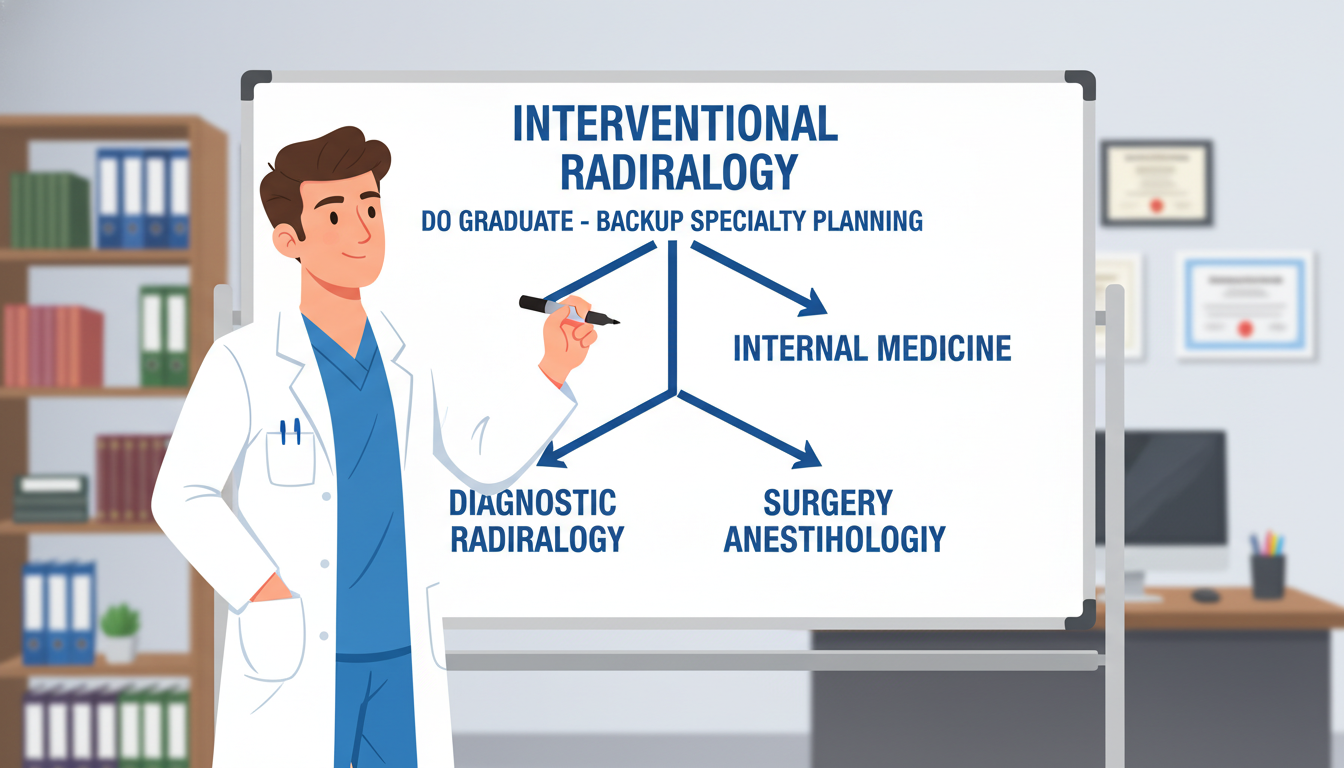
1. Diagnostic Radiology (DR) – The Most Direct IR-Adjacent Path
Why it makes sense:
Diagnostic Radiology is the traditional pathway to IR via subsequent Independent IR residency or fellowship. Many applicants who miss an Integrated IR spot still end up in IR through DR.
Pros:
- Very strong alignment with your ultimate IR goals
- You will gain imaging expertise essential for IR practice
- You can apply later to Independent IR programs
- Some DR programs have ESIR (Early Specialization in IR) pathways
Cons:
- DR itself has become moderately competitive, especially at top academic centers
- Some DR programs are also hesitant about DO graduates, though less than the most competitive IR programs
- No guarantee of Independent IR acceptance later (but many DR grads do match IR fellowship)
When to consider DR as backup:
- You are still relatively competitive (solid scores, decent research) but not quite at the top tier for IR
- You are committed to IR long-term and okay with a longer path
- You are comfortable accepting diagnostic-only practice if Independent IR doesn’t work out
This is often the primary backup for DO graduates: you might dual apply IR and DR in the same cycle.
2. General Surgery
Why it makes sense:
If your favorite part of IR is procedural, hands-on work, general surgery gives you robust procedural exposure and multiple future subspecialties (vascular surgery, transplant, surgical oncology, etc.).
Pros:
- Fulfills desire for procedural work and acute care
- More DO-friendly than some radiology programs, especially at community-based sites
- Future opportunity to work closely with IR or in parallel procedural fields (e.g., vascular access, endovascular surgery in certain tracks)
Cons:
- Very different day-to-day lifestyle than IR (more OR time, long hours, different culture)
- If your core love is imaging-guided procedures and image interpretation, pure surgery might not fully satisfy you
- Transition from general surgery to IR is not a standard pathway and can be difficult
Best as a Plan B specialty when:
- You genuinely enjoy open surgery and critical care
- You are open to a long, physically demanding training path
- You are willing to potentially accept a career that may not involve imaging as its core
3. Internal Medicine → Interventional Subspecialties (Cardiology, GI, etc.)
Why it makes sense:
Many internal medicine subspecialties offer procedural and imaging-heavy careers that can satisfy the same interests that draw you to IR.
Examples:
- Interventional Cardiology (via Cardiology → Interventional)
- Advanced Endoscopy (via GI)
- Pulmonary/critical care with bronchoscopy and ICU procedures
- Vascular medicine with some procedural work in certain systems
Pros:
- Internal Medicine has many DO-friendly residency programs
- Good long-term lifestyle options depending on subspecialty
- You can still build a career of complex procedural and consultative work
Cons:
- Long path: IM → fellowship → sometimes additional interventional training
- Extremely competitive subspecialties (like interventional cardiology) can be nearly as difficult as IR
- Much more rounding, clinic-based care, and longitudinal disease management than IR
Best for DO graduates who:
- Enjoy physiology, longitudinal patient care, and complex medical decision-making
- Can genuinely see themselves in IM-derived subspecialties even if advanced procedures don’t pan out
- Are comfortable with the idea that their future might include a lot of clinic and inpatient medicine
4. Anesthesiology (with Possible Interventional Pain or Procedural Focus)
Why it makes sense:
Anesthesiology provides substantial procedural exposure (airways, lines, blocks) and later offers routes like interventional pain that involve imaging-guided procedures.
Pros:
- Traditionally more welcoming to DO graduates at many programs
- Strong procedural foundation
- Opportunity to pursue chronic pain, regional anesthesia, or critical care
Cons:
- The procedural skill set is different from IR (more anesthesia-related than vascular/interventional)
- Interventional pain fellowships are competitive and not a guaranteed path
- Many anesthesiology jobs are OR-focused rather than imaging-guided procedural work
Best for applicants who:
- Enjoy physiology, pharmacology, and acute care
- Like procedural hands-on work but are flexible with the specific type
- Are open to a career heavily centered in the OR, ICU, or pain clinics
5. Other Thoughtful Alternatives
Depending on your personal profile, you might also consider:
- Emergency Medicine – Procedural, DO-friendly, but fewer imaging-guided opportunities
- Physical Medicine & Rehabilitation (PM&R) – With a longer-term goal of pain/spine or MSK interventions
- Vascular Surgery (Integrated) – Access to endovascular procedures, but highly competitive and surgery-based
Whichever you choose, your plan B specialty must be something you can realistically see yourself practicing for an entire career if IR ultimately doesn’t happen.
Step 3: Designing a Dual Applying Residency Strategy
Once you’ve selected a rational backup, the next step is to decide whether you will dual apply in the same cycle and, if so, how to do it without undermining your IR candidacy.
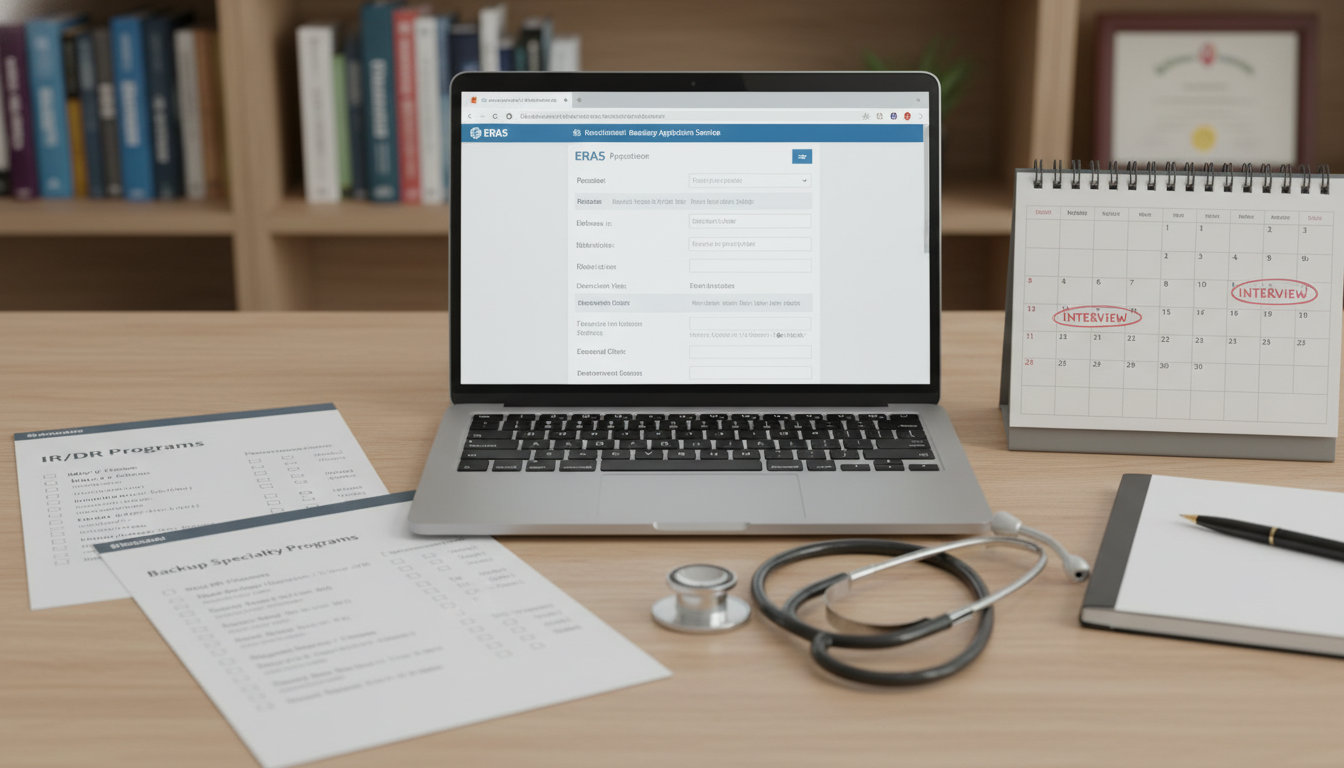
Common Dual Applying Combinations for IR-Aiming DO Graduates
- Integrated IR + Diagnostic Radiology (most common and coherent strategy)
- Integrated IR/DR + Internal Medicine (if strongly drawn to procedural IM subspecialties)
- Integrated IR/DR + Anesthesiology
- Less commonly: IR/DR + General Surgery
Coordinating Your Application Materials
To dual apply effectively:
Personal Statement(s)
- Write a dedicated IR/DR personal statement focused on:
- Imaging, procedural interests, minimally invasive therapies
- Academic curiosity and patient-centered outcomes
- Write a second statement tailored to your backup specialty, with:
- Authentic reasons for that field
- Procedural or patient-care aspects you value
- Never send an IR-focused statement to non-IR programs or vice versa.
- Write a dedicated IR/DR personal statement focused on:
Letters of Recommendation (LoR)
For IR-focused pathways:- At least 1–2 letters from interventional radiologists or radiologists
For your backup specialty: - Obtain at least one strong letter from a physician in that specialty
- For many programs, a combined set works if thoughtfully chosen (e.g., IM + IR letters when dual applying IR/DR + IM)
- At least 1–2 letters from interventional radiologists or radiologists
Program List Strategy
For a DO graduate, consider:
- Apply broadly to IR/DR programs that:
- Have previously matched DOs
- Are community-based or mid-tier academic centers
- Apply more broadly to your backup specialty than you would if it were your only field
- Use geographic flexibility as a major lever: be open to less popular locations
- Apply broadly to IR/DR programs that:
How Honest Should You Be With Programs?
This is a common anxiety when dual applying residency programs.
- It is acceptable and common to dual apply.
- You do not need to volunteer to an IR program that you are also applying in another field, unless directly asked.
- If a program asks explicitly, answer honestly but succinctly:
- “Yes, I am also applying to Diagnostic Radiology programs, but my primary goal is to train in IR and ultimately practice as an interventional radiologist.”
- For your backup specialty programs, be genuine about your interest:
- Don’t describe them as “backup” to their face.
- Emphasize genuine aspects of their field that appeal to you.
Step 4: Scenario Planning — If You Don’t Match IR
Despite best efforts, some applicants do not match into an interventional radiology residency during their first IR match attempt. You should think in advance about concrete steps if that happens.
Outcome 1: You Match Your Backup Specialty
If you dual applied and matched your backup specialty:
- Accept that this is your actual career path, at least for now.
- During training:
- Excel clinically and academically—future doors open to top residents.
- Identify procedural niches, imaging-adjacent opportunities, and multidisciplinary collaborations.
- Maintain relationships with IR colleagues at your institution.
Can you still pivot into IR? Sometimes, but pathways are limited:
- From Diagnostic Radiology:
- Independent IR residency is a clear, structured path. This is the most realistic route to IR if you matched DR.
- From other fields:
- Rare cases of physicians retraining, but this usually requires starting over with a DR or IR residency, which is costly and time-consuming.
For most DO graduates, if you match a non-radiology backup specialty, plan to fully commit to that specialty and build the best version of a procedural, patient-centered career there.
Outcome 2: You Don’t Match IR but Do Match DR
This is often a favorable outcome:
- You can pursue ESIR if available and apply to Independent IR programs later.
- You’ll be well positioned to join practices with some mix of IR and DR, even if you do not complete an IR fellowship at first.
This is why many DO graduates interested in IR treat DR not just as a backup specialty, but as part of a multi-step IR match strategy.
Outcome 3: You Don’t Match Any Specialty (IR or Backup)
If you go “unmatched” entirely:
Participate in SOAP
- Look for DR prelim, transitional year, or categorical spots in DO-friendly specialties.
- Sometimes, spots open in DR or IM that can maintain your competitiveness.
Post-match year plan
Options might include:- Preliminary year in medicine or surgery
- Dedicated research year in IR or radiology (particularly valuable for DO graduates)
- Another clinical or teaching role that keeps you engaged and builds your CV
Re-evaluate your competitiveness
- Strengthen board scores if eligible (Step 3, COMLEX Level 3)
- Present or publish IR-related research
- Obtain stronger letters
- Reconsider backup specialty choices if your initial list was too narrow or unrealistic
Practical Tips Specifically for DO Graduates
1. Target DO-Friendly IR and DR Programs
- Use your school’s match list to identify programs with a history of taking DOs in radiology and IR.
- Connect with recent DO graduates in those programs; ask directly about:
- Program culture toward DOs
- PD and faculty openness
- How they framed their application and backup planning
2. Optimize COMLEX and USMLE Strategy
- If you have USMLE, report both if strong; if your USMLE is weak but COMLEX is strong, consider how each program views scores.
- Some competitive IR programs still prefer or strongly value USMLE; lack of USMLE can place more weight on your COMLEX percentiles, clinical performance, and research.
3. Consider Strategic Away Rotations
- Prioritize away rotations at institutions that:
- Have Integrated IR and DR programs
- Have a reputation for being DO-friendly or at least DO-neutral
- During rotations:
- Show reliability, humility, and curiosity
- Ask about both IR and Diagnostic Radiology paths
- Seek at least one strong letter from an academic IR who can speak to your procedural aptitude and work ethic
4. Build an Osteopathic Narrative Without Overemphasizing It
Programs will know you are a DO graduate. Frame it as:
- Strength: holistic patient care, OMT training (if relevant), more hands-on early clinical exposure
- Not an excuse: avoid framing DO status as a barrier you “overcame,” but acknowledge that you intentionally pursued high-quality experiences and research to be competitive in any environment.
Putting It All Together: A Sample Strategy for a DO IR Applicant
Applicant Profile:
- DO graduate, solid but not stellar Step 2 / COMLEX Level 2 scores
- One IR elective at home institution, one away at a mid-sized academic center
- 1–2 posters in IR; no first-author publications yet
- Strong clinical evaluations, especially in surgery and internal medicine
Reasonable Plan:
- Primary Goal: Integrated IR or, secondarily, DR with ESIR.
- Backup Specialty (Plan B): Diagnostic Radiology (primary backup) and possibly Internal Medicine as a secondary safety net if very risk-averse.
Application Approach:
- Apply to:
- 40–60 IR/DR integrated programs (prioritizing DO-friendly, mid-tier programs)
- 60–80 DR programs, broad geography, strongly including DO-friendly places
- Optionally, 20–30 Internal Medicine programs if worried about score competitiveness
- Separate personal statements:
- IR/DR: focus on imaging + procedures + minimally invasive care
- IM: focus on physiology, consultative skills, and interest in cardiology/GI as potential subspecialties
- Letters:
- 2 IR/DR letters, 1 IM letter, 1 surgery or medicine letter usable across specialties
- Interviews:
- Attend all IR/DR interviews possible
- Treat DR interviews seriously; show interest in ESIR and future IR fellowship
- Be honest but tactful if IM programs ask about other applications
In the rank order list:
- Rank all Integrated IR programs first
- Then DR programs (especially with ESIR)
- If applying IM, decide whether to place them at the bottom based on your risk tolerance and willingness to repeat a cycle
FAQs: Backup Specialty Planning for DO IR Applicants
1. As a DO graduate, is it realistic to aim for Integrated IR without a backup?
It’s risky. While DO graduates do match into interventional radiology residency programs, the IR match is highly competitive, and some programs are still less DO-friendly. Unless you have exceptional scores, research, and letters, not having a backup specialty significantly increases your chance of going unmatched. Even very strong applicants usually benefit from at least a DR backup.
2. If I match in Diagnostic Radiology, how realistic is it to still become an interventional radiologist?
Very realistic. DR → Independent IR is a common and well-accepted pathway. Many current IRs trained this way. Matching DR at a program with ESIR or strong IR faculty gives you an excellent chance of eventually joining the IR workforce. This is why DR is often the best backup specialty for IR-focused DO graduates.
3. How many specialties can I apply to before it becomes counterproductive?
Most applicants should limit themselves to one primary field plus one backup specialty. More than two can dilute your application quality, confuse your narrative, and overextend your time and finances. For a DO graduate in IR, the most coherent dual applying residency strategy is usually IR/DR + DR, or IR/DR + one other field (like IM or Anesthesiology) if your IR competitiveness is modest.
4. What if my heart is set on IR, but my scores are mediocre and I have little IR research?
You still have options, but you must be very pragmatic:
- Strongly consider DR or a DO-friendly procedural specialty as your main focus, with IR as an aspirational possibility.
- Use away rotations and a research year to build a stronger IR profile if you have flexibility before applying.
- If you’ve already graduated, prioritize getting into a solid DO-friendly residency (especially DR or IM) where you can flourish, then explore IR-related opportunities from there.
The key is to avoid sacrificing a stable, fulfilling career by overcommitting to a single highly competitive pathway without a solid, realistic plan B specialty.