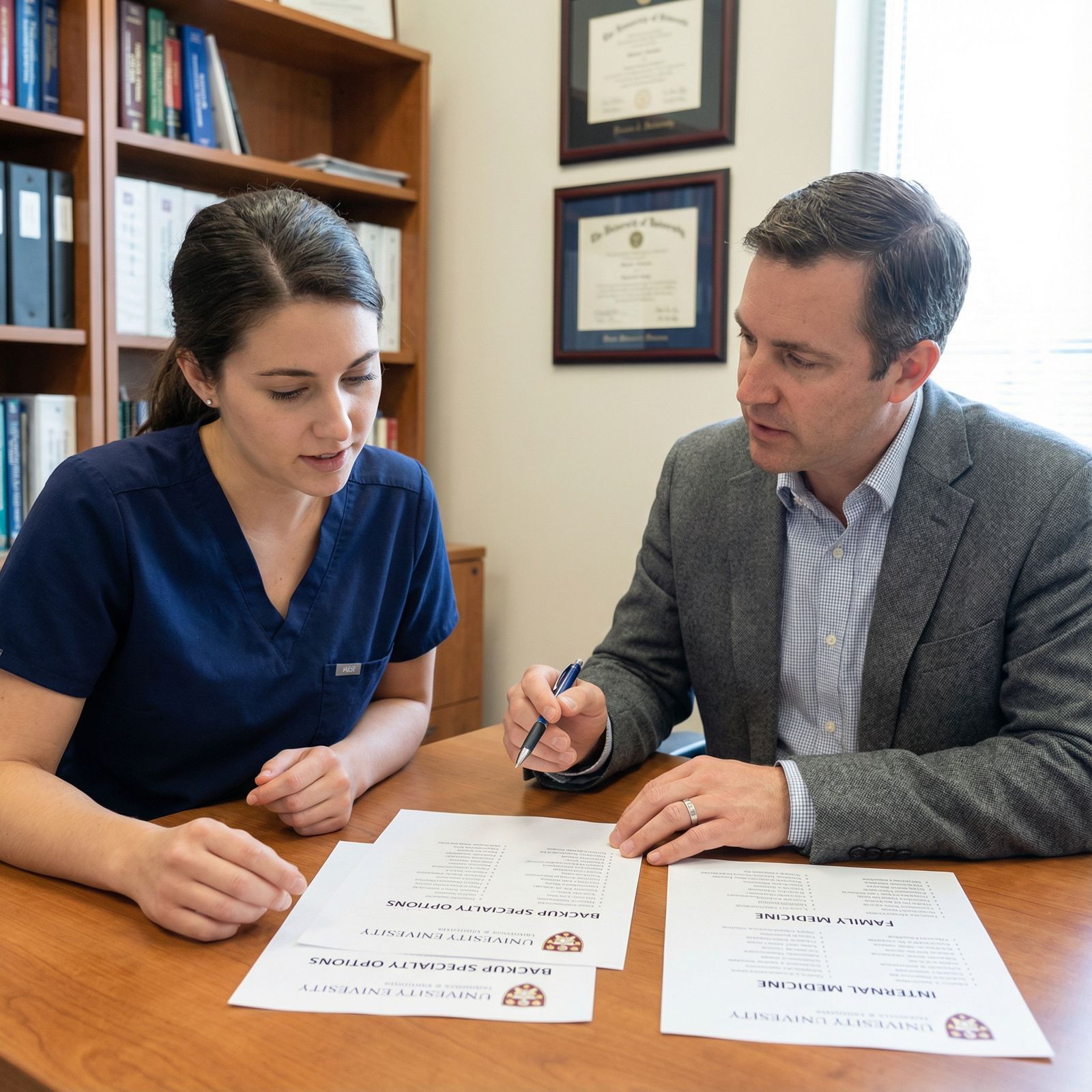
Choosing vascular surgery as a career is bold and inspiring—especially as a DO graduate. But vascular surgery residency, particularly an integrated vascular program, is also small, competitive, and somewhat unpredictable. Thoughtful backup specialty planning is not a sign of doubt; it is a sign of strategic maturity.
This article walks you through how a DO graduate targeting vascular surgery can create a smart, realistic backup plan—without losing focus on their primary goal.
Understanding the Landscape: DO Graduate + Vascular Surgery
Before you can design a backup strategy, you need to understand the competitive and structural realities shaping the osteopathic residency match for vascular surgery.
The nature of vascular surgery training
There are two main pathways:
Integrated Vascular Surgery (0+5)
- Match directly into vascular surgery out of medical school.
- Five years total.
- Highly competitive, small number of positions nationally.
- Early subspecialty focus; less general surgery exposure.
Traditional Pathway (5+2)
- Match into general surgery.
- Then apply for a 2-year vascular surgery fellowship.
- Larger number of entry points via general surgery.
- More flexible if you later pivot to another surgical field.
As a DO, you can absolutely match an integrated vascular program, but the small program numbers mean you must assume higher statistical volatility. One or two unexpected applicants at a few key programs can shift your chances dramatically.
DO-specific considerations
A DO graduate applying to vascular surgery commonly faces:
Variable program familiarity with DO training
- Some academic programs have long histories with DO residents.
- Others may have never had a DO in vascular surgery or in their department.
USMLE vs COMLEX
- Many competitive surgical programs still prefer, or require, USMLE scores.
- Strong USMLE Step 2 (if taken) and strong COMLEX Level 2 help mitigate bias.
Research expectations
- Academic vascular programs often prefer applicants with research, QI projects, or publications, especially in vascular or surgical topics.
- DO schools may have fewer built-in research opportunities; you may have to be more proactive.
Letters and institutional reputation
- Strong letters from vascular surgeons—especially well-known faculty—carry significant weight.
- Away rotations (sub-I’s) at vascular surgery residency programs become more important.
Because of these factors, a DO applicant’s risk of not matching their first-choice specialty is often slightly higher—particularly in small fields like vascular surgery. That’s exactly why backup specialty planning matters.
Stepwise Approach to Backup Specialty Planning
Think of backup planning as a structured decision-making process rather than a vague plan B. Your goal: maximize your odds of a satisfying surgical career while giving yourself multiple paths into vascular work.
Step 1: Define your non‑negotiables
Before picking a plan B specialty, clarify what truly matters to you:
- Do you need to be in the OR regularly?
- Are you comfortable with a longer training path if it increases security?
- How important are:
- Geographic limitations?
- Lifestyle (call, nights, weekends)?
- Research or academic career goals?
- Early vs late subspecialization?
Write down your “must-haves” and “nice-to-haves.” This will shape whether your backup is:
- Another primary surgical specialty
- A broad-base specialty that leads to vascular fellowship
- A closely aligned field where you can still see vascular pathology
Step 2: Understand your applicant profile honestly
Assess yourself across four domains:
Academics
- COMLEX Level 1 and 2 (and USMLE if taken).
- Any failures, repeats, or red flags.
- Class rank / honors / AOA or Sigma Sigma Phi.
Clinical performance
- Surgery and medicine clerkship grades.
- Narrative comments highlighting technical skills, work ethic, and teamwork.
- Sub-I evaluations, especially in surgery.
Surgical exposure and commitment to vascular
- Vascular rotations: home and away.
- Shadowing or longitudinal exposure.
- Vascular or surgery-related research, case reports, QI.
Institutional support and letters
- Do you have strong letters from vascular or general surgeons?
- Does your institution have a vascular fellowship or integrated program?
- Any mentors willing to advocate for you personally?
From there, roughly categorize yourself:
- High-strength applicant – Solid or strong scores, strong clinical performance, meaningful research, strong letters, at least one or two vascular away rotations.
- Moderate-strength applicant – Average scores, good clinical performance, some vascular exposure, perhaps limited research.
- At-risk applicant – Significant academic red flags, fewer connections or letters in vascular, late interest in vascular with limited evidence on paper.
The more risk factors you have, the more seriously you should consider dual applying residency and designing a robust backup strategy.
Step 3: Clarify your approach: pure vs dual application
You generally have three broad strategies:
Single-Track Vascular (High Risk, High Reward)
- Apply only to integrated vascular surgery programs.
- Works best if: strong applicant, no serious red flags, flexible about location, comfortable with risk, and have a genuine fallback in mind (e.g., SOAP, research year, or re-application).
Dual Applying with a Surgical Base (Most Common Strategy)
- Apply to both:
- Integrated vascular surgery; and
- A base specialty that still allows a path to vascular (e.g., categorical general surgery).
- This balances risk and keeps the door to vascular surgery fellowship open.
- Apply to both:
Dual Applying with a Distinct Plan B Specialty
- Apply to integrated vascular and also to a more attainable plan B specialty that you could see yourself doing long-term even if vascular never happens.
For most DO graduates, Option 2 or 3 is more realistic and protective.
Strategic Backup Choices for Vascular-Focused DO Applicants
The most effective backup plan is one that:
- Is realistic for your competitiveness.
- Preserves as many vascular-related options as possible.
- Still leads to a career you’d be comfortable with if vascular never materializes.
1. General Surgery: The classic backup and parallel path
Why it works:
- Direct route to traditional 5+2 vascular training.
- Wide range of programs with variable competitiveness.
- Many DO-friendly community and university-affiliated general surgery programs.
- Maintains an identity as a surgeon with substantial vascular exposure in many residencies.
How to strategize:
- Apply broadly to categorical general surgery programs, not just prestigious academic centers.
- Include:
- Academic medical centers
- Community programs with strong case volume
- Regional programs with established DO presence
- On ERAS, your personal statement and experiences can emphasize:
- Love for operating
- Interest in complex perioperative care
- Long-term interest in vascular pathology (but stressing that you’d be happy within general surgery training as well)
Risk consideration: If you match into general surgery and later choose not to pursue vascular, you still have many career options (MIS, surgical oncology, acute care, etc.)

2. Interventional Radiology (IR) and Diagnostic Radiology
IR offers a procedure-heavy, image-guided vascular-focused career. For some applicants, it’s an excellent plan B specialty or even a co-primary interest.
Pros:
- High procedural volume with endovascular interventions.
- Strong overlap with vascular disease management.
- Growing field with expanding minimally invasive options.
- Integrated IR pathways and DR→IR fellowships.
Cons:
- IR itself is increasingly competitive.
- Requires comfort with radiology physics, imaging interpretation, and less direct open surgery.
- Training path and lifestyle differ from classic OR-based surgery.
For DO graduates:
- Many radiology programs are DO-friendly, but some academic IR programs are highly selective.
- Strong board scores (both COMLEX and USMLE, if taken) are particularly helpful here.
- Early radiology electives or IR shadowing strengthen your application.
When to consider IR/DR as backup:
- You love vascular pathology and procedures but are open to an imaging-heavy career.
- You have strong test scores and analytical skills.
- Your mentors suggest your competitiveness aligns well with radiology.
3. Internal Medicine or Transitional Year → Vascular-Related Fellowships
This is less direct, but for applicants with major academic red flags or who discover vascular late, Internal Medicine may be a realistic secondary path.
While you cannot become a board-certified vascular surgeon via IM, you can:
- Subspecialize in vascular-adjacent areas:
- Interventional cardiology (coronary and peripheral arterial interventions)
- Vascular medicine (non-surgical management of vascular disease)
- Critical care with a focus on vascular and surgical patients
- Hospitalist role in a vascular-heavy institution
This path is best if:
- You are open to a medical, not surgical, identity.
- Lifestyle, geography, and security weigh more heavily than the need to operate.
- Your academic record makes direct surgical specialties risky.
4. Other surgical or procedure-heavy plan B specialties
Depending on your interests and competitiveness, consider:
Anesthesiology
- Significant involvement in vascular cases (cardiac + vascular anesthesia).
- Procedural skills: lines, blocks, TEE in some settings.
- Good for applicants who like physiology, hemodynamics, and OR environment.
Emergency Medicine (EM)
- DO-friendly historically (though competitiveness has fluctuated).
- Lots of acute vascular pathology recognition and initial stabilization.
- Procedural, shift-based work; but no longitudinal operative role.
Interventional Cardiology (long path: IM → Cardiology → Interventional)
- Heavy vascular procedural exposure (coronaries, peripherals).
- Very long training path and non-surgical identity.
These make sense as plan B specialties if you genuinely like the core work of the backup field—not just as a placeholder.
Designing a Dual-Application Strategy (Vascular + Backup)
Once you’ve selected a realistic backup, you must carefully execute a dual applying residency strategy without undermining your primary vascular narrative.
1. Personal statements and messaging
Use two different personal statements:
Vascular Surgery Statement
- Emphasize your passion for vascular disease, complex decision-making, and longitudinal patient relationships.
- Describe:
- Specific vascular cases you’ve seen.
- Research or QI work in vascular/aortic/limb salvage.
- Your commitment to mastering both open and endovascular skills.
Backup Specialty Statement (e.g., General Surgery)
- Emphasize your dedication to surgery more broadly:
- Enjoyment of technical skills and procedural learning.
- Team-based perioperative care.
- Interest in complex surgical patients, possibly with a vascular interest.
- Clarify that you would be happy and fulfilled as a general surgeon, even as you anticipate future specialization options.
- Emphasize your dedication to surgery more broadly:
Avoid sounding like you’re using the backup specialty only as a stepping stone. Programs want residents who are genuinely committed to their field.
2. Letters of recommendation
For vascular surgery:
- Aim for:
- At least one letter from a vascular surgeon who knows you well.
- A mix of vascular, general surgery, and possibly research mentors.
- Preferably at least one letter from an away rotation at a vascular or strong surgery program.
For your backup specialty (if different from surgery):
- Secure at least one specialty-specific letter if possible.
- Radiology letter for DR/IR.
- IM letter if you’re seriously considering internal medicine.
- For general surgery as backup, your vascular letters are usually acceptable and often valued, as long as they highlight general surgical aptitude.
3. ERAS application strategy
Key principles:
- Experiences are the same across all applications; what changes is your emphasis through personal statements and interview conversations.
- Your vascular-related projects can be framed to highlight different skills:
- For vascular programs: commitment to vascular field, initiative, specialty fit.
- For general surgery: research productivity, perseverance, surgical thinking, teamwork.
If asked directly about dual applying, be honest but strategic:
- Emphasize:
- Respect for the competitiveness of integrated vascular.
- Genuine enthusiasm for the backup specialty.
- Commitment to being an outstanding resident in whichever field selects you.
Programs respect applicants who acknowledge reality while showing sincere interest.

Practical Timeline and Action Plan for the DO Vascular Applicant
Timing matters. Here’s a high-yield roadmap oriented to a typical DO student or recent graduate.
M3 (or final clinical year if already graduated)
Clarify your interest in vascular early.
- Seek a vascular elective at your home institution if available.
- If not, look for:
- Vascular surgery exposure on general surgery rotation.
- Shadowing local vascular surgeons in community or academic practice.
Meet with an advisor who understands residency selection.
- Ideally, a vascular surgeon or general surgery program director.
- Ask directly about:
- Your competitiveness.
- How many vascular vs backup programs to target.
- Which specialties would serve as the best backups given your profile.
Plan research or scholarly projects.
- Case reports (e.g., complex PAD, aneurysms, limb salvage).
- Retrospective reviews or QI projects in vascular or related surgical care.
Early M4 (or pre-application year for graduates)
Schedule away rotations strategically.
- At least one vascular surgery or vascular-heavy general surgery sub-I.
- If you’re dual applying to a non-surgical field (e.g., DR), consider an elective in that specialty as well.
Take Step 2/Level 2 early and perform as strongly as possible.
- For DO applicants, Step 2 can be a major equalizer if Step 1/Level 1 was pass/fail or weaker.
Begin drafting two personal statements.
- Circulate them to mentors for feedback.
- Ensure consistency with your CV and experiences.
During application season (ERAS submission through interviews)
Apply broadly.
- For integrated vascular: include a mix of academic and mid-sized programs known to consider DOs.
- For your backup:
- General surgery or your chosen alternative, with a particular focus on DO-friendly programs.
- Many DO applicants apply to:
- All vascular programs where they are geographically and realistically flexible; and
- 40–80+ general surgery programs, depending on competitiveness and risk tolerance.
Prepare for interviews with two narratives:
- A vascular-centered story for vascular programs.
- A surgery-broad or backup-specialty story for your other programs.
- Practice how you’ll answer:
- “Why this specialty?”
- “What are your long-term career goals?”
- “Where do you see yourself in 10 years?”
Use mentors and advisors during rank list formation.
- Show them your rank list (for both specialties).
- Discuss what it would actually feel like to match each program on your list.
If you don’t match vascular (or don’t match at all)
If you match your backup specialty, shift your mindset:
- Commit to being the best resident you can be in that field.
- Look for ways to preserve your vascular-related interests, such as:
- Vascular-heavy rotations.
- Research with vascular or endovascular faculty.
- Fellowship exploration if relevant (especially for general surgery or DR).
If you do not match any program:
- Participate in SOAP with an open mind.
- Consider:
- Prelim general surgery.
- Transitional year or preliminary medicine with strong ICU exposure.
- A dedicated research year in vascular or surgical outcomes.
- Meet urgently with advisors and vascular mentors to redesign your approach for the next cycle.
Mental Health and Identity: Reducing the Emotional Whiplash
Vascular surgery attracts high-achieving, intense personalities. When you dual-apply or emphasize a plan B specialty, it can feel like you’re betraying your dream. You’re not.
A few guiding principles:
- Your worth is not tied to a specific match outcome.
- Being a vascular surgeon is one possible expression of your talents, not the only one.
- Medicine is full of satisfying alternate paths.
- Many physicians discover that their eventual specialty was not their original first choice, yet it’s a great fit.
- Backup planning is a professional duty to yourself and your future patients.
- It ensures you remain in a position to grow, train, and contribute—rather than stalled completely.
Make sure you have:
- At least one mentor who knows your full story and supports your choices.
- Emotional support from peers, family, or counseling services.
- A realistic sense that any match outcome, if chosen carefully, can lead to a meaningful career caring for patients with vascular disease—surgically or otherwise.
FAQs: Backup Specialty Planning for DOs Aiming at Vascular Surgery
1. As a DO graduate, is it unrealistic to aim for an integrated vascular surgery residency without a backup?
It’s not inherently unrealistic, but it is high risk, especially given the small number of integrated programs and variable DO acceptance patterns. If you have:
- Strong USMLE/COMLEX scores
- Excellent clinical performance
- Robust vascular exposure and research
- Strong letters from vascular faculty
you may choose to apply only in vascular. However, most DO applicants benefit from applying to a backup specialty, especially categorical general surgery, to keep a safer path to a vascular career open.
2. What is the best backup specialty for someone who is absolutely sure they want a vascular-focused career?
For most, the most logical backup is categorical general surgery, because:
- It is the traditional entry point for a vascular surgery residency (5+2).
- Many general surgery programs are DO-friendly.
- You can still pursue vascular fellowships after residency. Other reasonable options include Diagnostic Radiology/Interventional Radiology if you are comfortable with a less OR-centric and more imaging-guided, endovascular career. Your choice depends on whether your non-negotiable is “operating as a surgeon” versus “doing vascular procedures,” which can include endovascular approaches outside of surgery.
3. If I dual apply to vascular surgery and general surgery, will programs see that and hold it against me?
Most programs understand dual applications in highly competitive fields. ERAS does not automatically tell programs all the specialties you applied to. However:
- Your narrative should be consistent during each interview.
- When interviewing for general surgery, emphasize your enthusiasm for being a surgeon, with room for future subspecialization.
- When interviewing for vascular, emphasize your deep commitment to vascular specifically. If asked directly, you can acknowledge applying broadly out of respect for the competitive nature of integrated vascular while expressing genuine interest in the program you’re speaking to.
4. As a DO, do I need USMLE to be competitive for vascular and related backup specialties?
You don’t strictly need USMLE, but having strong USMLE Step 2 scores can be a significant advantage in the osteopathic residency match for competitive specialties like an integrated vascular program, general surgery at academic centers, and radiology. Many programs can and do evaluate COMLEX alone, but:
- Taking USMLE may open more doors.
- It may help mitigate bias at some institutions. That said, if you have not taken USMLE and are close to applying, focus on maximizing your COMLEX Level 2 performance, clinical excellence, research, and strong letters. Discuss this with mentors who know your full profile before deciding.
Thoughtful backup specialty planning does not dilute your passion for vascular surgery. Done well, it broadens your options, protects you from the inherent volatility of a small competitive field, and ensures that—whether through an integrated vascular program, a general surgery route, or a related plan B specialty—you end up with a career that aligns with your skills, values, and long-term goals as a DO graduate.