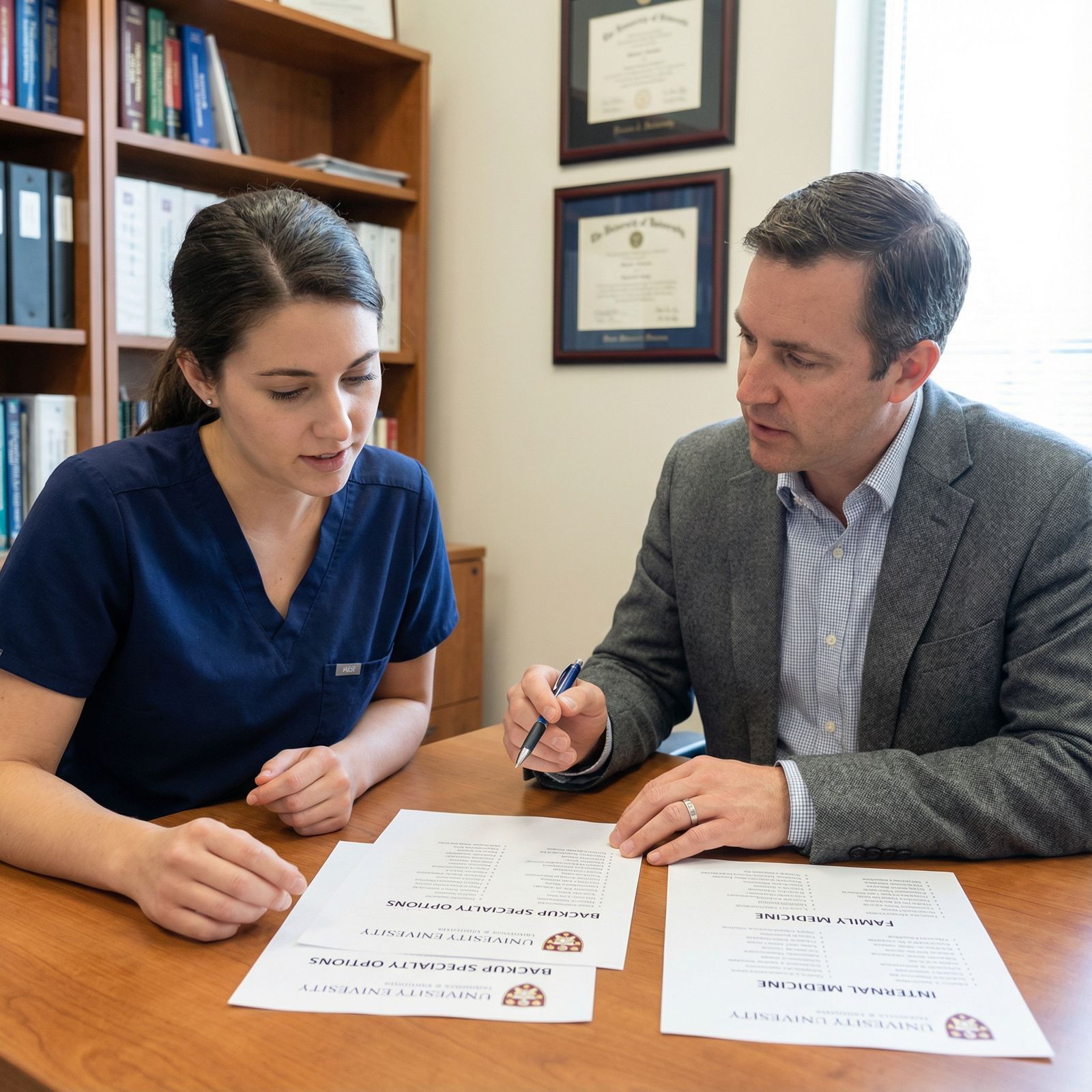
As a DO graduate targeting urology, you’re aiming for one of the most competitive specialties in the Match. That makes backup specialty planning not just smart, but essential. Done well, a backup plan protects your career trajectory without weakening your primary urology application.
This guide walks you through how to strategically build a plan B specialty and, if appropriate, pursue dual applying residency strategies—while still presenting yourself as a serious and credible urology applicant.
Understanding Your Risk Profile as a DO Applying to Urology
Before you can design a backup strategy, you need a realistic sense of your odds in the urology match as a DO graduate.
Why urology is particularly challenging for DO graduates
Several factors make the urology residency landscape more challenging for DOs:
High competitiveness overall
- Fewer total spots than IM, FM, or EM
- High USMLE/COMLEX expectations
- Strong emphasis on research and away rotations
Historic bias toward MD applicants
- Many academic programs have traditionally matched mostly MD graduates
- Some programs still show limited DO representation among residents and faculty
AUA match timing
- Urology uses the American Urological Association (AUA) match (often earlier than NRMP)
- This timing affects how you structure a backup specialty strategy through NRMP
Key data points to assess your individual risk
Your personal risk in the osteopathic residency match and urology depends on:
Board scores
- COMLEX Level 1/2
- USMLE Step 1/2 (if taken)
- Where you stand relative to recent matched urology cohorts
Research portfolio
- Urology-focused projects, abstracts, posters, manuscripts
- Quantity and quality (first-author vs co-author, clinical vs basic science)
Clinical performance
- MS3 core rotation evaluations
- Sub-I/urology electives performance
- Letters of recommendation (especially from urologists)
Institutional factors
- Whether your DO school has a home urology program
- Strength of department advocacy for DOs
- Access to mentors and research infrastructure
Geographic and visa considerations
- Preference for specific regions (limits options)
- Visa requirements (if IMG/DO-IMG)
When a serious backup plan becomes essential
You should strongly prioritize backup specialty planning if any of the following apply:
- USMLE Step 2 (if taken) below typical urology matched averages
- Limited or no urology-specific research
- No home urology program and difficulty securing strong away rotations
- Repeated exam failures or remediation
- You are geographically very restrictive (e.g., only one metro area)
For DO graduates, even with strong metrics, having at least a contingency framework for backup is wise. The key is: plan early, execute selectively.
Step 1: Clarify Your Career Priorities Before Picking a Backup
A backup specialty isn’t just “anything I might match into.” To protect your long-term satisfaction, you need to think carefully about how a plan B specialty aligns with your core values.
Core questions to guide your backup planning
Ask yourself:
How important is operative practice to me?
- If you’re deeply drawn to surgery, purely medical specialties may feel unsatisfying.
- Consider which surgical or procedural fields still give you that OR exposure.
What patient population do I care about most?
- Men’s health? Oncology? Reconstruction? Chronic disease management?
- Many elements of urology overlap with other fields.
How do I feel about lifestyle and call?
- Will you accept a heavier call burden in exchange for operative work?
- Or would you trade some OR time for more predictable hours?
What is my tolerance for additional training or fellowships?
- Some backup routes (e.g., general surgery → urology-like practice through MIS or colorectal) might require longer training.
How location-sensitive am I?
- Narrow geography might push you toward less competitive backup specialties.
By clarifying answers here, you can rule out backups that are purely “safety” but terrible fits, and instead focus on realistic, meaningful alternatives.
Step 2: Smart Backup Specialty Options for DO Urology Applicants
You have two main strategic choices:
- Close-proximity surgical or procedural fields (“urology-adjacent”)
- More secure, less competitive fields that still fit your core interests
Both routes can be valid, depending on your risk tolerance and profile.

1. Urology-adjacent surgical specialties
These are attractive if you strongly want an operative career and enjoy the OR.
General Surgery
Pros
- Heavy operative volume
- Multiple subspecialties overlap with urology (surgical oncology, colorectal, minimally invasive, transplant)
- Can still practice in a way that serves some similar patient populations (e.g., hernia, oncologic resections, pelvic surgery)
Cons
- Also competitive at good academic centers (though less so than urology overall)
- Longer training (5+ years), often followed by fellowship
- Lifestyle can be intense
Who should consider it?
- Strong board scores, good surgery rotations
- Comfortable with a demanding residency
- Open to a longer training path and complex cases
OB/GYN
Pros
- Operative focus, pelvic surgery, endoscopy, and reconstruction
- Overlap with pelvic floor and incontinence issues (similar to female urology)
- Good mix of clinic and OR
Cons
- Highly specialized to women’s health; not everyone will find this satisfying coming from urology interest
- Unpredictable call (L&D)
Who should consider it?
- You enjoy pelvic anatomy, reproductive health, and procedural care
- Comfortable with managing emergencies and obstetrics
- You’re open to female pelvic medicine / urogynecology fellowship as a long-term niche
General Surgery → Urology Later?
Transitioning from general surgery to urology is rare and not something to rely on. Urology is its own distinct match and training pathway. Think of general surgery as its own destination, not as a back door.
2. Procedural but non-OR specialties
These allow frequent procedures but with less OR time.
Interventional Radiology (IR) or Diagnostic Radiology
Pros
- High-volume procedures (IR)
- Image-guided interventions related to urology (nephrostomy tubes, embolizations, biopsies)
- Good lifestyle in many practices (esp. DR)
Cons
- IR is highly competitive; DR moderately competitive
- Training pathways are distinct and complex (integrated vs ESIR vs independent IR)
- Less direct patient continuity in many IR/DR settings
Who should consider it?
- Strong interest in imaging and procedures
- Solid board scores and strong clinical evaluations
- Comfort with high-tech, anatomy-focused work
3. Medical fields that mirror urology’s patient base
If you’re open to less OR time but want to care for similar patients:
Internal Medicine → Nephrology or Oncology
Nephrology: Chronic kidney disease, electrolyte disorders, dialysis.
- Pros: Overlap with renal physiology, some shared patient populations.
- Cons: Virtually no OR; more longitudinal medical management.
Hematology/Oncology: GU malignancies (prostate, bladder, kidney, testicular).
- Pros: Significant overlap with urologic oncology; deep involvement in cancer care.
- Cons: Long training path; emotionally intense; limited procedures.
Family Medicine with Procedural Focus
- Vasectomies, point-of-care ultrasound, simple procedures, men’s health.
- Attractive if you value broad scope, flexibility, and high employability in nearly any geography.
4. High-security backup specialties
If your metrics are borderline for urology and you must secure a residency spot in a single cycle, consider:
- Family Medicine
- Psychiatry
- Pediatrics
- Less competitive Internal Medicine programs
These provide:
- High match rates
- Geographic flexibility
- Strong job markets post-residency
They may feel further from urology, but they protect your ability to complete GME training, become board-certified, and practice medicine.
Step 3: How to Execute a Dual Applying Residency Strategy as a DO
Dual applying can mean:
- Applying to urology + one NRMP specialty (e.g., IM, FM, GS)
- Applying to multiple NRMP specialties as well (less common, higher complexity)
Because urology uses the AUA match, you can sometimes sequence your strategy:
- Apply and interview for urology first.
- If not matched (or if your interview yield is low), intensify your backup NRMP strategy.
However, timing is tight, and you must prepare well before you know your AUA outcome.
Core principles of dual applying without sabotaging yourself
Maintain authenticity
- Do not claim lifelong devotion to urology in one personal statement and then say the same about an unrelated specialty.
- Instead, highlight overlapping skills and values, tailored to each specialty.
Use separate, clearly focused application materials
- One ERAS application profile, but:
- Distinct personal statements
- Some tailored experiences re-ordered or re-emphasized
- Different letter combinations for different specialties
- One ERAS application profile, but:
Be transparent (strategically)
- Urology programs know that DOs often consider backup plans. Dual applying is common.
- However, you do not need to lead with your backup plan at every urology interview.
- If asked, you can frame it as:
“Urology is my top choice, but I recognize it’s highly competitive. I have a parallel plan that keeps me clinically active and focused on similar patient populations if needed.”
Avoid overextending your time and bandwidth
- Urology interviews are time- and travel-intensive (even with virtual formats).
- Overcommitting to backup interviews can dilute your performance in urology interviews, which are your priority.
Practical timeline approach for a DO Urology Applicant
The specific dates change each year, but a common structure is:
Early MS3 – Mid MS3
- Decide if you’re committing to urology as primary.
- Start urology research and identify advisors.
- Begin thinking about broad backup categories.
Late MS3 – Early MS4
- Complete a home urology rotation if available.
- Schedule away rotations in urology at DO-friendly or DO-inclusive programs.
- Meet with advisors to discuss your competitiveness; get an honest read.
Late spring – Early summer before applications open
- Solidify your backup specialty choice based on feedback and performance.
- Arrange at least one rotation in your potential backup field (e.g., IM, FM, GS, OB/GYN).
- Identify potential letter writers for both urology and backup.
Application season
- Submit your AUA urology application first, with urology-tailored materials.
- Submit ERAS application to backup specialty programs around the same time or soon after.
- Prioritize urology interviews; accept backup interviews strategically.
Post-AUA match (if unmatched)
- If you do not match in urology, double down on your NRMP specialty:
- Update programs via email with any new achievements.
- Express sincere interest where appropriate.
- If you do not match in urology, double down on your NRMP specialty:
NRMP Match
- Rank lists for your backup specialty are crafted with the knowledge of your AUA outcome.
Step 4: Choosing Specific Backup Programs and Crafting Your Application
Not all programs are equally welcoming to DOs or to applicants with a urology focus. Strategic program selection is critical.

How to identify DO-friendly programs
Use these signals:
- Recent DO residents in program rosters or alumni lists
- Program websites or social media explicitly mentioning osteopathic graduates
- COMLEX acceptance listed in program requirements
- Positive word-of-mouth from DO residents or faculty
For your backup specialty, prioritize:
- Programs with a track record of training DOs
- Locations where you could realistically live for 3–5+ years
- A range of program competitiveness (a mix of “reach,” “target,” and “safer” options)
Tailoring your ERAS for dual applying
Experiences section
- Keep urology experiences visible; they show commitment to a challenging surgical field.
- For backup specialty applications, reorder your experiences so that the most relevant items (e.g., IM rotations, surgery evaluations, research in related domains) appear higher.
Personal statements
- Create one for urology and one for your backup specialty.
- For the backup personal statement:
- Acknowledge your interest in procedural work or patient populations in a way that is consistent but does not say “I wanted urology but came here instead.”
- Emphasize what authentically draws you to the backup field (e.g., longitudinal care, specific procedures, diagnostic reasoning, or opportunities in men’s health, oncology, pelvic health).
Letters of recommendation
- Urology: Aim for 2–3 letters from urologists (home + away rotations).
- Backup: At least 2 letters from faculty in your backup specialty.
- You can sometimes use a strong surgery/urology letter for other surgical or procedure-oriented specialties, but ask letter writers for permission and be sure the letter’s content is appropriate.
Program signaling and preference signaling tokens (if applicable)
- If your backup specialty uses signaling, reserve tokens for programs that:
- Are DO-friendly
- Align with your geographic and career goals
- Where your profile is realistically competitive
- If your backup specialty uses signaling, reserve tokens for programs that:
Step 5: Emotional and Career Management if You Don’t Match Urology
It’s crucial to prepare not only logistically but emotionally. Not matching urology can feel like a major loss, especially if you’ve invested heavily in the urology match process.
Reframing “backup” as “alternate pathway to a fulfilling career”
Many physicians who do not enter their first-choice specialty still have satisfying, impactful careers. Key strategies:
- Focus on what you enjoy daily: procedures, patient interaction, complex diagnostics, teaching, research, etc.
- Recognize that job satisfaction often depends more on practice environment (colleagues, autonomy, schedule) than on the exact specialty label.
- Understand that there is no single “right” way to serve patients with GU or pelvic health issues; IM, FM, OB/GYN, oncology, nephrology, and radiology all intersect with this space.
Considering a reapplication vs. moving forward in your backup field
If you don’t match urology, you have several options:
Enter your backup residency and build a career there
- Most common and usually the most stable choice.
- You can still maintain some involvement in urology-adjacent care depending on the field.
Urology reapplication after a research year or prelim year
- More complicated, especially for DOs.
- Requires strong mentorship and realistic assessment.
- High-risk: you may still not match the second time.
Leverage your backup specialty to work with overlapping patient populations
- Example: FM with men’s health focus, IM with GU oncology, OB/GYN with urogynecology collaboration, radiology with focus on GU imaging.
In advising DO graduates, most mentors will recommend that if you enter a solid backup specialty residency, plan to build your life there rather than holding on indefinitely to the hope of switching to urology.
Practical Example Scenarios
Scenario 1: Strong DO applicant, moderate urology competitiveness
- COMLEX and USMLE scores around recent matched averages
- Two urology research projects, one poster presentation
- Solid clinical evaluations, strong letters
- No home urology program but one strong away rotation
Plan
- Apply broadly to urology through AUA.
- Choose a backup specialty that preserves procedural excitement, e.g., General Surgery or OB/GYN.
- Do at least one rotation in the backup field, obtain 1–2 letters.
- Dual apply through ERAS with a focused backup list (e.g., 25–40 programs, DO-friendly).
- Prioritize urology interviews; attend backup interviews that don't conflict.
Scenario 2: DO applicant with lower board scores, strong clinical skills
- COMLEX/USMLE below average for matched urology applicants
- Very strong clinical feedback and work ethic
- Limited urology research
Plan
- Still apply to urology if it’s your vision, but target programs with known DO representation.
- Choose a more secure plan B specialty such as Family Medicine, Psych, or IM.
- Apply to a large, geographically broad set of backup programs (40–60+ if FM/IM).
- Highlight your surgical rotations and procedural interest in backup applications to carve a niche (e.g., procedural FM, hospitalist IM).
Scenario 3: DO applicant, late decision toward urology
- Initially planned IM, discovered love for urology on late MS3 rotation
- Some IM research but minimal urology exposure
- Limited opportunity for urology away rotations before applications
Plan
- If timing permits, complete one intensive sub-I in urology and secure at least one urology letter.
- Apply to urology with a modest list, focusing on DO-friendly programs and those open to late converts.
- Maintain IM as primary backup (or co-primary), with robust IM application: strong letters, targeted personal statement, IM research portfolio.
- Allow yourself to be truly open to an IM career while exploring urology fully.
FAQs: Backup Specialty Planning for DO Graduates Targeting Urology
1. As a DO graduate, do I really need a backup if my scores are strong?
Even with strong scores, the urology residency match remains small and competitive, with program-level variability in DO acceptance. A backup plan doesn’t mean you doubt yourself; it means you understand the numbers. At minimum, sketch out a contingency pathway so you’re not forced into last-minute decisions if the urology match doesn’t go your way.
2. Which backup specialty is most compatible with later men’s health or GU-focused practice?
Several specialties can position you near urology’s patient population:
- Family Medicine: Men’s health, vasectomies, sexual dysfunction, BPH symptom management.
- Internal Medicine → Oncology: GU malignancies (prostate, bladder, kidney, testis).
- OB/GYN: Female pelvic floor and incontinence (overlap with urogynecology).
- Radiology / IR: GU imaging, nephrostomies, biopsies, embolizations.
Pick the one whose day-to-day practice you could see yourself genuinely enjoying.
3. Will dual applying hurt my chances in the urology match?
If managed carefully, dual applying residency generally does not hurt your urology application:
- Use separate personal statements.
- Ensure your urology letters are strong and clearly show commitment.
- Be prepared to answer honestly if asked about backup planning, emphasizing urology as your first choice but acknowledging the competitiveness of the field.
Programs understand that DO graduates face additional uncertainty and often appreciate pragmatic planning.
4. Should I skip USMLE and rely only on COMLEX for urology and backup specialties?
For urology—especially if you’re a DO—USMLE Step 2 is strongly recommended (and often expected) by many programs, even if some accept COMLEX alone. For backup specialties, policies vary, but taking USMLE:
- Expands the number of programs that will fairly review you
- Allows direct comparison with MD applicants
- Strengthens your overall application profile
If you’re early enough in training and aiming for urology, plan to take at least USMLE Step 2 in addition to COMLEX Level 2.
Thoughtful backup specialty planning doesn’t take away from your dedication to urology. Instead, it protects your ability as a DO graduate to build a fulfilling, stable, and meaningful career in medicine—whether that winds up being in urology or a well-chosen alternative where your skills and passions still shine.