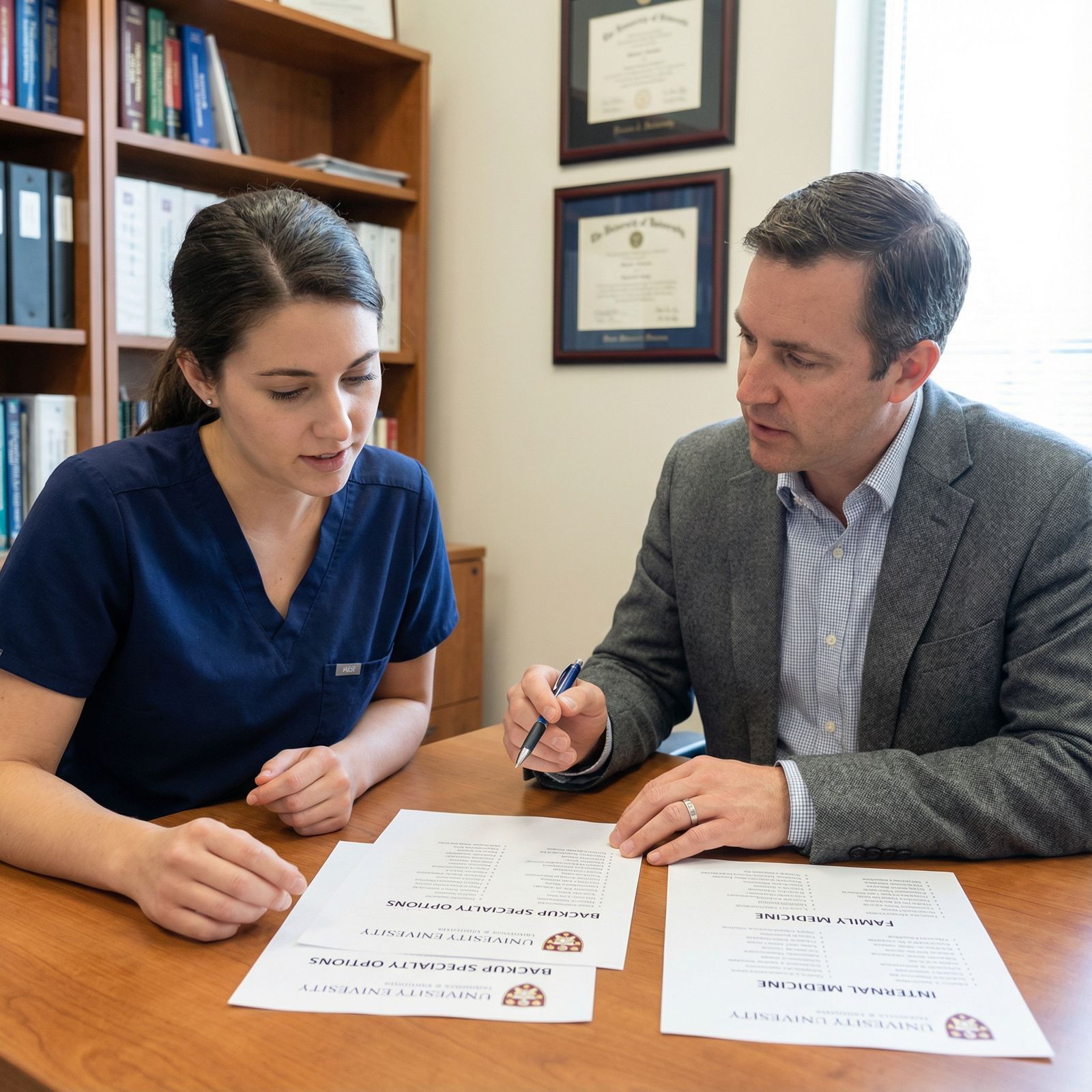
Choosing a backup specialty is one of the most strategic decisions you’ll make as a Caribbean IMG. It influences your study plan, rotations, residency application list, letters of recommendation, and even how you spend your elective time. Doing it well can mean the difference between matching into something you can grow in versus going unmatched and losing a year.
Below is a practical, in-depth guide to backup specialty planning strategies for Caribbean IMG applicants, with specific tips tailored to schools like SGU, AUC, Ross, Saba, and other Caribbean medical schools.
Understanding Why Backup Specialty Planning Matters More for Caribbean IMGs
As a Caribbean IMG, you’re operating in a more competitive space than many US MD or DO students. Even at strong schools with solid SGU residency match outcomes and similar schools, the reality is:
- Some specialties are extremely competitive for IMGs (e.g., Dermatology, Plastic Surgery, Ortho, ENT, Radiology, Ophthalmology).
- Program directors may prioritize:
- US grads over IMGs
- IMGs from schools with long track records and strong support structures over lesser-known programs
- Visa needs can further limit your options if you require sponsorship (J-1 or H-1B).
Why a Backup Specialty Is Essential (Not Optional)
For a Caribbean IMG, having a well-thought-out plan B specialty is not a sign of weakness; it’s a smart risk-management strategy:
Mitigates the risk of going unmatched
Dual applying residency allows you to remain in the match ecosystem, gain US clinical experience, and potentially re-apply later for your primary specialty if desired.Reduces anxiety and decision paralysis
Knowing you have a reasonable, evidence-based backup specialty gives you clarity about:- What electives to choose
- Which letters to secure
- How to structure your personal statements
Positions you for long-term stability
A backup specialty can still lead to a happy, fulfilling career. Many physicians start in a “plan B” specialty and later:- Subspecialize into areas closer to their original interest
- Shift into research, leadership, or academic roles
- Build niche practices that align with their passions
Provides leverage to build a US-based CV
Residency in a less competitive specialty may allow you to accumulate research, US experience, and networking—assets that can open doors later if you decide to pursue a transition or fellowship.
Step 1: Clarify Your Primary Goal and Your Non‑Negotiables
Before picking a plan B specialty, you must be crystal clear about your primary specialty goal and your non‑negotiable life/career values.
A. Identify Your Primary Target Specialty
Typical Caribbean IMG primary targets often include:
- Internal Medicine (IM)
- Family Medicine (FM)
- Pediatrics
- Psychiatry
- Emergency Medicine (EM)
- General Surgery (more competitive for IMGs but still relatively common)
Some Caribbean graduates also target highly competitive fields (e.g., Anesthesiology, Radiology, Ophthalmology, competitive surgical subspecialties). If you’re in this group, robust backup planning is especially crucial.
Write down:
- My primary specialty:
- Why I want it (top 3 reasons):
This will help you identify what must be preserved in your backup plan—e.g., high acuity, procedures, continuity of care, lifestyle, income, or geographic flexibility.
B. Define Your Non‑Negotiables
List what truly matters to you long term. Examples:
- I want a procedural specialty vs. mainly cognitive.
- I’m okay with nights and weekends vs. I strongly prefer predictable hours.
- I must earn a certain income ceiling due to loans/family obligations.
- I’m willing to work in rural or underserved areas vs. I want mostly urban centers.
- I’m open to longer training vs. I prefer the shortest possible pathway.
This step prevents you from choosing a backup that you’ll resent later.
Step 2: Assess Your Competitiveness Honestly (Scores, CV, Timing)
Backup specialty planning only works if it’s grounded in reality.
A. Objective Metrics
Key data points:
- USMLE Step 1: Pass/fail, but your performance can still influence internal screening.
- USMLE Step 2 CK score: The single most important objective metric now.
- US clinical experience (USCE): Number and quality of core and elective rotations.
- Gaps and red flags:
- Exam failures or repeats
- Leaves of absence
- Multiple school transfers
As a Caribbean IMG, your Step 2 and clinical evaluations are critical. Be bluntly honest with yourself:
- If targeting a very competitive specialty (e.g., Radiology, Anesthesiology, EM), are your scores and CV in the top tier for Caribbean IMGs?
- If you’re closer to average or slightly below average for Caribbean schools, your backup needs to be truly more attainable.
B. School Resources and Match Data
Use your school’s data:
- SGU residency match lists (or your specific Caribbean school’s match outcomes)
- Specialty‑specific match reports for your school and peer institutions
- NRMP and FREIDA data on IMG match rates by specialty
Look for:
- Where do graduates from your Caribbean medical school residency pipeline most often match?
- Which specialties show reliable IMG match rates (especially for your program) over 3–5 years?
- Are those specialties aligned with your interests?
This data-driven approach helps you avoid wishful thinking.
Step 3: Choosing a Strategic Backup Specialty (Plan B That Actually Works)
Now you want to pick a backup specialty that:
- You could realistically match into as a Caribbean IMG.
- Still overlaps with your interests, skills, and values.
- Leaves room for later subspecialization or career flexibility.
A. Common Backup Specialty Routes for Caribbean IMGs
Below are some practical “primary-target / plan B specialty” pairings:
Primary: Internal Medicine → Backup: Family Medicine or Psychiatry
- IM is relatively IMG-friendly, but if your scores are borderline, FM or Psych may provide a safer alternative.
- FM allows inpatient + outpatient mix and broad practice options.
- Psych is increasingly competitive, but still reasonable for strong Caribbean IMGs with good Step 2 and relevant rotations.
Primary: General Surgery → Backup: Internal Medicine or Transitional Year (TY)
- Surgery is moderately competitive for Caribbean IMGs.
- With lower scores or average letters, IM becomes a solid backup with potential for procedural subspecialties (GI, Cards, Pulm/CC).
- A TY year is not a true backup specialty but may be acceptable if clearly aligned with a continued surgical path and you’re prepared to re-apply.
Primary: Emergency Medicine → Backup: Internal Medicine or Family Medicine
- EM has tightened substantially for IMGs; dual applying residency to IM or FM is now common.
- You can still work in urgent care or hospitalist roles that approximate some aspects of EM practice.
Primary: Anesthesiology or Radiology → Backup: Internal Medicine or Family Medicine
- These fields have become increasingly competitive; IM or FM are realistic backups that still provide procedural or diagnostic subspecialty pathways (e.g., Cardiology with cath lab, Interventional Pain, etc.).
Primary: Pediatrics → Backup: Family Medicine or Psychiatry
- Peds is relatively IMG friendly, but if you’re marginal, FM offers similar continuity and family-centered practice.
- Psych can work if you gravitate toward behavioral/developmental aspects of pediatrics.
Primary: Psychiatry → Backup: Family Medicine
- Psych is gaining competition. FM can be a workable backup if you like longitudinal relationships and are open to integrating behavioral health into primary care.
These are not rigid rules, but common patterns that align with US match realities.

B. Traits of a Good Backup Specialty (for Caribbean IMGs)
When choosing your plan B specialty, look for:
Higher overall IMG match rates
Specialties traditionally more open to IMGs include:- Internal Medicine
- Family Medicine
- Pediatrics
- Psychiatry
- Pathology (varies by year)
- Some community-based Transitional Year (TY) programs
Breadth and flexibility
A good backup offers:- Many fellowship options (e.g., IM → Cards, GI, Heme/Onc, Pulm/CC, Nephrology, Endocrine, ID)
- Scope to practice in a variety of settings (urban vs rural, academic vs community).
Practical fit with your clinical interests
For example:- If you like acute care and procedures, IM or FM with an EM‑heavy practice or hospitalist track may fit.
- If you’re drawn to long-term psychotherapy and behavioral health, Psych or FM with behavioral focus can be viable.
Realistic Step 2 CK expectations
If your Step 2 is below the median for your primary target specialty, your backup should be in a range where your score is at or above typical matched IMG applicants.
C. Examples of Strategic Dual Applying Paths
Example 1: Caribbean IMG with Step 2 = 225, Primary: Emergency Medicine
- School: Major Caribbean institution (e.g., SGU, AUC)
- Profile: Strong evaluations, but no major EM research
- Strategy:
- Dual applying to EM + IM
- 1–2 EM audition rotations for strong EM letters
- 1–2 IM electives to secure strong IM letters
- One EM‑focused personal statement, one IM‑focused statement
- EM list: 25–35 programs (mostly community, IMG-friendly)
- IM list: 60–80 programs emphasizing IMG‑friendly institutions
Example 2: Caribbean IMG with Step 2 = 238, Primary: General Surgery
- Strategy:
- Apply General Surgery and Internal Medicine
- Schedule at least one Sub‑I in surgery and one strong inpatient IM rotation
- Use surgery‑heavy elective time but still get 1–2 IM letters
- Rank list ultimately may lean heavily toward IM if surgery interviews are limited.
Step 4: Structuring Your Application for Dual Applying
Dual applying is more than just clicking multiple specialty boxes in ERAS. For Caribbean IMGs, it must be deliberate and organized.
A. Building Parallel Application “Tracks”
For each specialty (primary and backup):
- Draft a separate personal statement tailored to that specialty.
- Identify 2–3 faculty in each specialty for letters of recommendation:
- For IM: Inpatient ward attendings, subspecialty attendings.
- For FM: FM clinic attendings, outpatient preceptors.
- For Psych: Inpatient Psych or CL attendings.
- For EM: EM clerkship directors, EM attendings from US rotations.
B. Strategically Using Letters of Recommendation
ERAS allows you to assign different letters to different programs. Use this to your advantage:
- For IM programs:
- Aim for 2–3 IM letters + 1 from a related field (e.g., Cardiology, Pulm, or even FM).
- For FM programs:
- At least 1–2 FM letters, plus one IM or Peds letter.
- For Psych:
- At least 2 Psych letters if possible, plus 1 IM/FM letter demonstrating solid medical skills.
- For EM:
- At least 1–2 SLOEs (Standardized Letters of Evaluation), if available, plus 1 IM/FM letter where needed.
Do not send a specialty‑specific letter (e.g., EM SLOE) to a backup specialty program unless it’s clearly framed as a strong global endorsement of your clinical skills.
C. Managing Personal Statements
Never send a generic statement that looks like it was copy‑pasted for multiple fields.
Do:
- Write distinct statements for each specialty.
- For the backup specialty, be genuinely positive—avoid implying this is only your second choice.
- Emphasize overlaps:
- EM → IM backup: highlight love of acute care, systems‑based practice, continuity potential as a hospitalist.
- Surgery → IM backup: highlight procedural interest via subspecialties like GI or Cards.
Step 5: Electives, Rotations, and Clinical Strategy for Caribbean IMGs
Your clinical rotation plan should reflect your backup specialty planning early—ideally by the middle of third year.
A. Rotations Aligned With Both Primary and Backup
If you’re targeting one specialty but keeping another in mind:
- EM primary, IM backup:
- Do EM Sub‑I/auditions early.
- Ensure at least one strong inpatient IM rotation (ward or ICU).
- Surgery primary, IM backup:
- Prioritize a surgery Sub‑I.
- Also complete at least one high‑quality IM inpatient elective.
- Psych primary, FM backup:
- Do an inpatient Psych rotation and an outpatient Psych clinic.
- Also secure a solid outpatient FM rotation.
B. Maximizing Evaluations and Letters
For Caribbean IMGs, strong US letters can offset some disadvantages. During rotations:
- Show up early, stay late, and be proactive.
- Ask for mid‑rotation feedback so you can improve before final evaluations.
- Near the end of a rotation, if you’ve performed strongly:
- Ask directly: “Do you feel you know me well enough to write a strong letter of recommendation for residency?”

Step 6: Application Volume, Program Selection, and Ranking Strategy
Even with a backup specialty, Caribbean IMGs must be smart about where and how widely they apply.
A. Number of Programs to Apply To
Rough ranges for Caribbean IMGs (these vary with scores and CV):
- Internal Medicine: 60–120 programs
- Family Medicine: 40–90 programs
- Pediatrics: 40–80 programs
- Psychiatry: 40–80 programs
- General Surgery: 40–80 programs (often more if scores are borderline)
- EM (with backup): 25–40 EM + 60–80 IM/FM
Discuss specific numbers with your school’s dean’s office or advisors—they’ll know the “sweet spots” for SGU residency match or similar institutions.
B. Selecting IMG‑Friendly Programs
Use tools like FREIDA, NRMP data, and your school’s match lists to find:
- Programs that consistently take IMGs, especially from Caribbean schools.
- Programs with small or no US MD preference stated in their criteria.
- Locations where Caribbean medical school residency alumni have done well (e.g., your own school’s graduates currently in training).
Prioritize:
- Community programs
- Programs in less competitive geographic regions (Midwest, South, some rural regions)
- Institutions known to sponsor visas, if applicable
C. Ranking Strategy When Dual Applying
When it’s time to create your rank list:
- Rank all programs—both primary and backup—purely in order of where you’d most like to train, regardless of specialty.
- If you would rather be an internist than unmatched, then you should rank IM (backup) programs above “no match.”
- Avoid ranking a specialty you truly would not be willing to practice just to say you matched.
You may have to face a hard truth:
Is it better to match into your plan B specialty now or risk going unmatched hoping for a shot at your dream specialty later? For many Caribbean IMGs, the safer path is usually to secure a spot in a reasonable backup specialty and then explore specialized paths within it.
Step 7: Long‑Term Career Planning From a Backup Specialty
Matching into a backup specialty does not mean your dream is dead. It means your path is different.
You can:
- Subspecialize closer to your interests:
- IM → Cardiology, Pulm/CC, GI, Hem/Onc, Endocrine, Rheumatology, etc.
- FM → Sports Medicine, Palliative Care, Geriatrics, Addiction Medicine.
- Psych → Child & Adolescent, CL, Forensic, Addiction.
- Develop a niche practice:
- FM with EM‑style urgent care focus
- IM or FM with a heavy procedure focus (endoscopy, minor procedures, point‑of‑care ultrasound)
- Psych with strong consultation‑liaison work interface with medicine.
- Transition toward academic or research roles related to your original passion.
- Consider future transitions (e.g., second residency) in specific, narrow cases, though this is challenging and not guaranteed.
Your plan B specialty, if chosen wisely, can still get you much closer to your “ideal” clinical life than you might think.
Common Mistakes Caribbean IMGs Make With Backup Specialties
Avoid these pitfalls:
Choosing a backup you actually hate
This leads to poor performance, burnout, and regret. You must at least “like” it enough to envision yourself doing it long term.Being unrealistic about competitiveness
Applying Anesthesia + Radiology as primary and “backup” with mediocre Step 2 is not a true backup strategy.Applying too narrowly
Caribbean IMGs often under‑apply. If you’re dual applying, you likely need to apply broadly to both the primary and backup.Sending the wrong letters to the wrong specialty
Don’t send a glowing EM SLOE as your only letter to an IM program. Ensure each program gets specialty‑appropriate letters.Ignoring visa or geographic constraints
If you need a visa, your backup specialty should include many visa‑sponsoring, IMG‑friendly programs. Don’t only apply to places that rarely sponsor.
Putting It All Together: A Step‑By‑Step Action Plan
For a Caribbean IMG in 3rd or early 4th year:
- Clarify your primary specialty and your non‑negotiables.
- Assess your competitiveness using Step 2 CK, clinical performance, and your school’s match data.
- Choose a realistic backup specialty (plan B specialty) that:
- Is relatively more attainable for a Caribbean IMG
- Aligns with your interests and values
- Map your rotations to support both specialties.
- Ensure at least 1–2 electives in each field.
- Secure letters from both specialties.
- Aim for 2–3 in each track.
- Prepare two application “packages”:
- Distinct personal statements
- Separate letter configurations in ERAS
- Apply broadly and strategically, using FREIDA, NRMP, and your school’s match history to find IMG‑friendly programs.
- Interview authentically:
- For each interview, talk genuinely about your motivation for that specific specialty.
- Rank programs in true order of preference across both specialties.
If you follow this structured approach, your backup specialty planning becomes a deliberate, powerful tool instead of a last‑minute panic decision.
FAQ: Backup Specialty Planning for Caribbean IMGs
1. If I dual apply, will programs know I’m also applying to another specialty?
Programs generally do not see which other specialties you applied to. They only see the application you send to them. However:
- If your personal statement is vague or generic, they may suspect divided interest.
- If your letters seem mismatched (e.g., only EM letters for an IM program), that can raise questions.
Solution:
Use specialty‑specific personal statements and letters for each program to demonstrate clear commitment.
2. As a Caribbean IMG, is Internal Medicine always the best backup specialty?
Not always, but it is a very common and logical backup because:
- IM has relatively high IMG match rates in many programs.
- There are numerous fellowship options that can approximate other fields (e.g., Cards vs some aspects of EM; GI vs some procedural specialties).
- Many Caribbean medical school residency outcomes strongly cluster in IM, meaning more established pathways.
However, if you truly dislike inpatient medicine, another field like Family Medicine or Psychiatry may be a better plan B specialty.
3. Should I apply to a backup specialty only if I don’t get interviews in my primary specialty?
No. For Caribbean IMGs, delaying backup applications until after primary specialty rejections is risky and often too late.
You should:
- Decide on your backup before ERAS opens.
- Plan your letters, electives, and personal statements accordingly.
- Submit applications to both specialties at the start of the season.
Waiting reduces your chances significantly.
4. I’m at SGU (or similar Caribbean school) with an average Step 2. Can I still match my primary specialty without a backup?
It’s possible, but risky—especially in moderately or highly competitive fields. Even with a strong SGU residency match infrastructure, no school can guarantee outcomes.
If:
- Your Step 2 is average or slightly below average compared with peers targeting that specialty,
- You don’t have unique research or connections,
then not having a backup exposes you to the real risk of going unmatched. A thoughtful dual applying residency strategy usually offers a safer, more sustainable path into US training.
Backup specialty planning doesn’t mean giving up on your goals. For a Caribbean IMG, it’s about playing the long game wisely—securing a solid residency position now while keeping doors open to grow your career in the direction you truly want.