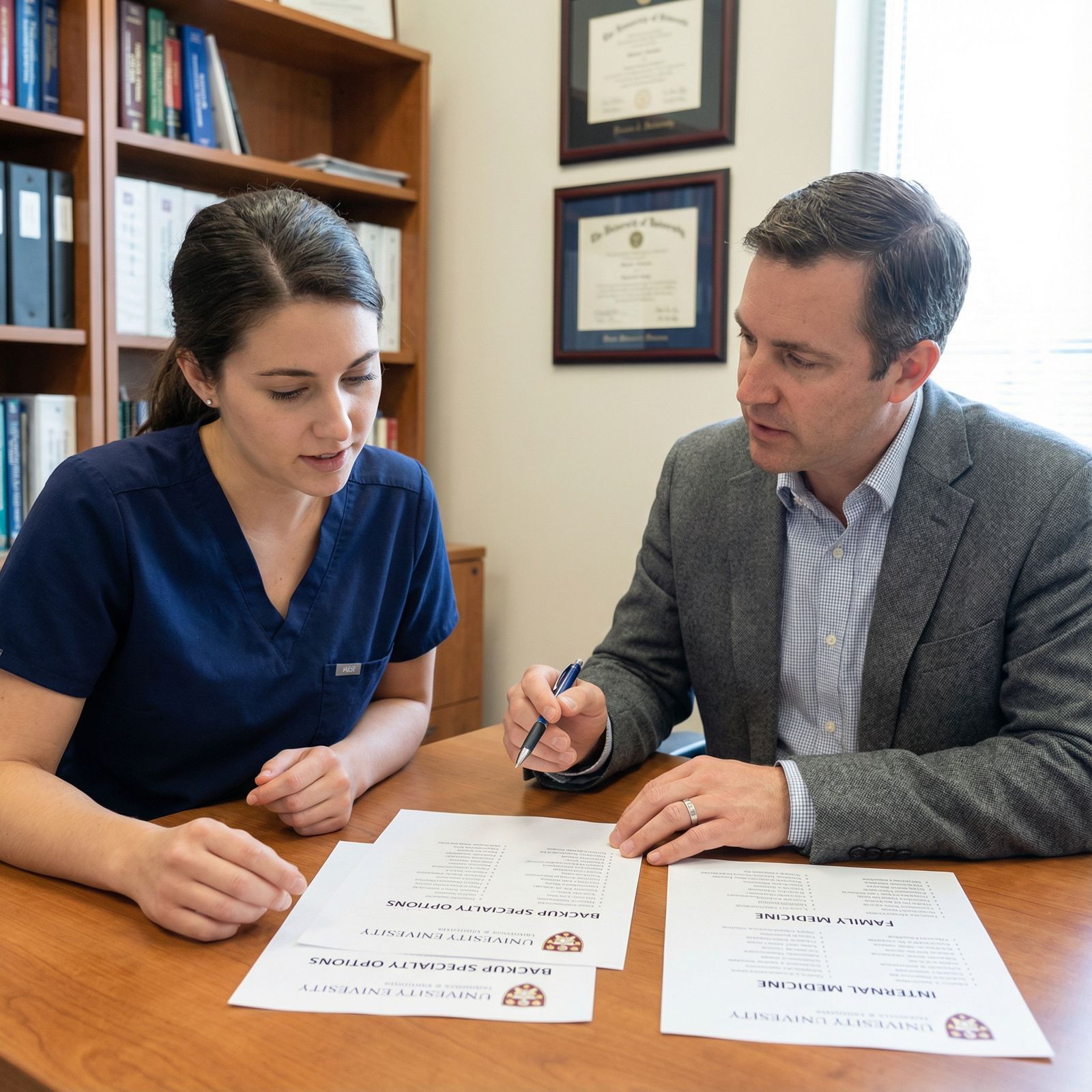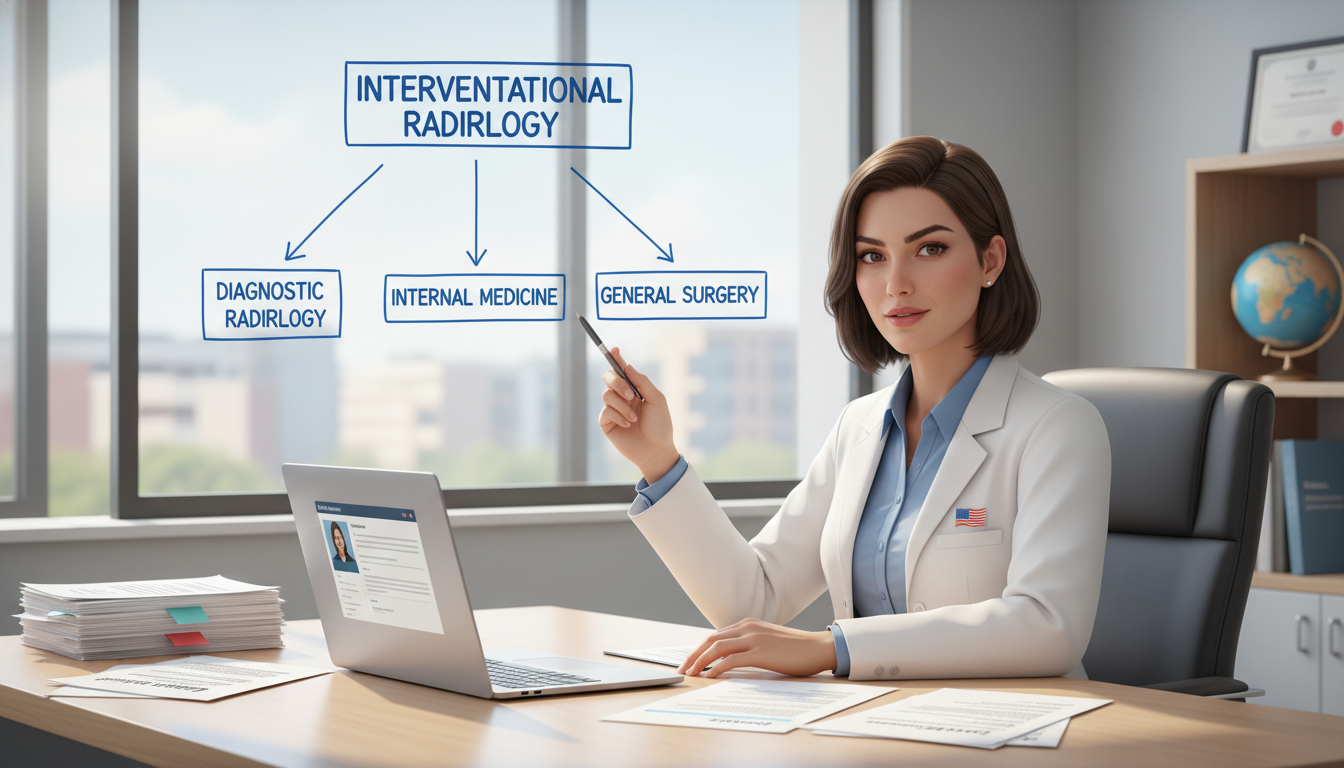
Why Backup Specialty Planning Matters for Future Interventional Radiologists
Interventional Radiology (IR) is one of the most competitive and rapidly evolving specialties in modern medicine. As an MD graduate aiming for an interventional radiology residency, you’re entering a field with limited positions, high applicant volume, and increasing interest every year. That combination makes strategic backup specialty planning not just wise—but essential.
A thoughtful backup plan does not mean you are less committed to IR. Instead, it signals maturity, self-awareness, and an understanding of risk management in the allopathic medical school match process. The goal of this guide is to help you structure a realistic, evidence‑based strategy for:
- Maximizing your chances in the IR match
- Identifying a well‑fitting plan B specialty
- Deciding if dual applying is right for you
- Maintaining flexibility for a future transition into IR when possible
Throughout, we’ll focus specifically on the MD graduate residency applicant, highlighting nuances relevant to allopathic medical school graduates, including your relative advantages, gaps, and strategic opportunities.
Understanding the IR Match Landscape and Your Risk Profile
Before picking a backup specialty, you need a clear sense of how competitive you are for an interventional radiology residency and where you fall on the risk spectrum.
IR Pathways: Integrated vs Independent
You can reach IR primarily through:
Integrated Interventional Radiology (IR/DR) Residency
- NRMP match after medical school (PGY‑2 entry after a preliminary/transitional year)
- Highly competitive, limited number of spots nationwide
- Grants dual certification in Diagnostic Radiology and IR
Independent IR Residency (after DR)
- Match after completion of (or late in) a Diagnostic Radiology residency
- Still competitive, but you already have a solid residency home in DR
- Often filled by residents who discovered or solidified interest in IR during DR
For an MD graduate residency applicant, the integrated IR match is typically the primary target. Backup planning must consider both failure to match IR now and preserving pathways to IR in the future.
Key Competitiveness Factors for IR Applicants
Your individual risk profile will determine how aggressive your backup strategy should be. Programs usually look at:
- USMLE/COMLEX scores (Step 1 may be pass/fail, but Step 2 still matters)
- Medical school pedigree (allopathic medical school match applicants often have some advantage over IMGs)
- Clerkship grades and class rank/AOA
- Research output in IR or related fields
- Letters of recommendation from interventional and diagnostic radiologists
- Demonstrated commitment to IR:
- IR electives
- IR interest group leadership
- Case logs, QI projects, or IR‑oriented presentations
- Red flags (remediations, professionalism concerns, large test score gaps)
Self-Assessment Exercise
Assign yourself a rough rating in each area:
- Exam strength (below average / average / strong)
- Academic record (below average / average / strong)
- IR‑specific commitment and experiences (weak / moderate / strong)
- Overall application risk (high / moderate / low)
If two or more domains are “below average/weak,” you should strongly consider a robust backup specialty and dual applying strategy.
Principles of Effective Backup Specialty Planning
Your backup specialty plan should be structured, not improvised. Think in terms of goals, alignment, and pathways.
Core Goals of a Backup Plan for IR Applicants
Avoid going unmatched
A gap year without a clear plan can be demoralizing and logistically complicated.Preserve pathways back to IR when possible
Some specialties (like DR) are “IR‑proximal,” meaning they open doors to the IR match later.Provide a fulfilling career even if you never practice IR
A backup specialty should still be something you can imagine doing long term.Optimize your application’s coherence
Your story should make sense to both your primary IR programs and your backup specialty programs.
Alignment: What to Look For in a Plan B Specialty
Consider these domains when evaluating a plan B specialty:
Procedural content
If you love hands‑on work, a procedure‑heavy backup specialty will feel more aligned.Imaging exposure and collaboration with IR
Specialties that frequently consult IR may keep you close to the field.Lifestyle and call structure
IR often involves emergent procedures and off‑hours work. Decide if you want similar or different lifestyle characteristics in your backup.Training length and flexibility
Some residencies offer additional fellowships that can approximate parts of IR practice (e.g., endovascular, vascular, or pain procedures).Geographic distribution and competitiveness
Your backup should be realistically attainable given your academic record and personal constraints.
High-Yield Backup Specialties for Aspiring Interventional Radiologists
Not all backup choices are equally strategic if your long‑term dream is IR. Below are common and pragmatic backup options for MD graduates targeting the interventional radiology residency pathway.

1. Diagnostic Radiology (DR): The Most Direct IR-Proximal Backup
For an MD graduate targeting IR, Diagnostic Radiology is usually the ideal backup.
Why DR is an excellent backup:
- Direct path to IR: Completing DR opens the door to independent IR residency or IR fellowship‑type opportunities.
- Shared skills and mindset: Image interpretation, cross‑sectional anatomy, procedural planning.
- Overlap in application content: Your IR‑focused research, electives, and letters also signal strong DR interest.
- Stable and versatile career: Even if you never transition to IR, DR offers subspecialties and varied practice settings.
Strategic considerations:
- Many integrated IR programs are housed within strong DR departments.
- DR is also competitive but offers more positions than IR.
- As an MD graduate, you generally have favorable odds in the allopathic medical school match for DR compared with IR.
How to present your dual interest:
- On ERAS and in interviews, emphasize:
- Commitment to radiology broadly
- Enthusiasm for both diagnostic and interventional components
- Openness to a career that might include more DR than IR if needed
- For DR‑only programs:
- Make clear you value diagnostic work itself and are not “using DR” solely as a stepping stone.
Scenario Example
An MD graduate with:
- Step 2 score slightly above national mean
- Good but not stellar research (1‑2 IR‑related abstracts)
- Strong radiology letters
Strategy:
- Apply broadly to IR/DR integrated programs
- Apply broadly to DR programs as a backup
- Articulate a cohesive narrative: you love imaging and image‑guided therapy; either IR or a DR subspecialty would be a satisfying career.
2. Surgical and Procedure-Heavy Backups: General Surgery and Vascular Surgery
If what draws you to IR is complex procedures, anatomy, and acute care, surgical fields can be a compelling plan B specialty.
General Surgery (GS)
Pros:
- Heavy procedural volume, technical skills, and acute care similar to emergent IR.
- Wide range of fellowships afterwards:
- Vascular surgery
- Surgical oncology
- Trauma/critical care
- HPB, transplant, etc.
- Involvement in multidisciplinary care where IR is also active.
Cons:
- Longer and physically demanding residency.
- Less direct path back to IR; switching from GS to IR is possible but uncommon and complex.
- Lifestyle and call can be more intense than many radiology paths.
Ideal for MD graduates who:
- Love being in the OR and want a hands‑on career no matter what.
- Can realistically see themselves as a surgeon even if IR never works out.
- Value high‑acuity patient care and team-based perioperative management.
Vascular Surgery (Integrated or Fellowship)
Pros:
- Very procedure‑heavy and endovascular‑oriented.
- Lots of overlap with IR in managing peripheral arterial disease, aneurysms, and access.
- Combines open and endovascular skills.
Cons:
- Even more specialized and intense than GS.
- Training length and competitiveness can be significant.
This should generally be a primary rather than purely “backup” choice, unless you already have strong vascular exposure and a credible story for dual interest.
3. Internal Medicine‑Based Backups: Cardiology, GI, and Beyond (Longer Path)
Some MD graduates drawn to IR are primarily motivated by technology, complex decision-making, and longitudinal patient care. In those cases, internal medicine routes can function as a more indirect backup.
Internal Medicine (IM)
Alone, IM is not a close analog to IR, but it can be a launchpad for procedural subspecialties:
- Interventional Cardiology
- Electrophysiology
- Gastroenterology (with ERCP/advanced endoscopy)
- Pulmonology (with advanced bronchoscopy)
Pros:
- Very broad career options.
- If you like pathophysiology and continuity of care, IM‑based careers can be deeply rewarding.
- You can still collaborate with IR heavily (e.g., in oncology, hepatology, vascular medicine).
Cons:
- Multiple additional training layers (residency + fellowship + possibly advanced fellowship).
- Procedural volume and style differ substantially from IR.
- Pathway back into IR from IM is exceptionally rare.
IM is a reasonable backup if:
- You are genuinely excited about internal medicine and its subspecialties.
- You can clearly articulate why IM interests you independent of IR.
- You are comfortable potentially never doing catheter-based image-guided procedures.
4. Other Potential Plan B Specialty Options
Depending on your interests, you might also consider:
- Anesthesiology – Procedural, acute care, pain management, interventional pain opportunities.
- Emergency Medicine – Fast-paced, procedural, frequent collaboration with IR; but IR transition would be quite rare.
- Neurology with Neurointerventional Focus – In some pathways, neurologists can train into neurointerventional procedures, though these are highly specialized tracks.
Each of these is more of a parallel path than a stepping stone to IR, so they only make sense if you would be satisfied in them as a primary career.
How to Execute a Dual Applying Strategy Without Hurting Your IR Chances
Dual applying residency (i.e., applying to both IR and another specialty in the same application cycle) is common for IR hopefuls, but it must be carefully planned.

Step 1: Decide Early if You’ll Dual Apply
Aim to decide by late spring or early summer of your application year, because:
- You’ll need time to arrange letters relevant to both specialties.
- Your personal statement strategy and elective choices will be affected.
- You can more strategically select audition rotations and mentors.
Waiting until the last minute often leads to a scattered application that neither specialty finds convincing.
Step 2: Choose a Coherent Backup
For most MD graduates aiming for IR, the most coherent dual application is:
- Primary: Integrated Interventional Radiology
- Backup: Diagnostic Radiology
Other combinations (e.g., IR + General Surgery, IR + Anesthesiology) can work, but you must be more careful to explain your dual interests.
Step 3: Structure Your Application Materials
ERAS Program Signaling (if available):
- Use your top priorities to signal your most desired IR and DR programs.
- Don’t signal too many top IR programs at the expense of DR if DR is a critical backup.
Personal Statements:
You may need more than one statement:
IR-Focused PS:
- Emphasize your passion for image‑guided therapy, procedural innovation, and patient-centered care.
- Describe specific IR experiences, mentors, and projects.
DR-Focused PS (if using separate):
- Highlight your fascination with imaging as the central diagnostic hub of medicine.
- Discuss experiences that show you value the cognitive and collaborative aspects of radiology.
- It’s acceptable to mention IR interest as a component but avoid suggesting you see DR only as a consolation prize.
Letters of Recommendation:
Aim for:
- At least 2 letters from radiologists, ideally one from an interventional radiologist and one from a diagnostic radiologist.
- For other backup specialties (e.g., surgery, IM), secure at least one strong letter from that department.
- Coordinate with letter writers so they understand:
- Whether their letter is intended for IR, DR, or both.
- How you’re framing your narrative.
Step 4: Tailor Your Program List Intelligently
For an MD graduate in IR aiming to minimize risk:
- IR integrated programs: Apply broadly unless you’re an exceptionally strong applicant (top scores, many publications).
- DR programs: Also apply broadly, including a healthy number of mid‑tier and community programs.
- Other backup specialties: If using a non-DR plan B, include programs across the competitiveness spectrum, not just top academic centers.
Typical balanced strategy (numbers vary by year and applicant):
- 25–40 IR integrated programs
- 40–60 DR programs
- Optional: Additional 10–20 in a secondary backup specialty if your risk profile is high
Work closely with your Dean’s office or an advisor familiar with NRMP data to calibrate these numbers.
Step 5: Interview Season: Messaging and Authenticity
IR Interviews:
- Focus on your IR commitment, technical curiosity, and patient care experiences.
- If asked about backup plans, be honest but concise:
- “I’m also applying to diagnostic radiology, because I love imaging and I know DR provides a solid foundation for IR as well. That said, integrated IR is my first choice.”
DR Interviews:
- Avoid making programs feel like a safety net.
- Emphasize:
- Genuine interest in radiology as a whole.
- Appreciation for the intellectual challenge of diagnostic work.
- Openness to subspecialties outside IR (e.g., neuro, body, MSK).
Other Specialty Interviews:
- Tailor your story to reflect a parallel passion (e.g., for surgery or IM).
- It is okay to acknowledge liking IR, but do not frame the backup specialty as second‑tier.
Long-Term Planning: If You Don’t Match IR the First Time
Even with careful planning, some MD graduate residency applicants will not match into an interventional radiology residency on the first attempt. How you respond matters greatly.
Scenario 1: You Matched into Diagnostic Radiology
You have an excellent platform:
- Seek early exposure to IR in your DR residency:
- IR electives and mentorship
- IR call/shadowing opportunities
- IR‑related research or QI projects
- Perform well in DR:
- Strong evaluations
- Good in‑training exam performance
- Professionalism and teamwork
When the time comes, you can apply for:
- Independent IR residency (most common path)
- Hybrid and evolving training pathways as regulations change
Even if you ultimately remain in DR without formal IR training, you can:
- Subspecialize in areas that interface with IR (e.g., body imaging, vascular/interventional adjacent work).
- Become a strong collaborator with IR teams.
Scenario 2: You Matched into a Non‑Radiology Specialty
In surgery, IM, EM, or anesthesia:
- Decide early whether you still want to pursue IR or pivot fully.
- Understand that transferring to DR or IR residencies is possible but:
- Requires open spots.
- Demands strong performance and proactive networking.
- Alternatively, explore procedural fellowships within your chosen specialty (e.g., endovascular, interventional cardiology, advanced endoscopy, interventional pulmonology, pain).
In many cases, the most realistic path is to embrace your matched specialty and build a fulfilling procedural career there.
Scenario 3: You Go Unmatched
If you go unmatched in both IR and your backup specialty:
- Enter SOAP (Supplemental Offer and Acceptance Program)
- Be open-minded about categorical and preliminary positions (e.g., prelim surgery, prelim medicine, transitional year).
- After SOAP:
- Decompress and realistically reassess your competitiveness.
- Consider:
- A research year (preferably in IR or radiology).
- Additional clinical experience (e.g., prelim year, non‑ACGME positions, if available).
- Work closely with advisors to rebuild and reapply with a more strategic plan (often focusing more heavily on DR or a less competitive backup).
Practical Action Plan for MD Graduates Targeting IR
To make this concrete, here’s a semester‑by‑semester style roadmap for an MD graduate in the final year or two before applying.
12–18 Months Before Application
- Confirm your commitment to IR:
- IR electives, shadowing, reading core IR texts.
- Start or continue IR‑related research or QI projects.
- Meet with:
- IR faculty mentor
- Radiology program director or advisor
- Your Dean’s office
Ask explicitly:
“Given my metrics and experiences, should I dual apply? If so, what backup specialty makes the most sense?”
6–12 Months Before Application
- Solidify your IR and backup specialty choices.
- Arrange strong letters:
- IR attending
- DR attending
- Other specialty (if applicable), such as a surgeon or internist.
- Schedule away rotations if appropriate, prioritizing:
- IR (for exposure and letters)
- DR (for broad radiology experience) if IR away options are limited.
3–6 Months Before Application
- Draft multiple personal statements as needed:
- IR‑specific
- DR‑specific or other specialty‑specific
- Identify programs:
- Build a tiered list (reach, target, safety) for IR and backup specialties.
- Take Step 2 (if not already done) and aim to score competitively for IR and DR.
Application Season and Beyond
- Submit ERAS early in the opening window.
- Respond to interview invitations promptly.
- Practice interview answers focusing on:
- Your motivation for IR.
- Your understanding of IR’s realities (call, emergent cases, longitudinal follow‑up).
- Your genuine interest in DR or other backups.
FAQs: Backup Specialty Planning for IR‑Bound MD Graduates
1. If I’m an MD graduate with strong scores, do I really need a backup specialty?
Even a strong MD graduate IR applicant benefits from considering a backup. IR positions are limited, and year‑to‑year variability can affect outcomes. For some top applicants, a light DR backup (a smaller but targeted list) may be enough. Discuss your risk profile with radiology advisors who know current match trends before deciding to apply IR‑only.
2. Is dual applying to both interventional radiology residency and diagnostic radiology frowned upon?
No. It is common and generally well understood by program directors. The key is authenticity: you must convincingly show DR programs that you value diagnostic radiology as a career, not just as a stepping stone. Many IR attendings themselves trained in DR first, so they respect that pathway.
3. Can I switch from another specialty into IR later if I change my mind?
Switching from another specialty (e.g., surgery, IM, EM) into IR is possible but challenging. You would typically need to:
- Transfer into a DR residency spot (if available), then pursue IR.
- Or, in rare circumstances, enter specific neurointerventional or vascular pathways if you come from neurology or surgery.
This uncertainty is why DR is the most practical backup if your primary motivation is a future in IR.
4. What is a realistic plan B specialty if I discover late that IR might be out of reach?
If you realize during your final year that your chances for IR are low (due to exams, lack of IR experiences, or other factors), consider:
- Diagnostic Radiology as a still-viable path into a radiology-based career and possible later IR.
- General Surgery if you want a procedure-intensive life and can see yourself as a surgeon.
- Anesthesiology or Emergency Medicine if you enjoy acute care and procedures but are flexible about imaging.
The best plan B specialty is one that fits your core interests (procedures vs cognition vs longitudinal care) and that you could genuinely practice if IR never materializes.
Thoughtful backup specialty planning does not weaken your IR ambitions; it strengthens your overall residency strategy, protects you from going unmatched, and widens your options for a meaningful, procedurally rich career—whether or not you ultimately practice interventional radiology.