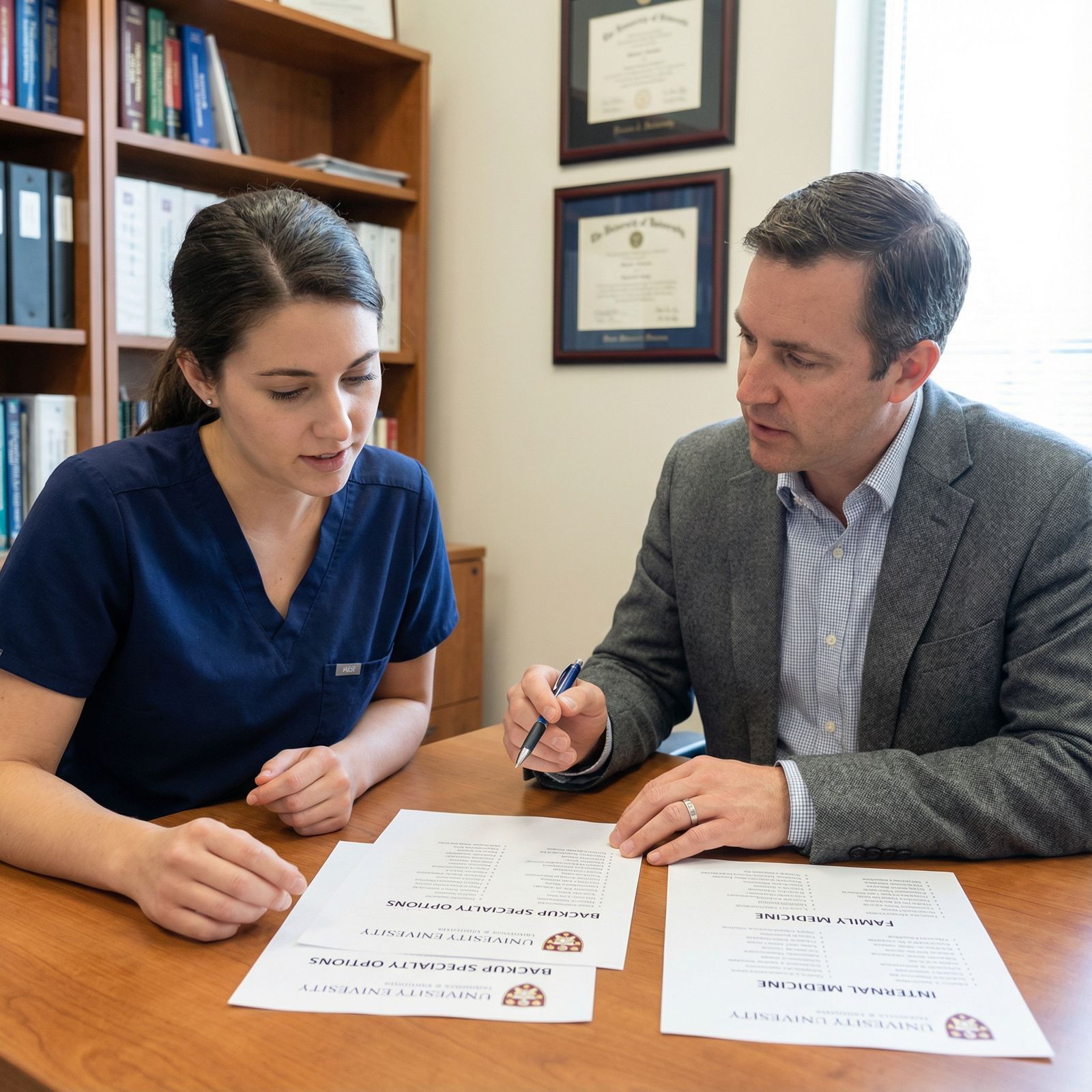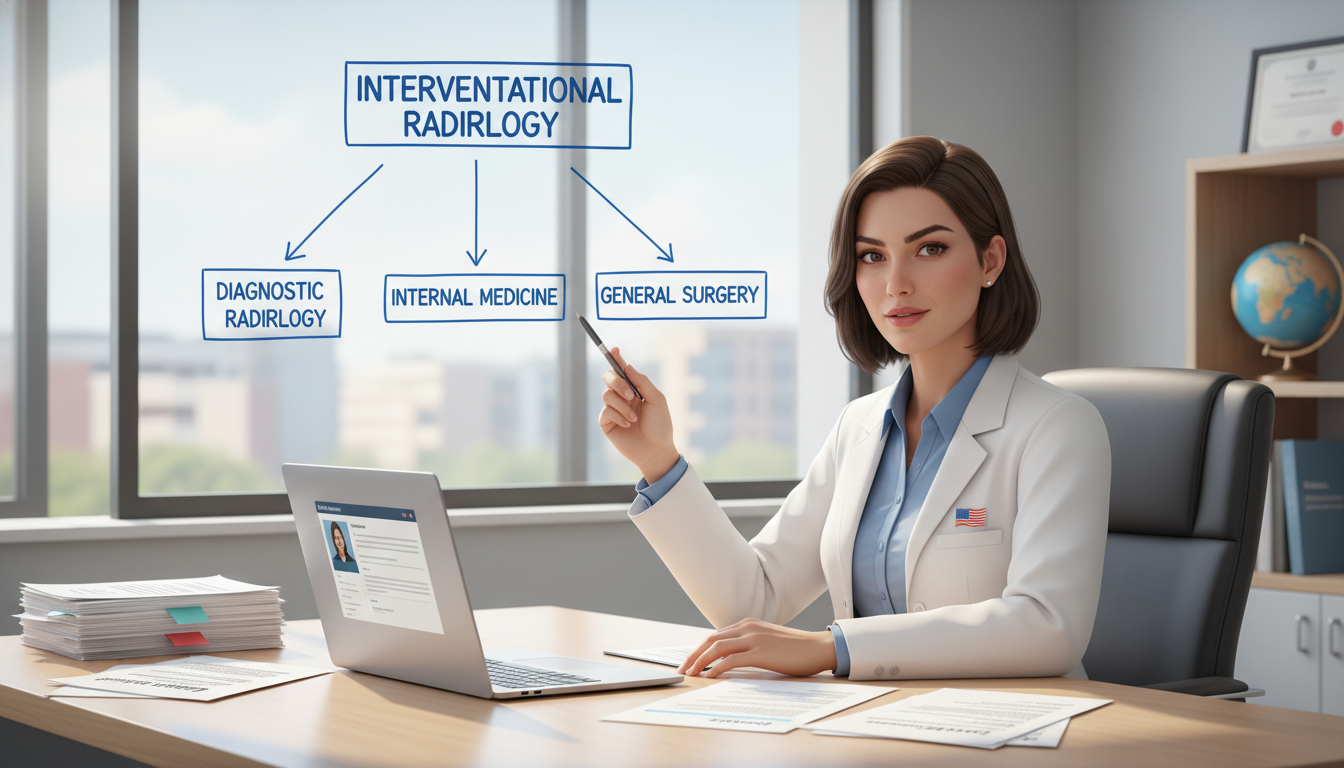
Why Backup Specialty Planning Matters in Interventional Radiology
Interventional radiology is now one of the most competitive specialties in the Match. Integrated interventional radiology residency positions are limited, applicant numbers are rising, and many candidates with strong applications still fail to match each year. That reality makes intentional backup specialty planning essential—not pessimistic.
For most applicants, a thoughtful “plan B specialty” strategy does three crucial things:
- Protects you from going unmatched
- Keeps you close to your long‑term goal (IR or IR‑adjacent work)
- Reduces anxiety so you can apply boldly to interventional radiology
Effective planning does not mean you are less committed to IR. It means you are managing risk like a professional.
In this guide, we’ll walk through how to approach backup specialty planning for an interventional radiology residency step by step, including common IR‑adjacent options, how to dual apply, and how to make decisions if your IR match doesn’t work out the first time.
Understanding the IR Match Landscape
How competitive is interventional radiology?
Integrated IR residency (IR/DR) has consistently been among the most competitive specialties. While exact numbers vary by year, typical patterns include:
- High proportion of applicants who fail to match despite being strong on paper
- Emphasis on board scores (though shifting with Step 1 pass/fail)
- Heavy weighting on:
- Research (especially in IR/DR, procedural specialties, or imaging)
- Strong letters of recommendation from interventional radiologists
- Demonstrated interest (electives, sub‑internships, away rotations)
- Very limited total positions compared to internal medicine or pediatrics
Because integrated IR is small and selective, the risk of going unmatched is real, especially for:
- Applicants from lower‑known schools or international schools
- Those with red flags (exam failures, gaps)
- Candidates with limited IR exposure or weak IR letters
- Late converts to IR who lack specialty‑specific preparation
Risks of “IR‑or‑bust” without a backup
Going all‑in on IR without a backup specialty or clear plan B can have serious consequences:
- Going unmatched and being forced into a scramble/soap situation that may:
- Land you in a program or specialty that was never on your radar
- Make future IR reapplication more complicated
- Loss of continuity in training if you take a research year or a non‑clinical role without a plan
- Psychological stress and burnout from feeling that anything less than IR is failure
In contrast, a structured IR match and backup strategy lets you:
- Maximize your odds of matching somewhere you can grow
- Keep doors open for future transition into IR or IR‑adjacent practice
- Be more honest and authentic in your IR applications because you have a safety net
Core Principles of Backup Planning for IR Applicants
Before talking about specific specialties, it helps to clarify some guiding principles.
1. Backups are about strategy, not lack of commitment
Residency program directors understand the competitiveness of interventional radiology. Many expect that strong IR applicants will have a backup specialty strategy.
Your goal is not to “pretend” you only love one field. Instead:
- Be genuinely prepared to train and practice in your backup field if needed.
- Choose something compatible with your values, skills, and lifestyle goals.
- Aim for synergy—background that could still help you if you re‑approach IR.
2. Define your non‑negotiables
When choosing a backup or dual applying, be explicit about:
- Patient contact: Do you need longitudinal relationships, or are episodic/procedural encounters okay?
- Procedural intensity: Do you want your hands on wires, scopes, and devices every day?
- Imaging orientation: Do you enjoy reading imaging, anatomy, and 3D relationships?
- Work hours/lifestyle: Are irregular hours and emergent call acceptable?
- Long‑term income and practice patterns: Are you comfortable with potential private practice vs academic balance?
Knowing your baseline values will make it easier to distinguish between a true plan B specialty and something you chose out of panic.
3. Your backup should fit at least one of two goals
A good backup specialty or dual applying residency strategy should:
- Provide a satisfying standalone career if you never transition to IR
and/or - Serve as a launchpad toward IR or IR‑adjacent practice
(e.g., ESIR, independent IR, procedural fellowships)
If your backup doesn’t plausibly do one of these, reconsider.
Common Backup and “Plan B” Options for IR Applicants
There isn’t a single correct backup specialty for everyone pursuing interventional radiology. Instead, think in categories based on your interests, risk tolerance, and long‑term goals.

1. Diagnostic Radiology (DR) – The Most Direct IR‑Adjacent Backup
Why it’s popular: Diagnostic radiology is the single most common backup for IR applicants because it keeps you in the imaging space and preserves multiple routes back to IR or procedural work.
Pros:
- Direct overlap in skills (imaging, anatomy, image‑guided thinking)
- ESIR pathways available in many DR programs, reducing time to independent IR
- Potential to apply for independent IR residency after DR
- Solid, flexible career in DR if you never transition to IR
- Strong lifestyle and compensation profiles for most DR positions
Cons:
- DR is itself competitive, especially at top programs
- You may not have guaranteed access to ESIR or independent IR from any specific DR program
- Long training pathway if you do DR then IR
Best for applicants who:
- Love imaging and procedures
- Could see themselves satisfied as a diagnostic radiologist
- Value keeping IR options open structurally
If you’re dual applying to interventional radiology residency and DR, you need to be deliberate about:
- Tailoring your personal statements (one for IR, one for DR)
- Being honest in interviews about your interest in interventional vs diagnostic work
- Targeting DR programs with clear ESIR or IR‑supportive pathways
2. Internal Medicine → Interventional or Procedural Pathways
Internal medicine is a broad, flexible baseline that can pivot to multiple procedural and IR‑adjacent careers.
Potential long‑term directions:
- Advanced endovascular or structural heart work via:
- Cardiology → Interventional Cardiology
- Vascular Medicine/Endovascular (in some systems)
- Procedural subspecialties:
- Gastroenterology (ERCP, EUS)
- Pulmonology (bronchoscopy, pleural procedures)
- Critical care (ultrasound‑guided procedures, lines, drains)
Pros:
- Large number of positions → safer as a backup
- Diverse fellowship options with high procedural content
- Strong patient contact if you value longitudinal care
- Possible collaboration with IR on complex patients
Cons:
- More indirect route to IR; transitioning to formal IR training from medicine is difficult and uncommon
- Long training (residency + fellowship)
- More inpatient rounding and cognitive work than pure image‑guided practice
Best for applicants who:
- Enjoy pathophysiology, patient relationships, and multidisciplinary care
- Could see themselves satisfied in a procedural IM subspecialty if IR doesn’t happen
- Value a relatively “safe” plan B specialty in the Match
3. General Surgery and Surgical Subspecialties
Some IR applicants are primarily drawn to procedures, anatomy, and the operating room environment. For them, surgical fields can be a reasonable plan B.
Common options:
- General Surgery (with later vascular, transplant, or HPB interest)
- Vascular Surgery (integrated or traditional pathways)
- Other surgically oriented programs, depending on your interests and competitiveness
Pros:
- Very procedural, device‑oriented work
- Opportunities for hybrid OR/endovascular practice in some systems
- Clear, well‑defined training pathways
- High acuity and significant impact on patient outcomes
Cons:
- Lifestyle can be demanding with long hours and frequent call
- Transitioning directly from surgery to IR is not a common or direct pathway
- Operative rather than image‑guided focus, though overlap exists in vascular/endovascular work
Best for applicants who:
- Are strongly procedure‑driven
- Enjoy the OR environment and surgical team dynamics
- Are comfortable with intensive, physically demanding training
4. Anesthesiology and Critical Care
For some students, anesthesiology or critical care can serve as a procedural, acute‑care‑oriented backup that still leverages image guidance and technology.
Pros (Anesthesia/CC):
- High use of ultrasound guidance for lines, regional blocks
- Intensive procedural exposure in critical care tracks
- Fast‑paced, physiology‑focused, team‑oriented work
- Reasonable number of positions nationwide
Cons:
- Not a conventional stepping stone into IR
- Less focus on catheters, endovascular treatments, or complex imaging than IR
- Different patient relationship structure (e.g., short encounters in anesthesia)
Best for applicants who:
- Love physiology and acute care
- Value procedural skills but are open to a different kind of practice than IR
- Could genuinely see themselves happy in anesthesia or ICU roles
5. Other Less Common but Viable Plan B Specialties
Depending on your interests, other specialties can function as a backup specialty or a “dual applying residency” option:
- Emergency Medicine – Procedural exposure, acute imaging, but less direct connection to IR training
- Neurology → Neuro‑interventional pathways – In a few systems, neurologists pursue endovascular work, but pathways are specialized and not universally available
- Physical Medicine & Rehabilitation (PM&R) – MSK procedures, pain interventions, ultrasound guidance; more tangential to IR but can scratch the procedural itch
These are best for applicants with a very clear sense of their own interests and risk tolerance.
How to Build a Dual Applying Strategy for IR
Having a sense of potential plan B specialties is only the first step. The next is execution: how to structure your IR match application and your backup specialty application so they both remain strong.

Step 1: Honestly assess your IR competitiveness
Before you decide how aggressively to dual apply, sit down with:
- An interventional radiologist mentor
- Your home program director or radiology advisors
- Possibly a dean’s office career advisor
Review:
- USMLE/COMLEX scores (with Step 2 CK now more critical)
- Clinical grades and honors (especially in surgery, radiology, and medicine)
- Research output in IR, radiology, or related fields
- Strength and number of IR‑specific letters of recommendation
- Quality and quantity of IR rotations (home and away)
A few general patterns:
- Highly competitive applicants (strong scores, robust IR research, multiple IR letters, away rotations with excellent evaluations)
- May apply primarily IR with DR as a focused backup
- Moderately competitive applicants
- Often benefit from robust dual applying (IR + DR + a broader backup like IM or Anesthesia)
- At‑risk applicants (exam failures, no IR home program, limited exposure)
- Often need a strong primary backup strategy with IR as a “reach” section of their application
Step 2: Clarify your primary and backup target
Define explicitly:
- “My primary target is: ___ (e.g., Integrated IR).”
- “My structured backup specialty is: ___ (e.g., DR, IM, General Surgery).”
Then decide whether you’re:
- Dual applying (e.g., IR + DR, IR + IM)
- Or backing up inside radiology only (IR + DR with many DR programs)
The more competitive you are, the more you can concentrate your efforts. The higher the risk, the more robust your backup needs to be.
Step 3: Letters of recommendation strategy
You’ll typically need:
- Strong IR letters for IR programs
- At least one strong DR letter for DR programs (if applying)
- Specialty‑specific letters for other fields (IM, Surgery, Anesthesia, etc.)
Tactics:
- Ask letter writers whether they feel comfortable tailoring letters toward IR or DR.
- For dual applying outside radiology, be transparent:
“I am applying primarily to interventional radiology and diagnostic radiology, but I’m also applying to [backup specialty] as a strategic backup given IR competitiveness. I’d be grateful if you could comment on my suitability for [backup specialty] as well.” - Avoid generic, lukewarm letters by choosing attendings who know you well.
Step 4: Personal statements and ERAS materials
Use separate personal statements when dual applying. For example:
- IR statement: Focus on image‑guided procedures, IR‑specific experiences, procedural decision‑making, and your vision within interventional radiology.
- DR statement: Emphasize your interest in imaging, diagnostic reasoning, the central role of radiology in patient care, and openness to ESIR/IR if relevant.
- Other specialty statements (IM, Surgery, etc.): Center them fully on that specialty—avoid sounding like you’re only applying because you want IR.
You can keep a common core about your values (patient care, curiosity, teamwork), but the narrative focus should fit the specialty in question.
Step 5: Program list construction
Be realistic but opportunistic. Consider:
- IR: Apply broadly, especially if you are not at a top 10 institution or have any red flags.
- DR: Include a mix of academic and community programs, paying attention to:
- Programs offering ESIR
- Programs with strong track records of graduates entering independent IR
- Other backups: Apply to a sufficient number to have a statistically strong chance of matching:
- At least 20+ IM programs, or equivalent, depending on your competitiveness
- Enough different geographic regions to avoid overconcentration
Tools like NRMP’s Charting Outcomes and your school’s match data can help you model an appropriate number of applications.
Step 6: Interview strategy and honesty
In interviews:
- IR interviews: You can be open about your love for IR and your long‑term vision in the field. You do not need to detail your backup strategy unless directly asked.
- DR interviews: It’s fine to acknowledge that you enjoy both diagnostic and interventional work. Avoid framing DR as purely a stepping stone or “backup”; instead, articulate what you like about diagnostic radiology as a possible career.
- Other specialty interviews: Commit to talking sincerely about what interests you in that field. You don’t need to volunteer that IR is your #1 passion, particularly if you would genuinely train and practice in the specialty if you match there.
If asked directly whether you’re dual applying:
- Be brief and honest:
“Yes, I’m also applying to [specialty], given the competitiveness of IR. I could see myself happy in either path, and I’m very interested in what your program offers in [specialty].”
Programs understand you’re managing risk. What matters is that you don’t come across as insincere or disinterested in their specialty.
What If You Don’t Match IR? Next Steps and Long‑Term Planning
Despite careful planning, some applicants don’t match into an integrated interventional radiology residency on their first attempt. Your response in the weeks and months after Match Day is critical.
Scenario 1: You match your backup specialty
If you match into DR, IM, Surgery, or another backup:
- Give yourself time to adjust emotionally. It’s normal to grieve the “lost” IR dream, even if you’re heading into a strong backup field.
- Fully commit to your new program. Show up engaged, hard‑working, and curious. Your new colleagues and PD are now your professional home.
- Explore IR/IR‑adjacent opportunities from within your field:
- DR: ESIR tracks, independent IR applications later.
- IM: Procedural fellowships, collaboration with IR on complex cases.
- Surgery: Endovascular, vascular surgery, or other high‑procedure niches.
- Reassess your long‑term goals after PGY‑1/PGY‑2. Sometimes, residents happily pivot away from IR; others still aim for IR‑adjacent roles or independent pathways.
Scenario 2: You go unmatched
If you neither match IR nor a backup specialty, you have a more urgent decision tree:
Short‑term steps:
- Participate in SOAP with an open mind:
- There may be open DR, prelim, or categorical positions in other specialties.
- Meet immediately with:
- Your dean’s office
- Specialty advisors
- Any supportive faculty mentors
Longer‑term options:
- Research year in IR or radiology:
- Build publications, connections, and a stronger application.
- This can be powerful but should be structured (clear mentor, defined deliverables).
- Non‑categorical or transitional year:
- Gain clinical experience, strengthen letters, and then reapply.
- Revisiting your specialty choices:
- You may decide to emphasize a more attainable specialty in the next cycle, with or without IR in the mix.
In all cases, the key is to have a concrete, 1–2 year plan with measurable steps (research, clinical exposure, networking) rather than drifting.
Practical Tips and Common Pitfalls
Do: Start planning early
Begin thinking about your IR and backup strategy in:
- Late MS2 / early MS3: explore IR, radiology, and related fields
- MS3: schedule core rotations to test your preferences
- Early MS4: finalize your primary target and backup specialty plan
Do: Seek multiple perspectives
Talk to:
- IR faculty at your home institution (and at away rotations)
- DR residents and attendings
- Residents and attendings in your potential backup fields
- Recently matched IR residents who dual applied
They can share real‑world stories about what worked and what didn’t.
Do: Protect your mental health
The IR match can be stressful. Backup planning is partly an emotional buffer:
- Knowing you have a Plan B specialty reduces catastrophic thinking.
- Having realistic expectations prevents feeling blindsided on Match Day.
- Consider peers, therapists, or wellness resources if anxiety becomes overwhelming.
Don’t: Treat your backup as a throwaway
Program directors can sense when you see their specialty as a consolation prize. That can hurt your chances:
- Write thoughtful, specialty‑specific personal statements.
- Prepare seriously for every interview, regardless of specialty.
- Be ready to commit if you match your backup—a “regretful” resident is bad for everyone.
Don’t: Assume DR → IR is guaranteed
Even if you back up with DR, remember:
- ESIR spots are limited and competitive within some programs.
- Independent IR spots are also competitive.
- You should be prepared to practice DR as a career if IR doesn’t materialize.
Don’t: Hide information from mentors
Advisors can’t help you plan effectively if you’re not open about:
- Your competitive profile
- Your willingness (or not) to dual apply
- Your preferences for geography and lifestyle
Being candid allows mentors to give realistic guidance and advocate for you.
Frequently Asked Questions (FAQ)
1. Is Diagnostic Radiology always the best backup specialty for IR?
Not always, but it is the most direct and IR‑adjacent backup. DR keeps you close to imaging and maintains formal pathways into IR via ESIR and independent IR residencies. However, if you strongly prefer inpatient medicine, longitudinal relationships, or OR‑based procedures, another specialty (e.g., internal medicine, general surgery, anesthesia) may be a more authentic backup for you.
2. Can I apply to both integrated IR and independent IR in the same cycle?
No. Integrated IR (IR/DR) is for medical students and some early trainees entering at the PGY‑1 level. Independent IR residency is applied for from within a DR residency (usually ESIR or after full DR). As a medical student, your dual applying strategy will typically involve integrated IR plus a categorical primary specialty (DR or others), not independent IR.
3. Will programs hold it against me if they know I have a backup specialty?
In most cases, no—particularly in highly competitive fields like IR. Programs recognize that dual applying residency strategies and backup specialty planning are rational. What matters is how you present yourself: you should show genuine interest in the program and specialty you’re interviewing for. Being open about IR’s competitiveness and your desire to stay in a related field is usually acceptable when framed professionally.
4. If I match DR, how do I keep IR options open?
Ways to stay IR‑oriented during DR training include:
- Targeting DR programs with ESIR pathways or strong IR departments
- Building relationships with IR faculty early in residency
- Seeking rotations, electives, and research in IR
- Keeping your clinical and academic performance strong to be competitive for ESIR or independent IR slots
Even if you never transition formally into IR, these steps can position you for an IR‑friendly or procedure‑heavy diagnostic career.
Backup specialty planning for interventional radiology is not about abandoning your dream; it’s about expanding your options and protecting your future. A thoughtful, evidence‑based approach to IR match strategy, dual applying residency choices, and a realistic plan B specialty can help you enter residency with confidence—no matter which pathway you ultimately follow.