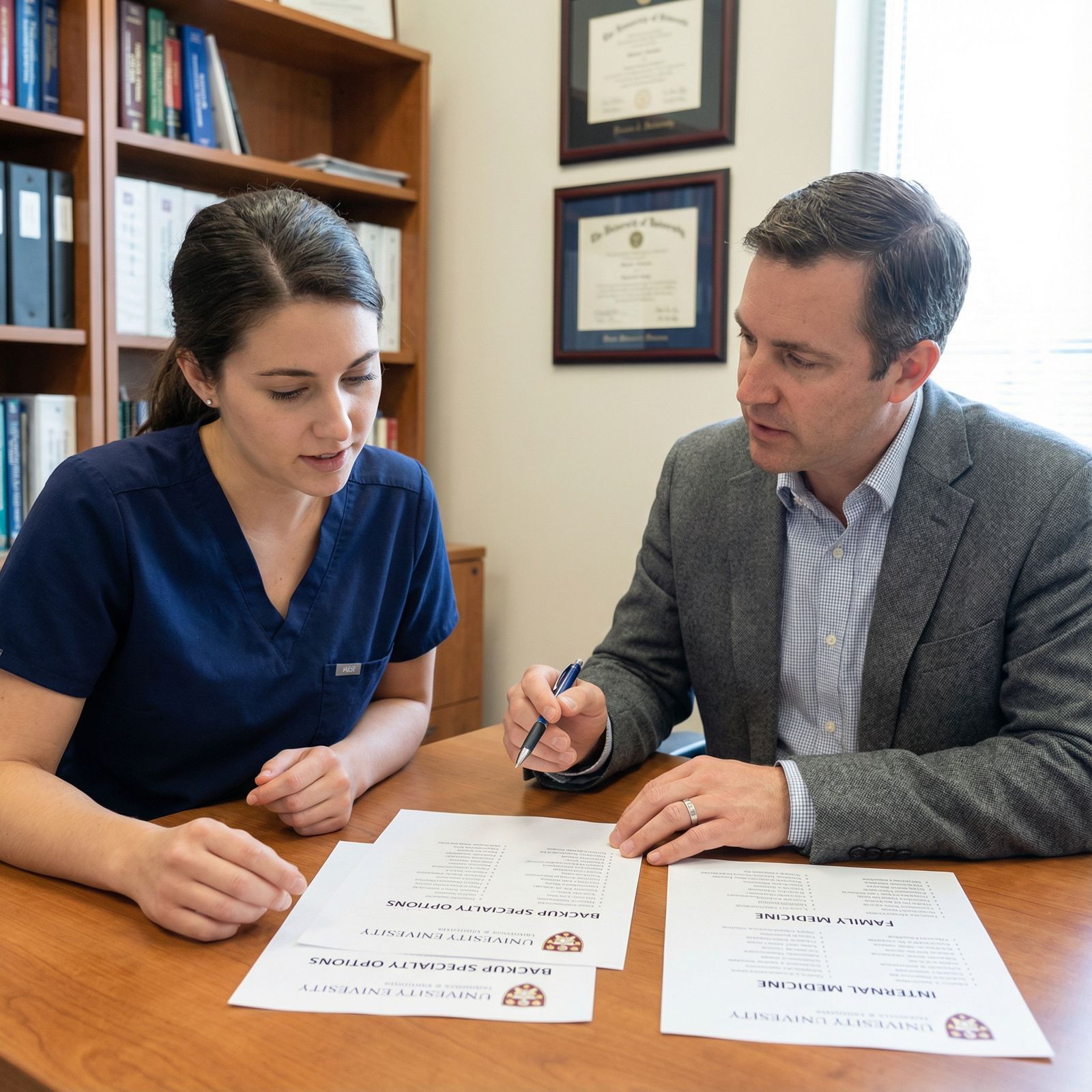
Why Backup Specialty Planning Matters More Than You Think
For an MD graduate navigating the residency match, backup specialty planning is not about pessimism—it’s about risk management and maximizing options. Even strong applicants from allopathic medical schools can end up unmatched in today’s competitive environment. Smart planning for a backup specialty (often including dual applying to more than one field) can preserve your career trajectory, your finances, and your mental health.
This guide focuses on strategic backup specialty planning for the MD graduate residency applicant: how to decide if you need a backup, how to choose a realistic yet satisfying plan B specialty, and how to execute a dual applying strategy without sabotaging your primary goals.
We’ll focus on:
- How competitiveness and your profile affect risk
- How to systematically choose an appropriate backup specialty
- How to practically implement dual applying residency strategies
- How to communicate your interests to programs without appearing unfocused
- Common pitfalls and how to avoid them
1. Do You Actually Need a Backup Specialty?
Not every MD graduate needs to dual apply, but more and more should seriously consider it. Start with an honest risk assessment that considers both the allopathic medical school match landscape and your individual profile.
1.1 Understand the Competitiveness of Your Primary Specialty
Look at objective data from NRMP’s Charting Outcomes and Program Director surveys for your target year. Pay attention to:
- Fill rates by US MD seniors
- Average Step/USMLE/COMLEX scores
- Number of applications per applicant
- Research output for matched applicants
- Percentage of applicants who go unmatched
High-risk specialties (often needing backup):
- Dermatology
- Plastic surgery (integrated)
- Neurosurgery
- Orthopedic surgery
- Otolaryngology
- Radiation oncology
- Interventional radiology (integrated)
- Diagnostic radiology (in certain cycles)
- Certain competitive internal medicine subspecialty tracks (e.g., physician-scientist)
Moderate-risk specialties (case-dependent):
- Emergency medicine (varying by year and region)
- Anesthesiology
- General surgery categorical
- OB/GYN
If you are applying in one of the historically ultra-competitive specialties, it is generally prudent to at least consider a backup pathway unless you have an exceptionally strong profile (e.g., stellar scores, top-tier school, powerhouse letters, strong research).
1.2 Assess Your Individual Risk Factors
Beyond specialty-level competitiveness, assess yourself honestly:
Key risk factors:
- Lower-than-average board scores for your specialty
- Failed attempts on Step exams
- Limited or no home program in your chosen specialty
- Minimal research relevant to the field (especially in research-heavy specialties like derm, rad onc, neurosurgery)
- Weak or generic letters of recommendation
- Applying late in the cycle
- Geographic restrictions (e.g., only applying in one region)
- Red flags in the MSPE or professionalism history
- Significant career gaps or extended timeline
If you have multiple risk factors and are targeting a competitive specialty, a backup specialty or dual applying residency strategy moves from optional to strongly advisable.
1.3 Consider Your Personal Risk Tolerance and Life Circumstances
A “numbers-only” analysis misses personal context:
- Do you need income urgently due to loans or family responsibilities?
- Are you okay with taking a research year and reapplying if you go unmatched?
- Would you consider doing a preliminary or transitional year and then reapplying?
- How would going unmatched impact your mental health and support system?
MD graduates who cannot easily afford a non-matched year—for financial, visa, or personal reasons—often benefit from more conservative, robust backup specialty planning.
Rule of thumb:
If matching in any reasonable specialty this year is critical for you, you should have a genuine plan B specialty.

2. How to Choose the Right Backup (Plan B) Specialty
Choosing a backup is not just “pick something less competitive.” Done poorly, it can lead to burnout or long-term dissatisfaction. Done well, a plan B specialty can still be a meaningful, sustainable career.
2.1 Clarify What You Actually Like About Your Primary Specialty
Before you choose a backup, dissect what attracts you to your primary field:
Ask yourself:
- Do you like procedures (hands-on interventions, OR time, devices)?
- Do you prefer cognitive problem-solving (complex diagnostics, longitudinal thinking)?
- Do you enjoy long-term patient relationships, or intense but short encounters?
- Are you drawn to acute care (ED, ICU) or chronic disease management?
- How much do you value lifestyle predictability vs. adrenaline or variety?
- Is research and academic medicine central to your satisfaction?
Make a short list (5–7 bullets) that define your non-negotiables and nice-to-haves.
Example:
Primary interest = Orthopedic surgery
Core likes might include:
- High-volume operative time
- Immediate, tangible impact on function
- Working in teams in the OR
- Musculoskeletal anatomy and biomechanics
- High physicality and hands-on work
A good backup should share some of these features, even if in a different balance.
2.2 Common Backup Pairings That Make Sense
Some pairings have natural overlap in skill set, patient population, or lifestyle expectations. These are examples, not prescriptions:
Dermatology → Internal Medicine, Pathology
- Reason: Cognitive diagnostic focus; possibility to later pursue derm-related subspecialty interests (e.g., rheumatology, dermatopathology through different routes).
Plastic Surgery (Integrated) → General Surgery, ENT
- Reason: Shared operative environments; potential to circle back to reconstructive tracks later.
Orthopedic Surgery → Physical Medicine & Rehabilitation (PM&R), General Surgery, Anesthesiology
- Reason: Musculoskeletal focus (PM&R) or procedural/OR environment (gen surg, anesthesia).
Neurosurgery → Neurology, Radiology, Anesthesiology
- Reason: Neuroanatomy overlap (neurology), imaging focus (radiology), critical care and OR environment (anesthesia).
Radiation Oncology → Internal Medicine, Transitional Year + later re-application
- Reason: Oncologic patient population, research focus, longitudinal thinking.
Emergency Medicine → Internal Medicine, Family Medicine, Anesthesiology
- Reason: Acute care overlap; EM’s competitiveness fluctuates, so some applicants have used IM/FM as a safety net.
OB/GYN → Family Medicine, Internal Medicine
- Reason: Women’s health continuity; procedural opportunities in FM with OB tracks.
Anesthesiology → Internal Medicine, Transitional Year
- Reason: Perioperative medicine foundation, ICU overlap.
2.3 Evaluate Each Potential Backup Across Key Dimensions
When considering a plan B specialty, systematically rate each candidate on:
- Competitiveness and match rate for MD graduates
- Is this realistically a safer option than your primary?
- Fit with your interests and skills
- Does it share core elements you value?
- Training pathway and length
- 3 vs. 4 vs. 5+ years, plus potential fellowships.
- Geographic flexibility
- Are there many programs nationally, or highly clustered?
- Career prospects and job market
- Consider long-term stability and regional needs.
- Lifestyle and call
- Can you realistically tolerate its typical schedule and stressors?
- Future flexibility
- Can this specialty lead to fellowships that bring you closer to your original interests (e.g., pain, sports, ICU, palliative, hospitalist, etc.)?
Create a simple comparison table for yourself with 2–3 candidate backups and see which aligns best.
2.4 Avoid “I’ll Just Do Anything” as a Strategy
Applying to a backup you fundamentally dislike is risky:
- You may match somewhere you don’t want to be long-term.
- Transferring between specialties later is uncertain and competitive.
- Chronic dissatisfaction can lead to burnout or depression.
Your backup does not need to be your dream job, but it should pass this test:
“If I match only in this backup specialty, could I envision a meaningful, sustainable career with reasonable satisfaction?”
If the honest answer is no, keep searching for a better-aligned plan B.
3. Building a Coherent Dual Applying Residency Strategy
Once you’ve identified a realistic and acceptable backup, the real work begins: planning how to present yourself to two fields at once without appearing unfocused to either.
3.1 Decide on Your Application Mix (How Many Programs in Each)
For an MD graduate residency applicant, the split depends on:
- Competitiveness of your primary and backup
- Strength of your application
- Geographic flexibility
- Whether you have strong home or mentor support in one field
Examples of application splits:
Ultra-competitive primary, moderate backup, moderate-risk applicant
- e.g., Primary Derm / Backup IM
- Possible split: 30–40 derm, 80–100 IM (with a mix of academic and community)
Competitive primary, clearer backup, somewhat strong applicant
- e.g., Primary Ortho / Backup PM&R
- Possible split: 40–50 ortho, 40–60 PM&R
Moderately competitive primary, safer backup, applicant with notable red flags
- e.g., Primary EM / Backup IM or FM
- Possible split: 30–40 EM, 70–90 IM or FM
These numbers are examples, not rules; adjust based on current match cycle trends and your advisor’s input.
3.2 Letters of Recommendation: Field-Specific and Strategic
Aim for field-specific letters for each specialty:
- Primary specialty: 3-4 strong letters from faculty in that field (ideally from your home institution or well-known programs).
- Backup specialty: At least 2, preferably 3, letters from the backup field.
Avoid letters that state or imply your loyalty to a different field (e.g., “She is utterly committed to a career in neurosurgery” for an application you’re using in neurology). If a letter writer is strongly tied to your primary field, ask for a separate letter tailored to your backup if possible.
If you lack exposure in your backup:
- Consider doing a late sub-I or elective in your backup specialty.
- Ask to participate in a small project or case report to generate contact and letter potential.
- Arrange clinic or OR shadowing followed by meaningful responsibilities.
3.3 Personal Statements: Separate, Specific, and Genuine
Never use the same personal statement for both specialties.
Primary specialty statement:
- Be explicit about your motivation and experiences in that field.
- Show trajectory and commitment (research, rotations, mentors).
Backup specialty statement:
- Avoid framing it as “second best” or a consolation prize.
- Instead, focus on true overlapping interests and strengths.
- You can acknowledge a broad range of interests without saying “I wanted X but settled for Y.”
Example framing for a backup IM personal statement for an applicant also applying in dermatology:
“Throughout medical school, I found myself drawn to complex, chronic conditions that require thoughtful longitudinal management. My experiences with patients with autoimmune disease, chronic infections, and multisystem disorders highlighted how internal medicine offers a unique platform to integrate detailed clinical reasoning, long-term patient relationships, and multidisciplinary care…”
No need to mention dermatology or that it’s your backup.

4. Presenting Yourself Authentically to Both Specialties
Many MD graduates worry that dual applying will make them look disloyal or unfocused. Handled carefully, it doesn’t have to.
4.1 Be Honest but Selective About What You Share
You do not have to disclose that you are dual applying to every program. However:
- If directly asked in an interview, do not lie.
- Have a calm, thoughtful answer about why both fields genuinely appeal to you.
Example interview response:
“I’m attracted to both anesthesiology and internal medicine because they each allow me to engage in complex physiology and critical thinking, but in different ways. Anesthesiology appeals to my love of acute perioperative care and immediate feedback; internal medicine draws me to longitudinal relationships and systems-level thinking. I have applied to both with a sincere interest in building a career in either path, and at your program, I would be fully committed to the training environment and opportunities you offer.”
Focus on:
- Overlapping values and skills
- Genuine enthusiasm for the program in front of you
- Reassurance of your commitment if matched there
4.2 Tailor Your Interview Preparation Separately
Prepare distinct talking points for each specialty:
For each field, know:
- Why this specialty suits your skills and personality
- A few compelling patient cases from that specialty
- One or two meaningful experiences or mentors
- Your potential career directions within that field
- A realistic understanding of lifestyle and challenges
Avoid cross-contamination:
- Don’t tell a PM&R program your ultimate dream is “to be an orthopedic surgeon.”
- Don’t tell an IM program you aim to transfer to derm unless you are explicitly applying for a preliminary year with clear plans.
4.3 Be Careful with Program Signaling and Preference Signals
If your specialty uses signals (preference signaling, gold/silver tokens, etc.):
- Signal your true first-choice programs within each field.
- Avoid over-signaling in your backup in a way that makes it look like your only plan.
- Don’t waste signals on programs that are unrealistic reach outliers for your profile.
Discuss with mentors how many signals to allocate to primary vs backup if there is overlap.
5. Tactical Timeline and Logistics for Backup Planning
Timing matters. Here’s how to integrate backup specialty planning into your MD graduate residency timeline.
5.1 MS3 / Early MS4 (or Early Final Year)
- Clarify your primary specialty by the end of core clerkships if possible.
- Start early exposure to possible backup fields (shadowing, electives).
- Talk to advisors and residents about realistic competitiveness.
- If leaning toward a highly competitive specialty, explore research and mentorship early.
5.2 Late MS4 (or Mid Final Year): Lock In Your Strategy
By the time ERAS preparations begin:
- Decide whether you will single apply or dual apply.
- If dual applying:
- Schedule an elective or sub-I in your backup specialty.
- Identify potential letter writers for both fields.
- Begin drafting two personal statements.
- Gather specialty-specific CV elements (presentations, research, leadership).
5.3 Application Season: Monitor and Adjust
After you submit ERAS:
- Track interview invitations by specialty.
- If you see a significant imbalance (e.g., very few invites in your primary specialty), consider:
- Sending more targeted emails to programs.
- Expanding geographic range.
- Leaning more into your backup with late applications if still feasible (check deadlines).
Keep your schedule realistic:
- Don’t overschedule interviews to the point of burnout.
- Prioritize interviews where you are most likely to rank highly and match (balance prestige with match probability).
5.4 Ranking Strategy: Putting It All Together
On your rank list:
- Rank in true order of preference across both specialties.
- The algorithm favors your top choices; it does not punish you for ambition.
- Avoid “gaming” the system by ranking a backup above a primary program you would genuinely prefer.
- However, be honest with yourself:
- Would you truly prefer to reapply next year over taking a solid backup program now?
For many MD graduate residency applicants with significant loans or life constraints, ranking a reasonable plan B specialty above “no match” is the pragmatic choice.
6. Common Pitfalls and How to Avoid Them
Backup specialty planning can fail when done carelessly. Here are some traps to avoid.
6.1 Treating the Backup as an Afterthought
Red flags:
- No dedicated rotations or exposure in your backup field
- No backup-specific letters
- Generic personal statement with no clear connection to the specialty
Programs will notice. If your application looks half-hearted, they may assume you have no real intention of committing.
Solution:
Invest enough time to make your backup application coherent and credible. It doesn’t have to match the intensity of your primary, but it must look purposeful.
6.2 Overstretching Yourself Across Too Many Fields
Applying to three or more specialties (not counting prelims) usually:
- Dilutes the quality of each application
- Raises questions about your focus
- Overcomplicates your interview schedule and rank list
In most cases, limit yourself to one primary + one backup (plus preliminary programs if needed).
6.3 Ignoring Your Own Well-Being
Dual applying can be:
- Time-consuming: two sets of letters, personal statements, interview preps
- Emotionally draining: juggling identity and uncertainty
Protect your mental health:
- Build in rest and support from peers, mentors, counseling if needed.
- Set realistic application and interview limits.
- Remember that your worth as a physician is not defined solely by the prestige of your matched specialty.
FAQs: Backup Specialty Planning for MD Graduates
1. As an MD graduate from an allopathic medical school, do I really need a backup if I’m applying to a competitive specialty but have strong scores?
Not necessarily, but you should still perform a structured risk assessment. If you have high board scores, strong letters from leaders in the field, meaningful research, and a supportive home program, a backup may be optional. However, if matching this year is critical due to financial, visa, or family constraints, even strong MD candidates sometimes choose a backup for added security.
2. Will programs look down on me if they know I’m dual applying residency to another field?
Most program directors understand the current competitiveness of the allopathic medical school match. As long as you present a coherent, genuine interest in their specialty and don’t appear to be using them purely as a stepping stone, dual applying is generally accepted. The key is to be honest if asked and to show specific reasons why you would be happy to train in their field and at their program.
3. What if I match into my backup plan B specialty but still want my original primary field later?
Transfers between specialties are possible but not guaranteed and are often competitive. If you enter a backup specialty with the primary goal of leaving it, you risk long-term dissatisfaction. If you do later develop a desire to transition, you’ll need stellar performance in residency, strong faculty advocates, and realistic expectations. It’s wiser to choose a backup that you could accept as a permanent career if needed.
4. How many programs should I apply to in my backup specialty as an MD graduate?
It depends on the competitiveness of both specialties and your profile. As a general guide, many MD graduates applying to a competitive primary and moderate-risk backup consider something like 30–50 programs in the primary and 60–100 in the backup, adjusting based on geography, school reputation, and advisor feedback. Always confirm with your dean’s office and mentors who know current-year match trends and your specific strengths.
Thoughtful backup specialty planning does not dilute your ambition; it protects your future. For the MD graduate residency applicant, a well-designed plan B specialty and dual applying strategy can turn an uncertain match landscape into a set of multiple, genuinely acceptable paths forward.