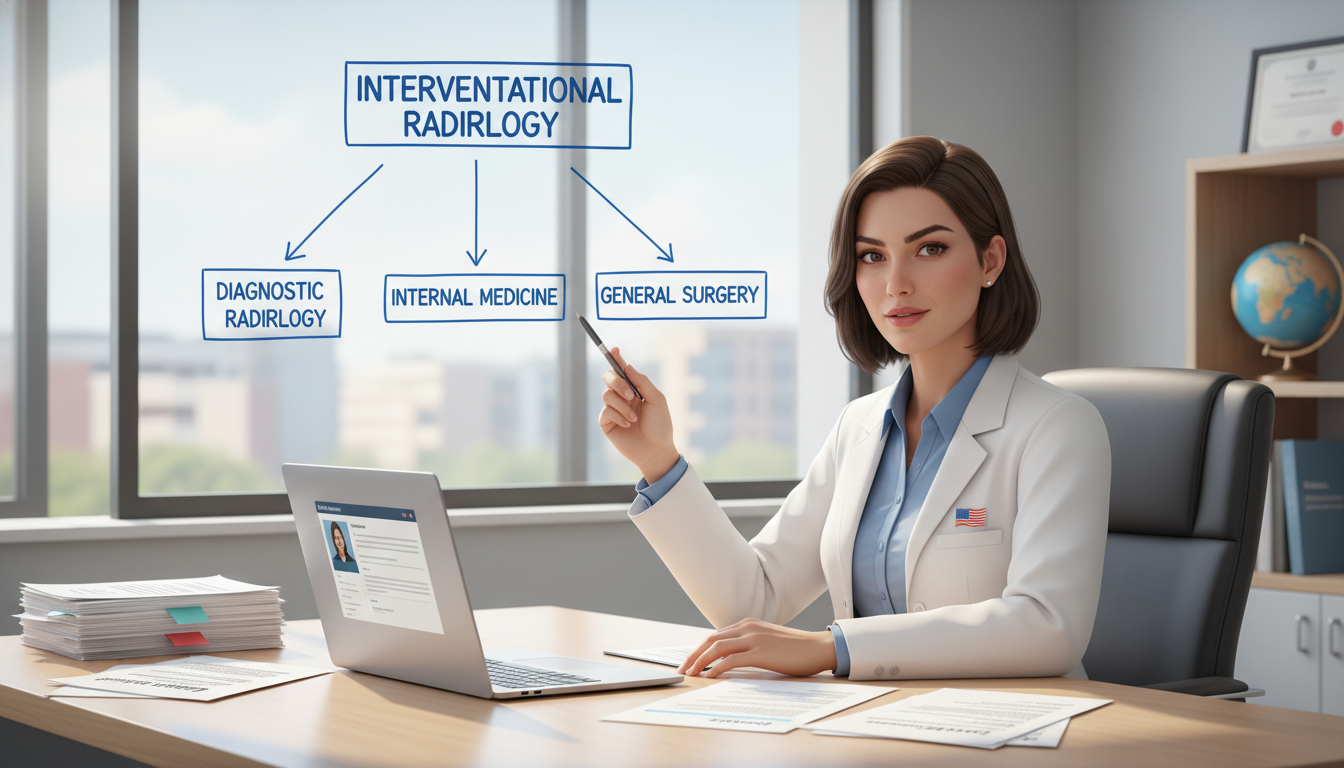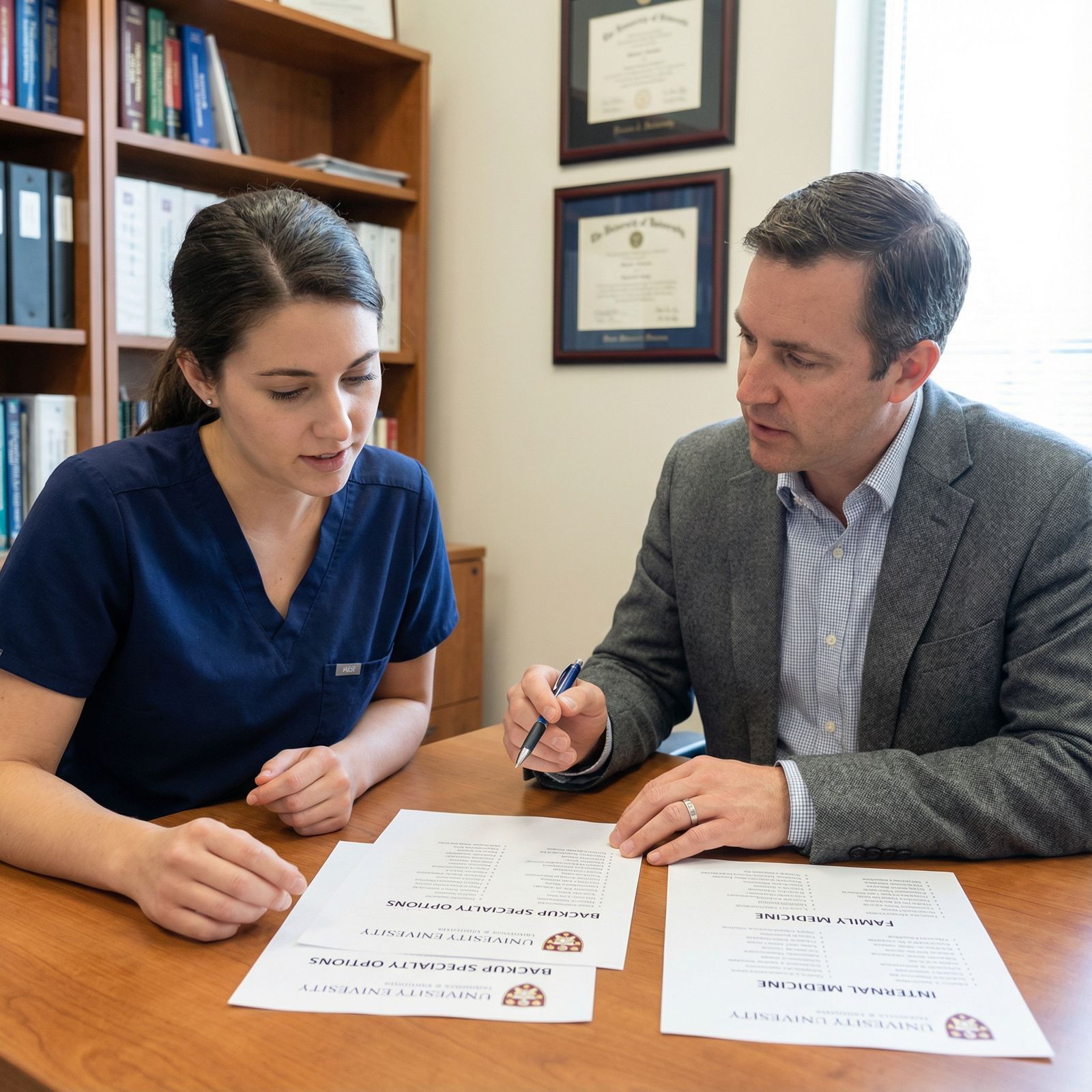
For many non-US citizen IMGs, residency applications are not just about medical interests—they are about immigration realities, limited chances, and very high stakes. Having a smart, intentional backup specialty plan is often the difference between matching somewhere vs. not matching at all.
This guide explains how to design a realistic, high-yield backup strategy as a foreign national medical graduate, especially if you are relying on ECFMG-sponsored J-1 visas or hoping for scarce H-1B spots.
Understanding Why Backup Specialty Planning Matters More for Non‑US Citizen IMGs
Non-US citizen IMGs face unique constraints that make backup specialty planning essential, not optional.
1. Limited Visa Options
Most non-US citizen IMGs enter residency on:
- J-1 visa (ECFMG-sponsored) – most common, accepted by many community and university programs.
- H-1B visa – fewer programs offer it; often requires:
- All USMLE Steps passed on first attempt
- Step 3 completed before residency start
- Strong academic or subspecialty interest
Some specialties and programs simply do not sponsor visas (or only sponsor J-1, not H-1B). This immediately narrows your realistic options. A strong “dream” specialty may be heavily restricted for foreign nationals.
2. Higher Competition in Popular Specialties
For non-US citizen IMGs, match rates are significantly lower in:
- Dermatology
- Plastic surgery
- Neurosurgery
- Orthopedic surgery
- Otolaryngology
- Radiation oncology
- Some internal medicine subspecialty tracks (e.g., physician-scientist programs with limited visa support)
Even mid-competitive specialties (e.g., radiology, anesthesiology, emergency medicine, OB/Gyn) may be challenging without:
- Strong USMLE scores
- Robust US clinical experience (USCE)
- US letters of recommendation (LORs)
- Research and publications
- Excellent English communication and interviews
A thoughtful backup specialty (or a dual applying residency strategy) improves your overall probability of matching without completely abandoning your interests.
3. One Cycle Often Requires a Whole Year of Your Life
If you do not match, you typically lose:
- 1 year of professional progress
- 1 year of income and clinical development
- Visa opportunities that may be time sensitive
- Momentum (as “years since graduation” increase)
A well-designed Plan B specialty can protect you from repeating application cycles multiple times.
4. NRMP Rules and Ethical Considerations
You can only start one residency program at a time, but you can apply to multiple specialties as long as:
- Your application materials are honest
- Your personal statements and program communications are specialty-specific
- You can genuinely see yourself training and working in any specialty you rank
Backup planning is not “cheating” the system; it is responsible risk management—especially important for a non-US citizen IMG.
Step 1: Assess Your Realistic Competitiveness as a Non‑US Citizen IMG
Before selecting any backup specialty, you need a brutally honest self-assessment.
A. Evaluate Your Academic Profile
Key factors:
- USMLE Step 1 and Step 2 CK scores
- Are you above, close to, or below the average matched non-US IMG in your target specialty?
- Any fails or multiple attempts?
- Medical school performance
- Class rank, honors, gold medals (for some countries)
- In-training exam scores (if you already trained abroad)
- Years since graduation
- Many programs prefer ≤ 5 years since graduation (some more flexible, some stricter)
- If > 5–7 years, low-competition cognitive specialties (e.g., psychiatry, internal medicine in community programs) may be more realistic as backups.
Use NRMP Charting Outcomes, FREIDA, and program websites to compare your profile.
B. Review Your Clinical Experience and LORs
- How many US clinical experiences (USCE) do you have?
- Observerships, externships, electives, sub-internships, research with clinical exposure
- Do your LORs:
- Come from US faculty in your preferred specialty?
- Comment on your clinical skills, communication, and reliability?
- Explicitly support you for a specific specialty?
If your USCE and LORs are heavily focused in one field (e.g., internal medicine), then some backup specialties will be easier to justify (e.g., psychiatry, family medicine) than others (e.g., surgery or radiology).
C. Research and Scholarly Work
- Any publications, posters, QI projects, or audits?
- Are they:
- In your primary specialty only?
- In fields that transfer well to backups (e.g., general internal medicine, epidemiology, psychiatry, public health)?
Some specialties value research highly (e.g., radiology, neurology at academic centers). Others, particularly community programs in IM/FM/psych, prioritize clinical performance and reliability over extensive research.
D. Language Skills and Communication
Specialties with more intensive patient interviews and longitudinal care (e.g., psychiatry, family medicine) rely heavily on:
- Clear English communication
- Cultural sensitivity
- Building rapport with patients and families
If your spoken English is still developing, you may want a backup specialty that:
- Has more procedural/technical focus or shorter patient interactions, or
- Provides strong supervised training in communication early on
Step 2: Define Your Acceptable Backup Specialty Profiles
You should never treat a backup as “any specialty that will take me.” You’ll likely spend your entire career in that field. Instead, design a shortlist of acceptable backup specialty types.
A. Broad Categories of Backup Specialties for Non‑US Citizen IMGs
Common Plan B specialty choices for foreign national medical graduates include:
Internal Medicine (categorical)
- High number of positions
- Many programs sponsor J-1; some H-1B
- Pathway to subspecialties (cardiology, gastroenterology, nephrology, etc.)
- Especially realistic if you already have IM electives, observerships, or research
Family Medicine
- Good number of positions, especially in community and rural programs
- Often J-1 friendly; some H-1B opportunities in underserved areas (eventually via J-1 waivers)
- Broad outpatient care; good for those interested in primary care, geriatrics, sports medicine, or women’s health
Psychiatry
- Traditionally more IMG-friendly than many other specialties
- Growing need in the US; more openings in community and state hospital settings
- Strong focus on communication, empathy, continuity
Pediatrics
- Moderate IMG-friendliness (varies by region)
- More competitive than family medicine in some locations but less than many surgical fields
- Great for those passionate about child health and preventive care
Transitional year / Preliminary programs
- These are not true backups for long-term careers, but:
- Can provide 1-year US experience
- May help you reapply more competitively
- Risky if there is no guaranteed categorical position afterward
- These are not true backups for long-term careers, but:
B. Align Backup Choices with Your Core Interests
Ask yourself:
- Do you prefer:
- Inpatient vs. outpatient care?
- Procedural vs. cognitive work?
- Short-term vs. long-term patient relationships?
- What kind of lifestyle and schedule do you want?
- More flexibility (e.g., outpatient-oriented, psychiatry, some FM jobs)?
- High-intensity but potentially procedure-heavy (e.g., hospitalist in IM)?
- Are you open to fellowship training after residency?
Example:
- Primary interest: Cardiology or anesthesia (procedural, acute care)
- Realistic backup: Internal medicine (with future cardiology/hospitalist pathway), or family medicine with focus on urgent care/ED shifts.

Step 3: Map Competitiveness vs. Visa vs. Personal Fit
Now combine three key dimensions:
- Competitiveness (Can I realistically match here?)
- Visa friendliness (Will programs in this specialty sponsor J-1/H-1B?)
- Personal fit (Can I see myself doing this for life?)
A. Create a Specialty Scorecard
Make a table (even just on paper) and rate each specialty from 1–5 for:
- Match likelihood for a non-US citizen IMG with your profile
- Visa and IMG friendliness (using FREIDA, past IMG match data, program websites)
- Personal satisfaction potential (honestly: can you be happy there?)
Example (hypothetical):
| Specialty | Competitiveness for me | Visa/IMG Friendly | Personal Fit | Overall Priority |
|---|---|---|---|---|
| Neurology | 2 | 3 | 3 | Low |
| Internal Medicine | 4 | 4 | 4 | Very High |
| Psychiatry | 3 | 4 | 5 | High |
| Family Medicine | 4 | 5 | 3 | High |
| Radiology | 1 | 2 | 4 | Very Low |
This helps you identify 1–2 serious backup specialties that make sense for you.
B. Research Specialty-Specific Visa Patterns
For each chosen backup specialty, investigate:
- What percentage of programs list “Visa sponsorship: J-1” in FREIDA?
- How many mention H-1B sponsorship?
- Do program websites explicitly say:
- “We accept J-1 visas only”
- “We do not sponsor visas”
- “We have previously sponsored H-1B for exceptional candidates”
For a non-US citizen IMG, this data is often more important than the reputation ranking of the program.
C. Geographic Flexibility
Many non-US citizen IMGs limit themselves to certain states (e.g., California, New York, Texas). Backup planning often requires maximizing geographic openness, such as:
- Midwest and Southern states
- Smaller cities and rural areas
- Community programs affiliated with academic centers
Expanding your geographic range is often critical to making a backup specialty work.
Step 4: Structuring a Dual Applying Residency Strategy
Dual applying (applying to a primary and a backup specialty in the same cycle) is a powerful but delicate strategy for a non-US citizen IMG.
A. When Dual Applying Makes Sense
You should seriously consider dual applying if:
- Your primary specialty is competitive for non-US citizen IMGs (e.g., radiology, anesthesiology, neurology in top centers, OB/Gyn, EM in many regions).
- Your scores or profile are below average for matched non-US citizen IMGs in that specialty.
- You cannot afford to lose a year (financially, immigration-wise, or emotionally).
In these situations, a well-planned backup specialty like internal medicine, family medicine, or psychiatry may greatly increase your overall chances of matching.
B. How Many Specialties Is Too Many?
As a general rule:
- 1 primary + 1 backup = reasonable.
- 1 primary + 2 backups = sometimes feasible if closely related (e.g., IM, FM, psych) and if you can tailor documents accordingly.
- Applying to 3–4 very different specialties usually dilutes your application quality and creates credibility issues.
Aim for depth over scatter: better 60–80 strong applications in 2 specialties than 120 weak generic applications in 4 specialties.
C. Tailoring Your ERAS Application for Dual Specialties
You must customize:
Personal Statements
- Separate, fully specialty-specific for each field.
- Avoid generic phrases like “I love internal medicine and psychiatry equally” in the same statement.
- Explain:
- Why this field specifically
- How your experiences and strengths match that specialty
- Long-term goals (e.g., outpatient psychiatrist vs. cardiologist vs. rural family physician)
Program Signaling and Application Filters (if applicable)
- Use any preference signaling (if offered) strategically for high-priority programs.
- Don’t waste signals on “dream” ultra-competitive programs where your profile is far below typical candidates.
Experiences and Activities
- In ERAS descriptions, highlight specialty-relevant skills:
- For IM: diagnostic reasoning, inpatient work, complex multi-system cases
- For psych: communication, empathy, mental health volunteering
- For FM: continuity of care, community health projects
- In ERAS descriptions, highlight specialty-relevant skills:
You can emphasize different facets of the same activity for different specialties.
- Letters of Recommendation (LORs)
- Ideally:
- 3 LORs for your primary specialty
- 2–3 for your backup specialty (including at least 1 from US faculty if possible)
- Some letters (e.g., from core IM rotations) may be acceptable for IM, FM, and psych, but check each program’s requirements.
- Ideally:
D. Interview Season Tactics for Dual Applicants
Once interviews arrive:
- Track which specialty each interview is for.
- Prepare separate interview narratives:
- Why this specialty?
- Why this program?
- How does your background make you a good fit?
- If asked whether you are applying to other specialties:
- Be honest but strategic.
- Emphasize that you would be fully committed if they matched you.
- Example response:
- “Yes, I also applied to family medicine programs. As a non-US citizen IMG, I needed to be realistic with visas and match chances. However, I would be fully committed to psychiatry if I matched here, and my long-term goal would be to build a career in community mental health.”
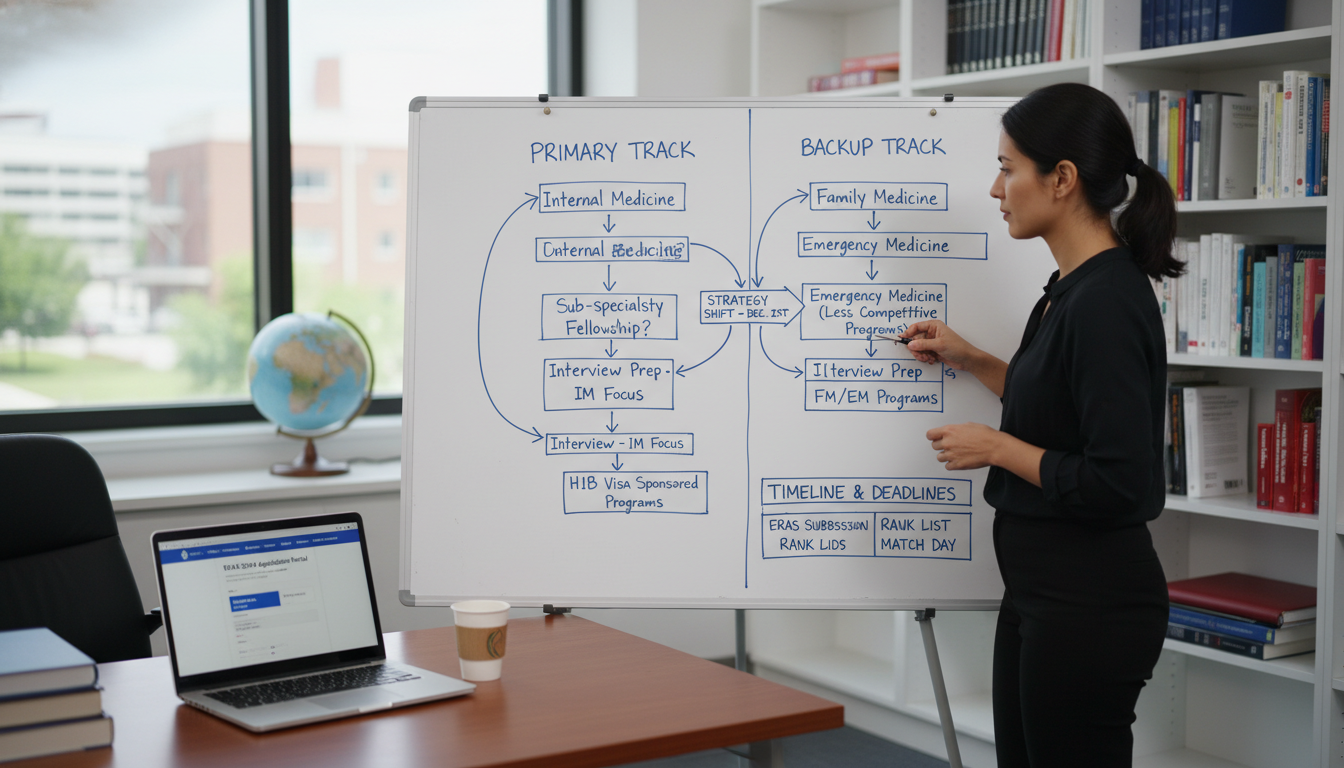
Step 5: Choosing a Backup Specialty That Still Aligns with Your Long-Term Goals
Backup does not mean “give up your dreams entirely.” It means choose a realistic path that keeps some of your goals alive.
A. Think in Terms of Pathways, Not Single Steps
Ask:
- If I match into this backup specialty, could I:
- Pursue a fellowship related to my interest?
- Example: Anesthesia interest → Backup IM → future pulmonary/critical care.
- Work in a setting that overlaps with my preferred field?
- Example: Emergency medicine interest → Backup family medicine → work in urgent care or rural EDs.
- Integrate my passion through niche practice?
- Example: Neurology interest → Backup psychiatry → focus on neuropsychiatry or psych patients with neurological comorbidities.
- Pursue a fellowship related to my interest?
For many non-US citizen IMGs, internal medicine is a particularly flexible backup because of the broad range of fellowships and practice environments.
B. Immigration and Job Market Considerations
After residency, as a non-US citizen IMG you may need:
- J-1 waiver job (if on a J-1 visa), often in underserved or rural areas
- Employer willing to sponsor H-1B → green card
Some backup specialties (e.g., family medicine, psychiatry, general internal medicine) have strong demand in underserved areas, which can:
- Make J-1 waiver jobs easier to find
- Speed up your transition to more stable immigration status
When selecting a backup specialty, consider:
- Job availability in rural or underserved regions
- Willingness of employers to sponsor visas and green cards
- Your willingness to live initially in less urban locations
C. Emotional Acceptance and Professional Identity
You will almost certainly interview with programs in your backup specialty. Program directors and faculty can sense whether:
- You genuinely respect and value their specialty, or
- You see it as inferior or only as a backup.
To be successful:
- Learn the culture, values, and daily work of your backup field.
- Speak with residents and attendings in that specialty.
- Visualize yourself being proud to introduce yourself as, for example, a psychiatrist, family physician, or internist.
If you cannot imagine that, reconsider whether that specialty is a good backup at all.
Step 6: Practical Timeline for Non‑US Citizen IMGs Planning Backup Specialties
Use this rough timeline and adapt based on your year of graduation and where you are in preparation.
12–18 Months Before Application (or Earlier)
- Research:
- Primary and backup specialties’ match rates for non-US citizen IMGs
- Visa policies by specialty and by program
- Plan:
- USMLE Step 1 and Step 2 CK timing
- Step 3 (especially if H-1B is part of your long-term strategy)
- Start identifying potential USCE opportunities in at least two related fields.
9–12 Months Before Application
- Secure USCE and observerships:
- Aim for at least 1 rotation in your primary specialty and 1 in your backup.
- Start research projects (even small ones, case reports, QI).
- Build relationships with attendings who can write strong LORs for each field.
6–9 Months Before Application
- Decide: Are you definitely dual applying?
- Draft specialty-specific CV highlights:
- Adjust how you describe activities and experiences.
- Begin writing:
- Separate personal statements for each specialty
- A clear narrative for your long-term goals in each field
3–6 Months Before Application
- Finalize USMLE exams (preferably including Step 3 if targeting H-1B).
- Confirm LORs:
- Make sure you label which LORs are for which specialty in ERAS.
- Build an application list:
- Primary specialty: balanced list (reach, target, and safety programs).
- Backup specialty: more emphasis on IMG-friendly and visa-friendly programs.
Application and Interview Season
- Submit tailored applications early in the opening window.
- Track interview offers by specialty and region.
- Decide how to distribute your time:
- If backup specialty offers many more interviews, you might need to favor those to secure a match.
- Prepare for different types of interview questions depending on specialty.
Rank List Strategy
When creating your rank list:
- Never rank a program in any specialty that you would not actually want to attend.
- Order by true preference, not by perceived chance:
- If you prefer psychiatry over internal medicine, rank psych programs above IM programs, even if IM seems more “secure.”
- Consider long-term immigration, job opportunities, and personal happiness.
Frequently Asked Questions (FAQ)
1. As a non-US citizen IMG, should I always have a backup specialty?
Not always, but often it is wise. You may not need a backup if:
- Your scores, USCE, and LORs are very strong.
- Your chosen specialty is relatively IMG-friendly (e.g., internal medicine) and your profile matches or exceeds recent IMG data.
- You are financially and emotionally prepared to reapply if you do not match the first time.
However, if your primary specialty is moderately to highly competitive, or your profile has red flags (gaps, low scores, multiple attempts, older graduation), having a serious Plan B specialty is usually prudent.
2. Will programs think less of me if I apply to more than one specialty?
Programs generally understand that applicants, especially foreign national medical graduates, need to manage risk. Problems arise only when:
- Your application looks generic or inconsistent.
- You cannot convincingly explain your interest in their specialty.
- It appears that you are not truly committed.
If your personal statement, interview answers, and LORs are aligned and sincere for each field, dual applying is fully acceptable.
3. How many programs should I apply to in my backup specialty?
There is no universal number, but for non-US citizen IMGs:
- Many apply to 40–80+ programs in their backup specialty, depending on competitiveness, visa restrictions, and finances.
- You might apply to:
- 60–100 in your primary specialty (if competitive)
- 40–80 in your backup (if more IMG-friendly)
- The key is quality and suitability, not just quantity. Focus on programs that:
- Sponsor visas
- Have a history of accepting IMGs
- Match your academic profile and graduation year
4. Is it possible to switch specialties later if I match into my backup?
Sometimes, but it is not guaranteed and should not be your main plan. Switching specialties depends on:
- Availability of open positions
- Willingness of new programs to accept transfer residents
- Visa complications (you may need new sponsorship or cannot easily change employment)
- Support from your current program
It is safer to choose a backup specialty that you can accept as a long-term career, instead of assuming you will later switch.
Thoughtful backup specialty planning allows you, as a non-US citizen IMG, to balance ambition with realism, and passion with immigration and job market constraints. The goal is not to limit your dreams, but to secure at least one viable pathway into the US healthcare system—so you can build a stable, fulfilling career and potentially pursue your deeper interests over time.