
Why Backup Specialty Planning Is Essential for Non‑US Citizen IMGs Aiming for Cardiothoracic Surgery
For a non-US citizen IMG with dreams of becoming a cardiothoracic surgeon in the United States, the path is steep, competitive, and full of visa‑related complexity. Cardiothoracic surgery residency (and its typical entry route through general surgery) sits among the most competitive training pathways in the US. Even outstanding foreign national medical graduates can face rejection because of factors beyond their control—limited program spots, visa caps, institutional IMG policies, and funding constraints.
That’s why backup specialty planning is not a lack of confidence—it’s a smart, strategic safeguard. Thoughtful planning gives you:
- A realistic Plan A (primary path to heart surgery training)
- A viable Plan B (backup specialty that fits your profile and still aligns with your long‑term goals)
- Emotional and financial stability if the first attempt doesn’t succeed
- Flexibility to re‑enter the cardiothoracic path later, or to build a satisfying career elsewhere
This article focuses on how a non-US citizen IMG targeting cardiothoracic surgery can select, structure, and execute a backup specialty strategy—including dual applying, creating a “coherent story,” and managing risk without closing doors to heart surgery training.
Understanding the Cardiothoracic Training Pathway and Its Risks
Before building a backup plan, you need a realistic sense of how cardiothoracic training works in the US and where the risk points are, especially for a foreign national medical graduate.
The Two Main Pathways to Cardiothoracic Surgery
Traditional Pathway: General Surgery → Cardiothoracic Fellowship
- 5 years of general surgery residency
- Followed by 2–3 years of cardiothoracic surgery fellowship (standard or I-6/4+3 variants at some centers)
- Most common pathway and generally more accessible for IMGs than integrated CT positions
Integrated Cardiothoracic Surgery (I-6) Residency
- 6-year integrated program straight from medical school
- Extremely competitive, very few spots nationally
- IMGs (especially non-US citizen IMGs) match far less frequently due to:
- Very small numbers of positions
- Preference for US graduates
- Institutional limitations on visas
For most non-US citizen IMGs, the primary realistic on-ramp to heart surgery training is through general surgery residency, then cardiothoracic fellowship.
Challenges Specific to Non‑US Citizen IMGs
As a foreign national medical graduate, you face additional hurdles beyond competitiveness:
- Visa limitations
- Many programs only sponsor J-1 visas (through ECFMG)
- Some sponsor H-1B, but often with stricter USMLE score and step completion requirements
- Some academic institutions do not sponsor any visas for categorical surgery spots
- Institutional IMG policies
- Programs that never or rarely interview IMGs
- Hidden preferences for US grads even when not explicitly stated
- Funding and hospital policies
- Some hospitals limit the number of visas or international hires for budget or administrative reasons
- US clinical experience requirements
- Many surgical programs want strong, US-based letters of recommendation from surgeons
All of this compounds the already intense competitiveness of general and cardiothoracic surgery.
Implication: Even if your profile is excellent, you cannot assume a surgery match. That makes a structured backup specialty and dual applying strategy critical.
Step 1: Clarify Your Primary Goal and Time Horizon
Backup planning should start with clarity, not fear. Before choosing a plan B specialty, define your Plan A in detail.
Define Your Primary Cardiothoracic Goal
Ask yourself:
- Do you want to operate as a primary cardiothoracic surgeon in the US?
- Would you be satisfied with a more limited role in heart surgery training (e.g., cardiac anesthesia, cardiac imaging, critical care)?
- What is your time and financial tolerance for multiple application cycles?
For most applicants reading this, Plan A is:
Match into a US general surgery residency that supports complex cardiac or thoracic surgery exposure, then competitively apply for a cardiothoracic surgery fellowship.
Your entire backup strategy should support or, at minimum, not sabotage that goal.
Decide Your Risk Level and How Many Cycles You’ll Try
Some non-US citizen IMGs say, “Surgery or nothing.” Others are open to pivoting after one or two unsuccessful cycles.
Clarify:
- How many times are you willing to apply for surgery?
- Can you fund 2–3 application cycles, exams, and living expenses?
- Are you comfortable being in a long training pathway (7–9+ years)?
If you only want to apply once and then pivot, your backup specialty strategy will be more aggressive and more central to your application planning.
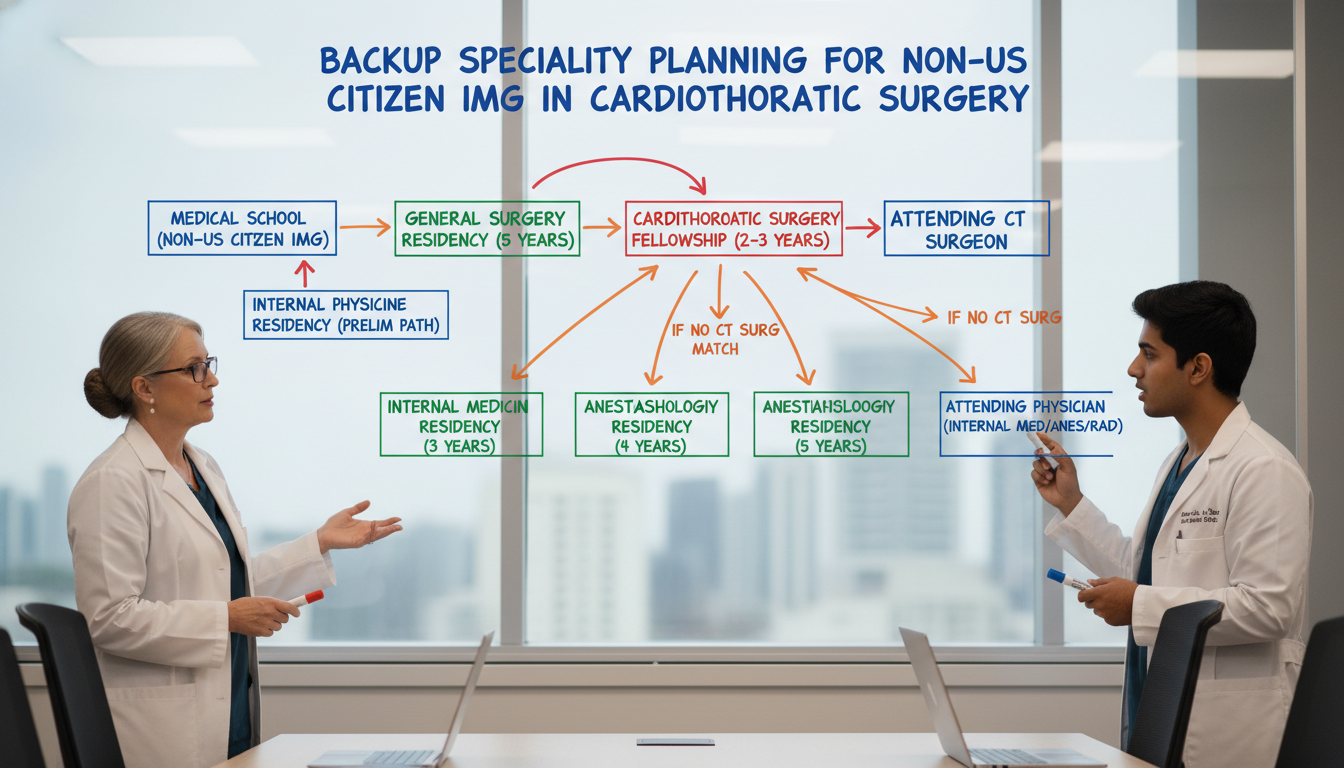
Step 2: Choosing a Strategic Backup Specialty (Plan B)
Not all backup options are equal. A good backup specialty for a non-US citizen IMG targeting cardiothoracic surgery should:
- Be more attainable than categorical general surgery or integrated CT.
- Preserve some connection to cardiothoracic care if possible.
- Offer solid long‑term career satisfaction, even if you never return to surgery.
- Be IMG‑friendly with a reasonable number of visa-sponsoring programs.
This is where the concepts of plan B specialty and dual applying residency become key.
Three Broad Backup Strategies
Adjacent Surgical or Procedural Fields
– Maintain a procedural, OR-based or interventional role:- Vascular surgery (rarely realistic as a backup; also highly competitive)
- Thoracic surgery-only tracks (still quite competitive)
- Surgical prelims (not a real long-term backup, but a tactical bridge)
- Interventional cardiology via internal medicine (very long path)
Perioperative and Critical Care Fields – Close to the operating room and heart surgery training:
- Anesthesiology (including potential for cardiac anesthesia fellowships)
- Critical care medicine paths (via anesthesia, internal medicine, or surgery)
- Emergency medicine (in some systems, though visa and IMG friendliness vary)
Diagnostic and Cardiac-Related Fields – Focused on heart and thoracic disease without operating:
- Cardiology via internal medicine
- Radiology (especially cardiac CT/MRI, thoracic imaging)
- Nuclear medicine (less common and niche)
- Pulmonology/critical care via internal medicine
Below is a closer look at some of the more realistic backup specialties for a non-US citizen IMG.
1. Internal Medicine as a Backup for a Cardiothoracic Aspirant
Why it works:
- IM is relatively more IMG-friendly.
- Many programs sponsor J-1 and some H-1B visas.
- Pathways to:
- Cardiology → interventional cardiology or structural heart interventions
- Pulmonology/critical care → ICU care for cardiac surgery patients
- Academic roles in cardiovascular research
Pros:
- Strong job market and geographic flexibility
- Multiple cardiac-adjacent subspecialties
- Allows you to remain close to complex cardiovascular disease
Cons:
- You will not be a cardiothoracic surgeon; your role is medical, not surgical.
- Long training: IM (3 years) → Cardiology (3 years) → Interventional/structural (1–2 years)
Example applicant fit:
- Strong USMLE scores but limited US surgical experience
- Strong cardiovascular research background
- Open to academic medicine and interventional cardiology as a “second dream”
2. Anesthesiology as a Backup Specialty
Why it works:
- Intimate involvement with cardiothoracic surgery via cardiac anesthesia
- OR‑based, procedural specialty: intubations, lines, TEE in cardiac cases
- Many programs consider IMGs; visa sponsorship varies
Pros:
- High exposure to heart surgery training environments if you pursue cardiac anesthesia
- OR lifestyle without the same level of surgical training length
- Good earning potential and demand
Cons:
- Fewer total positions compared to internal medicine
- Some regions/programs are less IMG-friendly
- Not a surgeon; you are in a parallel but distinct specialty
Example applicant fit:
- Strong interest in physiology, hemodynamics, ICU care
- Good letters from anesthesiologists or perioperative rotations
- Enjoy OR environment but open to a non-surgeon role
3. Radiology (Diagnostic Radiology) with a Cardiothoracic Focus
Why it works:
- You can specialize in cardiac and thoracic imaging:
- Coronary CT angiography
- Cardiac MRI
- Thoracic oncology imaging
- Strong academic possibilities with cardiothoracic surgery collaborations
Pros:
- Good lifestyle and compensation
- Opportunity to be central in cardiovascular diagnostics
- Some programs accept IMGs and sponsor visas, though competitiveness varies
Cons:
- Not procedural in the same way as surgery (unless further specializing in IR)
- Requires strong performance on USMLE, imaging rotations/research preferred
- Some radiology programs have limited IMG acceptance
Example applicant fit:
- Strong interest in anatomy, imaging, and technology
- Prior radiology or cardiac imaging research
- Comfortable with less patient-facing daily work
4. Critical Care / Pulmonology via Internal Medicine
Why it works:
- You can work in cardiac surgery ICUs, manage post‑operative ECMO, ventilators, hemodynamics.
- Pulmonology and critical care are highly relevant to thoracic and cardiac patients.
Pros:
- High‑acuity medicine, still close to cardiothoracic surgery teams
- IM base is IMG-friendly
Cons:
- Again, not operating; it is medicine, not surgery
- Critical care can be intense and emotionally demanding
Step 3: Designing a Dual Applying Strategy Without Losing Your Narrative
Dual applying residency—applying to both your dream path (e.g., general surgery) and a plan B specialty in the same cycle—can be critical for a non-US citizen IMG. But it must be handled strategically to avoid sending mixed signals.
Key Principles of Dual Applying
Separate, specialty‑specific personal statements
- One for general surgery (or integrated CT if applying)
- One for your backup specialty (e.g., anesthesiology or internal medicine)
- Each must sound fully committed to that field, not “backup‑ish”
Thoughtful program list segmentation
- Apply to a wide range of general surgery programs that are IMG‑ and visa‑friendly.
- Build a separate, robust list of your backup specialty programs.
- Avoid applying to both specialties at the same small hospital when possible, to reduce confusion. Large universities may be an exception.
Aligned letter of recommendation strategy
- Minimum:
- 2–3 strong letters from surgeons for surgery applications
- 2–3 letters from faculty in your backup specialty or aligned medicine fields
- Some letters can be used for both if they are written in a way that supports either (e.g., focusing on clinical excellence and teamwork, not only “future surgeon”).
- Minimum:
Know your story and be ready to explain it
- In interviews, you will be asked: “Why this specialty?”
- You should never say: “Because I didn’t think I’d match surgery.”
- Instead, emphasize genuine motivations and experiences.
Building a Coherent Narrative Across Specialties
Even while dual applying, your CV should look intentional, not scattered. For example:
Case Example 1: Surgery + Anesthesia Dual Applicant
- Core theme: “I’m deeply drawn to the physiology and high‑stakes decision‑making in the OR.”
- Surgery PS: Emphasize hands‑on operating, leadership in surgical teams, procedural skills.
- Anesthesia PS: Emphasize perioperative physiology, hemodynamic control, airway management, and love for real‑time critical thinking.
- Shared foundation: Commitment to perioperative care and high-acuity patients.
Case Example 2: Surgery + Internal Medicine (Cardiology Focus)
- Core theme: “I’m committed to cardiovascular disease and long‑term impact on heart health.”
- Surgery PS: Focus on repairing heart and thoracic structures through operations.
- IM PS: Focus on longitudinal cardiovascular care, prevention, and advanced interventions (e.g., cath lab).
- Shared foundation: Lifelong dedication to cardiovascular health.
The goal is to ensure that, if a program director compares your applications, they see two sincere, focused pathways rather than a random scatter approach.

Step 4: How to Prepare During Medical School or Gap Years
Your preparation should support both heart surgery training aspirations and your chosen backup specialty.
Academic Profile and Exams
- USMLE/COMLEX (if applicable)
- Aim for strong Step scores; surgery and anesthesiology especially care about test performance.
- Failing an exam greatly complicates surgery and some backup specialties; if that happens, backup planning becomes even more central.
- ECFMG Certification
- For non-US citizen IMGs, complete documents and credentials early. Delays can kill opportunities, especially for competitive fields.
US Clinical Experience (USCE)
Prioritize USCE that aligns with both your primary and backup plans:
- Core:
- General surgery rotations (ideally in academic centers with CT exposure)
- Cardiothoracic surgery electives if you can get them
- Backup-aligned:
- If Plan B is anesthesiology: do anesthesiology electives, PACU, ICU
- If Plan B is internal medicine: do inpatient IM, cardiology, ICU
- If Plan B is radiology: do radiology, particularly body imaging or cardiac imaging electives
Aim to secure letters of recommendation from US faculty in both domains.
Research and Scholarly Work
For a non-US citizen IMG, research is a powerful differentiator.
- Cardiothoracic-focused:
- Cardiac surgery outcomes, thoracic oncology, ECMO, valve disease, transplantation
- Backup specialty-focused:
- Anesthesia: perioperative management, pain, hemodynamics
- Internal medicine: cardiology, heart failure, interventional cardiology outcomes
- Radiology: cardiac CT/MRI, lung cancer imaging
If possible, choose projects that sit at the intersection, such as:
- Imaging for transcatheter valve procedures
- ICU care pathways for postoperative cardiac surgery patients
- Perioperative myocardial protection protocols
This way, your CV supports both surgery and your plan B specialty convincingly.
Step 5: Tactical Application Planning for Non‑US Citizen IMGs
Once you’ve chosen a backup specialty, convert your strategy into a concrete plan.
Build a Program List Based on IMG- and Visa-Friendliness
For both cardiothoracic‑relevant surgery paths and your backup specialty, research:
- Past IMG match data (if available)
- Stated visa policies on program websites
- Size and structure of the program (larger academic centers often have more flexibility and subspecialty exposure)
Prioritize:
General surgery programs that:
- Have had IMGs in recent years
- Sponsor J-1 (and ideally H-1B)
- Are affiliated with cardiothoracic surgery fellowships or high‑volume heart centers
Backup specialty programs that:
- Explicitly accept IMGs
- Have many categorical positions
- Are clinically strong but not hyper‑elite (to improve match chances)
How Many Programs to Apply To?
For a non-US citizen IMG aiming for surgery with a backup:
- General surgery: Often >80–100+ programs if financially possible, focusing on IMG‑friendly institutions.
- Backup specialty (IM, anesthesia, radiology, etc.): Another 60–100 programs depending on competitiveness and your profile.
This is expensive, but consider it an insurance policy against going unmatched.
Prelim Surgery vs. Categorical Backup Specialty
You may consider preliminary general surgery positions as a “halfway” backup:
Pros:
- US surgical experience
- Potential internal opportunities to move into categorical if a spot opens
- Keeps you close to your dream field
Cons:
- No guarantee of a categorical position later
- Very unstable long‑term plan
- Visa renewal can be tricky if you’re not in a long-term spot
For many non-US citizen IMGs, pairing categorical backup specialty applications with selective preliminary surgery applications can be safer than relying exclusively on prelim positions.
Step 6: Emotional and Career Realities of Backup Planning
Backup planning is not only technical—it’s also emotional.
Accepting That Plan B Might Become Plan A
You must be emotionally prepared that:
- You might never match into general surgery or cardiothoracic surgery.
- Your “backup” specialty could become your primary career and identity.
That’s why your plan B specialty should be something you could truly see yourself doing long term:
- Can you imagine yourself in that field at age 50?
- Would you respect your own career in that specialty?
- Do you find real aspects of it genuinely inspiring now?
If the answer is “no,” refine your choice.
Keeping the Door Slightly Open to Cardiothoracic Surgery
Even if you start in a backup specialty, there may be opportunities later to:
- Transition into a surgical path (rare, but sometimes possible via:
- Reapplication to general surgery after a year or two of IM/anesthesia)
- Or pivot into cardiac subspecialties:
- Cardiac anesthesia
- Interventional cardiology
- Structural heart disease teams
- Cardio‑thoracic imaging
Although you might not become a cardiothoracic surgeon, you can still build a career centered on cardiac and thoracic disease.
Frequently Asked Questions (FAQ)
1. As a non-US citizen IMG, is it realistic to aim for cardiothoracic surgery?
It is achievable but extremely competitive. Direct entry via integrated cardiothoracic surgery residency is very rare for foreign national medical graduates. A more realistic strategy is:
- Target categorical general surgery at an IMG‑friendly program.
- Build a strong surgery portfolio (case volume, research, letters).
- Apply for cardiothoracic fellowship after residency.
Even then, there are no guarantees, so a robust backup specialty plan is important.
2. What is the best backup specialty if I am deeply committed to heart surgery training?
There is no universal “best,” but common strategic choices include:
- Anesthesiology → potential path to cardiac anesthesia
- Internal medicine → potential path to cardiology or ICU
- Radiology → potential focus on cardiac and thoracic imaging
Choose the one that most closely aligns with your strengths and genuine interests, and that you could see as a satisfying career if surgery never happens.
3. Will programs see me as less committed if I dual apply to a backup specialty?
Most programs understand that applicants—especially non-US citizen IMGs—must manage risk. The key is that each application should appear fully committed to that specific specialty:
- Separate personal statements
- Appropriate letters of recommendation
- Coherent explanation of your interest during interviews
If executed well, dual applying will not automatically be seen as a lack of commitment.
4. Should I accept a preliminary general surgery position instead of a categorical backup specialty?
It depends on your risk tolerance and long‑term strategy:
- Prelim surgery:
- Keeps you closer to surgery.
- But is unstable and offers no guarantee of conversion to categorical.
- Categorical backup specialty (e.g., IM, anesthesia):
- Provides security and a clear career path.
- Moves you away from being a primary surgeon but can keep you close to cardiac care.
Many non-US citizen IMGs apply to both prelim surgery and at least one categorical plan B specialty to balance opportunity with stability.
Thoughtful backup specialty planning allows you, as a non-US citizen IMG, to pursue cardiothoracic surgery with ambition while respecting the realities of the US Match system. By aligning your heart surgery training goals with a coherent, realistic Plan B specialty and a well‑structured dual applying approach, you maximize your chances of building a meaningful, sustainable career—whether or not you ultimately stand at the head of the operating table.