Choosing the right backup specialty as a non-US citizen IMG targeting urology residency is both a strategic and emotional decision. You have invested years building a profile for a highly competitive field; now you must also protect yourself against the real possibility of not matching in urology on the first attempt.
This article walks you step‑by‑step through how to design a rational, data‑driven backup plan without undermining your primary goal of becoming a urologist.
Understanding Your Risk Profile as a Non‑US Citizen IMG in the Urology Match
Before picking a backup specialty, you need a clear sense of your actual risk in the urology match.
Why Urology Is High‑Risk for a Foreign National Medical Graduate
As a non-US citizen IMG (also often referred to as a foreign national medical graduate), you face multiple structural challenges in urology:
Limited program openness
Many urology programs historically prefer US MD seniors. Some explicitly state they do not sponsor visas or rarely rank IMGs.Small number of positions
Urology has far fewer residency spots compared with internal medicine or family medicine. One poor interview, or one weaker letter, can significantly affect your outcome.Separate match process
Urology participates in a separate match (currently coordinated through the AUA, though interfaces with ERAS). Timeline, application logistics, and counseling resources can be more confusing for IMGs.Visa and funding constraints
Some hospitals cannot or will not fund a J‑1 or H‑1B for surgical specialties, even if they might do so for internal medicine.
Personal Risk Factors You Must Honestly Assess
Key factors increasing your risk of not matching in urology:
- Late or limited US clinical experience (USCE) in urology or surgery
- Limited urology research or few publications
- Step scores below typical matched ranges for urology programs you are targeting
- No home urology program and few strong US letters from urologists
- Need for visa sponsorship (particularly H‑1B)
- Graduation year more than 2–3 years ago
If several of these apply to you, a robust backup plan is not optional; it is essential.
Core Principles of Backup Specialty Planning for Urology Applicants
Before we dive into specific backup specialties, you need a framework for how to think about backup planning as a non‑US citizen IMG.
1. Protect Your Primary Goal: Urology Remains Plan A
Your backup strategy should support, not sabotage, your urology aspirations:
- Do not divert all of your energy into a backup so early that your urology application becomes weak.
- Use your backup planning to make you a stronger urology candidate over time (research, clinical skill, professionalism).
Practical rule:
Until your urology application is submitted, at least 70–80% of your time should still go toward strengthening it (research, networking, sub-internships, personal statement, letters).
2. Understand the Real Purpose of a Plan B Specialty
A plan B specialty is not simply “anything you could potentially match into.” It should:
- Be realistically attainable for a non‑US citizen IMG with your metrics and visa status.
- Offer meaningful clinical work you can see yourself doing daily.
- Either:
- Provide a path back toward urology or a urology‑adjacent niche, or
- Provide long-term job satisfaction and stability if you never transition to urology.
3. Dual Applying vs. Single Specialty: What Is Dual Applying Residency?
Dual applying residency means applying to urology and at least one other specialty in the same match cycle.
For non-US citizen IMGs in urology, this is common and often wise, but it has trade‑offs:
Benefits
- Increases your overall chance of matching into some residency training.
- Reduces emotional and financial risk of going unmatched.
- Creates flexibility if your application receives little urology interview interest.
Risks
- Time dilution: writing multiple personal statements, securing extra letters, additional interviews.
- Potential signaling conflict: If a program senses you are not committed, they may rank you lower.
- Financial cost: ERAS fees, travel (for in‑person interviews), time off from rotations.
The key is coherent storytelling: design your application so that urology remains the clear top choice, while your backup specialty appears as a thoughtful, compatible alternative, not a random fallback.
Choosing a Rational Backup Specialty: Strategic Options for Urology Applicants
This is the heart of backup specialty planning. As a non‑US citizen IMG focused on urology, you should think about backup fields in three broad categories:
- Urology‑adjacent surgical specialties
- Non‑surgical fields with strong overlap
- High‑yield match safety specialties
You may mix and match depending on your risk tolerance and long‑term plans.
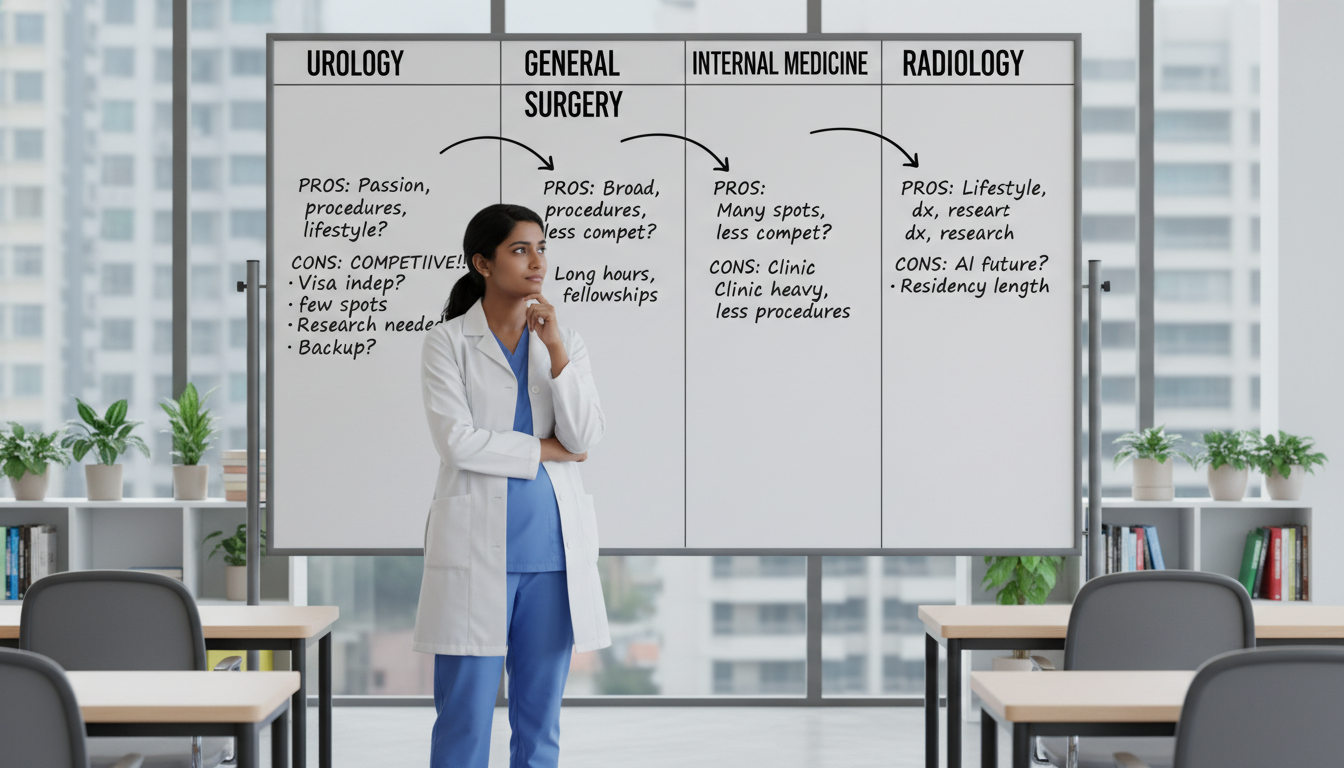
1. Urology‑Adjacent Surgical Backup Options
These are fields that maintain a surgical lifestyle and some overlap in anatomy, procedures, or patient population.
a. General Surgery
Pros
- Robust surgical foundation (operative skills, perioperative care) that can be leveraged if later pursuing:
- Urology research fellowships
- Non‑accredited urology fellowships abroad or in specific systems
- Urology‑like subspecialties (e.g., colorectal with pelvic surgery, though not the same field)
- More residency positions than urology; some programs are IMG‑friendly.
- Keeps you in the operating room and aligned with your surgical identity.
Cons
- Still competitive for non‑US citizen IMGs in many places, especially for visas.
- Lifestyle can be challenging; many who choose urology do so partly to avoid classic general surgery hours.
- Transitioning from general surgery to accredited urology residency in the US is rare and difficult.
Who should consider it?
- Applicants with strong Step scores, solid US surgical letters, and good tolerance for a demanding lifestyle.
- Those willing to accept that they may remain general surgeons long term if re‑entry to urology does not happen.
b. Preliminary Surgery Year as a Tactical Option
Technically not a “backup specialty,” but a preliminary surgery position can serve as a bridge year if you:
- Go unmatched in urology
- Want to stay in the US system, build contacts, and strengthen your application
However, it is risky to rely only on prelim years as backup—they do not guarantee progression to categorical training in any field.
When a prelim year makes sense
- You are strongly committed to reapplying to urology.
- You have realistic prospects for improvement (research, networking, extra letters).
- You have emotional and financial support to endure another application cycle.
c. Obstetrics & Gynecology (Ob/Gyn)
Surprisingly, there is some conceptual overlap:
- Pelvic surgery
- Minimally invasive procedures
- Pelvic floor, incontinence issues (often co-managed with urology or urogynecology)
For a non‑US citizen IMG:
- Some Ob/Gyn programs are IMG‑friendly, but competitiveness varies.
- Could offer a long-term career with opportunities in urogynecology (though that is usually from the Ob/Gyn route, not urology).
This is best for:
- Candidates who genuinely like women’s health.
- Those comfortable with obstetrics (call-heavy, high-risk, medicolegal considerations).
2. Non‑Surgical, Clinically Relevant Backup Options
These fields may not offer operative work but are intellectually aligned or allow you to work closely with urologists.
a. Internal Medicine (with Nephrology or Oncology Focus)
Why it can be a strategic backup
- Internal medicine is one of the most IMG‑friendly specialties, including for many non‑US citizen IMGs.
- From internal medicine you can pursue:
- Nephrology – frequent overlap with urologists in renal disease, transplant evaluations, dialysis access decisions.
- Oncology / Hematology-Oncology – managing urologic malignancies alongside urologists (prostate, bladder, kidney cancers).
- You remain in a domain where you will interact with urology as a consultant.
Pros
- High chance of match if you apply broadly and meet minimum metrics.
- More visa‑friendly programs (especially J‑1) compared to surgical fields.
- Good long‑term job prospects, hospitalist roles, outpatient careers.
Cons
- Less procedural/surgical work.
- May feel like a major shift in identity if you are strongly surgery‑oriented.
Best suited for:
- Urology applicants with:
- Slightly lower Step scores or red flags
- Strong interest in physiology, complex medical care, oncology, or renal disease
- Those with higher risk tolerance for not ending up in the OR, but who still want intellectually complex, specialty‑oriented medicine.
b. Diagnostic or Interventional Radiology
Radiology has a natural link to urology:
- CT urography, MR urography, ultrasound of kidneys/bladder/prostate, interventional procedures (nephrostomy tubes, embolization).
- You remain very close to urologic pathology and procedures.
Pros
- Complex visual/problem‑solving field.
- Potential for procedural work, especially in interventional radiology (IR).
- Some programs accept IMGs and sponsor visas, though competitiveness varies.
Cons
- Radiology is quite competitive in many regions, especially for non‑US citizens requiring visas.
- Less direct patient contact (depending on practice style).
- Requires strong test scores and often research or US-based radiology exposure.
Who should consider it?
- Applicants with strong scores, strong imaging or research background, and comfortable with a more tech‑focused specialty.
- Those okay with not being the primary surgeon but still playing a procedural role.
c. Anesthesiology
Anesthesia provides:
- Constant presence in the OR, including for urology cases.
- Understanding of perioperative care, fluid management, pain control.
- Opportunities to subspecialize (e.g., regional, critical care).
Benefits for non‑US citizen IMGs
- Moderately competitive; some programs are IMG‑friendly and sponsor visas.
- You maintain a surgical‑adjacent daily environment.
Drawbacks
- You are not the primary proceduralist except for lines, airways, and blocks.
- May feel like a shift away from ownership of individual surgical patients.
3. High‑Yield “Safety” Specialties for Maximizing Match Probability
Every applicant has a different “floor” they are willing to accept in terms of competitiveness of their backup specialty.
For many non-US citizen IMG applicants whose metrics are borderline for urology, it is wise to have at least one high‑yield match option if you absolutely must match in your first cycle due to personal or financial constraints.
Common higher‑yield options:
- Family Medicine – often the most IMG‑friendly field; many J‑1 sponsoring programs; broad clinical exposure.
- Pediatrics – relatively welcoming to IMGs, though visa policies vary by program.
- Psychiatry – historically IMG-friendly, though competitiveness has been increasing.
These are not particularly urology‑adjacent, but:
- They provide a stable US residency platform.
- After completion, you could still do:
- Urology‑related research as a collaborator
- Work in settings where you interact with urology colleagues.
Choosing one of these as your plan B specialty is a deeply personal decision and should consider family, finances, and your tolerance for reapplying.
How to Operationalize Dual Applications Without Undermining Urology
Once you’ve chosen appropriate backup options, you must implement them tactically in the application process.

Step 1: Map Out Programs by Category
Create a spreadsheet with columns such as:
- Program name
- Specialty (urology vs backup)
- Visa policy (J‑1/H‑1B/none)
- IMG friendliness (historical IMG matches, stated policies)
- Your connection (research, mentor, alumni, region)
- Priority level (high/medium/low)
For a foreign national medical graduate, visa policy is not optional data—it is central to your strategy.
Step 2: Time Your Backup Application Work
To avoid diluting your urology application:
Finish urology core documents first
- Urology personal statement
- CV and ERAS activities
- LORs from urologists and surgical mentors
Then build your backup package:
- Specialty-specific personal statement (e.g., internal medicine)
- Additional letters (e.g., internist, radiologist, anesthesiologist)
- Tailored description of experiences relevant to the backup field.
If possible, complete your urology materials 1–2 weeks earlier than the official application opening to leave time for backup planning.
Step 3: Design Consistent, Honest Narratives
Your application materials must make sense if any single specialty reads the entire file:
Urology personal statement:
- Clearly expresses passion for urologic surgery, patients, and research.
Backup specialty personal statement:
- Explains your core interests (systems‑based thinking, oncology, imaging, perioperative care, etc.).
- Does NOT sound like: “I really wanted urology but now I’m applying to you.”
- Instead, it emphasizes overlapping skill sets: meticulousness, teamwork, longitudinal care, etc.
You can internally know that internal medicine or anesthesiology is a plan B specialty, but on paper, it must sound like a well‑considered, authentic career choice.
Step 4: Decide When to Signal Your Backup Priority
Some specialties now use preference signaling tokens or special forms (e.g., signaling in urology match). Use them to:
- Prioritize a small group of programs where you are most invested.
- Avoid scattering signals across too many specialties.
Important:
If your ultimate loyalty is to urology, do not send signals that suggest equal interest in multiple fields to the same institution. Programs talk.
Example Scenarios: Applying the Strategy in Real Life
Here are three realistic applicant profiles and how their backup planning might differ.
Scenario 1: Strong Applicant, Higher Risk Tolerance
- Non-US citizen IMG
- Strong Step scores, solid urology research, 2 US urology electives
- Needs J‑1 visa; a few urology interviews likely
Plan
- Apply broadly to urology as primary focus.
- Limited dual applying: only add anesthesiology as backup with a small but targeted list of IMG‑friendly, visa‑sponsoring programs.
- If urology interview season goes poorly (few invites), increase focus on anesthesia interviews and networking.
- Comfortable with reapplying to urology after a prelim or initial residency year if absolutely needed.
Scenario 2: Moderate Applicant, Needs High Match Probability
- Non-US citizen IMG, mid‑range Step scores, limited urology research
- Strong internal medicine rotations and letters
- Need to start earning in the US for family reasons; cannot afford multiple unmatched cycles.
Plan
- Apply to urology but with realistic expectations that match chances may be modest.
- Parallel, full‑strength application to internal medicine (primary plan B specialty), with specific interest in nephrology or oncology highlighted.
- Broader list of internal medicine programs, prioritizing J‑1 friendly, historically IMG‑friendly institutions.
- Will choose IM match if urology offers are insufficient, without plans to reapply to urology later.
Scenario 3: Borderline Metrics, Primarily Seeking US Entry
- Lower Step scores, no significant urology research, older year of graduation.
- Very limited chance of urology match, but still passionate about GU pathology.
Plan
- Apply to urology at a smaller scale (selected IMG‑friendly programs) recognizing it is a long‑shot.
- Main application efforts in family medicine or psychiatry (high match probability) as the true backup specialty.
- Later, focus on GU‑adjacent interests through community practice, collaboration with urologists, or public health work related to urologic diseases.
Emotional and Practical Considerations in Backup Planning
Balancing Identity and Pragmatism
For many applicants, urology is not just a specialty; it is an identity. Planning for a backup specialty can feel like admitting defeat.
Important mindset shifts:
- A backup plan is not a prediction of failure; it is risk management.
- You are not “betraying” your passion by being realistic about the match statistics.
- Many excellent physicians in other fields once planned to be surgeons; career satisfaction is multifactorial.
Communicating with Mentors
Be open with trusted mentors, especially:
- Senior urologists who know the competitiveness landscape.
- Program directors or advisors familiar with IMG and visa issues.
Ask specific questions:
- “Given my profile, how would you estimate my urology match chances this cycle?”
- “Which backup specialties do you see aligning with my strengths?”
- “Would you support me with letters if I decide to dual apply to internal medicine or anesthesia?”
Mentors who are truly invested in your overall success, not just in their specialty, will respect and help shape your backup strategy.
Visa Strategy as Part of Backup Planning
As a foreign national medical graduate, your visa pathway and long‑term immigration goals are inseparable from specialty choice:
- J‑1 vs H‑1B availability
- Likelihood of jobs in your specialty after residency given your immigration status
- Geographic restrictions (e.g., underserved area requirements after J‑1 waiver)
In some cases, a less competitive but more visa‑friendly field can provide more stable long‑term prospects than a highly competitive field where visa barriers limit jobs even after residency.
Frequently Asked Questions (FAQ)
1. As a non-US citizen IMG, is it realistic to apply only to urology without a backup?
It depends on your profile and risk tolerance.
If you have:
- Top‑tier US scores
- Strong US urology research
- Excellent US letters and a visa‑friendly status
you may choose to apply only to urology, accepting the risk of going unmatched. However, for most foreign national medical graduates, especially those needing visas, dual applying is safer. The majority should at least consider a plan B specialty that they could live with long term.
2. Can I do internal medicine first and then switch to urology later?
Switching from internal medicine to urology residency in the US is rare and challenging. Urology residency is its own categorical pathway, and prior internal medicine training usually does not substitute for urology years. However, completing internal medicine can position you for:
- Nephrology or oncology fellowships with heavy GU overlap
- Collaborative research with urologists
If your true long‑term goal is to be a practicing urologist, a switch from internal medicine is unlikely; consider this carefully before committing.
3. Is general surgery a good stepping stone to urology?
In theory, general surgery seems like a natural stepping stone, but in practice, transitions from general surgery to urology categorical residency are uncommon. Programs may occasionally credit one year of surgical training, but this is not guaranteed.
General surgery is best considered a parallel career option, not a guaranteed bridge. If you would be content as a general surgeon in case urology never materializes, then it can be a sensible backup for a surgically oriented applicant.
4. Should I mention in my backup specialty interviews that I also applied to urology?
Use caution and honesty. If directly asked, you should not lie, but you can frame it professionally:
- Emphasize that you carefully considered multiple fields.
- Explain what ultimately attracts you to their specialty in its own right (not as “second choice”).
- Avoid sounding like you are only there because urology “didn’t work out.”
The narrative should be that you are genuinely committed to whichever specialty you are interviewing for, regardless of your original plan.
Thoughtful backup specialty planning does not dilute your ambition; it safeguards your future. As a non-US citizen IMG aiming for urology, your path is steep but navigable. By aligning realistic match data, visa constraints, and your personal values, you can create a strategy that gives you the best chance of practicing meaningful medicine—whether in urology or a well-chosen, satisfying plan B specialty.