Understanding Why Backup Planning Matters for Non‑US Citizen IMGs in Vascular Surgery
Vascular surgery is one of the most competitive surgical fields in the United States, and it is especially challenging for a non-US citizen IMG or foreign national medical graduate. An integrated vascular program (0+5) often prefers:
- US MD/DO graduates
- Applicants with strong research portfolios
- Those with US clinical experience and strong letters from US vascular surgeons
On top of this, visa requirements (J-1 or H-1B) add another layer of difficulty. Many excellent IMGs go unmatched in vascular surgery not because they are unqualified, but because there are:
- Very few integrated vascular positions nationwide
- Limited programs willing/able to sponsor visas
- Strong biases toward home and US graduates
For these reasons, deliberate backup specialty planning is not optional—it is a risk management strategy. Dual applying residency (applying to vascular surgery and to a backup specialty at the same time) protects your investment in exams, applications, and years of preparation.
A well-constructed plan B specialty should:
- Still align with your long‑term career interests (vascular, endovascular, or procedural care).
- Offer realistic match chances for a non-US citizen IMG requiring a visa.
- Keep pathways open to eventually practice vascular surgery–adjacent work or even reach vascular through a fellowship if possible.
The rest of this article walks through how to choose, structure, and execute an effective backup specialty strategy tailored to a non-US citizen IMG aiming for vascular surgery.
Step 1: Clarify Your Long‑Term Career Goals in Vascular Care
Before you pick a backup specialty, you need a clear picture of your “why” and “what” regarding vascular surgery:
1.1 Define what you actually love about vascular surgery
Different aspects of vascular surgery may resonate with you:
- Endovascular and catheter-based interventions (stents, angioplasty, thrombolysis)
- Open operations (bypass grafts, aneurysm repairs, carotid endarterectomy)
- Chronic disease management (PAD, carotid disease, venous disease, dialysis access)
- Critical care (ruptured aneurysms, acute limb ischemia)
- Long-term patient relationships with complex, high‑risk populations
Write down the top 3 elements that excite you the most. For example:
“I love image‑guided procedures, working in the angio suite, and solving acute vascular emergencies.”
This list will guide which backup specialties still give you some of what you love.
1.2 Be honest about your constraints as a non‑US citizen IMG
You must factor in:
- Visa needs: J-1 vs H-1B (many surgical programs only sponsor J-1; fewer offer H-1B).
- USMLE performance: Step 2 CK especially; Step 3 completion can help H-1B.
- US clinical experience: Rotations, sub‑internships, or observerships in the US, ideally in vascular or related fields.
- Research and publications: Vascular or surgical research boosts your vascular application and may enhance your backup options too.
Matching a highly competitive integrated vascular program as a foreign national medical graduate can be statistically unlikely unless you are a truly standout candidate. You don’t have to abandon the dream—but you need a realistic safety net.

Step 2: Understanding Pathways to Vascular Surgery and Where Backup Fits
There are two main pathways to vascular surgery in the US:
- Integrated vascular surgery residency (0+5)
- Vascular surgery fellowship after general surgery (5+2)
For a non-US citizen IMG, the second pathway—general surgery residency followed by vascular fellowship—is often more attainable than a direct 0+5 spot. But both pathways are competitive and visa-dependent.
2.1 Integrated vascular programs (0+5) as primary target
Advantages:
- Early, focused vascular training
- No need for a separate fellowship application
- Attractive to students certain about vascular from early on
Challenges for a non-US citizen IMG:
- Limited positions nationally (fewer seats than general surgery)
- Many programs have a strong home-student preference
- Visa sponsorship may be restricted or absent
If you apply here as your primary choice, you almost certainly need a robust backup specialty.
2.2 General surgery (categorical) as a de facto “backup” and alternate path
Pros:
- Higher number of positions than integrated vascular
- A recognized route to vascular surgery fellowship (5+2)
- Many programs accept IMGs and J-1 visas
Cons:
- Still quite competitive—especially for foreign national medical graduates
- Not all general surgery programs are equally supportive of fellows going into vascular
- Being a non-US citizen may still limit some fellowship options later
For many non-US citizen IMG applicants:
- Primary target: Integrated vascular surgery
- Backup 1: Categorical general surgery (with interest in vascular exposure and fellowship)
- Backup 2: A related plan B specialty that offers procedural or vascular‑adjacent work
However, general surgery alone may still be too competitive as a backup for some profiles, making a plan B specialty beyond surgery essential.
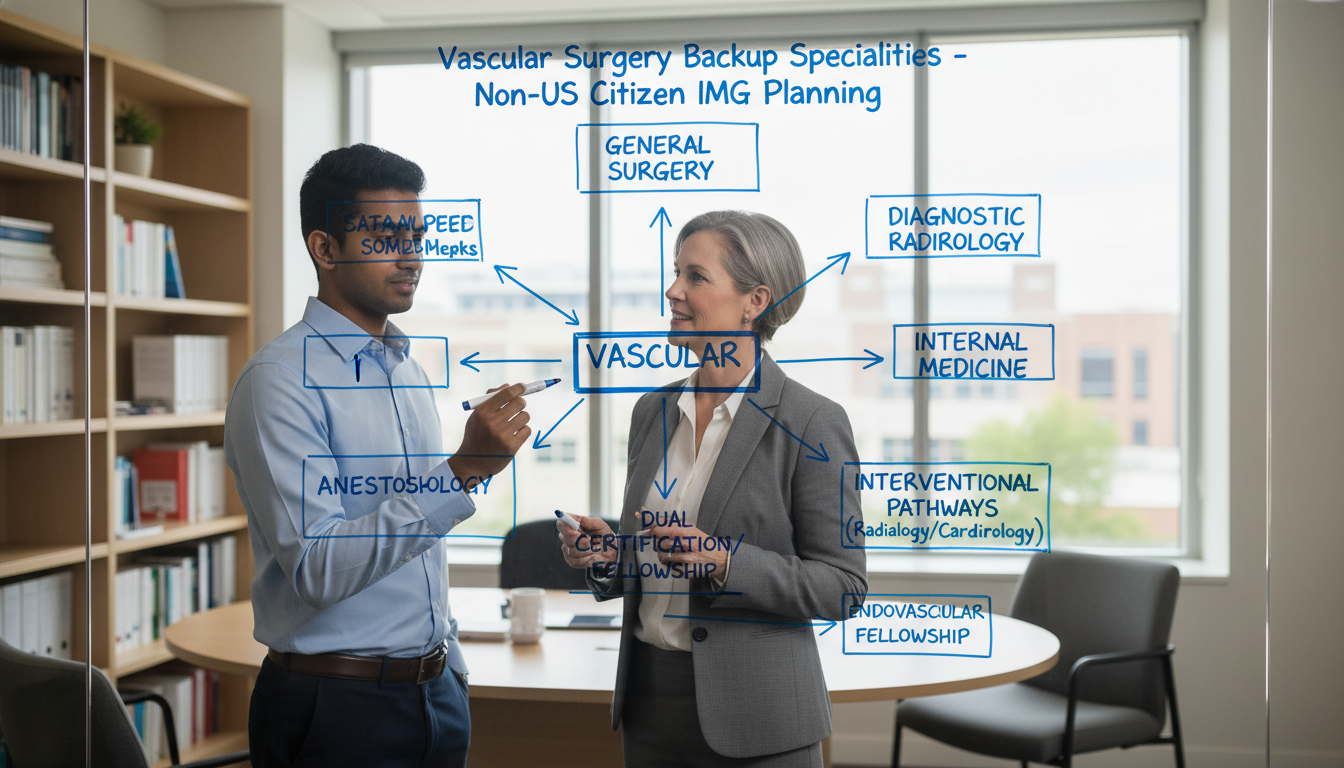
Step 3: Choosing a Realistic and Strategic Plan B Specialty
When thinking about a backup specialty (or multiple backup specialties), you want to balance three factors:
- Match feasibility for a non-US citizen IMG
- Overlap with your vascular interests and skills
- Long‑term career satisfaction and viability in your home country or globally
Below are commonly considered plan B specialty options for vascular‑interested IMGs, with pros, cons, and specific notes for foreign national medical graduates.
3.1 Diagnostic Radiology and Interventional Radiology Pathways
Why it’s attractive:
Image‑guided procedures, endovascular work, and vascular interventions are central to interventional radiology (IR). Many of the same disease processes (PAD, DVT/PE, aneurysms) are treated by IR.
Options:
- Integrated IR/DR residencies (competitive; limited spots; not ideal as backup).
- Diagnostic radiology (DR) residency with later IR fellowship—more realistic backup than integrated IR for an IMG.
Pros for non-US citizen IMG:
- High alignment with your love of vascular anatomy and endovascular interventions.
- Strong future demand in many health systems.
- Some DR programs sponsor J-1 and occasionally H-1B.
Cons:
- DR itself is moderately competitive; integrated IR is very competitive.
- Some programs strongly favor US grads.
- You must be comfortable with a hybrid of clinical and image-interpretation work (not only procedures).
Who should consider it?
Non-US citizen IMGs with strong Step scores, solid US experience, and good radiology research or exposure.
3.2 Internal Medicine with Plan for Interventional Cardiology or Vascular Medicine
This route shifts you into a medical (not surgical) path but can keep you close to vascular disease.
Pathways:
- Internal Medicine → Cardiology → Interventional Cardiology
- Internal Medicine → Vascular Medicine (less procedural but highly vascular‑focused)
Pros:
- Internal medicine offers a larger number of positions and many IMG‑friendly programs.
- Many IM programs sponsor J-1; a meaningful subset sponsor H-1B.
- Interventional cardiologists manage coronary and sometimes peripheral vascular interventions—still heavy in cath lab, imaging, and device-based therapies.
Cons:
- You will not be an operating-room vascular surgeon.
- Vascular medicine focuses more on non‑invasive management and medical therapy.
- Long training path: IM (3 years) + Cardiology (3 years) + Interventional fellowship (1–2 years).
Who should consider it?
Applicants who like physiology, longitudinal care, and the idea of endovascular work but can accept leaving the operating room.
3.3 Anesthesiology with Focus on Critical Care or Cardiothoracic/Vascular Anesthesia
Anesthesiology is not a vascular specialty per se, but it keeps you in the OR and around complex cardiovascular and vascular cases.
Pros:
- Moderate competitiveness; some programs are IMG‑friendly.
- Strong US demand and global portability of skills.
- You can specialize in cardiothoracic or vascular anesthesia or critical care, working closely with vascular surgeons.
Cons:
- You won’t be the primary proceduralist for vascular interventions.
- Some IMGs find fewer positions offering H-1B; J-1 is more common.
- Less direct vascular anatomy operative exposure than surgery or IR.
Who should consider it?
Those who value critical care, physiology, and OR atmosphere but can accept a non-surgeon role.
3.4 Transitional or Preliminary Surgery Years (Not a True Long-Term Backup)
A preliminary surgery or transitional year can be a bridge, not a plan B specialty:
- It can buy you a year to strengthen your CV (research, US performance, letters).
- It may help you reapply to vascular or categorical general surgery.
But:
- Prelim positions do not guarantee a future categorical spot.
- Visa sponsorship may be limited.
- They are not a sustainable long‑term career plan by themselves.
Use prelim years tactically, not as your sole backup.
Step 4: Structuring a Dual‑Application Strategy Without Diluting Your Message
Dual applying to vascular surgery and a backup specialty is delicate: you must appear fully committed to each field in the applications that program sees, while maintaining internal consistency and integrity.
4.1 Decide early: single backup vs multi‑tier backup
As a non-US citizen IMG aiming for vascular surgery, a practical hierarchy might be:
- Tier 1: Integrated vascular surgery (0+5)
- Tier 2: Categorical general surgery with strong vascular exposure
- Tier 3: Plan B specialty (e.g., internal medicine, diagnostic radiology, or anesthesiology)
Not everyone can realistically apply to three tiers due to cost and time. Many choose:
- Vascular + general surgery
- Or Vascular + one non‑surgical, more IMG-friendly plan B specialty
Your choice depends on your competitiveness, financial resources, and advisor feedback.
4.2 Crafting specialty‑specific personal statements
You should have:
- A vascular surgery personal statement focused on vascular pathology, operative passion, and your vision as a vascular surgeon.
- A separate statement for your backup specialty that is equally sincere and specific.
Avoid:
- Generic statements that could apply to any field.
- Statements that openly call your plan B specialty a “backup” or “second choice.”
- Contradictions—for example, saying you cannot imagine any career except vascular surgery in one essay and claiming lifetime dedication to radiology in another.
Instead, frame the story as:
- For vascular applications: a narrative of early exposure to vascular disease, your commitment to surgical care, and your vision as a vascular surgeon.
- For plan B specialty applications: an honest description of how you became deeply interested in that field’s approach to the same patient population (e.g., vascular disease, critical care, imaging), without referencing the other specialty.
4.3 Letters of recommendation strategy
Aim for:
- 3–4 letters for vascular/general surgery: at least two from surgeons (ideally vascular), plus maybe one from a research mentor.
- 2–3 letters for your backup specialty: from faculty in that field if you have exposure, or from internal medicine/radiology/anesthesia attendings who can specifically speak to relevant skills.
You may be able to use some letters across specialties if:
- They are written in a way that emphasizes general qualities (work ethic, professionalism, communication).
- They do not over-specify a dedicated commitment to only one specialty.
But it is better to have at least one or two letters clearly targeted to your backup specialty, especially if that field is not surgery.
4.4 Program list building: be realistic and data‑driven
For each specialty you apply to:
- Filter programs by visa sponsorship (check FREIDA, program websites, and emails).
- Look for stated IMG-friendliness or historical IMG match patterns.
- Consider geographic flexibility—being open to smaller cities or less popular regions can significantly increase your chances.
As a non-US citizen IMG, you cannot afford to waste applications on programs that never sponsor J-1/H-1B for foreign national medical graduates.
Step 5: Optimizing Your Profile for Both Vascular and Your Plan B
5.1 Clinical experiences
Try to structure your clinical experiences like this:
- At least one rotation in vascular surgery or general surgery with exposure to vascular cases.
- At least one rotation in your backup specialty (IM, DR, etc.) if possible, to secure letters and demonstrate genuine interest.
For each experience, keep a log of:
- Interesting vascular or complex cases
- Procedures you observed/assisted
- Patient stories that highlight your empathy and clinical skills
These details will enrich both interview conversations and personal statements.
5.2 Research and scholarly work
Prioritize:
- Vascular or cardiovascular research if your primary goal is vascular surgery.
- If aiming for plan B in radiology or interventional fields, imaging or endovascular‑focused projects are doubly useful.
- For IM, cardiology, or vascular medicine, focus on vascular risk factors, PAD, stroke prevention, or thrombosis.
Even case reports and small retrospective reviews can help, especially if they involve vascular pathology or your backup field’s methodology.
5.3 USMLE and Step 3 strategy
- Aim for strong Step 2 CK—critical for surgical and radiology fields.
- If possible, complete Step 3 before the Match, especially if you want to be eligible for H-1B visa sponsorship; many programs require or strongly prefer this.
Higher scores do not guarantee a spot, but as a non-US citizen IMG they help overcome screening thresholds.
Step 6: Interview Strategy and Managing the Narrative
Interviews are where your dual applying and backup specialty plans can get exposed if you are not prepared.
6.1 How to answer “Why vascular surgery?” in an integrated program interview
Focus on:
- The specific aspects of vascular surgery that inspire you (emergency saves, limb salvage, imaging‑guided interventions, long‑term patient impact).
- Your concrete steps so far—rotations, research, mentors.
- Your understanding of the lifestyle and intensity of vascular practice.
Do not mention that you are also applying to another specialty unless directly asked; even then, be careful and honest:
“I am fully committed to a career closely tied to vascular disease. My primary goal is to become a vascular surgeon. Given the competitiveness and my visa needs as a non-US citizen IMG, I also applied to [backup specialty] programs that allow me to care for similar patient populations through [e.g., endovascular procedures, vascular medicine, or critical care]. Wherever I match, I plan to build a career caring for patients with complex vascular disease.”
6.2 How to answer “What other specialties are you applying to?” in backup interviews
You can be transparent but strategic:
“My strongest interest is in [backup specialty], particularly [sub-area related to vascular disease]. I initially explored vascular surgery deeply, which shaped my interest in [hemodynamics/imaging/critical care, etc.]. As I progressed, I realized that [backup specialty] offers a way to engage with complex vascular or cardiovascular patients using a different but equally compelling skill set. So I am focused on programs like yours where I can build that expertise.”
The goal is to show that you have matured in your thinking and that you are not treating their specialty as a last‑resort.
6.3 Ranking strategy
When it comes time to create your Rank Order List (ROL):
- Rank all programs you would genuinely be willing to train at, in true order of preference.
- If your heart is completely set on vascular surgery, place those programs above backup ones, but be honest with yourself:
- Would you be okay with not matching at all vs matching in your backup field?
For most non-US citizen IMGs, the safer option is:
- Rank vascular programs first, followed by strong, IMG‑friendly backup programs where you can still have a fulfilling career.
FAQs: Backup Specialty Planning for Non‑US Citizen IMGs in Vascular Surgery
1. As a non-US citizen IMG, is it realistic to match into an integrated vascular surgery residency?
It is possible but statistically challenging. The number of integrated vascular program positions is small, and many are filled by US MDs with strong home‑institution connections. As a foreign national medical graduate, you must have:
- Excellent exam scores and clinical performance
- US vascular or surgical rotations with strong letters
- Research or scholarly work in vascular or related fields
- Clear visa eligibility (usually J-1; H-1B is rare)
Because of these barriers, most advisors recommend having at least one robust backup specialty strategy.
2. What is the best backup specialty if I eventually want to work with vascular patients?
There is no single “best” plan B specialty; it depends on your interests and profile. Common options for vascular‑oriented IMGs include:
- General surgery (route to vascular fellowship)
- Diagnostic radiology (route to interventional radiology and endovascular procedures)
- Internal medicine → cardiology → interventional cardiology
- Internal medicine → vascular medicine
- Anesthesiology with a focus on cardiothoracic/vascular anesthesia or critical care
Choose the one where you can realistically match as a non-US citizen IMG and where you can see yourself satisfied long term, even if you never become a vascular surgeon.
3. Will programs know that I am dual applying, and will it hurt my chances?
Programs do not automatically see where else you applied. They may infer it from your profile or ask directly during interviews. Dual applying residency is common—especially among those targeting competitive fields.
Dual applying only hurts you if:
- Your personal statements sound generic or contradictory.
- You appear half‑hearted or uncertain about their specialty.
If you present a coherent and genuine narrative for each field, dual applying usually does not damage your chances and can greatly reduce the risk of going unmatched.
4. Should I do a preliminary surgery year if I don’t match vascular?
A preliminary surgery year can be useful if:
- You have strong reasons to believe that one additional year of US experience, performance, and possibly research will meaningfully improve your chances at categorical general surgery or vascular.
- You understand that there is no guarantee of upgrading to a categorical spot.
It is not a true plan B specialty; it is a bridge. Many non-US citizen IMGs also use a prelim year to reassess and then apply more broadly, including to their backup specialty the following cycle.
In summary, as a non-US citizen IMG or foreign national medical graduate with aspirations in vascular surgery, you should pursue your goal ambitiously while structuring a thoughtful, realistic backup specialty plan. Carefully chosen plan B specialties and strategic dual applying residency can preserve your connection to vascular care, protect you from going unmatched, and still lead to a fulfilling, impactful career treating patients with complex vascular and cardiovascular disease.