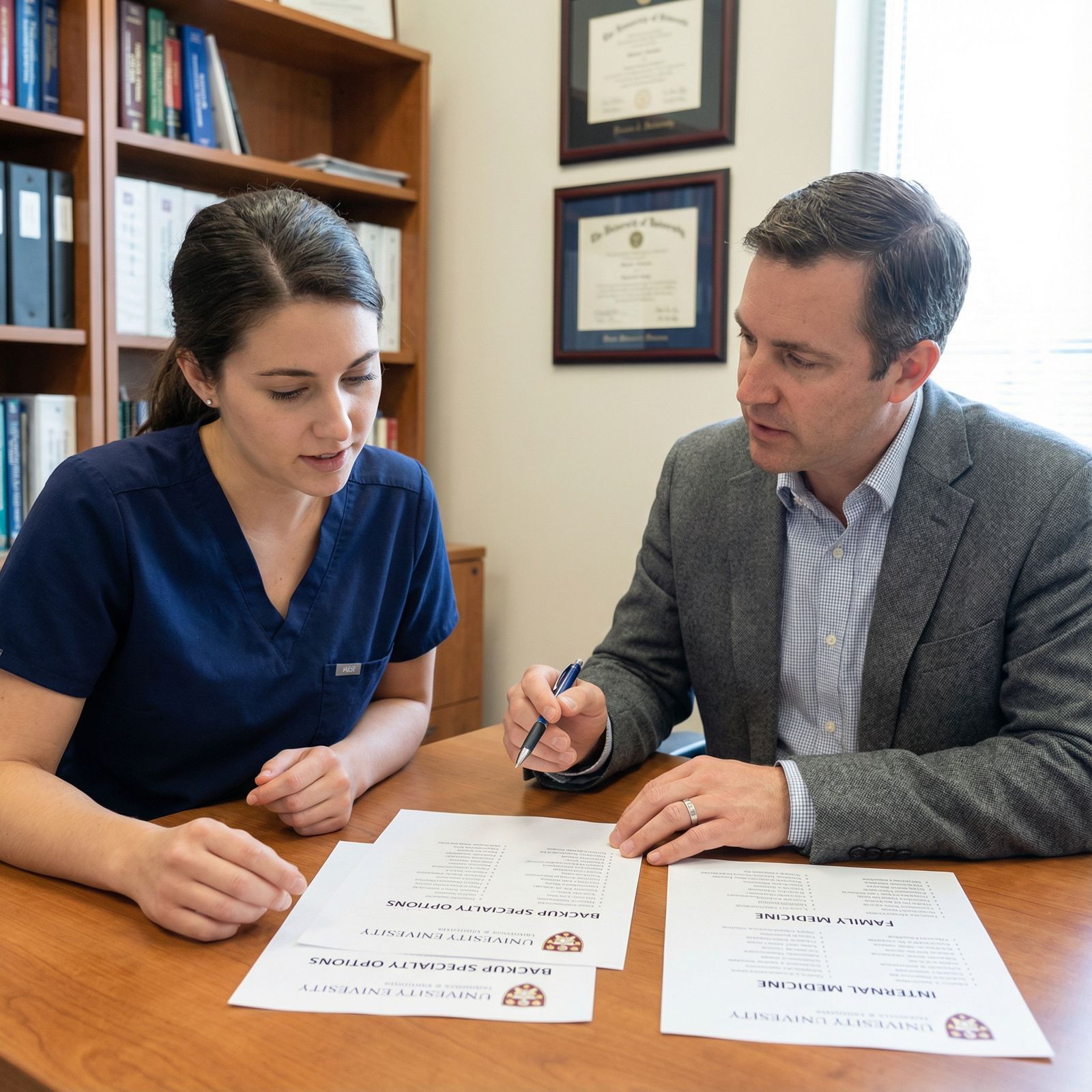
Understanding Why Backup Planning Matters in Ophthalmology
As an MD graduate targeting ophthalmology, you are aiming for one of the most competitive specialties in the allopathic medical school match. Every year, strong candidates go unmatched in the ophtho match for reasons that often have little to do with their clinical ability: limited geographic flexibility, letters that arrived late, poor program list strategy, or just a highly competitive cohort.
Backup specialty planning is not a sign that you’re “less committed” to ophthalmology. It is risk management and professional maturity. Your goal is to:
- Maximize your chances of matching into ophthalmology
- Protect yourself from going completely unmatched
- Avoid “panic decisions” late in the cycle
If you approach it correctly, dual applying to residency and selecting a plan B specialty can actually strengthen your primary application, not weaken it.
Key Realities of the Ophtho Match
Earlier, separate match:
Ophthalmology uses the SF Match (separate from NRMP) with earlier deadlines and interview season. Your MD graduate residency strategy must therefore be planned earlier than for many other specialties.One-year internship required:
After matching into ophthalmology, you still must match into a PGY-1 year, usually via the NRMP (medicine prelim, transitional year, or less commonly surgery prelim).High competition and limited spots:
Ophthalmology residency programs are relatively small, with fewer positions compared to big “workhorse” fields like internal medicine or family medicine.Strong applicant pool:
Many applicants have excellent board scores, strong clinical grades, and substantial research. Even well-qualified applicants can be left without an offer.
These realities make it critical to think early and deliberately about backup pathways.
Clarifying Your Priorities Before Choosing a Backup
Before you pick any backup specialty, get extremely clear on your goals and constraints. This ensures your plan B specialty isn’t random or misaligned with your long-term satisfaction.
Step 1: Define Your Non-Negotiables
Reflect on what you absolutely need in your future career:
- Degree of procedural work: Do you want to operate or do procedures? Ophthalmology is highly procedural. If that’s core to your career satisfaction, backup specialties should reflect this.
- Patient population: Adults vs pediatrics? Outpatient vs inpatient? Acute vs chronic disease?
- Lifestyle and schedule: Clinic-heavy vs call-heavy; tolerance for nights/weekends; need for predictable hours.
- Geographic flexibility: Are you location-limited due to family, partner, or other constraints?
- Research and academic interest: Desire for academic career vs community-based practice.
Write down your top 3–5 non-negotiables. These will guide which backup specialties make sense.
Step 2: Understand Your Application Profile
Assess your competitiveness honestly:
- USMLE/COMLEX scores: Are your Step 1 (even if pass/fail), Step 2 CK, and any Step 3 scores competitive for ophthalmology? For most U.S. MD graduates, Step 2 CK plays a big role.
- Clinical performance: Honors in core rotations? Evaluations that mention technical skills, fine motor ability, or patient communication?
- Research output: Ophthalmology-specific research is ideal, but any strong scholarly work is a plus.
- Subspecialty exposure: Number of ophtho rotations, away rotations, letters from ophthalmologists.
- Red flags: Any leaves of absence, exam failures, professionalism concerns, or late career changes.
If your metrics are solid but not stellar, or you have any red flags, thoughtful backup planning becomes even more important.
Step 3: Clarify Your Commitment to Ophthalmology
Ask yourself directly:
- If you don’t match in the upcoming ophtho match, would you:
- Be willing to take a research year and reapply?
- Prefer to match into a different specialty this year?
- Be open to a more circuitous path, such as prelim year + research + reapplication?
Your answer will shape how aggressively you dual apply and how you design your rank lists.

Common Backup Paths for Ophthalmology Applicants
There is no “one right” backup specialty for all ophthalmology applicants. But some patterns are common among MD graduates and can form the backbone of a rational strategy.
Below are frequently chosen plan B specialties and how they align with ophthalmology.
1. Internal Medicine (IM)
Why it’s popular:
- Broad-based training that leaves many doors open.
- High number of residency positions and a wide range of program tiers.
- Relatively friendly to applicants with strong academic backgrounds but without ultra-high board scores.
Pros for the ophtho-minded MD graduate:
- Flexibility for future ophthalmology re-application: You can complete a prelim or categorical year and then reapply to ophthalmology with enhanced clinical maturity.
- Subspecialty options with procedure focus: Interventional cardiology, GI, pulmonary/critical care offer procedural work, though different from microsurgery.
- Academic and research opportunities: Strong pathway to academic medicine.
Cons:
- Less overlap in day-to-day clinical work with ophthalmology.
- Many roles are more inpatient and chronic-disease focused, with less of the delicate microsurgical feel.
Who it fits:
- MD graduates who value intellectual variety, academic complexity, and want multiple future options if ophtho ultimately doesn’t work out.
- Those open to hospital-based and outpatient blended careers.
2. Transitional Year (TY) + Reapplication Strategy
A Transitional Year (TY) alone is not a long-term backup specialty, but it is a common tactical plan.
Concept:
- You apply to ophthalmology via SF Match and simultaneously apply for TY or prelim medicine internships through NRMP.
- If you match ophtho, your TY is your PGY-1 year.
- If you don’t match ophtho, a solid TY or prelim year at a strong institution plus research can make you very competitive the following cycle.
Pros:
- Maintains maximum flexibility; you’re not locked into another full categorical specialty.
- Allows you to strengthen your case with:
- Additional letters from non-ophtho faculty,
- Strong intern-year performance,
- Extra research.
Cons:
- You’ll likely need to delay full specialty training by at least a year.
- Funding and visa issues (where applicable) may be more complex.
- Emotional challenge of “trying again” while peers move into final specialty training.
Who it fits:
- Applicants who are highly committed to ophthalmology and willing to invest extra time.
- Those without severe financial or geographic constraints.
3. Neurology
Why it’s considered:
- Some conceptual overlap with visual pathways, neuro-ophthalmology, and neuroimaging.
- Growing field with good match odds for well-prepared MD graduates.
Pros:
- Clinically related to vision in neuro-ophthalmology subspecialty.
- Academic and research-rich specialty.
- Mix of outpatient and inpatient work.
Cons:
- Less procedural and surgical compared to ophtho.
- Visual system involvement is only a subset of neurology practice.
Who it fits:
- Those who enjoy neuroanatomy, complex diagnostics, and longitudinal care.
- Applicants drawn to the cerebral, consult-oriented aspects of ophthalmology more than purely surgical aspects.
4. Radiology (Diagnostic Radiology)
Why it appeals:
- Visual, diagnostic, image-based work with a strong cognitive component.
- Involves fine visual skills and pattern recognition.
Pros:
- Image-centric: appeals to those who enjoyed the detailed image interpretation aspects of ophthalmology.
- Typically good lifestyle once established.
- Variety of subspecialties (neuroradiology, interventional, etc.).
Cons:
- Very different patient interaction profile (often limited direct contact).
- Less direct procedural work (unless pursuing interventional radiology).
- Market and job dynamics can be regionally variable.
Who it fits:
- Applicants strongly drawn to the visual, diagnostic aspects of medicine but more ambivalent about direct patient care or hands-on surgery.
5. Anesthesiology
Rationale:
- Procedural field with direct impact on surgeries, including eye surgeries.
- Opportunities in regional anesthesia, pain, critical care.
Pros:
- Procedural, OR-centered environment.
- Typically good compensation and relatively controllable lifestyle in many practice settings.
- Approximate “OR vibe” similar to ophtho surgeons without the microsurgical focus.
Cons:
- Patient relationship is short-term and often limited.
- Different intellectual focus (pharmacology, physiology, airway, hemodynamics).
Who it fits:
- Those who enjoy OR environments, acute care, and rapid problem-solving.
- MD graduates who are procedure-oriented but flexible about the exact nature of those procedures.
6. Family Medicine and Pediatrics
These are less “similar” to ophthalmology but can serve as realistic plan B specialties.
Pros:
- High match rates, large number of positions across many locations.
- Strong fit if you’re drawn to primary care, longitudinal relationships, and holistic management.
Cons:
- Minimal overlap with ophtho’s surgical and highly specialized nature.
- You may miss the procedural and image-focused components of ophthalmology.
Who it fits:
- Applicants who genuinely enjoy broad-spectrum care, especially if you have consistently liked outpatient primary care during medical school.
- Those with strong geographic constraints (many FM and peds programs across the country).
Framework for Choosing Your Plan B Specialty
A rational, structured approach beats gut-feeling choices. Here’s a step-by-step framework.
Step 1: Map Overlaps with Ophthalmology
List aspects of ophthalmology you love most, then map them to other specialties:
Microsurgery / fine motor skills:
→ Consider ENT, plastic surgery, interventional specialties (but note, these are often equally or more competitive—risky backups).Visual diagnostics and imaging:
→ Consider radiology, neurology (for neuro-ophtho), sometimes pathology (for histology and image-based diagnosis).Outpatient, clinic-based work with procedures:
→ Consider dermatology (but it’s very competitive), allergy/immunology (after IM or pediatrics), or pain medicine (after anesthesia).Patient relationships and chronic disease management:
→ Consider internal medicine, family medicine, pediatrics.
Avoid choosing a plan B specialty that conflicts with most of what you value in your career.
Step 2: Assess Competitiveness vs Ideal Fit
You don’t want your “backup specialty” to be as competitive as or more competitive than ophthalmology. That defeats the purpose.
For example:
- Dermatology, plastic surgery, ENT, and interventional radiology are typically not reliable backup specialties for an MD graduate targeting an ophtho match.
- Internal medicine, neurology, anesthesiology, and family medicine are more realistic choices in terms of match probability.
Balance:
- Tier 1: Ophthalmology (primary choice)
- Tier 2: Moderately competitive but realistic backup (e.g., anesthesiology, neurology, radiology for strong applicants)
- Tier 3: More accessible backup (e.g., internal medicine, family medicine) if there are concerns about exam scores or red flags.
Step 3: Factor in Geographic and Visa Constraints
- If you are geographically constrained (partner, children, elderly parents), choose a plan B specialty with wide national distribution of programs (e.g., IM, FM).
- If you’re an international graduate with visa needs, research which specialties and programs are more visa-friendly. Often internal medicine and family medicine have more sponsor options.
Step 4: Test Your Choice with Real-World Feedback
Discuss your plan with:
- Ophthalmology mentors: Ask what they see successful unmatched applicants doing.
- Program directors or advisors in your potential backup specialty.
- Recent grads who dual applied to ophtho and another field.
If multiple experienced physicians raise strong concerns (e.g., backup is too competitive, doesn’t fit your skills, or is saturated in your region), reconsider your choice.

How to Execute a Dual-Application Strategy Effectively
Dual applying to residency is logistically and emotionally demanding, but with planning, it’s manageable.
Step 1: Timeline and Application Strategy
Because ophthalmology uses the SF Match (early) and other specialties use NRMP/ERAS, you must plan for two tracks:
Ophthalmology (SF Match):
- Early application deadlines (typically late summer/early fall).
- Interviews usually run fall to early winter.
- Match results released before NRMP rank list deadline.
Backup Specialty (NRMP/ERAS):
- ERAS application generally submitted in September.
- Interviews through fall and winter.
- Rank list due late winter; Match in March.
You have three main strategies:
Strategy A: Full dual-application
Apply broadly to both ophthalmology and your backup specialty from the start.Strategy B: Ophtho-first, backup as contingency
Apply primarily to ophthalmology; create and submit a narrower, well-chosen backup list via ERAS. If you match ophtho, you simply rank or withdraw accordingly.Strategy C: Ophtho-only, then scramble into plan B later
High risk, usually not advisable unless you have extremely strong metrics and a clear understanding with mentors.
For most MD graduates, Strategy A or B is safer.
Step 2: Tailoring Your Application Materials
Even with a dual-application approach, you must respect each specialty’s identity.
Personal Statements:
- Write separate, specialty-specific personal statements for ophthalmology and your backup specialty.
- Avoid “generic” essays that could apply to anything; programs detect this immediately.
Letters of Recommendation:
- Ophthalmology:
- 2–3 letters from ophthalmologists, ideally including someone who knows you well from a home or away rotation.
- Backup Specialty:
- 2–3 letters from attendings in that specialty or closely related fields.
- At least one letter highlighting relevant skills (e.g., procedures, cognitive reasoning, work ethic).
- Ophthalmology:
CV and Activities:
- Reframe your experiences slightly in ERAS for backup specialty (e.g., emphasize patient continuity for IM, emphasize diagnostic reasoning for neurology).
Step 3: Communicating Ethically with Programs
You are not obligated to open every conversation with “I’m dual applying,” but you must avoid deception.
If asked directly in an interview whether you are applying to other fields, answer honestly but professionally:
- “Yes, ophthalmology is my top choice and I’m applying there as well, but I’m also deeply interested in [backup specialty], and if I match here I would commit fully to this field.”
Do not:
- Claim their specialty is your “only” interest if that’s not true.
- Promise to rank them first if that’s not your actual intent.
Programs know applicants dual apply, especially in competitive fields. Integrity and clarity will serve you better than overpromising.
Step 4: Constructing Your Rank Lists
Because ophtho results come out before the NRMP rank deadline, you may:
Scenario 1: You match into ophthalmology.
- Celebrate.
- For NRMP, rank your desired PGY-1 programs (prelim medicine, TY, etc.) in order.
- Withdraw from categorical backup programs if appropriate (follow NRMP rules and institutional guidance).
Scenario 2: You do not match into ophthalmology.
- Consult mentors immediately.
- Decide among:
- Proceeding with your backup specialty categorical rank list as your new plan A.
- Reprioritizing research/TY options (if available) to reapply ophtho next cycle.
- Adjust your NRMP rank list before the deadline to reflect your revised goals.
Keep in mind that going completely unmatched generally carries more long-term risk than accepting a solid categorical position in a field you can see yourself doing. However, for some candidates with strong support and resources, a deliberate re-application plan can be rational.
Putting It All Together: Sample Backup Strategies
Example 1: Strong Applicant, High Ophtho Commitment
- Profile:
- MD graduate, strong Step 2 CK, honors in core rotations, 3 ophtho research projects, 2 away rotations.
- Priorities:
- Ophthalmology or closely allied career; willing to reapply if needed.
- Plan:
- Apply broadly to ophthalmology via SF Match.
- Apply to Transitional Year (TY) and a limited number of strong prelim medicine programs via NRMP.
- If unmatched in ophtho:
- Use TY year for additional ophtho research and clinical exposure.
- Reapply ophthalmology with improved profile.
Example 2: Solid Applicant, Desires Procedures but Needs Security
- Profile:
- MD graduate with mid-range Step 2 CK, strong clinical comments, moderate ophtho research.
- Priorities:
- Procedural field; stable match outcome this year.
- Plan:
- Apply to ophthalmology via SF Match.
- Simultaneously apply to anesthesiology as a backup specialty via ERAS.
- Tailor materials separately for each field.
- After ophtho result:
- If matched in ophtho → proceed.
- If not matched → focus on anesthesiology interviews and rank.
Example 3: Applicant with Red Flags, Realistic Outlook
- Profile:
- MD graduate, one exam failure, clinical grades improving over time, modest ophtho exposure.
- Priorities:
- High value on stability, open to non-surgical fields.
- Plan:
- Apply to ophthalmology (understanding the odds).
- Apply broadly to internal medicine as primary backup and realistic main path.
- Consider transitional or prelim IM options for possible ophtho reapplication only if advisors are strongly supportive.
- Keep an open mind about building a happy, fulfilling career in IM if ophtho does not work out.
FAQs: Backup Specialty Planning for Ophthalmology Applicants
1. Is dual applying to ophthalmology and a backup specialty viewed negatively by programs?
No. Programs know ophthalmology is highly competitive. Dual applying is common for MD graduate residency applicants in competitive fields. What matters is that you present authentic interest and well-tailored applications to each specialty. Being honest if asked, and demonstrating genuine understanding of each field, is far more important than pretending you are single-minded.
2. What if my backup specialty is also competitive (e.g., dermatology or plastic surgery)?
As a general rule, a backup specialty should be less competitive or at least more accessible than your primary target. Dermatology, plastics, and ENT are often as or more competitive than ophtho; they are poor true “backup” options. If you pursue them, do it as a co-primary interest, not as a safety net. For most applicants focused on an ophtho match, internal medicine, neurology, radiology, anesthesiology, or family medicine are safer plan B options.
3. Can I skip a backup and just reapply to ophthalmology if I don’t match?
It’s possible, but risky. Reapplication often requires:
- A funded research year or strong clinical year (TY or prelim),
- Additional letters and new scholarly output,
- Emotional and financial resilience.
If you are graduating without built-in research support or financial cushioning, going unmatched with no backup plan can be destabilizing. Discuss your specific situation with trusted mentors before opting for an ophtho-only approach.
4. How do I talk about my interest in another field during ophthalmology interviews (or vice versa)?
You don’t need to advertise your dual-application strategy unprompted. In interviews, focus on why you fit and are excited about that particular specialty. If an interviewer asks whether you’re applying elsewhere:
- Answer honestly,
- Emphasize that you would be fully committed if you matched into their field,
- Show that you’ve done thoughtful reflection rather than appearing unsure or scattered.
A mature, well-reasoned explanation almost always comes across better than evasiveness.
Thoughtful backup specialty planning doesn’t dilute your commitment to ophthalmology; it protects your ability to move forward confidently, wherever the match takes you. By aligning your plan B specialty with your true interests, understanding the mechanics of dual applying, and getting early mentorship, you can pursue an ophtho match aggressively while still securing a resilient professional future.