
Why Backup Specialty Planning Matters in Orthopedic Surgery
Orthopedic surgery is one of the most competitive specialties in the Match. Even strong applicants—excellent scores, research, leadership—sometimes do not secure an orthopedic surgery residency position on the first attempt. Limited positions, high applicant volume, and variability in program priorities create real uncertainty.
That’s where thoughtful backup specialty planning becomes essential. It is not about “giving up” on ortho; it is about risk management and aligning with your broader career values if the ortho match does not work out.
In this guide, we will walk through:
- How competitive orthopedic surgery really is—and what that means for you
- What smart backup planning looks like vs. “panic planning”
- How to choose a realistic and satisfying Plan B specialty
- Whether dual applying residency (ortho + another field) makes sense for you
- Application strategy, timeline, and how to talk about a backup without undermining your ortho application
Throughout, the goal is simple: help you pursue orthopedic surgery ambitiously while protecting your future with an intentional backup path.
Understanding Orthopedic Surgery Competitiveness and Risk
Before you build a backup plan, you need a realistic picture of your risk in the ortho match.
How competitive is orthopedic surgery residency?
Orthopedic surgery residency is consistently in the most competitive tier of specialties:
- High USMLE Step scores among matched applicants
- Strong emphasis on class rank, AOA, and clinical evaluations
- Heavy research expectations (especially ortho-specific projects)
- Preference for meaningful home or away rotations in orthopedics
- Limited number of positions relative to interested applicants
Each year, a non-trivial percentage of applicants go unmatched in orthopedic surgery—even those who appear strong on paper.
Core risk factors for the ortho match
No single factor determines your outcome, but the more of these you have, the higher your risk:
Academic profile
- Step 2 CK below the typical ortho range
- Failed Step or COMLEX attempt
- Middle or lower third class rank
- Limited or no AOA/Gold Humanism (where applicable)
Application strength
- Sparse or no orthopedic surgery research
- No home ortho program or weak institutional support
- No or limited away rotations in orthopedics
- Limited or generic letters from orthopedic surgeons
Personal factors
- Geographic restrictions (e.g., only able to apply to a narrow region)
- Late commitment to ortho with thin experience
- Red flags: professionalism issues, repeated leaves, etc.
If you have multiple risk factors, you should think seriously about backup specialty planning and possibly dual applying.
Quick self-check: How risky is your ortho application?
Use this simplified framework:
Relatively low risk (still not zero)
- Step 2 CK in competitive range for ortho
- Strong clinical performance, often honors in surgery
- Multiple ortho rotations with strong letters
- Several ortho-focused research projects, possibly publications
- Broad geographic flexibility
Moderate risk
- Step 2 CK around or slightly below average for matched ortho applicants
- Mixed clinical evaluations
- Some ortho exposure and research, but not deep or consistent
- Mild geographic constraints
High risk
- Step 2 CK clearly below typical ortho thresholds or a fail attempt
- Limited ortho rotations or lack of strong letters
- Minimal ortho research or no clear commitment to the field
- Strong geographic restrictions or major red flags
If you are in the moderate-to-high risk groups, serious backup planning is not optional; it is responsible.
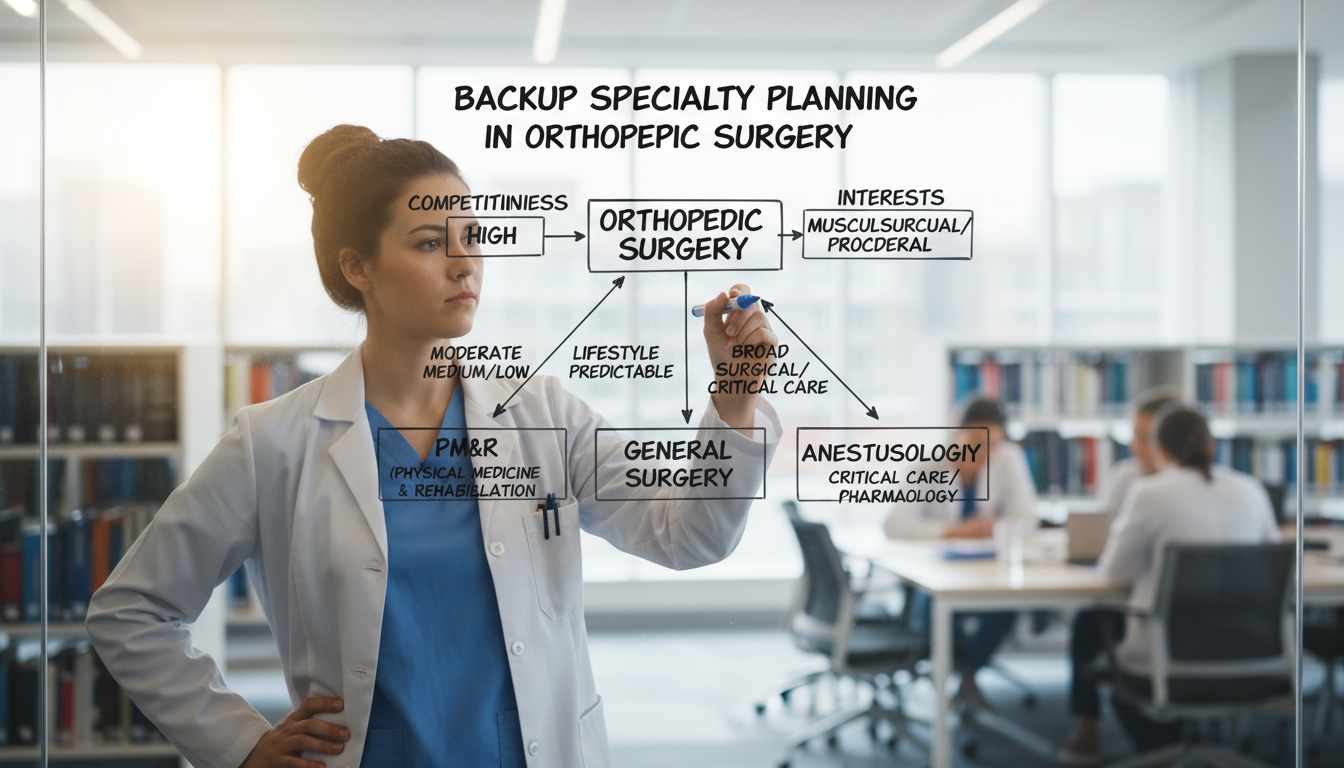
Principles of Smart Backup Specialty Planning
Backup planning is not simply “Pick another specialty just in case.” It requires strategic and introspective work.
Principle 1: Backup ≠ consolation prize
Your Plan B specialty should be something you can genuinely see yourself doing long term—not something you “could tolerate for a year” while you try again. Many people never reapply; many who do reapply do not ultimately match into ortho. You may end up in your backup specialty for your career.
Ask:
“If I never match orthopedic surgery, could I build a satisfying, meaningful career in this field?”
If the honest answer is “no,” keep looking.
Principle 2: Align with what you like about orthopedics
Clarify what draws you to orthopedic surgery:
- Using your hands / procedural work
- Anatomy and biomechanics
- Immediate functional impact (pain relief, mobility)
- Working with athletes / active patients
- Team-based care and OR environment
- Solving mechanical problems
Then explore backup specialties that preserve some of those same elements, for example:
- PM&R (Physical Medicine & Rehabilitation) – function, MSK, sports
- Anesthesiology – OR environment, procedures, acute care
- General surgery or subspecialties – operative focus, team-based care
- Emergency medicine – acute injuries, procedures, fast-paced
- Radiology (especially MSK) – anatomy-heavy, diagnostic focus
The closer the backup aligns with your core motivations, the more likely you’ll thrive if you end up in that field.
Principle 3: Consider realistic competitiveness (“orthopedics minus one notch” is still risky)
If you are a borderline candidate for orthopedic surgery residency, picking another extremely competitive field as your only backup (e.g., dermatology, plastic surgery, ENT) may not meaningfully reduce your risk.
Ask:
- How does the competitiveness of this backup specialty compare to ortho?
- How well does my current profile match typical applicants in that specialty?
- Do I have time to build a solid, credible application in that field this cycle?
You want a plan B specialty that you are both sincere about and realistically competitive for.
Principle 4: Develop a coherent narrative for each path
Programs can sense when a backup specialty is purely a fallback. To be credible:
- Understand the field deeply (rotations, mentors, reading)
- Articulate clear reasons you are drawn to it, independent of ortho
- Show some targeted experiences (clinic, research, electives) that match your stated interest
You do not need to pretend ortho was never your first love, but you must be able to present a positive, authentic narrative in either direction.
Common Backup and Plan B Specialties for Ortho Applicants
Below are commonly considered backup specialties among students pursuing an ortho match, with pros, cons, and key considerations.
1. Physical Medicine & Rehabilitation (PM&R)
PM&R is frequently chosen as a backup specialty by orthopedic applicants because of the shared focus on function, musculoskeletal medicine, and sports.
Why it appeals to ortho-minded students
- Deep involvement with MSK conditions, spine, and sports injuries
- Longitudinal care focused on function and quality of life
- Non-operative but highly impactful
- Team-based work with PT/OT, speech, and other rehab professionals
- Opportunities in sports medicine, pain, MSK ultrasound, EMG
Pros as a backup
- Often less competitive than orthopedic surgery residency (though it has become more competitive in many regions)
- Strong overlap in content with ortho: gait, biomechanics, MSK exam
- May leverage your existing ortho and sports-related research/experiences
Challenges
- Programs can quickly detect when PM&R is being treated as a “just in case” specialty
- Requires enough exposure (electives/mentors) to write a sincere personal statement and obtain letters
- Different lifestyle and clinical pace than ortho; you must genuinely be okay with non-surgical care
Best for applicants who:
- Enjoy MSK and neuro exam more than the OR itself
- Are drawn to rehab, disability, function, and quality-of-life outcomes
- Can see themselves as a non-surgical MSK or sports specialist long term
2. Anesthesiology
Anesthesiology is another common Plan B specialty for aspiring surgeons:
Overlap with ortho
- Work primarily in the OR
- Acute physiology, procedures (lines, airways, nerve blocks)
- High-stakes, team-based care
Pros
- Historically more accessible than ortho (though competitiveness is rising)
- Clear procedural focus, mix of cognitive and manual skills
- Regional anesthesia and pain medicine intersect with MSK and orthopedics
- Can often build on your existing OR experiences and letters from anesthesiologists or surgeons
Challenges
- Requires a convincing narrative on why anesthesia specifically, not just “I like the OR”
- Very different patient interaction pattern—often short-term, perioperative care rather than longitudinal
Best for applicants who:
- Like physiology, pharmacology, and acute care
- Enjoy the OR environment but are open to a non-surgical role
- Value procedural work and a shorter length of training relative to surgical subspecialties
3. General Surgery and Related Surgical Fields
Some ortho applicants consider general surgery or another surgical residency as their fallback.
Pros
- Maintains an operative career path
- Similar training environment: surgical wards, ICU, trauma, acute care
- For some, gen surg is actually a better match for their interests (e.g., abdominal, oncologic, or vascular surgery)
Challenges
- General surgery is itself a competitive specialty, especially in desirable locations
- Programs may worry that you see them as a second choice and might attempt to transfer after matching
- Surgical lifestyle and training demands can be even more intense than ortho in some institutions
Best for applicants who:
- Are certain they want a surgical career (even if not specifically ortho)
- Have strong performance in surgery clerkship and sub-internships
- Can honestly see themselves as a general or other non-ortho surgeon long-term
4. Emergency Medicine
Emergency medicine may attract ortho-oriented students who like acute care, procedures, and trauma.
Pros
- Broad exposure to trauma and acute MSK injuries
- Procedural opportunities (reductions, splinting, laceration repair, airway, lines)
- Shift-based schedule with potential for more predictable time off
Challenges
- Different identity: broad acute care vs. MSK specialization
- EM competitiveness varies significantly by region and year; trends have fluctuated
- Less continuity than ortho, which some applicants miss
Best for applicants who:
- Enjoy variety, critical decision-making, and acute presentations
- Value flexibility in schedule and practice settings
- Can let go of long-term follow-up and definitive operative care
5. Radiology (Especially MSK Radiology as a Long-Term Goal)
Radiology offers a distinctly different but still anatomy-driven path.
Pros
- Heavy emphasis on anatomy and imaging, including bone, joint, and sports injuries
- MSK radiology fellowship can keep you closely tied to orthopedic teams
- No direct procedural surgery, but interventional radiology is highly procedural
Challenges
- Different day-to-day: less direct patient interaction
- Requires strong imaging interest and comfort with long periods at a workstation
- Must demonstrate genuine interest in radiology rather than simply “I like looking at images in the OR”
Best for applicants who:
- Love anatomy and pattern recognition
- Are comfortable with a more diagnostic and consultative role
- Are open to limited patient continuity and interaction

Dual Applying Residency: Strategy, Timing, and Trade-Offs
Dual applying—submitting applications to both orthopedic surgery and a backup specialty in the same cycle—is increasingly common. It can be a wise strategy, but it comes with significant complexity.
When should you seriously consider dual applying?
You should strongly consider dual applying if:
- You have multiple risk factors for the ortho match (exam scores, no home program, late commitment, red flags), and
- You have identified a plan B specialty you can genuinely embrace, and
- You are willing to put in real work to build a credible application in both specialties
If you are relatively strong for ortho with only mild concerns, dual applying may dilute your efforts unnecessarily.
Core components of a dual-application strategy
Separate, authentic personal statements
- One clearly focused on orthopedic surgery
- One clearly focused on your backup specialty (PM&R, anesthesia, etc.)
- Avoid copy-pasting with superficial changes; each statement must stand on its own
Distinct letter portfolios
- Ortho: 3–4 letters from orthopedic surgeons who know you well
- Backup: 2–3 letters from faculty in that specialty (plus possibly one from a surgeon if justified)
- Use ERAS customization (where available) to assign letters appropriately
Strategic program list building
- Apply broadly in orthopedic surgery (most applicants already do)
- For the backup specialty, target a mix of academic and community programs, including some with historically higher match rates
- Be honest about your geographic flexibility in both specialties
Calendar management
- Track interview dates early; many cycles have significant overlap
- Prioritize interviews carefully if conflicts arise—skipping too many interviews in either specialty can send a negative signal
How to talk about dual applying without undermining yourself
You should not volunteer that you are dual applying during an interview unless directly asked. If asked, be honest but thoughtful:
- Emphasize that orthopedic surgery is your first choice (when speaking to ortho programs) or that you are fully committed to the field you’re interviewing in
- Frame backup planning as mature risk management, not indecision
- Example response to an ortho PD:
“Orthopedic surgery is what I’ve worked toward and where I see myself long-term. Given the competitiveness of the field and my personal risk factors, I also applied to a small number of PM&R programs. If I’m fortunate enough to match here, I would be fully committed to your program and to a career in orthopedics.”
Similarly, for backup specialty interviews:
- Highlight what you genuinely like about that field
- Avoid implying they’re merely your second choice; that will hurt your chances
Emotional and logistical costs of dual applying
- Time-intensive: two sets of applications, personal statements, letters, and interview prep
- Financial burden: additional ERAS fees, travel (if applicable), attire, etc.
- Emotional strain: managing mixed hopes and identities (future orthopedist vs. future PM&R physician, etc.)
Despite the costs, for many at-risk candidates, dual applying is the most rational way to balance ambition and security.
Building Your Backup Specialty Application Without Weakening Your Ortho Match
You need to strengthen your plan B specialty application while keeping your ortho candidacy as competitive as possible.
Step 1: Early honest discussion with mentors
Identify at least two people:
- An orthopedic mentor (faculty, PD, or senior resident)
- A neutral advisor (student affairs dean, advisor not tied to a single specialty)
With each, discuss:
- Your objective strengths and weaknesses
- Program director feedback (if any)
- Whether dual applying or choosing a backup specialty is advisable for you
Ask them to be candid; you are making career-shaping decisions.
Step 2: Strategic scheduling of rotations
Use your remaining fourth-year time to create a balanced schedule:
Ortho priorities
- At least one sub-I in orthopedics (preferably home or an away)
- Possibly one additional ortho rotation if you still need strong letters
Backup specialty exposure
- 1–2 rotations in your plan B specialty (e.g., PM&R inpatient, anesthesia, EM)
- Enough time for faculty to get to know you and write strong letters
Avoid stacking all ortho rotations at the expense of having zero credible exposure in your backup specialty.
Step 3: Targeted research and extracurricular alignment
You do not need to rebuild your CV entirely, but a few targeted additions help:
- Short, focused project in the backup specialty (case report, QI, retrospective review)
- Attendance at that specialty’s conferences or grand rounds
- Involvement in relevant student interest groups (if not too late)
Programs want to see more than a last-minute pivot; even small, genuine steps matter.
Step 4: Crafting your narratives for both specialties
When writing personal statements and preparing for interviews:
Ortho narrative:
- Emphasize your early and sustained exposure, OR experiences, mentorship, research
- Highlight concrete patient encounters that shaped your interest in orthopedic surgery
- Address (lightly) any weaknesses if relevant (e.g., what you learned from a test failure)
Backup specialty narrative:
- Focus on what is uniquely appealing about that field (not just what it shares with ortho)
- Use specific clinical examples from that specialty’s rotations
- Show that you understand typical career paths, practice settings, and the day-to-day work
Do not recycle the same story and simply change “orthopedic surgery” to “anesthesiology” or “PM&R”; that will sound hollow.
Practical Example Scenarios
Scenario 1: Mid-range applicant with strong clinical performance but average Step
- Step 2 CK: slightly below the recent ortho average
- Strong surgery clerkship honors, glowing clinical comments
- One home ortho rotation and one away rotation
- Minimal ortho research, no significant red flags
Plan
- Apply broadly in orthopedic surgery residency, prioritizing programs where your school has a track record
- Choose PM&R as a backup specialty due to love of MSK and function
- Do a PM&R rotation early in M4 to secure at least one strong letter
- Complete a small PM&R or MSK-related project or poster
- Dual apply with separate personal statements and customized letters
Scenario 2: High academic risk but very strong fit for patient care fields
- Step 2 CK: below average, plus a previous fail
- Excellent communication skills, strong patient feedback
- Enjoys procedures but less focused on the OR itself
Plan
- Have honest conversations about the realistic probability of an ortho match
- Consider whether to apply to ortho at all vs. focusing fully on a backup specialty
- If still deeply committed to ortho, dual apply with a very broad backup specialty list (e.g., EM or IM with a plan for sports med fellowship, or PM&R)
- Put substantial effort into the backup narrative and experiences, not just ortho
Scenario 3: Late switch to orthopedics in M4
- Initially interested in another specialty, few ortho experiences
- One late ortho sub-I with decent but not stellar letter potential
- Limited time left before ERAS deadlines
Plan
- Decide whether to push ahead with ortho this cycle or build a gap year with research/rotations and apply next year
- If applying this cycle, serious dual applying is almost mandatory
- Keep your previous field as potential backup if it still interests you (e.g., anesthesiology or EM)
- Quickly secure at least one ortho letter and one backup specialty letter
- Accept that your ortho application will be less competitive this year; consider a structured gap year if feasible
Final Thoughts: Balancing Ambition and Security
Backup specialty planning in orthopedic surgery is about disciplined hope: continue to pursue ortho with energy and purpose, while also recognizing that not everything is under your control.
Key takeaways:
- Orthopedic surgery residency is highly competitive; even strong applicants should think about risk.
- A plan B specialty should be a field you can happily build a career in, not just “something less competitive.”
- Dual applying residency can be a powerful strategy, but only if you build credible, authentic applications for both fields.
- Honest mentorship, early planning, and targeted exposure are critical.
- Protect your future self: create options that you would be proud to take, whether or not the ortho match works out.
FAQ: Backup Specialty Planning for the Ortho Match
1. If I dual apply, will orthopedic programs think I’m less committed and rank me lower?
Most programs will not know you are dual applying unless you tell them or your application clearly signals it (e.g., letters almost entirely from another specialty). Many PDs recognize that backup planning is rational given the competitiveness of orthopedic surgery. Focus on presenting a strong, coherent ortho narrative, with solid letters from orthopedic faculty. As long as your ortho application looks focused and genuine, dual applying quietly in the background usually does not hurt you.
2. What is the single best backup specialty for orthopedic surgery?
There is no universal “best” plan B specialty. PM&R is a very common backup due to its MSK and functional overlap, but anesthesiology, general surgery, EM, and radiology are also reasonable depending on your interests. The best backup is the one that:
- Shares key elements you love about ortho
- Matches your academic and application profile
- Feels like a field you could embrace long term if needed
3. Can I match ortho after starting a residency in my backup specialty?
Yes, some physicians successfully transition into orthopedic surgery after completing a preliminary year or even several years in another residency. However, this path is not guaranteed and can be difficult:
- You will need strong ortho rotations, letters, and often research during or between training years.
- Programs may be cautious about taking someone who is already in another residency.
- You may need to repeat some training years, with financial and personal implications.
If you enter your backup specialty, assume you might stay there and ensure it is a field you can live with long-term.
4. How many backup specialty programs should I apply to?
It depends on your risk profile and how confident you feel in your backup specialty application:
- Moderate-risk ortho applicant with a decent backup app: you might apply broadly in ortho (60–80+ programs, depending on guidance that year) and more selectively in your plan B specialty (e.g., 20–40 programs).
- High-risk applicant: you may want a truly broad backup list as well, mirroring the breadth of your ortho list.
Work with your advisor and review specialty-specific match data to tailor your numbers; requirements shift over time with changes in competitiveness and ERAS behavior.
Thoughtful backup specialty planning allows you to go all-in on your ortho match goals while still honoring your responsibility to your future career and personal life. Aim high—but plan wisely.