
Why Backup Specialty Planning Matters in Urology
Urology is consistently one of the most competitive specialties in the residency match. With a relatively small number of positions, early application timelines through the AUA (often before ERAS deadlines), and a national applicant pool that includes high-achieving MD, DO, and international graduates, even strong applicants may not match in urology on the first try.
Thoughtful backup specialty planning is therefore not a sign of weakness or lack of commitment—it is risk management. A well-designed Plan B allows you to:
- Maintain your progress toward a career in or related to urology
- Avoid being left unmatched and needing a full “re-applicant” cycle
- Reduce anxiety during interview season by knowing you have realistic alternatives
- Keep doors open for future fellowship or subspecialty options that still touch urology (e.g., urogynecology, interventional radiology, reconstructive surgery)
This guide will walk you through how to approach backup specialty planning for urology residency (often called “dual applying residency”), how to choose smart plan B specialties, and how to execute a strategy that is both ethical and effective.
Understanding Urology Match Competitiveness and Risk
The urology match landscape
Key features of the urology match that influence backup planning:
- Separate match system: The urology residency match is coordinated by the AUA and typically occurs earlier than the NRMP Main Match.
- Small specialty, limited spots: Compared with IM, FM, or general surgery, there are relatively few urology residency positions nationwide.
- High applicant quality: Applicants often have strong USMLE/COMLEX scores, significant research, and robust letters.
Even if you are a strong candidate, you are competing in a small market. The downside risk of going “all-in” on urology without a backup can be substantial: ending up unmatched after both the AUA match and the NRMP Supplemental Offer and Acceptance Program (SOAP), then needing to take a gap year, research year, or pursue a different path.
Who should seriously consider a backup specialty?
Nearly everyone applying in urology should at least think through a backup plan, but it’s especially important if:
- Your Step 2 CK / COMLEX Level 2 score is below the typical average for matched urology applicants
- You have limited urology-specific research or no publications
- Your clinical grades include multiple passes or fails, or no honors in surgery/medicine
- You have fewer urology away rotations than peers or no home program
- There are red flags: professionalism concerns, failed exams, significant academic delays
- You are an IMG or DO at a school with few alumni in urology or limited urology exposure
On the other hand, even highly competitive applicants often plan a backup specialty simply to guard against the unpredictability of the urology match and regional preferences.

Principles of Ethical and Effective Dual Applying in Urology
“Dual applying residency” means applying to urology and at least one other specialty in the same cycle. Doing this well requires clarity, honesty, and strategy.
Principle 1: Be honest with yourself about your goals
Before you choose a plan B specialty, define what you want most from your career:
- Is your non-negotiable that you must operate?
- Are you primarily drawn to longitudinal patient relationships?
- Do you want procedural work but not necessarily in the OR?
- Is urologic disease itself what interests you, or is it more the lifestyle/variety/technology of urology?
Your answers will help determine whether your backup specialty should be another surgical field, a procedural medicine field, or a broad medical specialty that keeps options open.
Principle 2: Respect both specialties
Programs and colleagues expect you to be transparent and professional. Dual applying becomes problematic when:
- You misrepresent your intentions (e.g., tell a backup specialty program they are your top and only choice while telling urology programs the same)
- You treat your backup as clearly “second-class” in interviews or statements
- You accept interviews in your backup specialty without any real willingness to train in that field
Ethical dual applying means you would genuinely be willing to match and practice in your Plan B specialty if urology doesn’t work out.
Principle 3: Protect your narrative coherence
Programs want to see a coherent story:
- Why you chose urology
- Why you are applying to a backup specialty (if it becomes known)
- How your skills and interests overlap in both interests
Your story should make sense even if someone reads both your urology personal statement and your backup specialty personal statement side by side.
Principle 4: Manage logistics early
Backup planning affects:
- Your fourth-year schedule (rotations, sub-Is)
- Letters of recommendation (from urology vs. backup specialty attendings)
- The content and timing of your personal statements
- Your budget and time for applications and interviews
Waiting until after the AUA rank list deadline or after the urology match results to think about a backup often leaves you with rushed, suboptimal options.
Choosing a Smart Plan B: Backup Specialty Options for Urology Applicants
When thinking through a backup specialty or Plan B specialty, consider overlap with urology in skills, patient population, and future flexibility.
1. General Surgery
Why it makes sense:
- Strong overlap in operative skills: endoscopy, laparoscopy, major abdominal and pelvic operations
- Similar team-based OR environment and acute care exposure
- After general surgery, you could pursue fellowships in colorectal, surgical oncology, vascular, transplant, etc.—not urology, but still high-level surgery
Ideal for applicants who:
- Primarily love surgery itself—the OR, anatomy, procedural problem-solving
- Enjoy trauma, acute care, ICU exposure, and high-intensity settings
- Are geographically flexible, since many general surgery spots are available nationwide
Considerations:
- General surgery has its own competitive tiers (university/academic programs vs. community programs)
- Lifestyle in training is intense; burnout and attrition are not negligible
- You’ll need at least 1–2 months of surgery-sub-I’s that are clearly general surgery–oriented, not just urology
2. Internal Medicine (with a procedural or subspecialty angle)
Why it makes sense:
- Broad training with potential for future subspecialty that touches urologic patients (e.g., nephrology, oncology, palliative care, critical care)
- Large number of positions and wide range of program competitiveness
- Potential to maintain a procedural focus through subspecialties (e.g., nephrology procedures, interventional cardiology, gastroenterology)
Ideal for applicants who:
- Are open to a career that is more cognitive and longitudinal
- Value versatility and the ability to pivot to multiple fellowships
- Still want contact with complex, multi-morbid patients, often including those with urologic comorbidities
Considerations:
- Less OR time; procedures vary by subspecialty
- You’ll need strong IM letters and ideally an IM sub-I
- Your narrative should emphasize love for complex internal medicine, not just “I like urology but needed a backup”
3. Obstetrics & Gynecology (with possible urogynecology)
Why it makes sense:
- Overlap in pelvic anatomy and surgery, including incontinence, pelvic organ prolapse, and reconstructive procedures
- Urogynecology / Female Pelvic Medicine and Reconstructive Surgery fellowship can align closely with some urologic interests
- A mix of clinic, OR, and procedures that parallels urology’s variety
Ideal for applicants who:
- Enjoy women’s health, reproductive health, and obstetric care
- Are interested in pelvic floor disorders, incontinence, and pelvic reconstruction
- Value both surgical and clinic-based practice
Considerations:
- Must genuinely be comfortable with obstetrics, prenatal care, and deliveries
- Demands a strong commitment to women’s health as a core identity, not just a “partial overlap” with urology
- Requires at least one Ob/Gyn sub-I and supportive letters from Ob/Gyn faculty
4. Diagnostic or Interventional Radiology
Why it makes sense (particularly interventional radiology):
- You can remain heavily procedural, performing image-guided interventions
- Urologic disease often interfaces with IR (e.g., nephrostomy tubes, embolization, percutaneous interventions)
- Strong overlap with technology, imaging, and minimally invasive techniques that urology applicants often enjoy
Ideal for applicants who:
- Love anatomy and imaging
- Appreciate procedural work but don’t require the traditional OR environment
- Are drawn to shorter procedures and wide anatomic variety
Considerations:
- DR/IR have their own competitive dynamics; IR in particular can be competitive
- Requires early radiology exposure and letters if possible
- Daily work style and patient interaction pattern differ from urology—ensure you understand that shift
5. Anesthesiology
Why it makes sense:
- Procedural, physiology-driven specialty with heavy OR exposure
- Constant interaction with surgical teams, including urologists
- Many positions, with a range from community to academic programs
Ideal for applicants who:
- Love applied physiology and pharmacology
- Enjoy technical tasks (lines, airways, regional blocks)
- Are comfortable with high-stakes, acute care situations
Considerations:
- Less longitudinal follow-up with patients
- Your narrative should center on love for OR environment and perioperative medicine, not only as a fallback
6. Other potential plan B specialties
Depending on your personality and priorities, additional options may include:
- Emergency Medicine – acute care, procedures, shift work, but limited longitudinal continuity
- Family Medicine – broad scope, potential for procedures and men’s health focus, but far from urology in daily practice
- Pathology – if your main passion is disease processes and histology rather than direct patient contact
These are less directly aligned with urology but may still be a good fit for particular applicants.
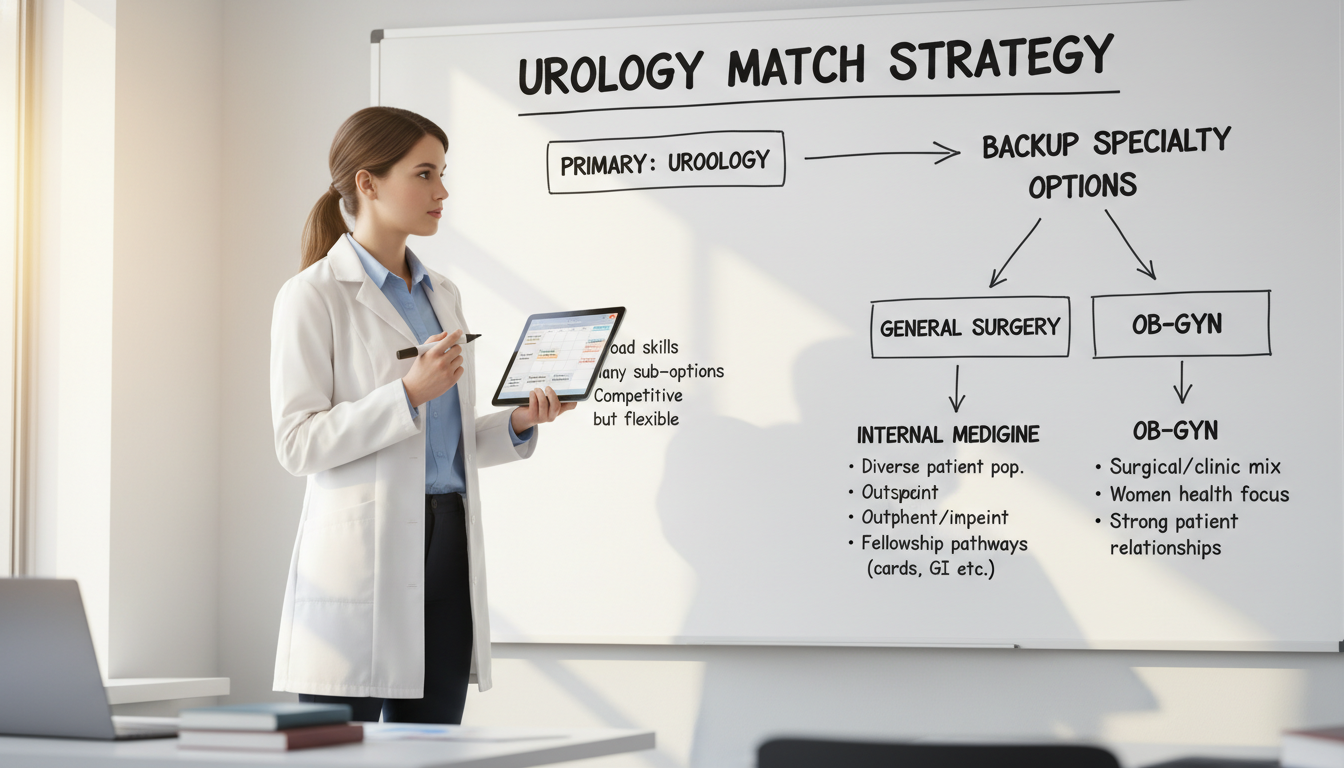
Building Your Backup Specialty Strategy: Step-by-Step
Step 1: Assess your urology competitiveness honestly
Look at your application on paper:
- Exam scores: Step/COMLEX relative to national urology means
- Clerkship performance: Honors in surgery/medicine; performance evals
- Clinical urology exposure: Home rotation, away rotations, letters
- Research: Urology projects, presentations, publications
- Geographic flexibility: Willingness to move anywhere vs. strong preferences
Talk with:
- Your urology advisors or program director
- A student affairs dean who sees multi-specialty outcomes
- Residents who recently went through the urology match
Ask for a realistic assessment, not just reassurance.
Step 2: Decide the type of backup you want
Three common approaches:
Highly aligned surgical backup (e.g., general surgery, Ob/Gyn, IR)
- Pros: Maintains surgical identity; significant overlap with urology skills
- Cons: May still be quite competitive; intense lifestyle
More secure, broader backup (e.g., internal medicine, family medicine)
- Pros: Higher probability of matching; flexible long-term options
- Cons: Less directly related to urology; identity shift
Research year + reapply strategy (sometimes combined with a backup)
- Pros: Strengthens urology application specifically
- Cons: Financial/temporal cost; no guarantee of matching the second time
You can also combine strategies: apply primarily in urology, have a limited but targeted backup specialty application list, and consider a research year only if completely unmatched.
Step 3: Plan your 4th-year schedule
You need to cover:
Urology needs
- Home urology sub-I
- 1–2 away rotations (if possible) at programs you’re interested in
- Time for urology interviews (AUA timeline)
Backup specialty needs
- At least one dedicated sub-I in your backup field
- Time to form relationships and obtain strong letters
- Space in your calendar for interviews during core interview season
Example schedule for a student dual applying in urology + general surgery:
- July–August: Home urology sub-I
- September: Urology away rotation #1
- October: General surgery sub-I (backup specialty)
- November: Urology away #2 or research/urology elective
- December–January: Flex time for urology and surgery interviews, possibly additional elective
Adjust this according to your school’s calendar and AUA match dates for your year.
Step 4: Secure letters of recommendation
Letters should align with what each specialty expects:
Urology residency application
- 2–3 letters from urologists (home faculty, away rotations, division chiefs if possible)
- 1 general surgery or core clerkship letter (optional but can be helpful)
Backup specialty application
- 2–3 letters from faculty in backup specialty (attendings from sub-I or key rotations)
- 1 general or core letter if that’s customary in that field
Be transparent but tactful with letter writers. For example:
“I’m applying primarily to urology but, given the competitiveness, I’m also submitting a limited number of applications in general surgery as a backup. I value your honest support in whichever way you feel comfortable.”
Most faculty understand the realities of the match and will support you if your request is professional and clear.
Step 5: Craft specialty-specific personal statements
You need distinct personal statements for urology residency and your backup specialty:
- Urology personal statement
- Center on your urologic experiences, motivations, and long-term vision
- You generally do not need to mention a backup specialty here
- Backup specialty personal statement
- Must stand alone as a convincing explanation of your interest in that field
- Avoid framing it as “I didn’t match urology, so I’m here”
- Emphasize genuine aspects you like: patient population, procedures, disease types, lifestyle, career flexibility
If asked directly in a backup specialty interview whether you are also applying in urology, answer honestly but thoughtfully. Example:
“Yes, I applied in urology as well. I love operative care and complex genitourinary disease. That said, I’ve also really enjoyed my experiences in general surgery and could see myself having a fulfilling career here, especially in [specific area], which is why I’m earnestly exploring both paths this cycle.”
Step 6: Build a realistic application list
For urology residency:
- Include a range of programs: academic, community, mid-tier, geographically diverse
- Work closely with mentors to build a list that matches your competitiveness
For backup specialty:
- Aim for a list that gives you a meaningful chance of matching if urology doesn’t work out
- Avoid applying only to hyper-competitive programs in your backup specialty
- Consider your geographic flexibility; more flexibility generally increases match probability
Your backup specialty list doesn’t need to be as large as a primary applicant’s list in that field, but it should not be tokenistic (e.g., 3–4 applications) if you truly want a safety net.
Step 7: Navigate interview season
You’ll need to:
- Track urology and backup specialty interviews separately
- Prioritize urology interviews when conflicts arise, if it remains your first choice
- Be careful not to overschedule to the point of burnout—quality of interviews matters
If asked directly about dual applying:
- In urology interviews, you can acknowledge the competitiveness of the urology match and that your school encourages having a backup specialty, but keep your clear commitment to urology front and center.
- In backup specialty interviews, acknowledge your urology interest without devaluing the other field.
After the Urology Match: Interpreting Outcomes and Next Steps
Because the urology match results come earlier than the NRMP Main Match, you’ll have some decisions to make depending on your outcome.
Scenario 1: You match in urology
Congratulations—your backup specialty planning did its job as a safety net. Next steps:
- Withdraw from your backup specialty applications in a timely and professional manner
- Send short, appreciative notes to mentors in both urology and your backup specialty
- Be gracious; do not publicize any negative comments about your backup field
Scenario 2: You don’t match urology but have ongoing backup specialty applications
At this point, your backup specialty becomes your main path for this cycle.
- Let your backup specialty mentors know your outcome and confirm your continued interest
- Focus your energy on preparing for and ranking backup specialty programs
- Reflect on what you learned from the urology process for future professional growth
If you match in your backup specialty in the NRMP Main Match, you then face a personal decision:
- Commit to this path and build a rewarding career in that field
- Or, in rare cases and with great caution, consider whether to re-approach urology later (e.g., through fellowship-related pathways or rare transfers). This is uncommon and complex; most applicants who match into a backup specialty appropriately commit to it.
Scenario 3: You don’t match in either urology or your backup specialty
This is difficult but not uncommon, especially for applicants with significant academic or visa-related challenges.
Options include:
- Research year in urology or your backup specialty
- Pursuing a preliminary surgical year if available and beneficial to your long-term plan
- Working with your school’s dean’s office to plan a stronger reapplication strategy
- Considering whether your long-term fit might be better in another, less competitive specialty
A thoughtful reassessment with mentors is essential here. Many successful physicians did not match on their first attempt and still built fulfilling careers through persistence and flexibility.
FAQs: Backup Specialty Planning in Urology
1. Do urology programs look down on applicants who have a backup specialty?
Most urology programs understand that the urology match is highly competitive and that students are encouraged to have a backup plan. What they may look down on is:
- Perceived lack of commitment to urology
- Dishonesty or evasiveness if directly asked about dual applying
If your application and interview clearly demonstrate robust engagement with urology (rotations, research, letters, thoughtful narrative), having a backup specialty itself is not usually a negative.
2. How many backup specialty programs should I apply to?
There’s no single number, but a common approach:
If you are moderately competitive for urology:
- Apply broadly in urology
- Apply to a moderate number of backup specialty programs (e.g., 20–40), balanced by geographic flexibility and your risk tolerance
If you’re highly competitive in urology (strong scores, research, glowing letters, home program support):
- You might apply to fewer backup programs (e.g., 10–20) or even skip dual applying, but this should be a joint decision with mentors.
If you’re borderline or have red flags:
- Your backup list may need to be larger and more diverse to ensure a realistic safety net.
3. Should I tell my backup specialty programs that I’m applying in urology?
If asked directly, yes—be honest. Many interviewers won’t ask, but if they do, they’re usually trying to understand your commitment and reasoning. You can frame it positively:
“Given the competitiveness of the urology match, my school strongly recommended a backup. My experiences in [backup specialty] have been very positive, and I would be happy to train in this field if that’s where I match.”
Volunteering this information unprompted on every application is not necessary, but you should never lie if it comes up.
4. Can I still end up doing “urology-like” work if I match only into my backup specialty?
Often, yes—depending on your backup specialty and your interests:
- Ob/Gyn → Urogynecology/FPMRS fellowship
- Internal Medicine → Nephrology, Oncology, Palliative Care, Hospital Medicine with a genitourinary focus
- IR → Image-guided interventions for renal and pelvic disease
- General Surgery → Complex abdominal, colorectal, or pelvic surgery
While you won’t be a urologist without urology residency training, you can still work closely with urology patients or in overlapping anatomic areas, blending your early interests with your final specialty.
Backup specialty planning in urology is about balancing ambition with realism. By understanding the dynamics of the urology match, choosing a thoughtful Plan B specialty, and executing an honest dual applying strategy, you can protect your future while still giving yourself the best possible chance to match into urology—or into a career that’s genuinely right for you.