Why Backup Specialty Planning Matters for a US Citizen IMG in Orthopedic Surgery
If you’re an American studying abroad with your heart set on orthopedic surgery, you already know you’re aiming for one of the most competitive residencies. As a US citizen IMG, you’re in a stronger position than non‑US IMGs, but ortho is still a high‑risk target: limited spots, program bias toward US MD seniors, and heavily Step‑score‑driven screening.
Backup specialty planning is not about “giving up” your ortho dream. It’s a strategic way to:
- Protect yourself from going unmatched
- Keep doors open to musculoskeletal or procedure‑heavy careers
- Maintain long‑term satisfaction and avoid feeling “stuck” in a field you hate
- Preserve options to re‑apply to ortho in the future if that remains your goal
This article walks you through a structured, honest approach to backup specialty planning specifically tailored to US citizen IMGs targeting orthopedic surgery.
Understanding Your Ortho Competitiveness as a US Citizen IMG
Before you can design a smart Plan B, you need a clear, unemotional assessment of your Plan A.
Key Ortho Competitiveness Factors
Residency programs in orthopedic surgery heavily weigh:
USMLE scores (especially Step 2 CK)
- Competitive applicants often have scores significantly above the national mean.
- Many programs use strict cutoffs; lower scores can quietly remove you from consideration.
Orthopedic‑specific experiences
- Ortho research (posters, publications, ongoing projects)
- Sub‑internships/away rotations in orthopedics
- Strong, personalized letters from orthopedic surgeons
Clinical performance
- Honors in surgery and medicine clerkships
- Evidence of technical aptitude and strong work ethic during rotations
IMG status and school reputation
- As a US citizen IMG, you usually fare better than non‑US IMGs, but:
- Many ortho programs still strongly prefer US MD seniors
- Limited spots may go to internal candidates or those from known feeder schools
- As a US citizen IMG, you usually fare better than non‑US IMGs, but:
Networking and advocacy
- Faculty actively calling program directors on your behalf
- Connections through research groups, conferences, or home institution affiliations
Honest Self‑Audit: Should You Dual Apply?
Create a simple rubric to grade your ortho application:
- Step 2 CK ≥ 245–250: Strong advantage for ortho; below that, you may be more borderline, especially as an IMG.
- 1+ meaningful ortho research projects or publications: Check.
- At least two US‑based ortho away rotations with strong feedback: Check.
- 2–3 personalized LORs from orthopedic surgeons who know you well: Check.
- Strong narrative tying your story to orthopedics (sports, rehab, biomechanics, etc.): Check.
If you are missing more than one of these major elements, or your scores are average or below average, you should seriously consider dual applying to residency with a viable backup specialty.
Dual applying is common among competitive‑field applicants—especially from IMG backgrounds. It is not a sign of weakness; it’s professional risk management.
Principles of Choosing a Backup (Plan B) Specialty
The right backup specialty for an orthopedic surgery hopeful is not just “whatever is easier to match.” It should be:
Realistically more attainable than ortho
- Lower average Step cutoffs
- Higher proportion of IMG‑friendly programs
- Less dominated by home‑program applicants
Aligned with your true interests and strengths
- Are you drawn to procedures and the OR?
- Do you enjoy acute care, chronic longitudinal care, or both?
- Are you comfortable managing medically complex inpatients?
Compatible with your application materials and clinical story
- Can your personal statement, letters, and experiences be reframed for the backup field?
- Or will you appear disjointed and unfocused?
Sustainable as a career if you never get into ortho
- You must be able to picture yourself doing this specialty long‑term without resentment.
- This is crucial. A “backup” that you secretly hate can lead to burnout and regret.
Potentially related to musculoskeletal care (if important to you)
- Not mandatory, but helpful if you want to stay close to your interests:
- PM&R (Physical Medicine & Rehabilitation)
- Sports Medicine pathways
- Interventional Pain (future fellowship options)
- Not mandatory, but helpful if you want to stay close to your interests:
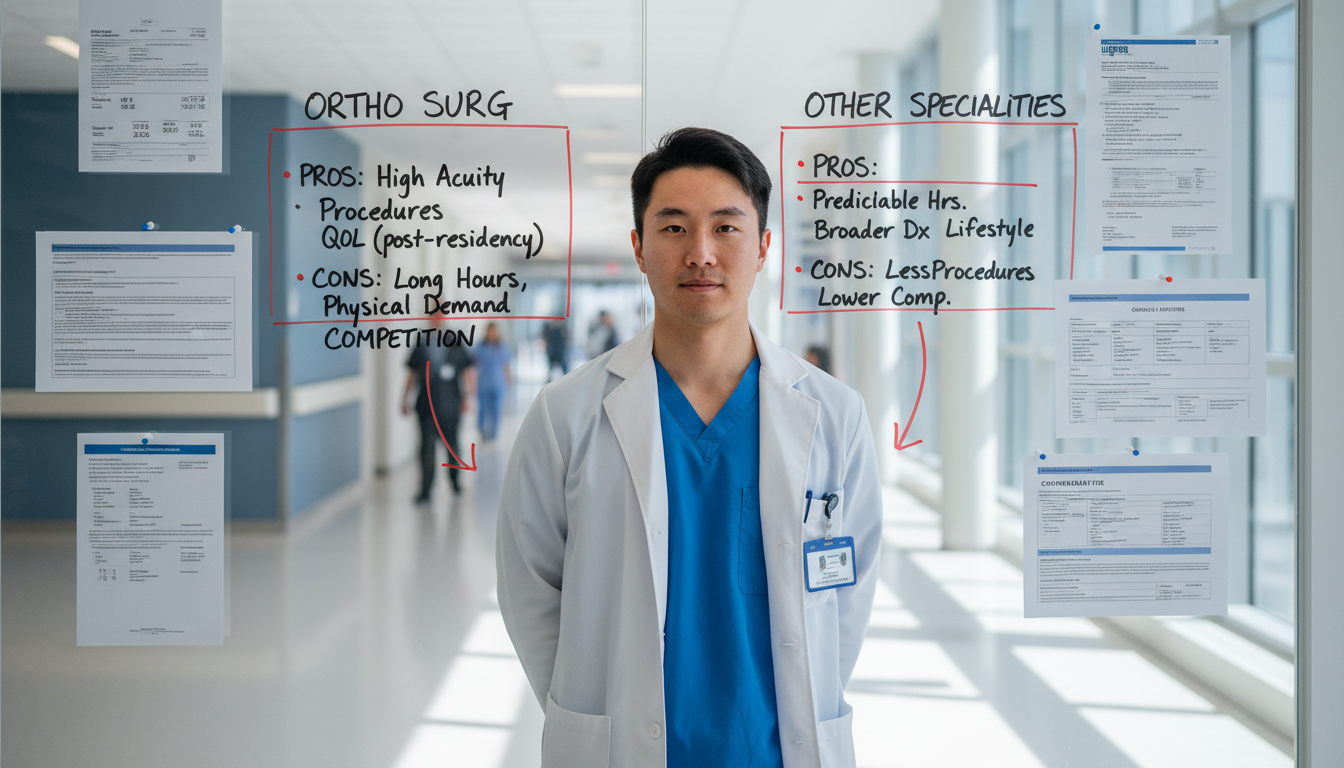
Common Backup Specialties for Ortho‑Bound Applicants
For a US citizen IMG in orthopedic surgery, these are some frequently considered backups:
- General Surgery
- Pros: OR‑heavy, procedural, familiar culture; some overlap with ortho.
- Cons: Still competitive, grueling; no guarantee you can later switch to ortho; some programs are not IMG‑friendly.
- PM&R (Physical Medicine & Rehabilitation)
- Pros: Strong musculoskeletal focus; common for sports/ortho‑interested applicants; some IMG‑friendly programs.
- Cons: Becoming more competitive; fewer total spots than IM/FM.
- Internal Medicine (IM)
- Pros: Broad, flexible; many IMGs match; multiple musculoskeletal‑adjacent fellowships (rheumatology, pain, sports via non‑ACGME routes).
- Cons: Less procedural by default; outpatient MSK focus requires extra effort.
- Family Medicine (FM)
- Pros: Highly IMG‑friendly; sports medicine fellowships commonly filled by FM grads.
- Cons: Heavier emphasis on primary care/systems‑based practice; less acute OR time.
- Emergency Medicine (EM) (varies by cycle)
- Pros: Procedure‑heavy, fast‑paced; good MSK exposure, reductions, acute injuries.
- Cons: Volatile job market; competitiveness fluctuates; some areas with limited IMG spots.
This doesn’t mean you must pick from this list, but these specialties often work logistically and narratively for ortho applicants.
Designing a Dual‑Application Strategy: Orthopedic Surgery + Backup
1. Decide Early Whether You Will Dual Apply
You need to decide no later than mid‑summer before ERAS submission (earlier is better). Why?
- You’ll need appropriate letters of recommendation for both fields.
- Your personal statements must be tailored.
- Your away rotations and electives may need adjusting.
- You may want to change your research focus if time allows.
If your Step 2 CK is significantly below typical ortho averages or if your school has limited ortho exposure, you should seriously consider dual applying even earlier.
2. Build a Narrative That Works for Both Fields
Your story should allow you to:
- Sound fully committed to orthopedic surgery when speaking to ortho programs
- Sound genuinely interested and appropriate for your backup specialty when speaking to that field
You do not need to (and should not) tell programs you are dual applying.
Example framing:
For ortho:
“I am driven by restoring function and mobility for patients through surgical solutions. My experiences assist in the operating room and my research in fracture outcomes have shown me how much we can change patients’ lives in a single procedure…”For PM&R (as backup specialty):
“I am driven by restoring function and mobility for patients through comprehensive, multidisciplinary care. My experiences working with post‑operative and injured patients have highlighted the importance of rehabilitation, not just surgery, in helping people return to independence…”
Notice how the core motivation (restoring function) stays the same, but the focus shifts appropriately.
3. Separate, Targeted Personal Statements
Prepare:
- 1–2 versions for ortho (e.g., a “generic ortho” and, optionally, a “research‑heavy ortho” statement)
- 1 for your Plan B specialty
Key tips:
- Do not mention your backup specialty in your ortho statement (or vice versa).
- Keep each statement consistent with the LORs and experiences visible in that application.
4. Letter of Recommendation Strategy
For an ortho + backup application, aim for:
Orthopedic Surgery application
- 3–4 letters, mostly from orthopedic surgeons
- At least one from a US ortho faculty member
- Optional: a strong surgery or research mentor letter if it highlights work ethic and technical skill
Backup specialty application
- 2–3 letters from attendings in that specialty (IM, FM, PM&R, etc.)
- 1 strong letter from a surgeon or ortho mentor can still be helpful if it emphasizes general clinical excellence, teamwork, and commitment—but avoid making the letter sound like you’re “only about ortho.”
Use ERAS to assign letters selectively to programs and specialties. Do not accidentally send a “this student is destined to be an orthopedic surgeon” letter to your PM&R or IM programs.
5. Application Volume and Program Selection
For a US citizen IMG dual‑applying to orthopedic surgery and a backup specialty:
Orthopedic Surgery
- Apply broadly: often 60–80+ programs, focusing on IMG‑friendlier programs and places where your school or mentors have connections.
- Target community‑based and university‑affiliated community programs in addition to big academic centers.
Backup Specialty
- Number depends on field:
- PM&R: often 40–60 programs.
- IM or FM: depends on your scores and region preferences, but many IMGs apply to 80+ if uncertain.
- Use filters:
- Programs with a history of accepting IMGs.
- Locations where you can realistically see yourself living for 3+ years.
- Number depends on field:
Build a spreadsheet including:
Program name, specialty, IMG‑friendliness, visa policies (for non‑citizens; still useful info), alumni matches, and any personal contacts.

Interview Season: Managing Dual Identity Without Losing Credibility
1. How to Present Yourself to Ortho Programs
On orthopedic surgery interviews, you are a single‑track ortho applicant in how you present yourself:
- Emphasize:
- Passion for orthopedics
- Comfort with OR lifestyle and long hours
- Long‑term commitment to the field
- You do not need to volunteer that you are dual applying.
- If directly asked “Are you applying to other specialties?”:
- Answers vary; many applicants say they focused primarily on ortho but also kept options open.
- If you disclose, keep it concise and emphasize that ortho is your top choice.
Example answer:
“I’m very committed to a career centered on musculoskeletal medicine and surgery, and orthopedic surgery is my clear top choice. Given how competitive the field is, I did apply to a small number of related programs where I could still focus on function and mobility, but I would be fully committed if given the opportunity to train here in orthopedics.”
2. How to Present Yourself to Backup Specialty Programs
When interviewing in your Plan B specialty, you must be as genuine and committed as any single‑track applicant:
- Avoid language that makes you sound like you “settled” or view this as second‑tier.
- Highlight aspects you truly appreciate:
- For PM&R: multidisciplinary rehab, function‑focused care, non‑operative sports medicine.
- For IM/FM: whole‑patient care, longitudinal relationships, complex diagnostics.
If asked “Are you applying to orthopedic surgery?”:
- You can be honest but forward‑looking:
- “Earlier in my clinical training I was strongly interested in musculoskeletal surgery, and I did explore orthopedic surgery. Through those experiences, I realized I’m more drawn to the comprehensive, long‑term functional care that your specialty provides. That’s why my focus in this application cycle is on finding a strong [PM&R/IM/FM] program where I can build that foundation.”
3. Ranking Strategy in the NRMP
The NRMP algorithm is applicant‑favorable. You should:
- Rank programs in the true order of where you would most like to train, regardless of specialty.
- If you have any ortho program where you’d rather do that than your top backup program, place it higher.
- Then list your backup specialty programs in descending order of preference.
Never rank a program (ortho or backup) you cannot see yourself attending; you may match there.
Long‑Term Planning: If You Don’t Match Ortho (This Cycle or Ever)
As a US citizen IMG, you may face several possible outcomes:
Match into orthopedic surgery
- Backup planning served as insurance but may not be needed.
- Still, the reflection you did can help you confirm this is the right path.
Match into your backup specialty
- You now have a stable residency position.
- You can:
- Commit fully and build a satisfying career, or
- Consider future transitions (though these are rare and complex).
Go unmatched in both ortho and your backup specialty
- You’ll need an immediate SOAP strategy and a long‑term plan.
If You Match Your Backup Specialty
To avoid long‑term regret:
- Give yourself 6–12 months of full commitment to the training you start.
- Seek MSK‑related electives early:
- In IM/FM: sports medicine, rheumatology, PM&R consults.
- In PM&R: sports, pain, spine, or limb loss clinics.
- Consider how you can:
- Pursue sports medicine fellowships (commonly through FM, IM, EM, or PM&R).
- Focus on MSK and disability medicine if you miss orthopedics.
Switching from a backup specialty into ortho residency is rare, especially for IMGs, but not impossible in unique circumstances. If this is truly important to you:
- Excel in your current program; be a top resident.
- Maintain some involvement in musculoskeletal research.
- Keep in touch with ortho mentors, but avoid appearing disengaged from your current specialty.
If You Go Unmatched
If your ortho match or ortho + backup attempt is unsuccessful:
Engage SOAP strategically
- Focus on categorical positions that keep doors open (IM, FM, transitional year, prelim surgery).
- Ask mentors which SOAP options best fit your long‑term musculoskeletal or procedure‑oriented goals.
Post‑Match Gap Year (if you choose not to SOAP/cannot secure a position)
- Consider:
- Dedicated research in orthopedics or your Plan B specialty.
- Observerships or externships in the US.
- Strengthening Step scores if you have not yet taken Step 3.
- Clarify whether you will:
- Re‑apply to ortho alone,
- Re‑apply as dual ortho + backup, or
- Pivot to a backup specialty only.
- Consider:
Re‑Evaluating Your Risk Tolerance
- After one unsuccessful ortho cycle, especially as an IMG, you must be realistic:
- Are you willing to risk another year without a residency?
- Would you be satisfied building a long‑term career in your backup specialty?
- After one unsuccessful ortho cycle, especially as an IMG, you must be realistic:
Having a thoughtful Plan B specialty makes these decisions less emotionally devastating because you have already thought through credible alternatives.
Practical Step‑by‑Step Plan for a US Citizen IMG Ortho Applicant
Here’s a tangible timeline and task list to guide your backup specialty planning:
12–18 Months Before ERAS Submission
- Clarify: Is orthopedic surgery definitely your top choice?
- Start/continue ortho‑related research.
- Arrange surgical rotations, especially orthopedic electives/aways, if available.
- Begin exploring potential Plan B specialties; talk to residents and attendings.
9–12 Months Before ERAS
- Obtain an honest assessment from:
- Ortho faculty who know you
- Your dean’s or academic advising office
- Consider:
- Do your scores, evaluations, and experiences support an ortho‑only approach?
- Or is dual applying to residency a safer, smarter move?
6–9 Months Before ERAS
- Decide firmly whether to dual apply.
- If yes:
- Schedule electives or rotations in your backup specialty.
- Identify potential letter writers in that field.
- Adjust your research and extracurriculars if time allows.
3–6 Months Before ERAS
- Draft:
- Ortho personal statement(s)
- Backup specialty personal statement
- Confirm:
- You will have at least 2–3 orthopedics letters
- You will have at least 2 letters from your backup specialty
- Start building your program list for both specialties, focusing on IMG‑friendly options.
0–3 Months Before ERAS Submission
- Finalize:
- ERAS entries, experiences, and publication list.
- Letters assigned correctly to each program type.
- Personal statements matched to the right programs.
- Have mentors review:
- Ortho application packet
- Backup specialty application packet
During Interview Season
- Keep a log of impressions for each program across both specialties.
- Prepare for:
- Ortho‑specific technical/behavioral questions
- Backup specialty‑specific questions about fit and motivation
- Protect your mental health:
- Dual applying can be emotionally and logistically exhausting.
Ranking and Post‑Match
- Build your rank order list strictly by where you’d most want to train, across both specialties.
- After Match Day:
- If matched: commit fully to your program.
- If unmatched: debrief with mentors and map out your next concrete steps.
FAQs: Backup Specialty Planning for Ortho‑Bound US Citizen IMGs
1. As a US citizen IMG, do I really need a backup specialty for orthopedic surgery residency?
You don’t have to, but it’s usually wise unless you are an exceptionally strong applicant (very high scores, significant ortho research, strong US rotations, influential letters). Ortho is hyper‑competitive, and US citizen IMGs—while better positioned than non‑US IMGs—are still at a disadvantage compared to US MD seniors. A thought‑out plan B specialty reduces the risk of going unmatched and gives you credible, fulfilling alternatives.
2. What is the best backup specialty for an American studying abroad who wants ortho?
There is no universally “best” backup, but PM&R and Family Medicine with an eye toward Sports Medicine are common choices for musculoskeletal‑oriented applicants. Internal Medicine is also a strong option due to broad opportunities and IMGs’ track record of matching. The key is picking a backup specialty that you could see yourself practicing long‑term, not just something “easier.”
3. Will dual applying hurt my chances in the ortho match?
Not if you structure it correctly. Programs generally only see the application you send to them. As long as your ortho personal statement, letters, and experiences convincingly support your interest in orthopedic surgery, they will evaluate you on that basis. Problems arise if:
- Your application to ortho looks half‑hearted or unfocused, or
- Letters intended for a backup field end up in your ortho file.
Careful planning and clear separation of materials allow you to dual apply without undermining your ortho candidacy.
4. If I match into my backup specialty, can I still switch to orthopedic surgery later?
Switching from a backup specialty into orthopedic surgery is possible but uncommon, especially as an IMG. It typically requires:
- Outstanding performance in your current residency
- Strong advocacy from ortho faculty
- An open ortho position (often from attrition) and program willingness to take a transfer
Because these situations are rare, you should choose a backup that you’d be genuinely comfortable doing if you never switch. Think of it as another primary pathway to a satisfying career, not just a temporary holding place.
Thoughtful backup specialty planning doesn’t weaken your ortho dream—it strengthens your overall career resilience. As a US citizen IMG, approaching the ortho match with a realistic, structured Plan A and Plan B gives you the best chance of ending up in a specialty and training environment where you can thrive.