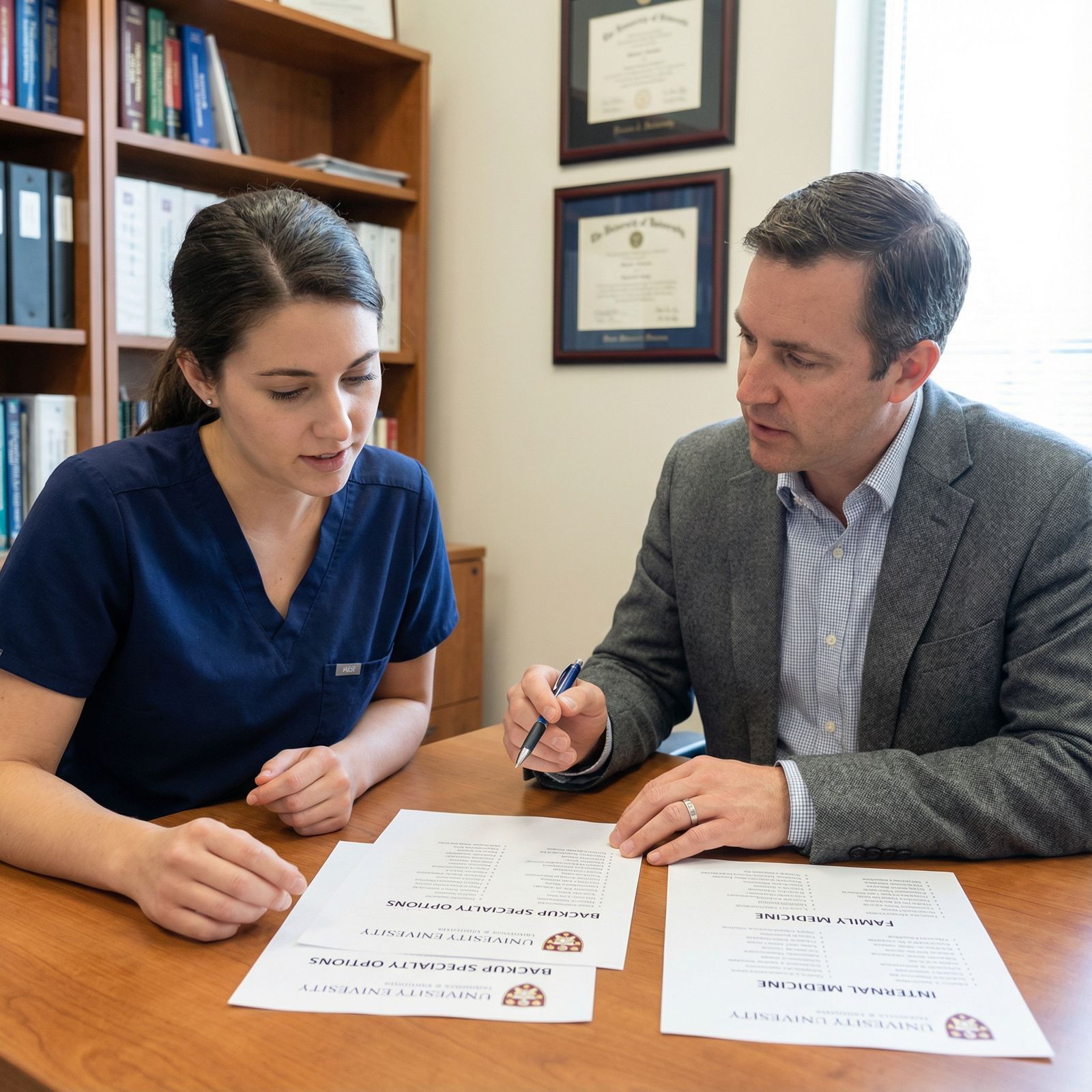
Why Backup Specialty Planning Matters for US Citizen IMGs
As a US citizen IMG (American studying abroad), you live in a unique and often precarious spot in the residency world. You carry the advantages of US citizenship—but you also face the statistical challenges that come with being an international medical graduate. This combination makes backup specialty planning not just smart, but essential.
You might be aiming for a competitive field—Dermatology, Orthopedics, ENT, Radiology, Anesthesiology, EM, or even competitive community Internal Medicine or Pediatrics programs in popular urban locations. The reality is:
- US citizen IMGs match less frequently than US MD/DO seniors in competitive specialties.
- Even solid applicants can miss the match due to factors beyond their control (visa-free does help, but doesn’t override program bias or volume).
- Many US citizen IMGs underestimate risk and do not build a deliberate Plan B until it’s too late.
This article will walk you through how to pick backup specialties, whether and how to dual apply, and how to protect your long-term career goals while still maximizing your chances of matching somewhere.
Keywords like US citizen IMG, American studying abroad, backup specialty, dual applying residency, and plan B specialty will be woven into practical strategies you can act on right now.
Step 1: Understand Your Risk Profile as a US Citizen IMG
Before choosing a backup specialty, you need to assess your actual risk of not matching into your primary choice. That requires a brutally honest look at your application.
Key Factors That Influence Your Risk
USMLE/COMLEX Scores
- Step 2 CK is now the major numeric screen.
- Scores below common program cutoffs (e.g., < 230–235) significantly reduce interviews for competitive specialties.
- Multiple failures or attempts heighten the need for a robust Plan B specialty.
Medical School Reputation and Support
- Some Caribbean or international schools are well-known to US programs; others are not.
- Strong, US-based clinical rotations and US faculty letters help—but being from an overseas school still places you at a structural disadvantage.
Clinical Experience and Letters of Recommendation
- US clinical experience (especially in your target field) is essential.
- For competitive specialties, letters from academic faculty in that specialty are often non-negotiable.
Gap Years, Red Flags, and Timeline
- Significant gaps, remediation, professionalism issues, or late graduation all increase risk.
- Applying late, with incomplete documents or late Step 2 CK results, can reduce interview numbers.
Competitiveness of Your Primary Specialty
- If you’re aiming for Dermatology, Ortho, ENT, Ophthalmology, Urology, Neurosurgery, or similarly competitive specialties, you should almost always have a serious backup specialty plan as a US citizen IMG—unless you are an exceptionally strong outlier.
Practical Self-Assessment Exercise
Write down, honestly:
- My primary specialty choice:
- My Step 2 CK score:
- Any exam failures (Y/N, which exam):
- Number of US letters in primary specialty:
- Any gaps/red flags:
- Specialty competitiveness (high/medium/low) for IMGs:
- School’s historic match results in this field (if known):
If more than two of these raise concern (e.g., modest scores, limited letters, unfamiliar school, competitive specialty), you should commit to developing a serious backup specialty strategy, not a cosmetic one.
Step 2: Principles for Choosing a Backup (Plan B) Specialty
As an American studying abroad, your backup specialty should not be random or purely based on perceived “ease.” It needs to balance match probability, alignment with your interests, and long-term career flexibility.
Core Principles
- Clinical Overlap with Your Primary Specialty
Pick a backup specialty that:
- Shares similar patient populations or skill sets, or
- Could someday allow you to pivot closer to your original interest.
Examples:
- Primary: Orthopedic Surgery → Backup: General Surgery or Physical Medicine & Rehabilitation (PM&R)
- Primary: Dermatology → Backup: Internal Medicine with future dermatology clinic focus or Rheumatology fellowship later
- Primary: Emergency Medicine → Backup: Family Medicine or Internal Medicine with EM-heavy elective focus, hospitalist track, or urgent care track
- Realistic Openness to the Backup Field
Ask yourself:
- Could I actually see myself working in this field happily?
- Do I like at least 60–70% of the day-to-day responsibilities?
If you secretly despise your backup specialty, that will show in your application and interviews.
- Relative Competitiveness & IMG-Friendliness
A backup specialty should generally:
- Be less competitive than your primary choice.
- Have a track record of accepting US citizen IMGs.
- Have a reasonable number of community-based and IMG-friendly programs.
Examples of specialties that are often more welcoming to US citizen IMGs (though this changes year to year):
- Internal Medicine (community programs, non-urban academic-affiliated)
- Family Medicine
- Pediatrics (select programs)
- Psychiatry (still competitive in desirable locations, but often more open to IMGs)
- Pathology in some regions
- PM&R at selected programs
- Geographic and Lifestyle Flexibility
Choosing a plan B specialty may also mean:
- Being willing to go to less popular geographic locations.
- Accepting that your first job may not be in your dream city.
- Prioritizing training and board certification now, location later.
- Long-Term Career Strategy
Your backup specialty can still be a launchpad:
- Subspecialty fellowships (e.g., Cardiology, GI, Rheumatology from Internal Medicine).
- Hospitalist roles, academic work, telemedicine, global health.
- Transitioning into medical education, administration, or non-clinical careers.
Think beyond PGY-1: How can this plan B specialty serve your broader career goals?
Step 3: How to Strategically Dual Apply in Residency
Dual applying residency means applying to two different specialties in the same match cycle. This can significantly increase your odds of matching, but it must be done strategically to avoid appearing unfocused.
When Dual Applying Makes Sense
You should strongly consider dual applying if:
- Your primary specialty is objectively competitive (e.g., EM, Anesthesiology, Radiology, General Surgery, some IM programs in popular cities).
- Your Step 2 CK score is average or modest for that field.
- You have limited home or away rotations and letters in that specialty.
- You are a US citizen IMG at a school/program with limited historical success in that specialty.
Dual applying is most effective when you:
- Start planning at least 6–12 months before applying.
- Design your clinical rotations to generate strong letters in both specialties.
- Understand the logistical complexity (two personal statements, sometimes two sets of letters, carefully differentiated ERAS application sections).
Models of Dual Application
1. Primary Specialty + Traditional Backup
Example combinations:
- EM + Family Medicine
- Anesthesiology + Internal Medicine
- Radiology + Internal Medicine
- General Surgery + Preliminary Surgery + Internal Medicine categorical
- Neurology + Internal Medicine
Here, you’re clearly signaling:
- “I’m trying for my dream field.”
- “I also seriously want this other, more realistic option.”
2. Closely Related Specialty Pairing
Example:
- PM&R + Neurology
- Psychiatry + Neurology
- Internal Medicine + Neurology
This can allow:
- Shared letters from overlapping rotations.
- A more coherent narrative: interest in brain/behavior, complex chronic disease, rehab, etc.
3. Categorical + Preliminary/Transitional Year Backup
This is more nuanced:
- Applying to your main specialty (e.g., Radiology) plus many prelim IM or surgery programs while still hoping for an advanced spot.
- For US citizen IMGs, this route is riskier unless you understand the gap between prelim and advanced spots and have a concrete plan if you end up with only a prelim.
For most US citizen IMGs aiming for security, a clear categorical backup specialty is safer than relying only on prelim positions.
Keeping Your Narrative Coherent
Programs may notice that you dual applied. That’s not automatically negative if you manage your story well.
Tips:
- Use separate personal statements tailored to each specialty.
- Avoid obvious copy-paste across specialties (e.g., “I love the OR” in your IM statement).
- Be ready in interviews to explain:
“I applied to [backup specialty] as well because my main goal is to train in the US and serve patients. I genuinely like the continuity/variety/lifestyle in [backup field] and would be happy working as a [backup specialty physician].”
Honesty without desperation is key.

Step 4: Building a Competitive Application for Both Primary and Backup Specialties
Once you’ve chosen your plan B specialty, you need to operationalize it. For a US citizen IMG, this means using every rotation, evaluation, and application tool strategically.
Rotations and Letters: Structuring Your Final Years
Aim to have:
- 2–3 rotations in your primary specialty.
- 1–2 rotations in your backup specialty.
- Letters: at least 2 strong letters in your primary field and 1–2 in your backup field (you can mix them carefully in ERAS).
Example:
US citizen IMG, primary EM, backup Family Medicine:
- EM core rotation + EM elective → 2 EM letters.
- Family Medicine sub-I at a community program → 1 strong FM letter.
- Optional: Internal Medicine or another primary care rotation for a flexible letter.
In ERAS:
- EM programs: 2–3 EM letters + 1 more general (IM/FM) letter that supports patient care/communication.
- FM programs: 1–2 FM letters + possibly an EM letter that emphasizes teamwork, primary care-like skills, and broad acuity.
Make sure each letter writer knows:
- You’re a US citizen IMG.
- Your primary and backup specialties.
- Specific examples of your performance they can highlight.
Personal Statements: Tailored and Genuine
Write separate statements for:
- Primary specialty.
- Backup specialty.
Each should clearly answer:
- Why this specialty, specifically?
- What experiences drew you in?
- What strengths do you bring that fit this field?
Avoid:
- Generic “I love helping people” themes.
- Overemphasis on one specialty in the other’s statement (e.g., talking about your dream of being a surgeon in your IM statement).
For backup specialties, emphasize:
- Real aspects you like: continuity of care, diagnostic puzzles, longitudinal relationships, mental health, procedures, etc.
- Your maturity in creating a sustainable career plan.
Program List Strategy
As a US citizen IMG, your application volume matters—but must still be targeted.
For primary specialty:
- Apply broadly, including many community and smaller academic-affiliated programs.
- Include IMG-friendly institutions (check their current residents on websites or look at past NRMP data).
For backup specialty:
- Also apply widely, especially to community programs and areas that historically accept IMGs.
- Don’t rely solely on big-name academic centers in major cities.
A common pattern:
- 40–60 applications in a competitive primary specialty (or more, depending on field).
- 60–120 applications in a backup specialty (especially for IM/FM/psych/neurology).
Adjust volumes based on:
- Competitiveness of your primary field.
- Your exam scores and overall profile.
- Financial constraints.
Step 5: Making Decisions When Interviews Come In
Once interview offers start arriving, you’ll need a plan to prioritize and rank them intelligently.
Managing Interview Conflicts
You may receive:
- Fewer primary specialty interviews.
- More backup specialty interviews.
If you get:
- 0–4 primary specialty interviews and 10+ backup interviews:
Focus on maximizing performance in backup specialty interviews; accept all or most of them. - 5–8 primary specialty interviews and 5–10 backup interviews:
Try to attend all primary interviews and as many backup ones as possible; avoid canceling backup interviews early.
Use a simple rule:
- Do not cancel a backup interview unless you are absolutely sure you would never attend that program.
Ranking Strategy: How to Combine Primary and Backup
For US citizen IMGs, the biggest mistake is creating an unrealistic Rank Order List.
General principle:
- Rank every program where you would honestly be willing to spend 3–7 years of your life in training, even if it’s not ideal.
- If you get both primary and backup specialty interviews:
- Some applicants rank all primary specialty programs first, then backup programs.
- Others intermix them, placing more desirable locations or better program cultures higher.
Reflect deeply on:
- What matters more—field vs. geography vs. training environment vs. simply matching into any residency this year.
- Your financial and personal ability to afford another application cycle if you don’t match.
For many US citizen IMGs, matching into any solid categorical residency is a huge step forward compared to reapplying with additional gaps.
Step 6: If You Don’t Match Your Primary (or at All)
Even with strong backup specialty planning, some US citizen IMGs will:
- Match only into their backup specialty, or
- Not match at all (or only into a prelim spot).
If You Match Your Backup Specialty
First, allow yourself to process mixed emotions. Then:
Commit to Excellence Where You Are
- Work to become an outstanding resident in your matched specialty.
- Build relationships with mentors and program leadership.
Explore Within-Field Opportunities
- Subspecialties, niche skills, leadership roles, academic projects.
- Many physicians eventually discover they truly enjoy their Plan B specialty.
Revisit Your Primary Specialty Honestly
- Is pursuing a second residency or fellowship later realistic or desirable?
- Would you be content building a fulfilling career in your current specialty?
Remember: Many physicians are extremely satisfied in careers that were once their backup plan.
If You Go Unmatched
For US citizen IMGs, an unmatched year is emotionally and logistically challenging, but not necessarily the end.
Immediate steps:
Participate in SOAP (Supplemental Offer and Acceptance Program)
- Be open to fields and locations you hadn’t previously considered.
- Having a clear backup specialty ahead of time improves your SOAP strategy.
Analyze What Went Wrong
- Not enough interviews? Scores too low? Red flags? Weak letters? Late application?
- Discuss your application with a trusted advisor, program director, or professional advisor who understands IMG challenges.
Rebuild Strategically
- Strengthen your profile: US clinical experience, research, publications, additional rotations in an IMG-friendly, backup specialty.
- Consider:
- Additional US rotations in your backup specialty.
- Improving Step 2 CK (if still possible) or taking Step 3 strategically.
- Gaining relevant work experience (clinical research jobs, hospital-based roles, etc.).
Reapply With a Sharper Plan B
- On the next cycle, prioritize an IMG-friendly plan B specialty from the start.
- Apply earlier, more broadly, and with a more coherent narrative.
FAQs: Backup Specialty Planning for US Citizen IMGs
1. As a US citizen IMG, do I really need a backup specialty if I have strong scores?
Even with strong scores, if you’re applying to a highly competitive field (Derm, Ortho, ENT, Ophtho, Plastics, Neurosurgery, competitive EM, Anesthesiology, etc.), a backup specialty is still wise. Strong scores improve your odds, but:
- Program volume is high.
- There is often bias toward US MD/DO schools.
- Interview slots are limited.
For moderately competitive fields (like Psychiatry, Neurology, less competitive Radiology or Anesthesiology programs), whether you need a backup depends on your entire profile (letters, school reputation, red flags, research, etc.) and your risk tolerance.
2. What are some realistic backup specialties for an American studying abroad?
For many US citizen IMGs, commonly successful backup options include:
- Internal Medicine (especially community-based or IMG-friendly academic-affiliated programs).
- Family Medicine (broad range of programs; good for those wanting flexibility and outpatient care).
- Psychiatry (though increasingly competitive in major cities).
- Pediatrics (variable but often accessible, especially outside major metros).
- Pathology and PM&R at certain programs (research current trends and IMG acceptance).
The right choice depends on your interests, clinical strengths, and comfort with the day-to-day work of that specialty.
3. How do I explain dual applying in interviews without looking indecisive?
Be honest, structured, and professional:
- Emphasize: “I took a realistic view of the match process as a US citizen IMG.”
- Clarify: “I am genuinely interested in [this specialty] and can see myself building a long-term career here.”
- Frame dual applying as maturity and pragmatism, not confusion:
- “I wanted to ensure that I could practice medicine in the US and serve patients, even if my most competitive option didn’t work out.”
Avoid sounding like the backup specialty is inferior or a last resort; programs want residents who want to be there.
4. Can I switch to my original dream specialty after matching my backup?
Sometimes, but it’s complicated and not guaranteed.
Options:
- Second residency: After completing one full residency, you may apply again into another specialty—but this is rare, competitive, and often financially challenging.
- Fellowships or niche pathways: Some fellowships can bring you closer to your original interests (e.g., sports medicine after FM, rheumatology after IM for skin/joint interests, addiction or consult-liaison psych after IM/psych).
- Within-specialty niche: You may carve out a career that uses similar skills or patient populations.
Your primary goal as a US citizen IMG should be to secure strong training and board certification first. From that foundation, you can explore advanced or alternative pathways.
Thoughtful backup specialty planning does not mean giving up on your dreams; it means protecting your future. As a US citizen IMG, you need both ambition and strategy. Choose your plan B specialty intentionally, prepare for dual applying if needed, and build an application that shows programs you are serious, adaptable, and ready to become an excellent physician—no matter which path opens first.