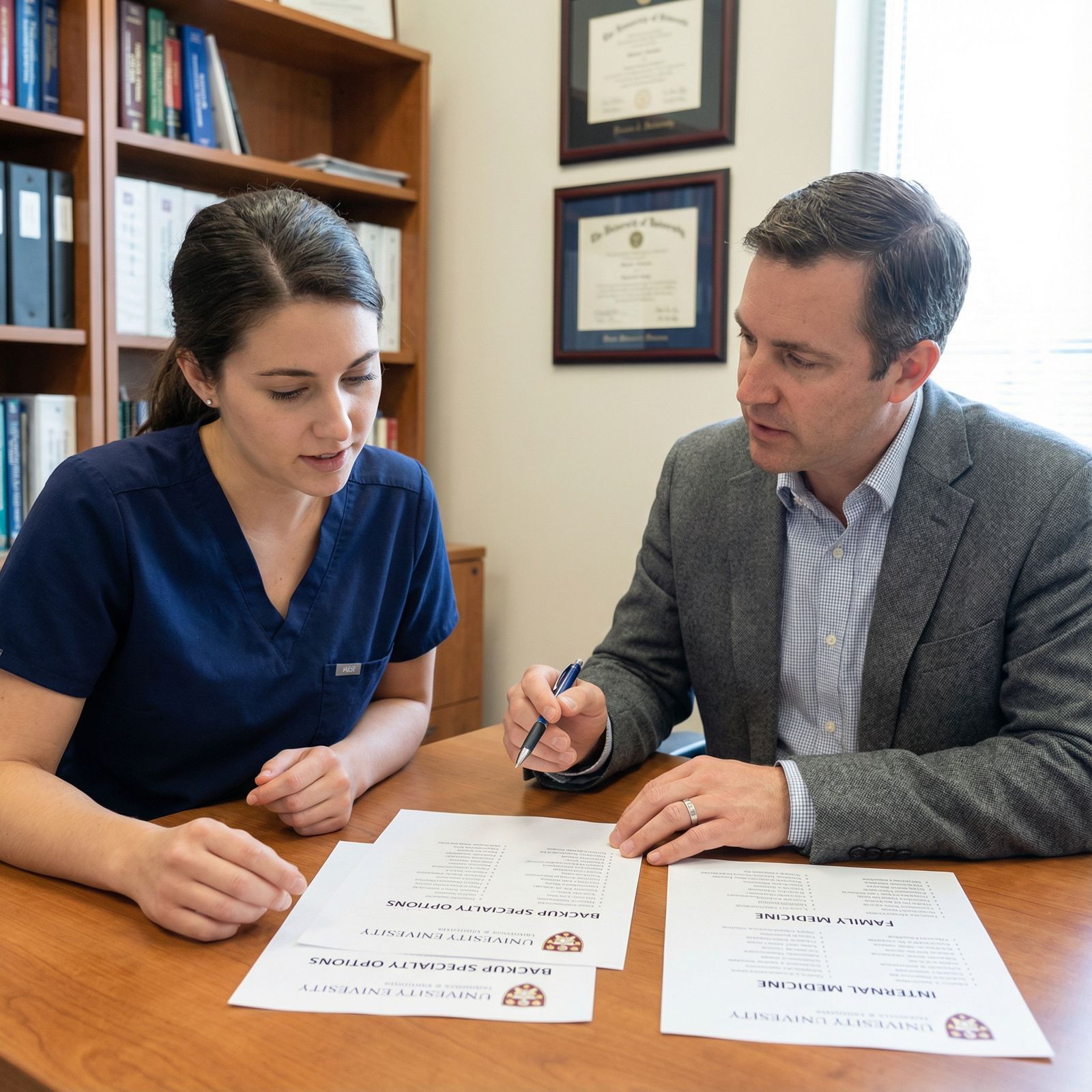
Navigating residency applications in vascular surgery is high-stakes—especially for an MD graduate applying to an integrated vascular program. With limited positions, variable competitiveness, and relatively few programs, backup specialty planning isn’t a sign of weakness; it’s part of being a prudent, strategic applicant.
This guide walks you through how to think about a backup plan, how to choose a backup specialty, and how to execute a dual applying residency strategy without undermining your primary goal of matching into vascular surgery.
Understanding the Risk Landscape in Vascular Surgery
Before building your Plan B, it helps to be honest about your risk profile and the realities of the vascular surgery match.
Why Vascular Surgery Is Particularly Risky
An integrated vascular surgery residency is one of the more competitive and niche surgical pathways:
- Small number of positions nationwide compared with other core specialties.
- High bar for academic metrics (Step 2 CK, class rank, AOA, research).
- Programs often favor:
- Strong performance in surgery rotations
- Evidence of commitment to vascular (research, electives, sub-I’s)
- Mature professional demeanor (this is a high-stakes, high-impact field)
Even very strong MD graduate residency candidates from allopathic medical schools sometimes fail to match into their desired integrated vascular program on the first try.
Self-Assessment: How Competitive Are You?
You can’t plan a realistic backup without an honest look at your application. Consider:
USMLE / COMLEX Scores
- Step 2 CK now carries more weight since Step 1 is pass/fail.
- Competitive vascular programs often prefer scores at or above their institutional average for surgical applicants.
- A significantly below-average score may increase the need for a robust backup specialty strategy.
Medical School Pedigree
- Coming from an allopathic medical school is an advantage compared with some other pathways, but:
- Program directors still differentiate between highly research-intensive and less research-focused schools.
- If your school has limited vascular exposure, you may have a thinner vascular CV.
- Coming from an allopathic medical school is an advantage compared with some other pathways, but:
Clinical Performance
- Honors in surgery, sub-internships, and strong narrative comments in MSPE are crucial.
- Any red flags (failed rotations, professionalism issues) must be weighted heavily in your risk assessment.
Vascular-Specific Engagement
- Research output (posters, abstracts, papers in vascular/Endovascular journals).
- Electives or away rotations at vascular programs, especially where you hope to match.
- Longitudinal involvement in vascular interest group, quality improvement, or outcomes research.
Geographic and Personal Constraints
- Strong geographic limitations (e.g., spouse’s job, family needs) effectively reduce your program pool.
- If you are only willing to apply to a narrow slice of programs, your risk of not matching increases, even with strong metrics.
Action Step:
Have a frank conversation with:
- At least one vascular surgery faculty mentor
- Your surgery clerkship director or program director
- A dean or advisor who understands the allopathic medical school match landscape
Ask directly:
“If I apply to an integrated vascular program as my primary goal, what is your level of concern that I may not match, and do you recommend a backup specialty or dual applying residency strategy?”
Their answers should heavily inform how robust your backup plan should be.
Core Principles of Backup Specialty Planning
A backup strategy is not simply “applying to more programs.” It is a structured plan that aligns with your goals if vascular surgery doesn’t work out in this cycle.
Principle 1: Clarify Your Ultimate Career Goal
You need to distinguish between:
Goal A: Become a vascular surgeon, no matter how I get there
- You are willing to:
- Train first in general surgery or another specialty
- Potentially pursue traditional fellowship pathways after residency
- Consider reapplying to vascular in future cycles
- You are willing to:
Goal B: Work in a vascular-adjacent or procedure-focused field, even if it’s not vascular surgery per se
- You are open to specialties such as:
- General Surgery (with vascular fellowship)
- Interventional Radiology
- Interventional Cardiology (via Internal Medicine)
- Interventional Nephrology or other procedure-heavy fields
- You are open to specialties such as:
Your long-term goal will determine whether your backup specialty is simply another route to vascular, or an entirely different but acceptable final destination.
Principle 2: Differentiate Between “Soft” and “Hard” Backups
Soft Backup:
- Sending some extra vascular surgery applications, or widening geographic range.
- Increasing the number of integrated vascular programs to which you apply.
- This is not truly a different specialty; it’s risk mitigation within your primary target field.
Hard Backup (True Plan B Specialty):
- A distinct specialty (e.g., general surgery, internal medicine, IR, anesthesiology) that you would be willing to match into and complete training in, even if you never return to vascular.
Most MD graduate residency applicants in vascular should strongly consider a hard backup. The stakes are too high to rely solely on soft backups.
Principle 3: Preserve Credibility in Both Fields
Dual applying residency strategies can backfire if you appear:
- Non-committal to either specialty
- Inconsistent in your story across programs
- Unprepared to answer “Why this specialty?” convincingly for both fields
Your backup plan must be designed so that:
- Each specialty sees a coherent, believable narrative.
- Your research, letters, and experiences can be interpreted in a way that fits both directions.
Choosing a Backup Specialty: Options for Aspiring Vascular Surgeons
When picking a plan B specialty, consider fit, competitiveness, and the connection to your vascular interest.
Interventional Cardiology', and 'Anesthesiology -> Critical Care', with a resident and faculty mentor discussing it, professional medical education style, photorealistic, DSLR photo.">
1. General Surgery: The Most Direct Plan B
Why it makes sense:
- General surgery is the traditional pathway to a vascular surgery fellowship.
- Most vascular surgeons in practice today trained first in general surgery.
- Your vascular research, letters, and sub-I’s translate naturally into general surgery interest.
Advantages:
- You maintain a credible path to vascular surgery via fellowship.
- Overlap in:
- Core clinical rotations
- Letters of recommendation (vascular faculty are surgeons)
- Research (surgical outcomes, vascular disease, etc.)
Challenges:
- General surgery itself can be competitive at top-tier academic programs.
- Your personal statement and interviews must clarify:
- Why you are genuinely excited about general surgery
- How you would be satisfied with a general surgery career, even if you never complete a vascular fellowship
When to choose General Surgery as your main backup:
- You strongly desire a career operating in the OR, even outside vascular.
- Your core surgical evaluations are strong.
- You have at least a couple of letters from non-vascular surgeons to show broader surgical fit.
2. Interventional Radiology (IR)
Why it makes sense:
- Heavy overlap in:
- Endovascular procedures
- Imaging, angiography, and minimally invasive vascular interventions
- IR can provide a vascular-like practice, focusing on:
- Peripheral arterial disease interventions
- Aortic aneurysm repair (EVAR, TEVAR)
- Venous interventions
Advantages:
- Highly procedural; still very “vascular-adjacent.”
- Your vascular research, especially endovascular topics, can look great to IR.
Challenges:
- Integrated IR residency is also competitive.
- Requires strong radiology and imaging foundation.
- Need letters and experiences that show true interest in radiology, not just “backup for vascular.”
Best for:
- MD graduates who genuinely enjoy imaging and are comfortable spending part of their day interpreting scans.
- Those willing to pivot their identity from “surgeon” to “interventionalist.”
3. Internal Medicine → Interventional Cardiology or Vascular Medicine
Why it makes sense:
- Many vascular disease patients are managed by cardiologists and vascular medicine specialists.
- You could:
- Complete Internal Medicine residency.
- Pursue cardiology fellowship.
- Subspecialize in interventional cardiology or vascular medicine.
Advantages:
- Internal Medicine has a broader range of match options and more positions.
- Still allows you to focus on vascular disease, albeit in a more medical and catheter-based orientation.
Challenges:
- Indirect and lengthy route to a partially overlapping career.
- Less time in the OR; more cath lab and clinic.
- Requires genuine comfort with long-term medical management and inpatient medicine.
Best for:
- Applicants who like physiology, longitudinal care, and procedural work but are open to less OR and more cath lab/clinic time.
4. Anesthesiology or Critical Care
While not traditional backups directly feeding into vascular surgery, some applicants consider:
- Anesthesiology (especially cardiac/vascular anesthesia).
- Surgical or critical care medicine managing vascular post-ops.
These are less direct; they can keep you in the perioperative and critically ill vascular patient space but usually do not lead back to a vascular surgeon role.
How to Execute a Dual Applying Residency Strategy
Once you’ve chosen a backup specialty, the execution details matter. You must structure your ERAS application so that each program (vascular and your plan B specialty) sees a coherent, tailored narrative.

1. Personal Statements: Separate and Specific
You should prepare distinct personal statements for:
- Integrated vascular surgery residency
- Your chosen backup specialty (e.g., general surgery or IR)
For Vascular Surgery:
- Emphasize:
- Motivation for vascular disease and complex limb salvage.
- Commitment to longitudinal, high-acuity patient care.
- Experiences specific to vascular rotations, research, cases.
- Make clear:
- Why an integrated vascular program specifically fits your vision.
For Backup Specialty (e.g., General Surgery):
- Emphasize:
- Broad interest in surgical disease.
- Enjoyment of variety in general surgery cases, trauma, acute care.
- How your vascular interests enrich your general surgery perspective without making it seem like general surgery is only a stepping stone.
Avoid phrases like:
- “If I can’t do vascular, I’ll settle for general surgery.” Instead:
- “I envision a career as a general surgeon with a strong interest in vascular and complex abdominal pathology, potentially further refined by fellowship training.”
2. Letters of Recommendation (LoRs)
You need a balanced letter portfolio that works for both specialties.
For Vascular Surgery:
- 2–3 letters from:
- Vascular surgeons you’ve worked closely with.
- A research mentor in vascular if applicable.
For Backup Specialty:
- At least 1–2 letters from:
- General surgery (or IR/IM) attendings who can speak to your performance in that broader discipline.
Strategy Tip:
- Ask letter writers if they would be comfortable with you using the letter for both vascular and general surgery (or another backup field).
- Some faculty may:
- Write a generic “surgery” letter.
- Or be willing to write separate versions if necessary (though this is more work for them).
3. Application Content: Research, Activities, and Experiences
Your ERAS entries must serve double duty.
- Research:
- Group vascular and endovascular projects under a broader “surgical outcomes” or “vascular and endovascular interventions” umbrella.
- Highlight analytic skills, teamwork, and scholarly productivity.
- Leadership and Service:
- Emphasize roles demonstrating professionalism, communication, and resilience.
- Avoid making your extracurriculars appear so hyper-specific to vascular that they undermine your credibility in your backup specialty.
Example:
Instead of:
“Led the Vascular Surgery Student Interest Group with a singular focus on vascular surgery.”
Consider:
“Led the Surgical and Vascular Interest Group, organizing case conferences on complex vascular and general surgical topics, coordinating faculty panels, and mentoring junior students interested in procedural specialties.”
4. Program List Strategy and ERAS Logistics
To optimize your match chances:
Apply broadly to vascular programs:
- Academic, community, varying regions.
- Consider programs less saturated with extremely high-stat applicants if your profile is mid-range.
For your backup specialty:
- Construct a realistic spread of reach, mid-tier, and safety programs.
- Factor in geography—but be more flexible than for vascular alone if possible.
ERAS Practicalities:
- You can assign different personal statements and LoR combinations to different programs.
- Create:
- “Vascular bundle”: vascular-focused PS + 2–3 vascular letters + 1 general surgery letter.
- “Backup bundle”: general surgery (or IR/IM) PS + 2 general surgery (or relevant specialty) letters + 1 vascular/surgical research letter.
Track this carefully with a spreadsheet so there are no mix-ups.
Responding to Match Outcomes and Reapplication Decisions
Even with a well-executed plan, outcomes can vary:
Scenario 1: You Match into Vascular Surgery
- Excellent. Your backup plan remains unused but was worth having.
- Maintain professionalism with any programs or mentors tied to your backup specialty.
Scenario 2: You Match into Your Backup Specialty
- Early in residency, reassess:
- Are you satisfied in this field?
- Does your program support fellowship aspirations (e.g., vascular surgery fellowship from general surgery)?
- If you still want vascular:
- Work with your program leadership to build a fellowship-applicable portfolio:
- Research.
- Rotation exposure in vascular.
- Letters from vascular faculty.
- Work with your program leadership to build a fellowship-applicable portfolio:
- Early in residency, reassess:
Scenario 3: You Go Unmatched
- Use SOAP strategically:
- Decide if you will pursue:
- Prelim surgery.
- Categorical spot in another specialty.
- Decide if you will pursue:
- Meet urgently with advisors to plan:
- One-year research or surgical preliminary year.
- A stronger reapplication to vascular or shift to another categorical Plan B.
- Use SOAP strategically:
Key Reflection:
Your backup strategy should be designed so that in any of these scenarios, you are not stranded without a viable path forward.
Practical Tips and Common Mistakes to Avoid
1. Don’t Hide Your Backup Applications From Mentors
Some applicants fear appearing disloyal by considering a plan B specialty. In reality:
- Most vascular faculty understand the high-risk nature of the allopathic medical school match for integrated vascular programs.
- Transparency allows mentors to:
- Help you craft appropriate letters.
- Advise on which backup specialty best fits your strengths.
2. Avoid “Copy-Paste” Personal Statements
If your general surgery personal statement just removes the word “vascular” and replaces it with “surgery,” reviewers will notice.
Each statement should credibly answer:
- “Why this specialty specifically?”
- “Is this applicant genuinely happy with a career here?”
3. Don’t Underestimate Your Backup’s Competitiveness
For instance:
- General surgery at prestigious academic centers can be very competitive.
- IR is also a competitive match.
- Internal medicine is broader, but top programs are selective.
You need a backup within your backup, meaning a balanced list of programs, not just top-tier ones.
4. Keep Your Story Consistent
Program directors talk. Inconsistent narratives can raise concerns.
Example of consistent messaging:
- To vascular: “I am highly committed to a career in vascular surgery, especially in [X focus area]. If I were to take a different surgical path, I would still aim to work with complex vascular patients, but my primary goal is the integrated vascular pathway.”
- To general surgery: “I am passionate about a broad surgical career and, over time, anticipate focusing on complex abdominal and vascular pathology, potentially through fellowship training.”
Both statements can be true and compatible.
FAQs: Backup Specialty Planning for Vascular Surgery Applicants
1. As an MD graduate from an allopathic medical school, do I really need a backup if my metrics are strong?
You might still benefit from a backup specialty plan, even with strong metrics. Integrated vascular programs remain numerically small and highly selective. Factors such as geographic constraints, limited vascular exposure at your school, or average letters can still introduce significant risk. Many advisors recommend at least some degree of dual applying—most commonly to general surgery—unless multiple experienced mentors explicitly advise that a backup is unnecessary for your specific profile.
2. Is general surgery always the best backup for an integrated vascular program applicant?
Not always, but it is the most common and often the most logical.
- It offers a direct path back to vascular through fellowship.
- Your vascular-focused experiences translate easily.
However, if you genuinely do not see yourself enjoying a broad general surgery career, other plan B specialty options (IR, internal medicine with a vascular-focused fellowship path, etc.) may be better fits. The key is honesty: pick a backup specialty you can commit to and be content in if a return to vascular is not possible.
3. Will dual applying hurt my chances in vascular surgery?
If executed poorly, yes; if done well, generally no.
Potential pitfalls:
- Program directors sensing that vascular is just a “reach” and you’re not truly committed.
- Incoherent or generic personal statements.
- Letters that hint you’re unsure of your path.
If your application clearly reflects a primary focus on vascular surgery, with a thoughtfully considered and honestly described backup plan B specialty, most programs will understand. Good mentorship and careful wording are critical.
4. If I match into my backup specialty, should I plan from day one to reapply to vascular surgery?
Approach this cautiously. Once you match into a categorical program, your ethical and professional obligation is to engage fully in that specialty. Many residents discover that they enjoy their backup specialty more than expected. If after a year or two you still feel strongly drawn to vascular:
- Discuss with your program director transparently.
- Explore vascular-focused rotations and research.
- Reassess whether switching is truly worth the personal and professional disruption.
For many, the best choice is to build a fulfilling career in their matched specialty, perhaps keeping a vascular-adjacent focus through specific patient populations, procedures, or fellowships in related areas.
Thoughtful backup specialty planning does not undermine your commitment to vascular surgery—it protects your future. As an MD graduate navigating the allopathic medical school match, approaching vascular surgery with a clear Plan A and a realistic, well-designed Plan B specialty gives you the highest chance of building a satisfying, sustainable career, whether or not your path runs through an integrated vascular program.