
Backup specialty planning is one of the most emotionally charged—yet strategically essential—parts of pursuing a cardiothoracic surgery residency. You’re investing years into becoming a heart and lung surgeon, but the path is long, competitive, and not fully under your control. Thoughtful backup planning does not weaken your commitment; it protects your future.
Below is a detailed, practical guide to backup specialty planning in the context of cardiothoracic surgery—whether you’re applying to integrated CT programs, general surgery with the goal of CT fellowship, or considering dual applying residency options.
Why Backup Planning Matters in Cardiothoracic Surgery
Cardiothoracic surgery is among the most competitive and demanding fields. Even strong applicants can face unexpected obstacles:
- Limited number of integrated cardiothoracic surgery residency positions
- Highly variable program preferences (some value heavy research, others clinical performance)
- Board score shifts (especially with Step 1 now Pass/Fail)
- Increasing emphasis on holistic review and fit, making outcomes less predictable
The Emotional Barrier: “If I Plan a Plan B, Am I Less Committed?”
Many applicants fear that choosing a backup specialty signals weak dedication. In reality:
Program directors know risk management is mature and realistic.
They are far more concerned with your commitment to the program you’re actually applying to than whether you had a private Plan B.You can be 100% committed to becoming a cardiothoracic surgeon and still have a backup path to that goal.
For example: general surgery → CT fellowship is a classic and respected route.Your future patients need you employed and trained, not unmatched and repeating application cycles indefinitely.
Backup planning is professional risk management, not a lack of passion.
When You Definitely Need a Backup Plan
You should give serious thought to a structured backup if any of the following apply:
- Limited or no cardiothoracic-specific research
- No home cardiothoracic surgery program or limited mentorship
- Step 2 CK score below typical integrated CT cutoffs (often competitive programs want ≥240–245+; this varies)
- Academic challenges (repeated coursework, lower class rank)
- Limited surgery honors, mixed clerkship performance
- Visa requirements that significantly restrict program options
- Late discovery of interest in CT surgery (less time to build a focused portfolio)
Even if you are a “strong applicant on paper,” a backup specialty still makes sense due to the small number of positions and high variability in match outcomes.
Core Strategies for Backup Specialty Planning
Before deciding which backup specialties to consider, you need a structured approach to backup planning itself.
1. Clarify Your Primary Goal
Define your true long-term goal:
- Do you want to be a cardiothoracic surgeon specifically?
- Or do you want a career centered on operative care, anatomy, and physiology of the chest, heart, and lungs, but would be fulfilled by closely related paths?
Your answer will shape how “close” your backup specialty should be to cardiothoracic surgery.
If your non-negotiable goal is: “I want to operate in the chest/heart,”
then your backup planning should prioritize:
- General surgery → CT fellowship
- Vascular surgery → some overlap, but less direct
- Thoracic surgery (where independent pathways exist)
If your broader goal is: “I want a high-acuity, procedure-heavy, OR-centered career,”
then you have more flexibility: general surgery, anesthesiology, interventional cardiology (via internal medicine), etc.
2. Understand the Cardiothoracic Pathways
Your backup strategy differs depending on your primary pathway:
Integrated Cardiothoracic Surgery (I-6) → CT attending
- Direct training with early cardiac/thoracic exposure
- Very few spots, highly competitive
- Backup is almost always another residency specialty
General Surgery Residency → CT Fellowship → CT attending
- Traditional route, still very common
- Solid, versatile training even if you later pivot away from CT
- Backup might be a different surgical or procedural specialty if general surgery competitiveness is a concern
Other route (e.g., vascular or cardiac surgery in another system)
- More niche; not the primary focus here, but the same backup logic applies.
Most applicants wishing to become cardiothoracic surgeons will anchor their strategy around the first two.
3. Choose a Backup Strategy Type: Adjacent vs. Divergent
Think in terms of two broad categories:
Adjacent Backup Strategy
You choose a backup specialty that still keeps cardiothoracic surgery in realistic reach.
Typical examples:
- Applying integrated cardiothoracic surgery residency + general surgery
- Applying general surgery at a more conservative competitiveness level (e.g., more community programs, wider geographic spread)
- Considering thoracic surgery pathways where available internationally
This path is ideal if your priority is: “I ultimately want to do heart or lung surgery, even if I don’t match integrated.”
Divergent Backup Strategy
You choose a backup specialty that does not guarantee a CT path but still aligns with your values and interests.
Common options:
- Anesthesiology (especially cardiac anesthesia / TEE)
- Internal medicine with eventual interventional cardiology or advanced cardiac imaging
- Radiology with a focus on cardiothoracic imaging
- Emergency medicine with interest in resuscitation and trauma
This is appropriate when:
- Your competitiveness for surgery overall is limited
- You have strong non-surgical interests
- You would be satisfied in a closely related high-acuity, procedure-based field even without CT surgery
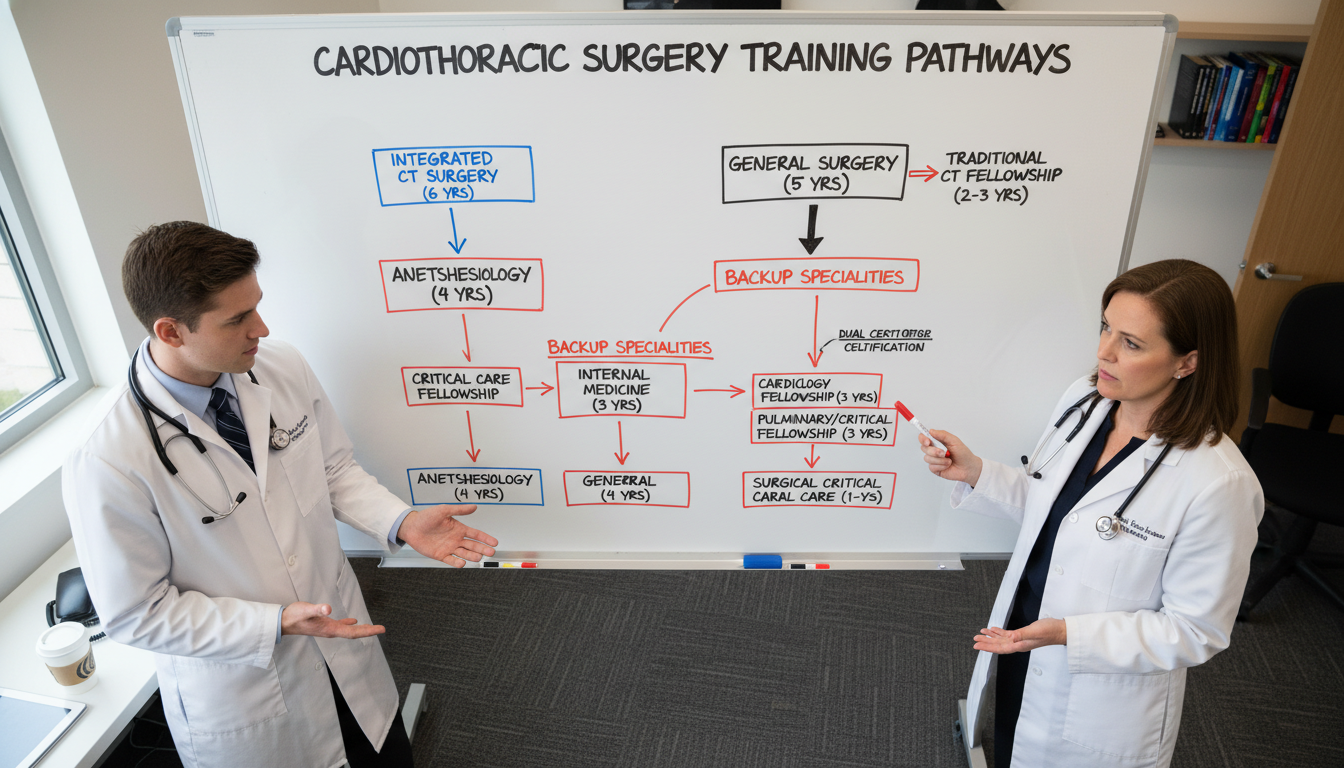
Best Backup Specialties for Cardiothoracic Surgery Applicants
When you think about cardiothoracic surgery residency backup planning, you want to balance three things:
- Realistic chance of matching
- Preservation of pathway to heart surgery training (when desired)
- Personal fit and day-to-day enjoyment
Below are the primary categories to consider.
1. General Surgery: The Classic Backup and Parallel Path
Why it’s often the best backup:
- Direct, well-established route to cardiothoracic surgery via fellowship
- Strong overlap in skills: open surgery, critical care, operative judgment
- Highly respected and versatile; you can pivot to other subspecialties (e.g., vascular, surgical oncology, trauma)
Pros:
- Keeps your primary dream—heart surgery training—very much alive
- Many more positions than integrated CT programs
- Strong “Plan B specialty” in its own right if you ultimately decide against CT
Cons:
- Still competitive at top academic programs
- Long and demanding (5+ years residency + 2–3 years fellowship)
- Lifestyle can be intense, even if you don’t subspecialize
How to use general surgery as a backup in dual applying residency strategies:
- Apply to integrated cardiothoracic surgery AND general surgery in the same cycle if you’re set on CT.
- Customize your personal statement and letters:
- For CT programs: highlight CT research, interest in cardiac/lung surgery, early CT experiences.
- For general surgery programs: emphasize commitment to surgical training as a foundation; you may mention CT goals if framed positively (e.g., “I plan to pursue cardiothoracic fellowship and am committed to excellent general surgery training as the backbone of that career”).
Key tip:
Be transparent enough that general surgery programs don’t feel like “second choice,” but avoid sounding like you’ll be disengaged from general surgery training itself.
2. Thoracic or Vascular-Focused Surgical Pathways
While in the U.S. cardiothoracic training is largely standardized through integrated or fellowship pathways, some applicants conceptualize vascular surgery or thoracic-focused general surgery as partial backups.
Vascular surgery residency (5+2 or integrated)
- Highly procedural, lots of open and endovascular work
- Overlaps with cardiac pathology (aortic disease, peripheral vascular disease)
Thoracic emphases in certain general surgery programs
- Some residencies are strong feeders into thoracic or cardiothoracic fellowships
- These are great if you dual apply: integrated CT + general surgery at CT-heavy institutions
These are nuanced options and best chosen with direct mentorship from CT surgeons or program advisors.
3. Anesthesiology: A High-Acuity, OR-Centered Backup
If you enjoy physiology, hemodynamics, and are comfortable not being the primary operator, anesthesiology can be an excellent divergent backup specialty.
Relevance to cardiothoracic interests:
- Cardiac anesthesia and transesophageal echocardiography (TEE)
- Close collaboration with CT surgeons in the OR
- Management of cardiopulmonary bypass, complex valvular and coronary cases
Pros:
- Good quality of life in many practice settings
- Strong job market in many regions
- Still heavily involved in CT cases if you subspecialize in cardiac anesthesia
Cons:
- You won’t be the primary surgeon; role is different in hierarchy and responsibilities
- Interviewers might question why you’re applying to anesthesiology if all your experiences are in CT surgery—this needs to be addressed thoughtfully
Key application strategy:
- Tailor your anesthesiology personal statement to emphasize:
- Love of physiology and perioperative care
- Interest in managing critical, complex cardiac and thoracic patients
- Direct experiences reading TEE, working with anesthesiologists, and enjoying that role
4. Internal Medicine → Cardiology / Interventional Cardiology
For students fascinated by heart disease more than the OR itself, a powerful backup is internal medicine with the goal of cardiology fellowship, possibly interventional cardiology or structural heart.
Pros:
- You stay deeply involved in heart disease and patient management
- Interventional cardiologists perform high-stakes, procedure-intensive work
- Growing field of structural interventions (TAVR, MitraClip, etc.) at the intersection of CT and cardiology
Cons:
- Long training pathway (3 years IM + 3 years cardiology + 1–2 years interventional)
- Less direct operative experience; no open-chest surgery
- Requires genuine enjoyment of medical wards, consults, and longitudinal care
Best fit when:
- You enjoy the diagnostic side, imaging, and hemodynamics
- You found internal medicine clerkship satisfying
- You could realistically see yourself never scrubbing into an open-heart case but still being fulfilled in a cath lab
5. Radiology with Cardiothoracic or Cardiac Imaging Focus
For students who are:
- Visually oriented
- Interested in cross-sectional anatomy
- Drawn to imaging and diagnostics around CT anatomy
Diagnostic radiology with fellowships in cardiothoracic imaging or cardiac MRI/CT is worth considering.
You’ll:
- Interpret CT scans of the chest, coronary CT angiography, cardiac MRI
- Play a central role in preoperative planning and postoperative complication evaluation
This is less commonly chosen as a backup by CT applicants, but can be ideal for those who realize they value anatomy and pathophysiology more than operating itself.
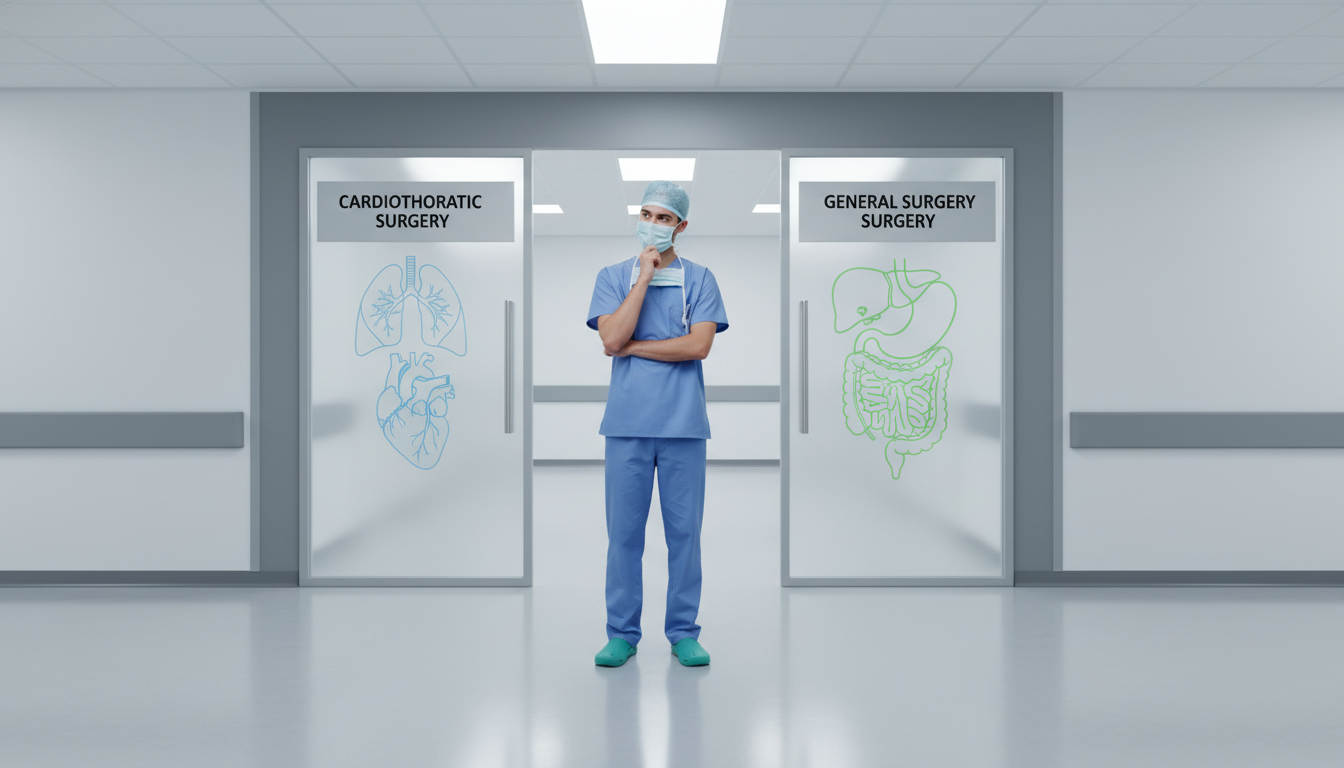
How to Dual Apply Without Compromising Either Application
Dual applying to residency—such as integrated cardiothoracic surgery + general surgery, or CT + anesthesiology—is entirely feasible with careful planning.
1. Be Strategic with ERAS Content
Your ERAS application has shared elements (experiences, publications) but you can customize:
- Personal statement (you can upload multiple)
- Program signaling priorities (when applicable)
- Letters of recommendation selection
Personal statements:
CT application statement
- Focus on: Longstanding interest in cardiothoracic surgery, key CT experiences, research, mentors
- Use CT-specific language, reflect understanding of heart surgery training demands
Backup specialty statement (e.g., general surgery, anesthesiology)
- Focus on: Genuine interest in that field, its breadth or depth
- For general surgery, it’s acceptable to mention your goal of CT fellowship, framed as a natural extension
- For non-surgery specialties, speak more about what you learned you enjoy rather than “I didn’t get into CT”
2. Manage Letters of Recommendation Carefully
Letters should match the specialty when possible:
For CT programs:
- At least one or two letters from cardiothoracic surgeons if feasible
- Additional letters from surgeons or research mentors who know you well
For general surgery or other backups:
- Letters from general surgeons, anesthesiologists, or internists depending on the specialty
- Avoid submitting obviously CT-centered letters to wholly non-surgical specialties (it can appear unfocused)
You can assign different letters to different programs within ERAS.
3. Prepare for Interviews Honestly but Strategically
Common challenge:
“What other specialties are you applying to?”
Principles:
- Be honest, but frame your answer as thoughtful career planning.
- Emphasize genuine excitement about the specialty you are interviewing for.
Example responses:
For a general surgery interview when also applying integrated CT:
“My long-term goal is to become a cardiothoracic surgeon. I applied to a small number of integrated CT programs, but I also deeply value robust general surgical training and see it as a traditional and respected pathway into CT. I’m fully prepared and enthusiastic about doing general surgery residency and then pursuing CT fellowship.”
For anesthesiology when you also applied CT:
“I’ve always been drawn to cardiac physiology and high-acuity perioperative care. As I explored CT surgery, I also developed a significant interest in the anesthesiology side of the cardiac OR. I’m applying to both fields because I can see myself deeply fulfilled as an anesthesiologist, particularly in cardiac cases, and I wanted to keep both paths open while I refine where I’m best fit.”
Avoid:
- Suggesting the specialty you’re interviewing for is clearly “second choice”
- Over-explaining your CT rejections or self-criticizing
4. Balance Your Application List
Your residency list should include:
- Reach programs: Highly competitive integrated CT or elite general surgery programs
- Realistic targets: Solid academic and large community programs
- Safety options: Programs where your metrics, experiences, and geography make you a clearly strong applicant
If your primary goal is CT fellowship via general surgery:
- Put extra emphasis on general surgery programs with strong CT exposure and fellowships.
- Ask explicitly in interviews about CT case volumes, mentor access, and fellowship match history.
Building a Backup Plan That Still Honors Your Identity
Backup specialty planning in cardiothoracic surgery isn’t only about probabilities; it must align with who you are as a clinician.
1. Identify Your Core Professional Values
Ask yourself:
- Do I value hands-on procedures above all?
- Do I want to lead the team in the OR, or am I comfortable in a highly collaborative but less visible role?
- Do I enjoy longitudinal relationships with patients, or do I prefer critical episodes of care?
- How do I feel about night call, emergencies, and life-or-death responsibility?
Your answers may steer you:
- Toward surgery (CT, general, vascular) if you value being the operator and leading the team
- Toward anesthesiology or interventional cardiology if you like high acuity and procedures but a more controlled scope
- Toward radiology or imaging if you love anatomy and pathophysiology without direct OR performance pressure
2. Stress-Test Your Contingency Plan
Imagine realistic outcomes:
Scenario A: You don’t match integrated CT but match general surgery at a strong program.
- Are you excited to do 5 years of general surgery before CT fellowship?
- Could you imagine being a general surgeon even if CT fellowship doesn’t happen?
Scenario B: You match anesthesiology instead of CT.
- Can you see yourself satisfied as a cardiac anesthesiologist or critical care anesthesiologist?
- Would you regret not having pushed harder for a surgical path?
Scenario C: You only match your divergent backup (e.g., internal medicine or radiology).
- Could you find meaningful satisfaction in that field?
If your answer is “absolutely not” for a given backup specialty, it is not a good Plan B specialty—even if it’s more “secure.”
3. Work Closely With Mentors
For cardiothoracic surgery in particular:
- Find at least one CT surgeon mentor and one general surgeon or other specialty mentor.
- Ask them:
- Candid assessment of your competitiveness
- Reasonable scope of programs (academic vs community, geographic regions)
- Whether dual applying residency is advisable in your specific situation
- Which backup specialties align with your observed strengths
Mentors can help you avoid extremes—either overreaching with no safety net or under-reaching and later regretting not applying CT at all.
FAQs: Backup Specialty Planning in Cardiothoracic Surgery
1. Do cardiothoracic surgery program directors look down on applicants who dual apply?
No. Many understand the reality of the match and support having a backup, especially when the backup is general surgery. What they want to see is that your application to their program is sincere, well thought-out, and aligned with the demands of heart surgery training. As long as your materials for CT programs are strong and specific, dual applying does not inherently hurt you.
2. Is general surgery always the best backup for a cardiothoracic surgery residency?
Not always, but often. General surgery is the most direct alternate route to a CT career via fellowship. If your primary goal is operating on the heart and lungs, general surgery is usually the top backup choice. However, if your metrics or experiences make you less competitive for any surgery program, or you discover you enjoy physiology, diagnostics, or imaging more than operating, then anesthesiology, internal medicine (cardiology), or radiology may be more appropriate.
3. How should I decide between applying integrated CT alone versus integrated CT + general surgery?
Consider dual applying if:
- Your application has gaps (limited research, marginal scores, fewer CT experiences)
- You’re geographically restricted
- You strongly prefer to match somewhere in this cycle rather than reapplying
If you are an extremely strong candidate with robust CT research, strong mentorship, and broad geographic flexibility, you may choose to apply CT only—but this carries a higher risk due to the small number of spots. A frank discussion with mentors is essential.
4. Will mentioning my interest in cardiothoracic surgery hurt my chances in general surgery or anesthesiology interviews?
Not if framed correctly. For general surgery, it can actually be a positive to have a clear long-term goal (CT fellowship) as long as you emphasize your respect for and commitment to general surgery training. For anesthesiology or internal medicine, focus less on “failing to get CT” and more on the elements of cardiothoracic care that made you realize you value physiology, perioperative medicine, or cardiac diagnostics—showing authentic interest, not a consolation choice.
Thoughtful backup specialty planning for cardiothoracic surgery residency applicants is not about abandoning your dream; it’s about designing multiple realistic routes toward a meaningful, stable, and fulfilling career. With clear priorities, honest mentorship, and a well-chosen Plan B specialty, you can pursue heart surgery training ambitiously while safeguarding your future.