
Understanding Why Dermatology Applicants Need a Backup Plan
Dermatology is one of the most competitive specialties in the allopathic medical school match. Even for a strong MD graduate, a derm match is never guaranteed. Planning a thoughtful backup specialty is not “planning to fail”; it is risk management so you don’t lose a full year or derail your long‑term career.
How Competitive Is Dermatology?
In recent NRMP data (MD seniors):
- Dermatology consistently ranks among the top few specialties in:
- Average Step scores
- Number of research products
- Percentage of Alpha Omega Alpha (AOA) members
- A notable portion of applicants—often 20–30% or more of U.S. MD seniors applying to dermatology—do not match in derm (this varies yearly and by applicant strength).
Even if you’re a solid candidate, you are competing against:
- MD/PhD and research‑heavy applicants
- Applicants from top‑tier academic institutions
- Re‑applicants who have completed research fellowships or preliminary years
Why Having a Backup Matters
For an MD graduate interested in dermatology, a well‑designed backup strategy:
Protects You from Ending Up Unmatched
- Being completely unmatched can be emotionally and financially stressful.
- It may require scrambling (SOAP) into an undesired position or taking a non‑clinical gap year under pressure.
Preserves Clinical Momentum
- A backup specialty can keep you in patient care, maintain your skills, and avoid large CV gaps.
- Continuous training is better regarded by many programs than being off‑cycle or non‑clinical.
Keeps Pathways to Dermatology Open
- Certain “plan B specialties” can:
- Provide strong letters relevant to dermatology.
- Allow future derm re‑application.
- Lead to dermatology‑adjacent careers (e.g., dermatopathology, cosmetic medicine, allergy/immunology).
- Certain “plan B specialties” can:
Reduces Anxiety During Application Season
- Dual applying to both dermatology and a backup specialty gives you more shots on goal.
- You can rank both derm and a backup in the main allopathic medical school match, reducing “everything rides on this one outcome” pressure.
The key is intentional backup specialty planning—not just throwing in a few applications to a random field.
Stepwise Self‑Assessment: Do You Need a Backup—and How Strong?
Before deciding on dual applying residency pathways, you need honest insight into your dermatology competitiveness and risk tolerance.
1. Objective Competitiveness Checklist
Compare yourself to recent dermatology match data for U.S. MD seniors:
- USMLE/COMLEX Scores
- Step 1 (if numeric) and Step 2 CK above or near recent dermatology matched medians?
- If your Step 2 CK is significantly below typical derm match ranges, you’re at higher risk.
- Research
- Substantial dermatology‑related research? (e.g., multiple abstracts, posters, or publications)
- Any first‑author work, or longitudinal commitment to a derm lab or project?
- AOA / Honors
- AOA or Gold Humanism Honors is helpful but not mandatory.
- Strong clerkship grades—particularly in medicine, surgery, and derm elective.
- Derm Exposure & Letters
- Completed dermatology rotations at your home institution and/or away rotations?
- At least 2 strong dermatology letters from faculty who know you well?
If you are objectively well‑aligned with these benchmarks, your risk is lower—but not zero. If you fall significantly below, a serious backup plan is strongly advisable.
2. Subjective and Contextual Factors
Consider:
School and Program Context
- Does your allopathic medical school have a dermatology residency?
- Are there home‑program derm mentors strongly advocating for you?
- Any red flags on your record (failed exam, professionalism concern, leaves of absence)?
Geographic Constraints
- Are you applying broadly nationwide, or limited to certain regions due to family needs?
- Geographic restriction can meaningfully lower your derm match probability.
Your Risk Tolerance
- How would you feel about reapplying after a gap year versus matching into a backup specialty now?
- Can you financially and emotionally tolerate an unmatched year or research year?
3. When a Backup Becomes Essential
You should strongly consider a robust backup specialty plan if any of these apply:
- You have a failed Step attempt or very low Step 2 CK.
- Limited derm‑specific research and late entry into the field.
- No home dermatology program and weak access to derm mentors.
- You are geographically restricted and not a top‑tier applicant.
- You are applying late, with incomplete derm rotations or letters.
In these cases, dual applying residency is often the most rational path: derm remains your priority, but a structured plan B specialty protects your future.
Choosing a Backup Specialty: Principles and Top Options
Choosing a backup is not as simple as “what’s less competitive than derm.” Your backup should be:
- Professionally Acceptable
- Could you realistically see yourself practicing this as a full career if derm never works out?
- Strategically Synergistic
- Overlapping content or skills with dermatology.
- Opportunities to maintain derm‑adjacent interests.
- Feasible in the Same Match Cycle
- Timelines, letters, and personal statements manageable while applying to derm.
Below are guiding principles and common plan B specialties for MD graduates targeting dermatology.
Core Principles for Backup Selection
- Content Overlap with Skin Conditions
- Look for fields with substantial skin involvement or diagnostic overlap.
- Shared Foundational Knowledge
- Immunology, internal medicine, pathology, pediatrics, rheumatology—these all intersect with derm.
- Flexible Career Paths
- Ability to subspecialize, join multidisciplinary clinics, or collaborate with dermatologists later.
Leading Backup Options for Dermatology Applicants
1. Internal Medicine (IM)
Why it pairs well with derm:
- High overlap in diseases: autoimmune conditions, vasculitis, infectious rashes, derm manifestations of systemic disease.
- Offers later subspecialization in:
- Rheumatology (many skin‑related autoimmune conditions)
- Allergy/Immunology (atopic dermatitis, urticaria, drug eruptions)
- Infectious Disease (cutaneous infections, HIV‑related derm)
- A strong IM residency keeps the door open for derm re‑application or for a career in medical derm‑adjacent fields.
Pros:
- Large number of positions; more forgiving than derm.
- Strong internal medicine foundation is respected across specialties.
- Built‑in opportunities to continue derm‑relevant research (e.g., autoimmunity, inflammatory disease).
Cons:
- Three years of residency before subspecialization.
- Workflow and lifestyle differ from classic derm (inpatient call, higher acuity).
For whom this is a good plan B specialty:
- MD graduates who like complex diagnostics, enjoy managing chronic disease, and can see themselves in rheumatology, allergy/immunology, or general IM if derm does not pan out.
2. Pathology
Why it pairs well with derm:
- Direct link to dermatopathology, a subspecialty at the interface of derm and path.
- Dermatologists lean heavily on skin biopsy interpretation; dermpath is a major part of the field.
Pros:
- Very strong content and career alignment with dermatology.
- Visual, diagnostic focus; limited direct patient contact, which some applicants prefer.
- You can later pursue a dermpath fellowship and still be deeply involved in skin disease.
Cons:
- Very different from outpatient clinical derm in terms of daily workflow and patient interaction.
- Requires true interest in lab medicine and microscopic diagnosis, not just a “fallback to stay near derm.”
For whom this is a good plan B specialty:
- Those who genuinely enjoy histology, microscopy, and diagnostic puzzles.
- MD graduates who could see themselves happy as a dermatopathologist even if never practicing clinical derm.
3. Internal Medicine–Pediatrics (Med‑Peds) or Pediatrics
Why it pairs well with derm:
- Many derm conditions manifest in childhood; pediatric derm is a niche with high demand.
- Med‑Peds gives versatility with both adult and pediatric populations.
Pros:
- Pediatric dermatology is a recognized subspecialty that can be entered from derm or, in some contexts, peds with collaborative practice arrangements.
- Med‑Peds or Peds allows ongoing derm‑like practice (e.g., managing atopic dermatitis, genetic skin disorders, hemangiomas, acne).
Cons:
- Not a standard gateway to formal dermatology board certification.
- Career may be more generalist; derm‑focused roles depend heavily on local opportunities and institutional needs.
For whom this is a good plan B specialty:
- Applicants passionate about working with children and families.
- Those who would be happy in general pediatrics or Med‑Peds even without any formal derm pathway.
4. Family Medicine (FM)
Why it pairs well with derm:
- High volume of dermatologic complaints in primary care.
- Many FM physicians develop niche practices in skin procedures, minor surgeries, cosmetics (depending on local scope of practice and training).
Pros:
- Opportunity for continuity care and procedures (biopsies, cryotherapy, simple excisions).
- More control over practice style and location, including rural/underserved settings.
Cons:
- Not a direct stepping‑stone to board‑certified dermatology.
- Financial and lifestyle profiles differ significantly from derm in many regions.
For whom this is a good plan B specialty:
- Those who like broad practice, continuity, and flexibility.
- MD graduates comfortable with the possibility of never practicing formal derm but maintaining a strong outpatient procedural niche.
5. Transitional Year (TY) or Preliminary Year Alone—With Caution
Some applicants use a preliminary medicine year or transitional year as a stopgap if they fail to match derm. This can:
- Maintain clinical activity.
- Provide time to bolster derm research and relationships.
However, this alone is not a full backup specialty. If you only rank derm and a few prelim/TY spots, you risk:
- Ending up with just one year of training and no clear long‑term position.
- Having to re‑enter the match in a different specialty later, still without a secured categorical residency.
Use this path only if you have strong mentorship and a clear, realistic derm re‑application plan.
How to Dual Apply Strategically: Derm + Backup in One Cycle
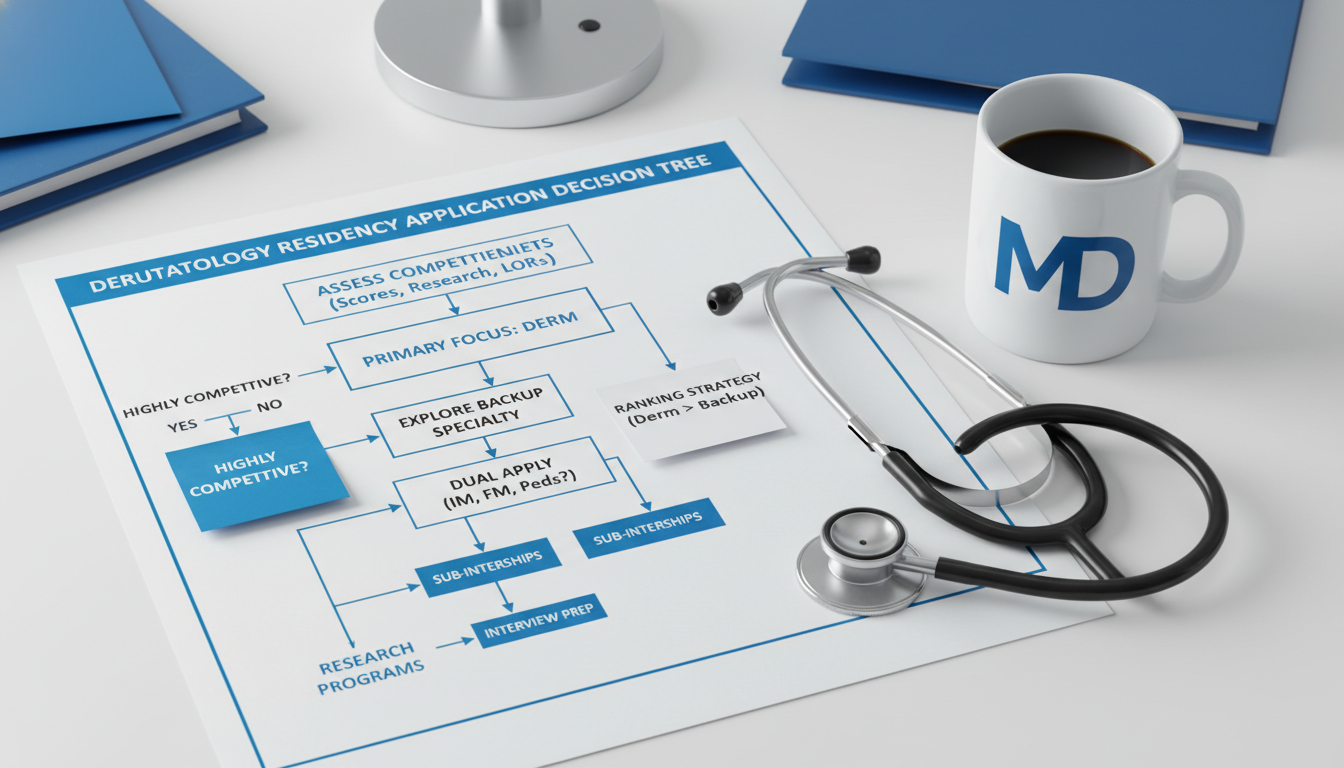
Dual applying residency—submitting applications to both dermatology and another specialty—is common for competitive fields like derm. The key is to avoid appearing unfocused while still protecting yourself.
1. Application Logistics: ERAS Strategy
You will need:
Dermatology Personal Statement
- Highly focused on your motivation for derm, research, and particular aspects of the specialty.
Backup Specialty Personal Statement
- Authentic explanation of your interest in that specialty, not “I love derm but this is my backup.”
- Emphasize overlapping skills (e.g., visual diagnosis, immunology interest) and personal experiences.
Tailored Program Lists
- For dermatology: prioritize programs that match your profile and geographic preferences.
- For backup specialty: apply broadly enough to make matching realistic (often more programs than derm).
Letters of Recommendation
- Aim for at least 2 dermatologist letters for derm applications.
- Obtain 1–2 letters from faculty in your backup specialty (IM, path, FM, etc.).
- You can assign different letters to different programs within ERAS.
2. Communicating Your Interests to Programs
A common concern is: “Won’t programs be upset I’m dual applying?” In most competitive specialties, this is expected.
Guiding principles:
With dermatology faculty
- Be honest if directly asked; many will encourage a backup.
- Emphasize that derm is your top choice, but you are planning responsibly.
With backup specialty faculty
- Do not present their field as “second‑best.”
- Focus on genuine aspects that attract you.
- You do not need to volunteer that you are applying to derm unless they ask or it’s contextually necessary.
3. Interview Season Management
Derm interviews tend to be fewer and more competitive; backup specialty interviews may be more numerous.
- Prioritize scheduling derm interviews over backup when there are conflicts.
- Be realistic: if you only get a small number of derm interviews (e.g., fewer than ~5–6), your odds of matching derm are lower, and backup interviews become increasingly important.
4. Ranking Strategy in the Allopathic Medical School Match
On your NRMP rank list:
- Rank programs in order of your true preference, not based on perceived chance.
- If your priority is still derm above all else:
- Rank all derm programs you would accept first, followed by backup specialty programs.
- If you are risk‑averse and could see yourself happier locked into a strong IM or path program than unmatched:
- You might intersperse a few top‑choice backup programs earlier in the list.
Discuss ranking strategy with trusted advisors who know your specific CV and interview performance.

Life If You Don’t Match Dermatology: Reapplying vs. Embracing Plan B
Even with careful planning, you may not secure a derm match on your first attempt. Your backup specialty decisions then shape your next steps.
Scenario 1: You Match Your Backup Specialty
You matched into Internal Medicine, Pathology, FM, or another plan B specialty.
Options now:
Fully Commit to That Specialty
- Many physicians discover genuine satisfaction and long‑term fulfillment in their backup field.
- You can still shape a derm‑adjacent niche:
- IM → focus on rheumatology, allergy/immunology, or complex autoimmune disease.
- Path → aim for dermpath fellowship.
- FM → build a strong procedural and dermatology‑heavy clinic within scope.
Consider a Future Derm Re‑application (Rare and Difficult)
- Re‑applying while already in another residency is logistically challenging.
- Requires:
- Strong derm mentors advocating for you.
- A compelling reason derm programs should reconsider.
- Many residents decide to pursue excellence in their matched field instead.
Scenario 2: You Do Not Match Derm or a Backup Specialty
This is more likely if you:
- Applied mainly to derm with very limited backup applications.
- Are a weaker applicant or highly geographically constrained.
- Focused on prelim/TY positions but did not secure one.
Immediate steps:
Engage in SOAP (Supplemental Offer and Acceptance Program)
- Consider any available prelim, TY, IM, FM, or other slots that are acceptable.
- Have pre‑defined boundaries (what you would vs. would not accept).
If Completely Unmatched
- Discuss with mentors whether a dedicated derm research year makes sense.
- Ensure you maintain some clinical exposure (locum tenens, part‑time work, or structured observerships where allowed).
Re‑evaluate Next Cycle’s Strategy
- Strengthen your derm portfolio (research, derm rotations, improved Step 2 if still pending).
- Or decide to pivot and apply primarily to your former backup specialty (or a new one) with a more competitive profile.
Scenario 3: You Secure a Prelim Year, Plan to Re‑Apply
If you match a prelminary medicine year:
Maximize derm‑relevant activities:
- Rotate through dermatology electives if your prelim hospital has them.
- Pursue derm‑related research with academic mentors.
- Seek out strong letters highlighting your clinical excellence.
Decide early if you will:
- Re‑apply dermatology only, or
- Apply to dermatology and a categorical backup specialty in parallel.
This pathway can work, but it is highly stressful and should be undertaken with clear eyes and strong mentorship support.
Practical Action Plan for MD Graduates Targeting Dermatology
To bring this together, here is a stepwise action plan:
Early in MS3 / Start of MS4
- Honestly benchmark your derm competitiveness.
- Meet with a dermatology mentor and your dean’s advising office.
- Start exploring potential backup specialties based on genuine interest.
Mid–Late MS4: Before ERAS Submission
- Decide whether you will:
- Apply dermatology only, or
- Pursue dual applying residency (derm + backup).
- Confirm which backup specialty fits you best (IM, path, FM, Med‑Peds, etc.).
- Draft two personal statements and line up letters for both fields.
- Decide whether you will:
Application Season
- Submit applications early.
- Respond promptly to interview offers and prioritize derm while still maintaining a healthy number of backup interviews.
- Continue building your derm and backup specialty narratives (sub‑internships, research, talks).
Pre‑Rank List Period
- Reassess: number and quality of derm interviews vs. backup specialty interviews.
- Discuss ranking strategy with 1–2 trusted mentors who understand the allopathic medical school match dynamics.
Post‑Match (Whatever the Outcome)
- If you match derm: excellent—your backup planning gave you peace of mind.
- If you match backup: commit to excellence there; keep derm‑adjacent doors open where appropriate.
- If you go unmatched: move quickly with your institution’s support to design the next year intentionally (research, prelim, or re‑application plan).
A thoughtful backup specialty plan does not diminish your commitment to dermatology. Rather, it reflects maturity, resilience, and strategic thinking—traits any residency program, derm or otherwise, will value.
FAQs: Backup Specialty Planning for Dermatology Applicants
1. If I dual apply to dermatology and a backup specialty, will derm programs see that as a negative?
In general, no. Programs recognize dermatology’s competitiveness and expect many applicants to have a contingency plan. It becomes a concern only if:
- Your application materials seem confused or unfocused.
- Your derm personal statement or letters appear generic or lukewarm.
- Interviewers sense that you are not genuinely committed to dermatology.
As long as your derm application clearly conveys authentic interest and effort, dual applying residency is considered responsible, not disloyal.
2. What is the best backup specialty for an MD graduate who is absolutely sure they want derm long term?
There is no single “best” plan B specialty. It depends on your interests and tolerance for alternative careers. Roughly:
- If you like systemic disease and complex diagnostics: Internal Medicine (with potential future rheum or allergy/immunology).
- If you enjoy microscopy and lab‑based diagnostics: Pathology (with dermpath possibilities).
- If you enjoy broad outpatient care and minor procedures: Family Medicine.
- If you’re passionate about children: Pediatrics or Med‑Peds.
Pick a backup that you could realistically practice for decades if derm ultimately does not work out.
3. Can I do a research year instead of having a backup specialty and re‑apply dermatology stronger?
Yes, this is an option. A dedicated derm research year can strengthen your derm match prospects, particularly if:
- You have solid but not stellar metrics and want to boost your academic profile.
- You gain strong mentorship at a recognized derm department.
However:
- You still risk going unmatched after the research year.
- You’ll be off the standard clinical training timeline.
- You must be prepared for the possibility that, even after a research year, your best path may be to pivot to a backup specialty later.
For many MD graduates, applying derm with a robust backup specialty in the same cycle is less risky than going “derm‑or‑nothing + research.”
4. If I match my backup specialty, is it realistic to switch into dermatology later?
It is possible but rare. Switching from another residency into derm typically requires:
- Exceptional performance and strong letters in your current program.
- A derm department willing to advocate for and sponsor your transfer.
- Availability of a derm PGY‑2 or PGY‑3 slot, which is highly unpredictable.
Most residents who enter their backup specialty find it more practical—and emotionally healthier—to commit fully to that field and build a satisfying career there. When choosing a plan B specialty, assume that switching to derm later may not happen, and make sure you would still be content.
By approaching backup specialty planning thoughtfully and early, you protect yourself, your career, and your well‑being—while still giving your dermatology ambitions every reasonable chance to succeed.