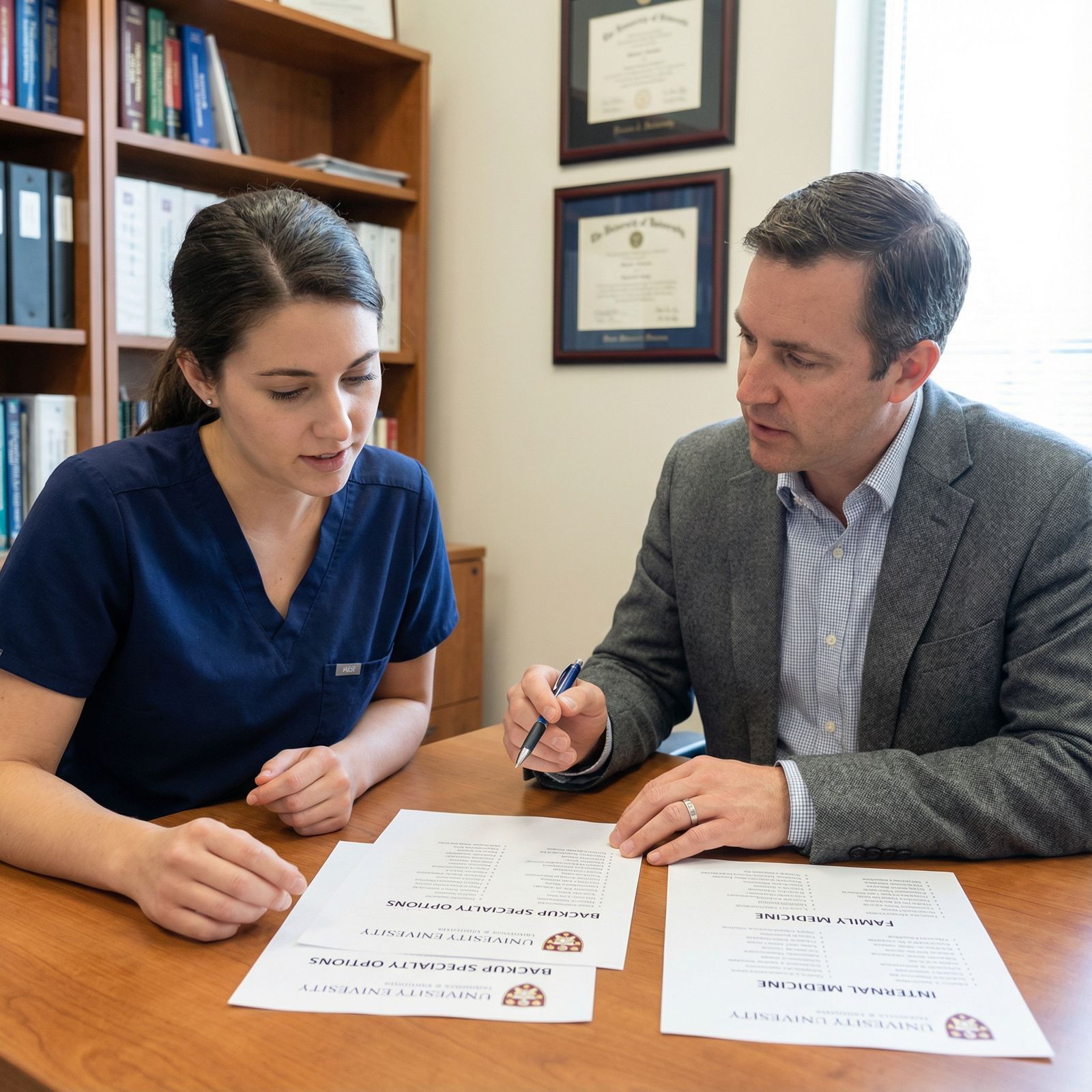
Understanding Why DO Applicants Need a Thoughtful Backup Plan
For a DO graduate aiming for cardiothoracic surgery, backup specialty planning is not a signal of doubt—it’s a strategic necessity.
Cardiothoracic surgery is among the most competitive and lengthiest training pathways. The traditional route in the US currently looks like one of the following:
General Surgery → Cardiothoracic Fellowship
- 5 years General Surgery residency
- 2–3 years Cardiothoracic (CT) Surgery fellowship
Integrated Cardiothoracic (I-6) Residency
- 6 years direct cardiothoracic surgery training after medical school
These paths are highly selective, and DO graduate residency applicants still face additional barriers in some academic and historically MD-dominant programs, especially at large quaternary centers with established CT programs.
Because of that, your application strategy should include:
- A primary pathway to CT surgery (I-6 or General Surgery with CT intent)
- A carefully chosen backup specialty (or specialties) that:
- You could see yourself doing long-term if necessary
- Keeps you connected to heart surgery training or cardiopulmonary care as much as possible
- Reflects realistic odds based on your academic profile and programs’ DO-friendliness
Thinking in terms of pathways instead of one dream vs. one backup is especially helpful. You’re not abandoning cardiothoracic; you’re building multiple roads that can still lead you toward high-acuity cardiopulmonary practice, operative exposure, or related procedural careers.
This article walks you through how to approach:
- The landscape for DOs interested in cardiothoracic surgery
- Core principles of backup specialty planning
- High-yield backup options aligned with CT surgery interests
- How to execute dual applying residency strategies as a DO graduate
- Common pitfalls and FAQs
The Competitiveness Landscape for DOs in Cardiothoracic Surgery
1. The Integrated CT Surgery (I-6) Route
I-6 programs are very limited in number and tend to:
- Be located in large academic centers
- Strongly prioritize research productivity
- Heavily weight USMLE Step 2 CK scores, clerkship honors, and prestigious letters
- Frequently favor applicants from “home” or affiliated medical schools
For DO applicants, there are three realities:
- Explicit or implicit screening: Some I-6 programs explicitly welcome DOs; others rarely interview them even without public exclusion.
- Applicant volume vs. spot count: The number of applicants per spot is high; even strong MD applicants commonly go unmatched.
- Profile expectations: Many matched I-6 residents have robust CT research, multiple publications, and strong academic track records.
This means if I-6 is your only plan and you are a DO graduate, the risk of going unmatched is substantial, even with a good application.
2. The General Surgery → CT Fellowship Pathway
This path is significantly more achievable for DOs:
- More General Surgery programs are DO-friendly
- You can develop your CT profile during residency (research, case logs, mentorship)
- Cardiothoracic fellowships evaluate applicants based on surgical residency performance, not just medical school letters or board scores
Nevertheless, categorical General Surgery is still competitive, especially at large, academic, big-name centers. Many of those programs use Step scores and class rank heavily in filters.
3. Why a Backup Specialty Still Matters
Even if you mainly target General Surgery, you may face risks such as:
- Limited interviews due to board score filters (especially if you only took COMLEX, or if scores are borderline)
- A thin application in research, honors, or strong letters from academic surgeons
- Late discovery that your application isn’t as competitive as peers in the same cycle
A well-chosen plan B specialty can:
- Protect you from going unmatched
- Still align you with cardiopulmonary and operative interests
- Support a very fulfilling alternative career that may still intersect with CT surgery (ICU, cath lab, heart failure, pulmonary hypertension, etc.)
The key is making this choice deliberate and early, not reactive and panicked in September.

Core Principles of Backup Specialty Planning for DO CT Aspirants
Principle 1: Separate “Interests” from “Pathways”
You may love heart surgery, the OR, high acuity, and anatomy. Those interests can be expressed in multiple careers:
- CT surgery (I-6 or fellowship)
- General Surgery with a focus on thoracic, vascular, or complex oncologic surgery
- Vascular Surgery
- Cardiology (especially interventional or structural)
- Cardiac Anesthesiology or Critical Care
- Pulmonary/Critical Care with a CT-ICU focus
Actionable advice:
List your top 3–5 elements of CT surgery that appeal to you (e.g., long complex operations, ICU care, cardiovascular pathophysiology, high-tech procedures) and then identify other specialties that share those elements.
Principle 2: Your Backup Cannot Be a Token Choice
Your backup specialty is not just “something easier”. You must:
- Be willing to train and practice in it long-term if CT is not ultimately feasible
- Invest in targeted experiences (rotations, letters, a short personal statement)
- Be authentic during interviews
Programs can sense when you have zero real interest in their specialty; this can hurt your match chances in both specialties.
Principle 3: Align Backup with Your Academic Profile as a DO Graduate
As a DO graduate, when planning an osteopathic residency match or ACGME match, consider:
- Board scores: COMLEX alone vs. COMLEX + USMLE; any failures or low scores
- Class rank and honors
- Research output, especially in CT or related fields
- Clinical evaluations and letters
You need a backup specialty where:
- Your metrics fall comfortably within or above the typical matched range
- Programs in that specialty have a track record of accepting DOs
- Your existing experiences can be reframed to demonstrate genuine fit
Principle 4: Manage the Logistics of Dual Applying
Dual applying residency (applying to more than one specialty) requires:
- Double or modified personal statements
- Thoughtful use of ERAS experiences (ordering, emphasis)
- Strategic letters of recommendation (LOR) allotment
- Slightly different program lists and geographic targeting
This takes time and emotional bandwidth. Plan early rather than trying to retro-fit your application in September or October.
High-Yield Backup Specialties for DOs Interested in Cardiothoracic Surgery
Not every possible plan B specialty will be appropriate for your profile. Below are commonly considered backup options for DO graduates with CT aspirations, along with pros, cons, and practical considerations.
1. General Surgery as “Primary,” With a True Plan B Specialty
Most DOs who dream of CT surgery sensibly make categorical General Surgery their primary target, rather than I-6. For many, the real backup is not another CT route, but a non-CT general surgery career that they would still enjoy.
Pros
- Widest match footprint across the country
- Many DO-friendly programs
- Keeps the door open to CT fellowship, thoracic, vascular, or other complex surgery
- High alignment with OR-based, procedural interests
Cons
- Still competitive at academic/university centers
- Residents can struggle with lifestyle demands if their heart isn’t in broad surgery, not just CT
- If you do not secure a strong surgery position, CT fellowship competitiveness may be limited
Who this fits best:
- DO grads with solid scores (COMLEX and ideally USMLE), decent research, and strong surgery letters
- Those willing to train in a wide range of geographic locations
If General Surgery is your primary road to heart surgery training, your backup specialty may be one of the following:
2. Vascular Surgery (Integrated or Fellowship Path)
Why it aligns with CT interests:
- Heavy focus on major vessels, aorta, peripheral circulation
- Complex open and endovascular procedures
- Close overlap with CT in aortic surgery, hybrid operations, and ICU care
Pros for DO applicants:
- Some integrated vascular (0+5) programs are open to DOs
- Strong General Surgery → Vascular fellowship pathway
- Combines high-acuity operative care with less intense competition than I-6 CT
Cons:
- Still competitive; not an “easy” backup
- Practically becomes another primary target, not a low-risk plan B
- Some programs may still favor MDs
Use case:
If you have strong metrics and truly like vascular pathology, integrated vascular or a vascular-focused General Surgery residency can be a quasi-backup that still keeps you in a world very similar to cardiothoracic surgery.
3. Anesthesiology (with Potential Cardiac Focus)
Why it aligns:
- Intraoperative care of CT patients, including CABG, valve surgery, lung resections
- Exposure to TEE, complex hemodynamics, mechanical circulatory support
- Potential subspecialization in cardiac anesthesiology and critical care
Pros:
- Anesthesiology is generally friendlier to DO graduates than CT I-6
- Many programs appreciate strong Step/COMLEX performance and physiology knowledge
- Lifestyle, compensation, and job market are robust
Cons:
- You are not the primary operator; if your deepest satisfaction derives from dissecting and suturing, this may be a big change
- Requires genuine interest in pharmacology, monitoring, and perioperative medicine
Practical approach:
- Arrange at least one anesthesia elective
- Secure at least one strong LOR from an anesthesiologist
- In your anesthesiology personal statement, emphasize your love for OR environment, cardiopulmonary physiology, and teamwork with surgeons
This can be an excellent plan B specialty for a DO who is fascinated by heart surgery training but is open to a non-surgical, yet high-acuity, OR-centered career.
4. Internal Medicine → Cardiology / Critical Care
Why it aligns:
- Deep dive into cardiovascular disease, hemodynamics, and advanced therapies
- Potential to become an interventional cardiologist or structural cardiologist doing catheter-based procedures (valve interventions, complex PCI)
- Critical Care and Cardiology both interface heavily with CT surgeons
Pros:
- Internal Medicine has a large number of positions nationwide, with many DO-friendly programs
- You can still work closely with cardiothoracic surgery through heart failure, cardiomyopathy, transplant, pulmonary hypertension, or CT-ICU services
- Good long-term flexibility in practice environment
Cons:
- You won’t be in the OR doing open heart surgery
- Training time can still be long (3 years IM + 3 years Cardiology +/- Interventional/Structural fellowship)
- Some top-tier cardiology fellowships are highly competitive, similar to CT fellowship
Best for:
- DO graduates with strong medicine evaluations, who enjoy pathophysiology, long-term patient relationships, and procedural work
- Those who might find long-term satisfaction in heart-centered medicine even without holding the scalpel
5. Pulmonary/Critical Care Medicine
Why it aligns:
- Critical care of post-op CT patients, ECMO, ventilator management, complex shock
- Many CT surgeries’ outcomes hinge on excellent ICU care
- Heavy overlap with cardiology, anesthesia, and CT surgery in multidisciplinary teams
Pros:
- Large number of Internal Medicine residency positions
- Realistic for DO graduates with solid but not off-the-charts board scores
- Can work in CT-ICUs, surgical ICUs, or mixed ICUs
Cons:
- Your work is primarily in the ICU, not the OR
- Demanding lifestyle in high-acuity ICUs
- Must enjoy longitudinal critical care rather than procedural focus alone

How to Execute a Dual Applying Residency Strategy as a DO
Once you’ve decided on your primary path (e.g., General Surgery with CT goal) and your backup specialty (e.g., Anesthesiology or Internal Medicine), you need a practical, step-by-step strategy.
Step 1: Map Out Your Application Components
Core ERAS components:
- Personal statement(s)
- Letters of recommendation
- Experiences section (research, work, leadership)
- Program list and filters
- MSPE and transcripts (largely fixed)
Create a table:
| Component | CT / General Surgery Path | Backup Specialty Path |
|---|---|---|
| Personal Statement | Focus on surgery, CT interest | Focus on that field (e.g., anesthesia, IM) |
| LORs | Surgeons/CT surgeons | At least 1–2 in backup specialty |
| Rotations/Aways | Surgery, CT surgery if possible | At least 1 in backup specialty if time allows |
| ERAS Experiences | Emphasize CT surgery leadership, research | Reframe same experiences for backup specialty |
Step 2: Plan Your Letters of Recommendation
Target:
- 2–3 surgical letters (including at least one from a CT surgeon if possible)
- 1–2 letters from your backup specialty (e.g., an anesthesiologist, cardiologist, internist)
Use ERAS’s flexibility wisely:
- Assign specialized letters to specific programs
- For surgical programs, emphasize your CT interests and technical ability
- For backup specialty programs, emphasize your overall clinical skills, team communication, and interest in that particular discipline
Step 3: Tailor Your Personal Statements
You will likely need two core personal statements:
Surgery / CT-focused Statement
- Why you’re drawn to surgery and CT
- Operative experiences, CT shadowing, research
- Long-term goals in cardiothoracic surgery
Backup Specialty Statement
- Authentic reasons you enjoy that specialty
- Overlap with your CT interests (e.g., cardiopulmonary physiology in anesthesia or IM)
- How your background will make you effective in that field
Avoid reusing a surgery-heavy statement for a non-surgical field. Programs notice.
Step 4: Build a DO-Friendly Program List
For both your primary and backup paths, explicitly research:
- Programs that historically interview and match DOs
- Programs that list COMLEX accepted or encouraged
- Highly competitive brand-name centers that rarely rank DOs highly (you can still apply, but adjust expectations)
For a DO graduate residency strategy:
- Cast a wide geographic net
- Apply more broadly to the backup specialty if your primary path is high-risk (e.g., I-6 programs + a broad anesthesiology list)
Step 5: Be Strategically Honest During Interviews
When interviewing in your backup specialty:
- Do not emphasize that you are “only here because of cardiothoracic surgery.”
- Instead, highlight genuine aspects you enjoy:
- “I’ve always loved cardiopulmonary physiology, which drew me to CT surgery; I realized anesthesia offers a different but equally compelling way to work in that space.”
- You can acknowledge a broad interest in cardiopulmonary care without implying that you will leave the field at the first chance to do CT.
Programs want residents committed to their specialty’s training and culture—not people who plan to leave at the earliest opportunity.
Common Pitfalls and How to Avoid Them
Pitfall 1: Waiting Too Late to Decide on a Backup
If you wait until August or September to choose your plan B specialty:
- You may not have time to schedule an elective rotation
- You may lack strong letters from that specialty
- Your personal statement may feel rushed and generic
Solution:
Start exploring backup options in late M3 or early M4, especially if your metrics are borderline for your dream path.
Pitfall 2: Ignoring Your DO Status in Program Selection
Some applicants apply heavily to hyper-academic I-6 or General Surgery programs with little historical DO representation, underestimating the risk.
Solution:
Use objective resources:
- Program websites (check resident rosters for DOs)
- Insights from current residents or alumni
- Specialty society lists or forums (with caution, but they give hints)
Be realistic in your osteopathic residency match strategy by balancing academic aspirations with DO-friendly programs.
Pitfall 3: Choosing a Backup You Actively Dislike
If you pick a plan B specialty that you cannot imagine practicing:
- You may undersell yourself at interviews
- You’ll be unhappy if you match there
- Burnout risk skyrockets
Solution:
When evaluating a backup, ask:
“If I knew today that I would never become a CT surgeon, could this still be a satisfying, meaningful career for me?”
If the answer is an honest “no,” reconsider that specialty.
Pitfall 4: Overemphasizing CT in Backup Interviews
Telling an anesthesiology or internal medicine PD that you “really want to be a cardiothoracic surgeon” can be interpreted as:
- Lack of commitment to their specialty
- High risk of attrition or low morale
Solution:
You can say:
- “I’ve always gravitated toward cardiopulmonary disease and high-acuity environments. Over time, I’ve realized that I’m drawn to the role [anesthesiologists/internists/cardiologists] play in that space.”
This keeps your story coherent without undermining your backup choice.
FAQs: Backup Specialty Planning for DO Graduates in Cardiothoracic Surgery
1. As a DO, is it realistic to aim for an Integrated I-6 Cardiothoracic Surgery residency?
It is possible, but highly competitive and relatively rare. Many I-6 programs have historically matched very few DOs. If you are a DO with:
- Outstanding board scores (preferably COMLEX + USMLE)
- Significant CT research and publications
- Strong letters from CT or cardiology mentors
- Honors in surgical rotations
…then you can include I-6 programs in your strategy. However, you should not rely on I-6 alone. Combine I-6 applications with a robust list of categorical General Surgery programs and a thoughtful backup specialty (e.g., anesthesiology, internal medicine).
2. What is the best backup specialty if I never want to give up on heart surgery training?
If your non-negotiable is staying as close as possible to heart surgery:
- Primary path: Categorical General Surgery at a DO-friendly program with CT exposure
- Backup but still CT-adjacent:
- Vascular Surgery (integrated or fellowship)
- General Surgery with a thoracic or complex aortic focus
- Later fellowship in Critical Care with heavy CT-ICU involvement
Even if you never become a board-certified cardiothoracic surgeon, you can still work in a high-acuity, operative, and cardiovascular environment through vascular, complex general, or ICU-based careers.
3. Should I dual apply to General Surgery and Internal Medicine as a DO interested in CT?
This can be a very reasonable strategy, especially if:
- Your board scores or clinical performance make a purely surgical match somewhat risky
- You have strong Internal Medicine evaluations and at least one IM LOR
In this dual applying scenario:
- Emphasize surgery and CT interests on your General Surgery applications
- Emphasize cardiology, critical care, or CT-ICU overlap on your Internal Medicine applications
You could then pursue cardiology, interventional cardiology, or pulmonary/critical care as a plan B that still aligns with high-acuity, heart-focused work.
4. How many programs should I apply to if I’m dual applying?
Numbers vary by year and by your competitiveness, but for many DO applicants:
- Primary specialty (e.g., General Surgery): Often 40–60+ programs, more if scores are borderline or you have geographic constraints
- Backup specialty (e.g., Anesthesiology or Internal Medicine): Another 30–50+ programs, depending on competitiveness
Discuss your exact numbers with your school’s advising office or mentors familiar with DO match data. When dual applying residency, err on the side of applying more broadly, particularly in the backup specialty, to reduce the risk of going unmatched.
Thoughtful backup specialty planning is not an admission of weakness; it is a mark of maturity and strategic thinking—especially for a DO graduate pursuing a highly competitive field like cardiothoracic surgery. By aligning your interests with realistic pathways, understanding where DOs are welcomed, and executing a coherent dual-application strategy, you can protect yourself in the match while still honoring your passion for cardiothoracic and cardiopulmonary care.