
Choosing backup medical specialties is one of the most strategic—and often under-discussed—parts of the residency application process. Thoughtful planning can protect you from an unexpected outcome in the Residency Match while still positioning you for a satisfying, sustainable career.
This guide walks you through how to choose backup specialties that genuinely fit your interests, skills, and long-term goals in medicine, instead of feeling like “settling.” It is designed for medical students and international medical graduates navigating Medical Education, Career Guidance, and Residency Match planning.
Understanding Backup Specialties in the Residency Match
Backup specialties are alternative medical specialties you apply to alongside your primary choice, in case you do not match into your top field. They are not “consolation prizes”; when chosen carefully, they are viable and fulfilling career paths that still align with who you are and how you want to practice medicine.
Why Thoughtful Backup Options Matter
The Residency Match is competitive and, at times, unpredictable. Even well-qualified applicants can go unmatched in their dream specialty because of limited positions, regional constraints, or small changes in application strategy.
Having realistic, well-chosen backup options offers several advantages:
Security in the Match Process
- You reduce the risk of going completely unmatched.
- You gain a more confident, less anxious mindset as you apply.
- You maintain a continuous path in your Medical Education instead of taking an unplanned gap year.
Room to Discover Other Interests
- Medical school and clinical rotations often shift your sense of what you enjoy.
- You may discover unexpected satisfaction in specialties you initially considered only as “backups.”
- Many physicians ultimately feel grateful they matched into what was once their second choice.
Better Alignment with the Job Market
- Some Medical Specialties are consistently oversubscribed (e.g., dermatology, plastic surgery, orthopedic surgery) while others have more robust job markets and geographic flexibility (e.g., family medicine, psychiatry).
- Backup specialties can position you in fields with strong long-term demand, geographic flexibility, and diverse practice settings.
Preserving Momentum in Your Career
- Matching into a compatible backup specialty lets you continue progressing—clinically, academically, and financially—rather than pausing your career to reapply.
- You can still pursue subspecialty training, research, teaching, or leadership from many “backup” fields.
Step 1: Honestly Assess Your Interests and Core Strengths
Choosing backup specialties is not about abandoning your interests—it’s about broadening where those interests could reasonably fit.
Reflect on What Actually Energizes You
Ask yourself:
What topics grab your attention during lectures and self-study?
Are you drawn to physiology and diagnostics, procedural skills, behavioral science, or population health?Which rotations have you looked forward to the most?
Think about:- The pace (fast vs. steady)
- Patient population (kids, adults, elderly, diverse communities)
- Setting (hospital, clinic, emergency department, OR, community outreach)
What kind of problems do you like to solve?
- Complex diagnostic puzzles → internal medicine, neurology
- Procedures and immediate results → emergency medicine, anesthesiology
- Longitudinal care and relationships → family medicine, pediatrics
- Systems and policy impact → preventive medicine, public health
Keep a running list or journal during clerkships. Patterns often appear by the middle of third year.
Evaluate Your Skills and Working Style
Consider both your natural abilities and what you enjoy practicing:
Cognitive vs. Procedural Balance
- Do you prefer thinking through complex cases over hours or days?
- Or high-volume, hands-on work with immediate tangible outcomes?
Communication and Counseling
- If you thrive on deep conversations about behavior change, coping, and support, psychiatry, addiction medicine, and family medicine may be good fits.
- If you prefer brief, targeted interactions, consider emergency medicine, anesthesiology, or radiology.
Tolerance for Uncertainty and Pressure
- ER and critical care doctors must make rapid decisions under pressure with incomplete information.
- Outpatient-focused specialties may involve more controlled environments and time to think.
Match these traits to specialties—not only your first choice, but possible backups. For example:
You love OR time and procedures, but are worried about matching into orthopedics.
- Potential backups: general surgery, anesthesiology, interventional radiology pathways, obstetrics & gynecology (for surgical content).
You enjoy diagnostic puzzles but are unsure about internal medicine competitiveness in certain regions.
- Potential backups: family medicine with strong inpatient training, transitional year plus later subspecialty options, neurology, or combined internal medicine–pediatrics where available.

Step 2: Weigh Lifestyle, Values, and Long-Term Fit
Lifestyle considerations are not superficial—they are central to sustaining a long, healthy career. Your backup specialties should be ones you can see yourself practicing for decades.
Work–Life Balance and Schedule Preferences
Ask yourself:
- How important are predictable hours to you?
- Are you comfortable with shift work (nights, weekends, holidays)?
- How do you feel about frequent on-call duty vs. predominantly clinic-based work?
Approximate tendencies (there are exceptions in every field):
More predictable or outpatient-heavy options
- Family medicine
- General pediatrics
- Outpatient psychiatry
- Outpatient internal medicine
- Many public health, occupational medicine, and preventive medicine roles
Shift-based but intense
- Emergency medicine
- Hospitalist medicine
- Some anesthesiology practices
Longer training and often higher call burden
- General surgery and surgical subspecialties
- Obstetrics & gynecology (especially with labor & delivery call)
If your first choice is highly demanding, you may want at least one backup with comparatively better work–life balance.
Subspecialty and Career Flexibility
Backup specialties should leave open multiple doors:
- Internal Medicine → cardiology, gastroenterology, hematology/oncology, infectious disease, hospitalist, academic medicine, research.
- Family Medicine → sports medicine, geriatrics, women’s health, addiction medicine, academic leadership, community health.
- Pediatrics → PICU, pediatric cardiology, neonatology, developmental-behavioral pediatrics.
- Psychiatry → child & adolescent, addiction psychiatry, consultation-liaison, forensic psychiatry.
Think about how much you value:
- Future academic or teaching opportunities
- Possibility of part-time work
- Geographic flexibility (urban vs rural vs international)
- Non-clinical pathways (administration, policy, Medical Education, telemedicine)
Step 3: Analyze Competitiveness and Job Availability
Career Guidance around the Match must balance what you love with where you are realistically likely to train and practice.
Understand Competitiveness for Your Profile
Look at recent data (NRMP, specialty societies, your dean’s office) for:
- Match rate by specialty
- Average Step/COMLEX scores
- Number of applicants vs. available positions
- Preference for US vs. international medical graduates
- Typical research output and leadership expectations
If your primary specialty is very competitive, think strategically:
Example: Applying to dermatology as primary.
- Consider backups like internal medicine (with plan for rheumatology/allergy), family medicine (with strong procedural focus), or preventive medicine/public health with dermatologic interests.
Example: Applying to orthopedic surgery.
- Consider general surgery, physical medicine & rehabilitation (PM&R) for musculoskeletal focus, or internal medicine with sports medicine fellowship potential.
Backup specialties should be fields where:
- Your application metrics are comfortably above or near the average, and
- You can demonstrate genuine interest and fit—not just a last-minute pivot.
Evaluate the Job Market and Geographic Realities
Consider:
National Demand Trends
- Primary care (family medicine, internal medicine, pediatrics) remains in high demand, especially in underserved areas.
- Psychiatry continues to experience workforce shortages in many regions.
- Geriatrics, palliative care, and hospital medicine are growing alongside an aging population.
Geographic Flexibility
- Some specialties are heavily concentrated in academic centers or large cities.
- Others (e.g., family medicine, general pediatrics) have broad opportunities in urban, suburban, and rural areas.
Your Personal Location Constraints
- If you must stay in a specific region for family or personal reasons, understand how that affects match odds and job options in each specialty.
Combining competitiveness data with job outlook helps you prioritize which backup specialties offer both realistic training opportunities and a stable future.
Step 4: Use Mentors, Advisors, and Networking Strategically
You do not have to design your backup plan alone. Strong guidance is one of the most powerful tools in Medical Education and career planning.
Talk Openly with Advisors and Program Leadership
Meet with:
- Your school’s career counseling office or dean’s office
- Specialty advisors in both your primary field and potential backups
- Residents or fellows who recently went through the Match
Ask specific questions:
- “Given my scores, clinical performance, and CV, how risky is it to apply only to [primary specialty]?”
- “What backup specialties would align with my strengths and interests?”
- “How do applicants typically structure applications when they’re applying to two specialties?”
Be honest about your goals and limitations. Advisors cannot help you plan effectively if they do not know your full situation.
Build Networks in Multiple Specialties
Attend:
- Specialty interest group meetings
- Departmental grand rounds
- Residency program open houses and Q&A sessions
- Conferences (local or national) when possible
Networking benefits:
- Clarifies how different specialties feel day-to-day
- Helps you secure letters of recommendation from multiple fields if needed
- Gives insight into competitiveness and culture of specific programs
Step 5: Maximize Rotations, Electives, and Shadowing
Hands-on exposure is the most reliable way to test whether a field is a good fit—for primary or backup specialties.
Use Core Rotations Intentionally
During required clerkships:
- Observe your emotional response to each environment
- Notice when time passes quickly vs. slowly
- Reflect on whether you enjoy the patients and the problems you’re managing
Even if you are “sure” about your first choice, remain open to genuine interest in other fields—it may shape your backup plan.
Targeted Electives and Sub-Internships
When developing backup options:
Schedule at least one focused elective in your potential backup specialty early enough to:
- Confirm or reject your interest
- Obtain at least one strong letter of recommendation
- Demonstrate commitment, not a last-minute fallback
Try a sub-internship (sub-I) or acting internship if possible:
- This provides near-resident-level responsibility and a realistic sense of workload.
- Programs value applicants who have performed well in these roles.
Shadowing and Short-Term Experiences
If scheduling full rotations is challenging:
- Arrange short shadowing experiences (even a day or two) with physicians in potential backup fields.
- Ask to see multiple practice settings: academic center, community hospital, outpatient clinic, telehealth sessions.
Questions to ask during shadowing:
- “What do you find most rewarding in this specialty?”
- “What are the biggest challenges or frustrations?”
- “If you could go back, would you choose this specialty again?”
- “What types of students and residents tend to thrive here?”
Step 6: Understand Training Pathways and Educational Requirements
Backup specialties may differ significantly in length and structure of training. Make sure those differences are acceptable to you.
Key Aspects to Compare
For each potential specialty (primary and backup):
Residency Length
- 3 years: family medicine, internal medicine, pediatrics, psychiatry, many pathology and neurology programs
- 4+ years: emergency medicine (some programs), anesthesia (4 with prelim year), general surgery (5+), OB/GYN, radiology, most surgical subspecialties
Preliminary or Transitional Year Requirements
- Some specialties require a separate preliminary year in medicine or surgery.
- Backup specialties like internal medicine or transitional year programs can be stepping stones.
Board Certification and Continuing Education
- Consider exam requirements and maintenance of certification.
- Are you comfortable with ongoing exams, CME, and recertification expectations?
Fellowship Options
- Are you willing to train longer to reach your ideal niche (e.g., cardiology after internal medicine, neonatology after pediatrics)?
- Does the backup specialty offer fellowships that approximate aspects of your first choice?
Understanding training cycles helps you avoid choosing a backup that conflicts with your desired timeline or tolerance for long training.
Step 7: Align Backup Specialties with Your Long-Term Career Vision
Your career is more than the Match—it spans decades. Backup specialties should support, not derail, your broader aspirations.
Clarify Your Long-Term Goals
Reflect on:
- Do you see yourself in academic medicine, teaching, and research?
- Are you drawn to community-based practice, long-term patient relationships, and local leadership?
- Do you envision roles in public health, administration, medical education, or health policy?
- How important is procedural work vs. mainly cognitive or administrative work?
Then ask:
- “Can this backup specialty realistically get me to that long-term vision, even if the path is different?”
Examples:
If you love oncology but worry about matching into competitive subspecialty programs:
- Internal medicine or pediatrics as a backup keep many oncology fellowships open.
- Public health + internal medicine may lead to population-level cancer prevention work.
If your passion is women’s health, but you are concerned about OB/GYN competitiveness:
- Consider family medicine with a strong women’s health and obstetrics focus.
- Med–peds with an interest in adolescent and young adult women’s health.
- Preventive medicine or public health roles focused on maternal and child health.
When backup specialties are aligned with your values and goals, they become alternate paths, not dead ends.
Popular and Practical Backup Specialties to Consider
Not every specialty makes sense as a backup for every applicant. However, certain fields often serve as flexible, interest-aligned backup options because of broad training and strong job markets.
Family Medicine
Why it’s a strong backup:
- Broad scope: Pediatrics, adult medicine, women’s health, geriatrics, chronic disease management.
- High demand in urban, suburban, and rural settings.
- Opportunities in sports medicine, addiction medicine, geriatrics, urgent care, and academic family medicine.
Great for applicants who:
- Value continuity and relationships.
- Are interested in health equity, underserved care, or community impact.
- Want a relatively shorter training path with many practice options.
Internal Medicine
Why it’s appealing:
- Strong foundation in complex adult care and diagnostics.
- Multiple competitive fellowships as later pathways.
- Hospitalist, outpatient, academic, and research-focused career options.
Great for applicants who:
- Enjoy deep diagnostic work and managing complex comorbidities.
- Seek flexibility in future subspecialization.
- Like a mix of inpatient and/or outpatient practice.
Pediatrics
Why it’s a meaningful backup:
- Focus on children and adolescents, preventive care, and developmental health.
- Possibility for NICU, PICU, pediatric cardiology, oncology, and other subspecialties.
Great for applicants who:
- Enjoy working with families and children.
- Appreciate preventive care and growth/developmental milestones.
- Want strong longitudinal relationships with patients and families.
Psychiatry
Why it’s increasingly popular:
- High and growing demand; significant workforce shortage in many regions.
- Opportunities in outpatient, inpatient, consult-liaison, addiction, and forensic settings.
- Emphasis on communication, counseling, and multidisciplinary collaboration.
Great for applicants who:
- Are drawn to mental health, behavior, and psychotherapy.
- Like complex biopsychosocial problem-solving.
- Value work–life balance potential and telepsychiatry options.
Emergency Medicine
Why it appeals as a backup for some:
- Variety of cases, rapid decision-making, and procedural work.
- Shift-based scheduling (blocks of time off between shifts).
- Opportunities in critical care, ultrasound, EMS, and administrative roles.
Great for applicants who:
- Enjoy fast-paced environments and acute care.
- Tolerate uncertainty and episodic patient relationships.
- Prefer shift work over traditional clinic schedules.
Public Health / Preventive Medicine
Why it’s a unique option:
- Focus on population-level interventions, epidemiology, and policy.
- Roles in government, NGOs, academia, and health systems leadership.
Great for applicants who:
- Care deeply about health systems, policy, and large-scale impact.
- Might combine clinical training (e.g., internal medicine, pediatrics) with an MPH or preventive medicine residency.
These are not the only options—but they highlight how backup specialties can still align with your interests and values while providing strong Residency Match and career prospects.
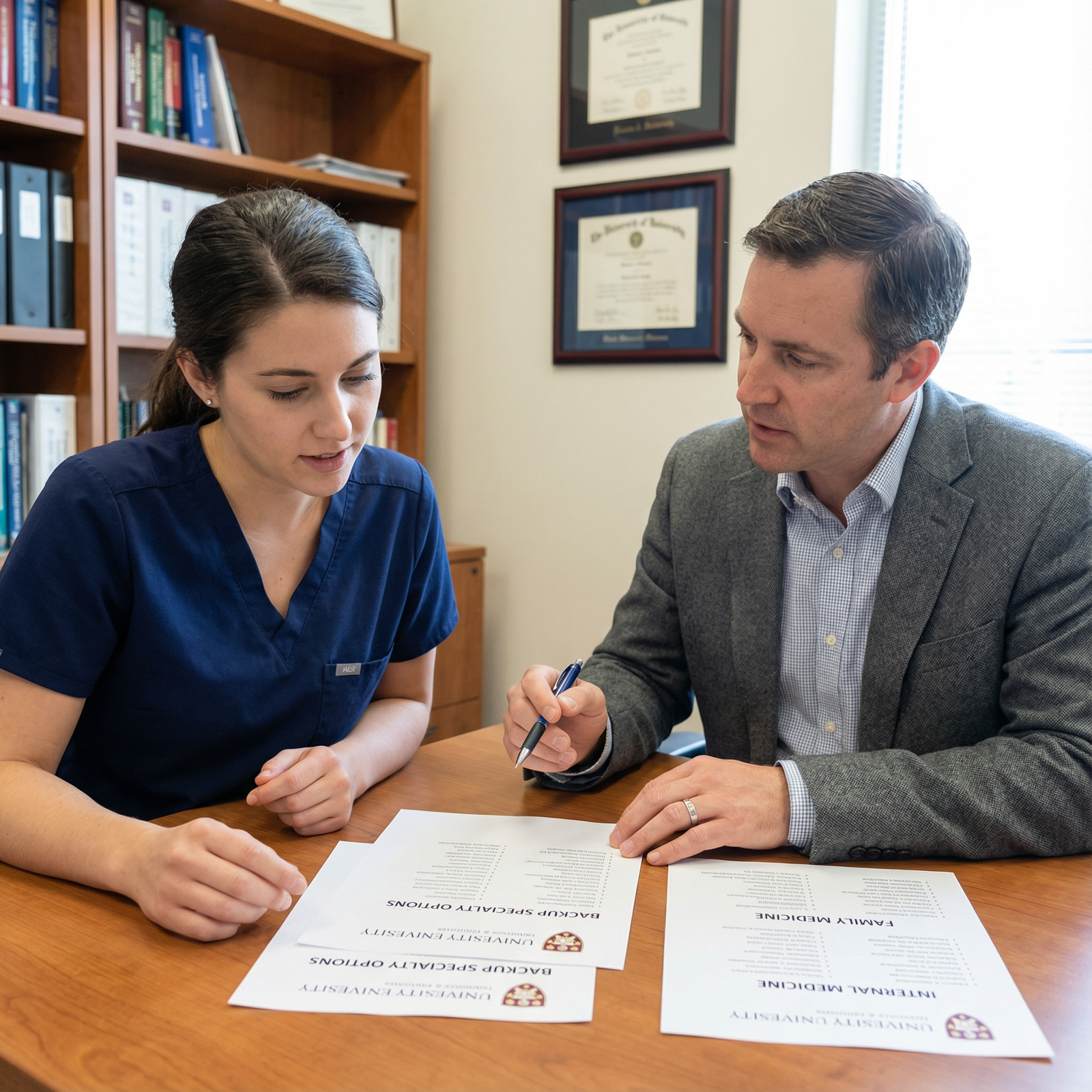
Putting It All Together: Building a Coherent Backup Plan
When you’re ready to formalize your strategy:
Identify 1–2 realistic backup specialties that:
- Genuinely interest you
- Fit your skills and lifestyle goals
- Are less competitive than your primary specialty (for your profile)
- Offer acceptable long-term career options
Plan your application mix:
- Discuss with your advisor how many programs to apply to in each specialty.
- Ensure your personal statement and letters of recommendation are tailored to each field.
- Avoid sending a generic application to very different specialties without clear, field-specific narratives.
Prepare for Interviews in Multiple Fields:
- Be ready to authentically articulate why you are applying to each specialty.
- Have a coherent story: your experiences, your interests, and how this specialty fits your goals.
Stay Flexible and Reflective:
- As you progress through interview season, reassess your comfort with each specialty.
- Rank lists should reflect where you can most realistically thrive, not only your original hierarchy.
FAQ: Backup Specialties and the Residency Match
Q1: What if I still can’t decide on a backup specialty?
It’s common to feel uncertain. Start by ruling out fields that clearly do not fit your interests or lifestyle preferences. Then, narrow your options by:
- Reviewing your rotation experiences and clerkship evaluations
- Meeting with mentors and specialty advisors
- Scheduling brief electives or shadowing in 1–2 promising fields
Choose the specialty where your interest, strengths, and competitiveness overlap most.
Q2: How do I find out which specialties are more competitive for my application?
Use multiple sources:
- NRMP and specialty-specific match data (Step/COMLEX averages, match rates)
- Your school’s dean’s office and career counseling reports
- Recent graduates’ experience from your institution
Compare your academic metrics, research, and extracurriculars to typical matched applicants in each field.
Q3: Can I change my backup specialty later in medical school or during residency?
Yes. Your preferences often evolve:
- During M3–M4, you can pivot your backup plan based on new experiences.
- During residency, some physicians change specialties by reapplying or pursuing fellowships that shift their practice.
However, changing later often requires more time, effort, and sometimes additional training, so early reflection and planning are helpful.
Q4: Will programs view me negatively if I apply to more than one specialty?
Not if you do it thoughtfully. Many students apply to two related fields. The key is:
- Tailor each application (personal statements, letters, experiences) to that specialty.
- Be honest and coherent in your story during interviews.
What raises concerns is a generic, unfocused application that suggests you haven’t seriously considered the specialty.
Q5: Should I feel disappointed if I match into a backup specialty?
It’s natural to have mixed emotions initially, but many physicians discover deep satisfaction in what was once a “backup.” Over time:
- You may find that the specialty aligns better with your strengths and values than your original choice.
- You retain opportunities for subspecialization, leadership, research, and teaching.
What matters most is building a meaningful, sustainable career—and backup specialties can absolutely offer that.
Selecting backup specialties is not a sign of doubt or weakness; it is smart, strategic planning in a competitive Residency Match environment. By aligning your backups with your genuine interests, strengths, lifestyle preferences, and long-term goals, you ensure that—no matter where you match—you are on a path to a rewarding and impactful career in medicine.