Understanding Backup Specialty Planning as an IMG
As an international medical graduate (IMG), you are navigating one of the most competitive processes in medicine: the U.S. residency Match. For many IMGs, the stakes feel existential—immigration status, finances, and years of training often ride on the outcome. That is exactly why a deliberate, well-researched backup specialty plan is not optional; it is essential risk management.
Backup specialty planning means intentionally developing a realistic “Plan B” (and sometimes Plan C) alongside your primary target specialty. It can include:
- Choosing a backup specialty that you would genuinely be willing to train and work in
- Dual applying residency in two or more fields
- Creating a non-residency Plan B for the year in case you do not match
The goal is not to lower your ambitions. The goal is to increase your odds of matching into a program that fits your life, skills, and values, while minimizing the chance of remaining unmatched.
This IMG residency guide will walk you step by step through how to:
- Assess your true competitiveness
- Identify realistic and meaningful backup specialties
- Strategically dual apply without sabotaging your primary application
- Communicate your plans ethically and convincingly
- Prepare contingency plans for SOAP and post-Match outcomes
Step 1: Honestly Assess Your Competitiveness as an IMG
Before you can design a smart backup plan, you must understand where you truly stand in the applicant pool.
Key Factors to Evaluate
USMLE Performance
- Step 2 CK score (Step 1 is now pass/fail, but history still matters)
- Number of attempts or failures
- Timing: Did you take exams within the last few years?
For competitive specialties (Dermatology, Plastic Surgery, Orthopedic Surgery, Radiology, Ophthalmology), IMGs often need significantly above-average Step 2 CK scores plus strong research and U.S. clinical experience (USCE). If your scores are average or below for those specialties, you must seriously consider a backup.
IMG Status Details
- US vs non-US IMG: U.S. citizen or permanent resident who studied abroad vs non-U.S. citizen IMG
- Visa requirement: Will you need a J-1 or H-1B?
- Year of graduation (YOG): More than 5–7 years since graduation can be a barrier for some specialties and programs
Clinical Experience
- U.S. clinical experience: observerships, externships, electives, hands-on roles
- Specialty-aligned experience: e.g., Internal Medicine sub-internships vs general observerships
- Home-country experience: internships, residency, or specialist training
Research and Publications
- Especially important for academic and competitive specialties: Internal Medicine (for top academic programs), Radiology, Neurology, Psychiatry, etc.
- Number of publications, abstracts, posters, ongoing projects
Geographic and Program Constraints
- Are you limited to certain regions due to family or visa issues?
- Are you only willing to apply to university programs, or are community programs also acceptable?
Red Flags That Strongly Suggest You Need a Backup Specialty
- Step 2 CK < 225–230 with no exceptional strengths elsewhere
- One or more USMLE failures
- Graduation > 5–7 years ago with limited recent clinical activity
- Minimal U.S. clinical experience, especially hands-on
- Needing an H-1B visa while targeting a specialty where few programs sponsor it
- Targeting a highly competitive specialty as a primary (e.g., Dermatology, Orthopedic Surgery, ENT, Plastics, Neurosurgery)
- Having significant geographical limitations (e.g., only one state)
If you see multiple of these in your profile, single-specialty applying is very risky. A structured backup specialty plan becomes critical.
Step 2: How IMGs Should Choose a Backup Specialty
Your backup specialty should be less competitive than your primary, but still aligned enough that you can present a believable narrative and genuinely imagine a career in it. It must be both strategic and sincere.

Common Primary–Backup Pairings for IMGs
These are examples, not rules. Always confirm updated competitiveness trends using NRMP and specialty-specific data.
- Internal Medicine (IM) → Backup: Family Medicine, Pediatrics, Psychiatry
- General Surgery → Backup: Preliminary Surgery + categorical Family Medicine / Internal Medicine, or Transitional Year
- Neurology → Backup: Psychiatry, Internal Medicine (prelim year then re-apply)
- Pediatrics → Backup: Family Medicine (especially for those interested in broad primary care)
- OB/GYN → Backup: Family Medicine with women’s health focus, Internal Medicine
- Psychiatry → Backup: Family Medicine, Internal Medicine (in some regions psych is now quite competitive)
- Radiology / Anesthesiology → Backup: Internal Medicine, Transitional Year, Family Medicine
Factors to Consider When Selecting a Backup
Competitiveness and IMG-Friendliness
- Does the specialty historically accept IMGs at a reasonable rate?
- Are there a good number of community or IMG-friendly programs?
- Does it commonly sponsor visas?
Generally more IMG-accessible specialties:
- Internal Medicine (especially community programs)
- Family Medicine
- Pediatrics
- Psychiatry
- Neurology
These make common Plan B specialty options for many international medical graduates.
Genuine Interest and Long-Term Fit Ask yourself:
- Can I realistically see myself doing this for 30+ years?
- Are there aspects of this specialty that align with my skills and personality?
- Would I feel regret or relief if I matched into this instead of my primary?
Do not choose a backup specialty you hate. That sets you up for burnout and possibly leaving the field later.
Transferable Skills and Overlap Programs like to see logical connections between your primary and backup specialties.
Example overlaps:
- Internal Medicine ↔ Neurology: complex diagnostics, inpatient care
- General Surgery ↔ Anesthesiology: OR environment, procedures, acute care
- OB/GYN ↔ Family Medicine: women’s health, prenatal care
- Psychiatry ↔ Neurology: brain, behavior, neuropsychiatric interface
The more overlap, the easier it is to write coherent personal statements and to answer interview questions without sounding inconsistent.
Lifestyle, Personality, and Values Consider:
- Work-life balance, call schedules, night shifts
- Procedural vs cognitive focus
- Patient population (children, adult, elderly)
- Outpatient vs inpatient
For example, if you strongly prefer continuity of care and clinic-based work, Family Medicine or Psychiatry might be better backup options than General Surgery.
Visa and Job Market Realities In some specialties, H-1B sponsorship is rare or the job market is saturated in certain regions. For IMGs needing visas, a Plan B specialty with broad geographic job opportunities is very important.
Step 3: Dual Applying Residency as an IMG – Strategy and Tactics
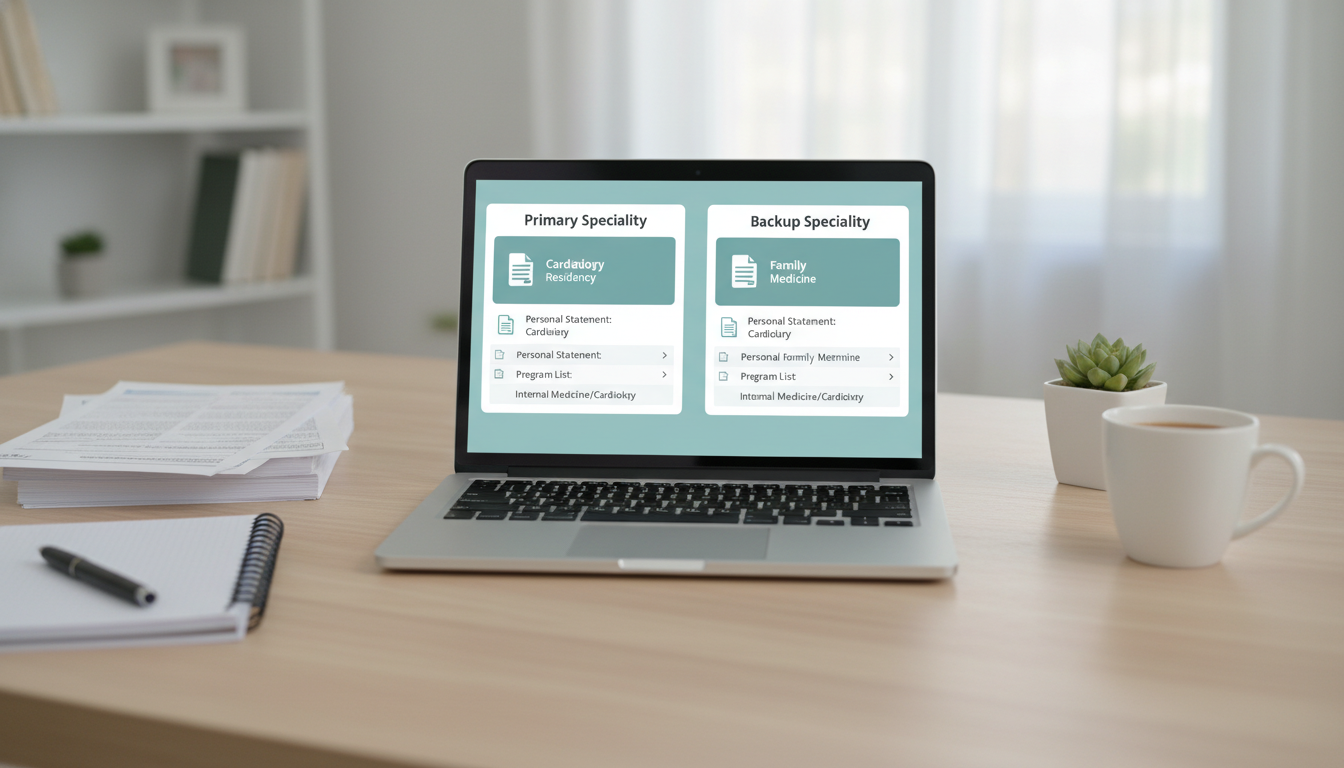
Dual applying means submitting ERAS applications to two different specialties in the same Match cycle. For IMGs, this is often the most practical execution of a backup specialty plan.
When Dual Applying Makes Sense
- Your primary specialty is clearly more competitive than your backup
- Your application has mixed signals (e.g., average scores but strong research in a competitive field)
- You have convincing experience in both specialties (rotations, letters, research)
- The risk of going unmatched is unacceptably high if you apply to only one field
It may be less ideal if:
- You are highly competitive on paper for your first-choice specialty
- Your professional experiences are in one field only (dual applying will look scattered)
Core Principles for Successful Dual Applying
Separate Personal Statements
- Write a distinct personal statement for each specialty.
- Each statement should explain:
- Why this specialty fits your skills and goals
- Relevant experiences (USCE, research, personal motivation)
- Do not reuse the same essay and simply change the specialty name.
Tailored Letters of Recommendation (LoRs)
- Aim for at least:
- 2–3 LoRs for your primary specialty
- 2–3 LoRs for your backup specialty (if possible)
- Use ERAS to assign specialty-appropriate letters to each program.
- A letter from a physician in the backup specialty saying, “This applicant will be a strong Family Medicine physician” is far more convincing than a generic internal medicine letter.
- Aim for at least:
Program List Segmentation
- Create separate Excel sheets or lists:
- Primary specialty programs
- Backup specialty programs
- Be realistic about:
- IMG-friendliness
- Score cutoffs (often unofficial but can be estimated from program data and forums)
- Apply broadly, especially for backup fields (100+ programs is common for IMGs in some specialties).
- Create separate Excel sheets or lists:
Application Content Consistency
- Your CV should tell one coherent story, even if you are applying to two specialties.
- Emphasize overlapping skills (communication, teamwork, patient-centered care, research, teaching).
- Avoid strong, conflicting language in experiences like:
- “Neurosurgery has always been my only dream” in one place, then
- “I am fully committed to a career in Psychiatry” elsewhere.
Instead, use wording like:
- “I am deeply drawn to working with patients with complex neurologic and psychiatric conditions…”
- “My clinical experiences confirmed my interest in both [primary field] and [backup field], and I am now applying to programs where I can develop as a strong clinician in these areas.”
Handling Interviews with Two Specialties
Prepare specialty-specific answers to common questions:
- “Why this specialty?”
- “Where do you see yourself in 10 years?”
If asked about your interest in other fields:
- Be honest but thoughtful.
- Example:
“I have also applied in Family Medicine, primarily because I am committed to practicing in the U.S. and working in patient-centered care. But in this interview, I want to focus on my genuine interest in Internal Medicine and what I can offer your program.”
Never talk negatively about your backup specialty when interviewing for your primary, and vice versa.
Example Dual Application Scenario
Profile:
- Non-US IMG, Step 2 CK: 229, one year of US observerships in Internal Medicine, some psychiatry shadowing, requires J-1 visa, YOG: 2019.
- Primary interest: Psychiatry
- Concern: Psychiatry has become more competitive in some regions and programs.
Strategy:
- Primary: Psychiatry (60–80 programs)
- Backup: Family Medicine (80–120 programs), especially IMG-friendly community programs
- PS: One psychiatry-focused personal statement highlighting interest in mental health, another for Family Medicine focused on holistic primary care.
- LoRs: 2 letters from psychiatrists, 2 from family medicine or internal medicine physicians; assign appropriately.
- Benefits: Maximizes chances of matching into at least one field where an ongoing interest in mental health can still be pursued.
Step 4: Advanced Backup and Plan B Specialty Strategies
A robust IMG residency guide should not stop at simple dual applying. You should also understand more nuanced “Plan B specialty” and structural strategies.
1. Using Preliminary or Transitional Years Strategically
If your primary specialty uses advanced positions (e.g., Radiology, Anesthesiology, Dermatology, PM&R), you will need a preliminary (prelim) or transitional year.
For some IMGs, prelim or transitional years can function as:
- A foot in the door at a hospital system
- A way to gain U.S. experience and stronger recommendations
- A temporary Plan B while you re-apply to your desired specialty
Limitations:
- Prelim positions do not guarantee automatic promotion to a categorical spot.
- You need a clear re-application plan from the start.
2. Specialty Switching Potential
Some specialties have higher historical rates of switching into them after starting in another specialty, such as:
- Family Medicine
- Psychiatry
- Internal Medicine
- Neurology (to some extent)
You should not rely solely on switching as a plan, but it can be part of your broader strategy.
Example:
- Start in Family Medicine (more IMG-friendly) with strong interest in Psychiatry.
- Seek rotations, mentorship, and electives in mental health during residency.
- After PGY-1 or PGY-2, apply for psychiatry positions if available.
This is not guaranteed and highly dependent on timing, performance, and openings.
3. Non-Residency Plan B for Unmatched IMGs
Even with smart dual applying and good planning, some international medical graduates will go unmatched. Your backup specialty planning must include a non-residency Plan B for at least 12–24 months.
Options include:
- Research positions (clinical or basic science) in U.S. institutions
- Clinical jobs where allowed:
- Clinical research coordinator
- Medical scribe
- Quality improvement roles
- Additional USCE: More observerships or externships
- Advanced degrees (cautiously):
- MPH, MS in Clinical Research, etc. (only if you understand the cost and visa implications)
- Re-taking or improving Step scores if possible
- Home-country clinical practice to avoid CV gaps
Your goal during this time is to strengthen your application for the next Match and maintain clinical relevance.
Step 5: Ethical and Emotional Aspects of Backup Planning
Backup planning isn’t just logistical; it is also emotional and ethical.
Showing Authenticity Across Multiple Specialties
Program directors are skilled at detecting insincere or “generic” applications. To maintain integrity:
- Only apply to specialties where you genuinely have some level of interest.
- Do not claim a program or specialty is your only dream if you are clearly dual applying.
- Focus on how your core values (patient care, curiosity, teamwork, service) manifest in each field.
Managing Expectations and Mental Health
Many IMGs feel pressure to avoid backup planning because it feels like “admitting defeat.” In reality, the most successful applicants often:
- Have realistic expectations
- Prepare multiple possible outcomes
- Seek mentorship early and continuously
Emotionally, it helps to:
- Talk with recent matched IMGs about their strategies
- Acknowledge that matching into any good residency is a major achievement
- Remember that career satisfaction is influenced more by how you practice than the exact name of your specialty
Practical Action Plan: Turning This IMG Residency Guide Into Steps
To operationalize your backup specialty planning:
6–18 Months Before Applying
Self-Assessment
- List your scores, YOG, visas, experiences.
- Compare with NRMP data and recent IMG match outcomes.
Identify Primary and Backup Specialties
- Choose 1 primary and 1–2 realistic backup specialties.
- Confirm IMG-friendliness and visa policies.
Plan USCE and Research
- Secure rotations that cover both your primary and potential backup specialties.
- Seek projects that can strengthen both areas.
3–6 Months Before ERAS Opens
Secure Letters of Recommendation
- At least 2 LoRs in your primary specialty; 2 in your backup if feasible.
- Request them early, explicitly explaining your plans.
Draft Multiple Personal Statements
- One per specialty.
- Ask mentors (ideally in the U.S.) to review each.
Build Specialty-Specific Program Lists
- Research programs for IMG-friendliness, visa sponsorship, and aligned strengths.
- Use spreadsheets to track application decisions.
During Application Season
Apply Broadly and Strategically
- Submit ERAS early.
- Double-check that each program has the correct PS and LoRs.
Prepare for Interviews
- Practice specialty-specific answers.
- Be ready to discuss your long-term goals in each field.
Rank Order List (ROL) Strategy
- Rank programs in the order you truly prefer, regardless of specialty.
- Do not play games with the algorithm; it favors your genuine preferences.
Frequently Asked Questions (FAQ)
1. As an IMG, is it risky to apply to only one specialty without a backup?
For most international medical graduates, yes, it is risky—especially if:
- Your Step 2 CK score is not clearly above average for that specialty
- You need a visa
- You have an older YOG or limited USCE
Highly competitive fields (Dermatology, Plastic Surgery, Ortho, ENT, Neurosurgery, Radiology) almost always require either exceptional strength or a well-designed backup specialty plan. Applying to only one specialty can significantly increase your chance of going unmatched.
2. Will programs know that I am dual applying to another specialty?
Programs do not automatically see which other specialties you applied to through ERAS. However, they can infer it from:
- Your CV content and experiences
- Letters of recommendation from other specialties
- Your explanations during interviews
This is why you should build a coherent narrative that can encompass both specialties and be ready to speak about your motivations transparently if asked.
3. Which specialties are most IMG-friendly as backup options?
Trends change, but historically, these specialties have been relatively more accessible for IMGs:
- Internal Medicine (especially community-based programs)
- Family Medicine
- Pediatrics
- Psychiatry
- Neurology
Within these, some programs are highly competitive and some are very IMG-friendly; your plan B specialty should be chosen based on program-level data, not just the specialty label.
4. Can I match into my backup specialty and later switch to my primary choice?
It is possible but not guaranteed. Switching specialties depends on:
- Availability of open positions
- Your performance in your current residency
- Support from your program leadership
- Timing and immigration constraints
If you are entering a backup specialty assuming you will definitely switch later, you may be disappointed. Always choose a backup specialty you could accept as a permanent career if needed.
By approaching backup specialty planning thoughtfully—assessing your competitiveness, selecting realistic and meaningful options, and considering dual applying residency strategies—you dramatically increase your chances of matching and building a fulfilling career in the U.S. healthcare system. As an international medical graduate, your path may be complex, but with a strong Plan B specialty strategy, it doesn’t have to be uncertain.