Why Every IMG Aiming for Interventional Radiology Needs a Backup Plan
Interventional Radiology (IR) is one of the most competitive residency pathways in the United States—especially for an international medical graduate. As an IMG, you are navigating visa issues, US clinical experience requirements, research expectations, and often fewer interview invitations than U.S. graduates. When you combine that with the difficulty of the IR match, the risk of going unmatched becomes substantial.
Backup specialty planning is not about giving up on IR. It’s about being strategic so that:
- You maximize your chances of training in the U.S. in a specialty you can be happy in.
- You keep future IR or image-guided procedure pathways open where possible.
- You avoid the “all-or-nothing” trap that leaves some IMGs with no match, no visa, and lost time.
This IMG residency guide will walk you through how to select and execute a smart backup strategy when your primary goal is an interventional radiology residency. You’ll learn:
- How IR training pathways work and what that means for IMGs
- The pros and cons of dual applying residency in IR and a backup specialty
- Which plan B specialty options make the most sense for IR-minded IMGs
- How to build an application portfolio that appeals to both IR and your backup field
- How to communicate your strategy on personal statements and interviews without undermining yourself
Understanding the IR Match Landscape for IMGs
The IR Training Pathways (U.S.)
There are three main routes related to IR in the current U.S. system:
Integrated Interventional Radiology Residency (Integrated IR)
- Categorical 6-year program (intern year + DR + IR)
- Extremely competitive, limited spots
- You match directly after medical school
Independent IR Residency
- 2-year fellowship-style residency after completing a Diagnostic Radiology (DR) residency
- You generally match into DR first, then into IR later
Diagnostic Radiology Residency with IR Exposure
- You match into DR
- You can pursue IR-focused electives, mini-fellowships, or later apply to an independent IR residency/fellowship
For an international medical graduate, each of these has different implications for backup specialty planning.
Why IR Is So Competitive for IMGs
Some key challenges:
- Small number of total positions, especially in integrated IR
- Many programs have limited or no history of taking IMGs
- Heavy emphasis on:
- USMLE Step scores (especially Step 2 now that Step 1 is pass/fail)
- Research in radiology/IR
- U.S. letters of recommendation from radiologists/interventional radiologists
- Visa sponsorship may be limited or not offered
- Many programs perceive IR as a lifestyle-sensitive, high-intensity, procedure-heavy specialty, further driving up U.S. graduate interest
This means that even strong IMG applicants—those with good scores, solid research, and strong clinical experiences—may still face uncertainty in the IR match.
What This Means for Your Backup Strategy
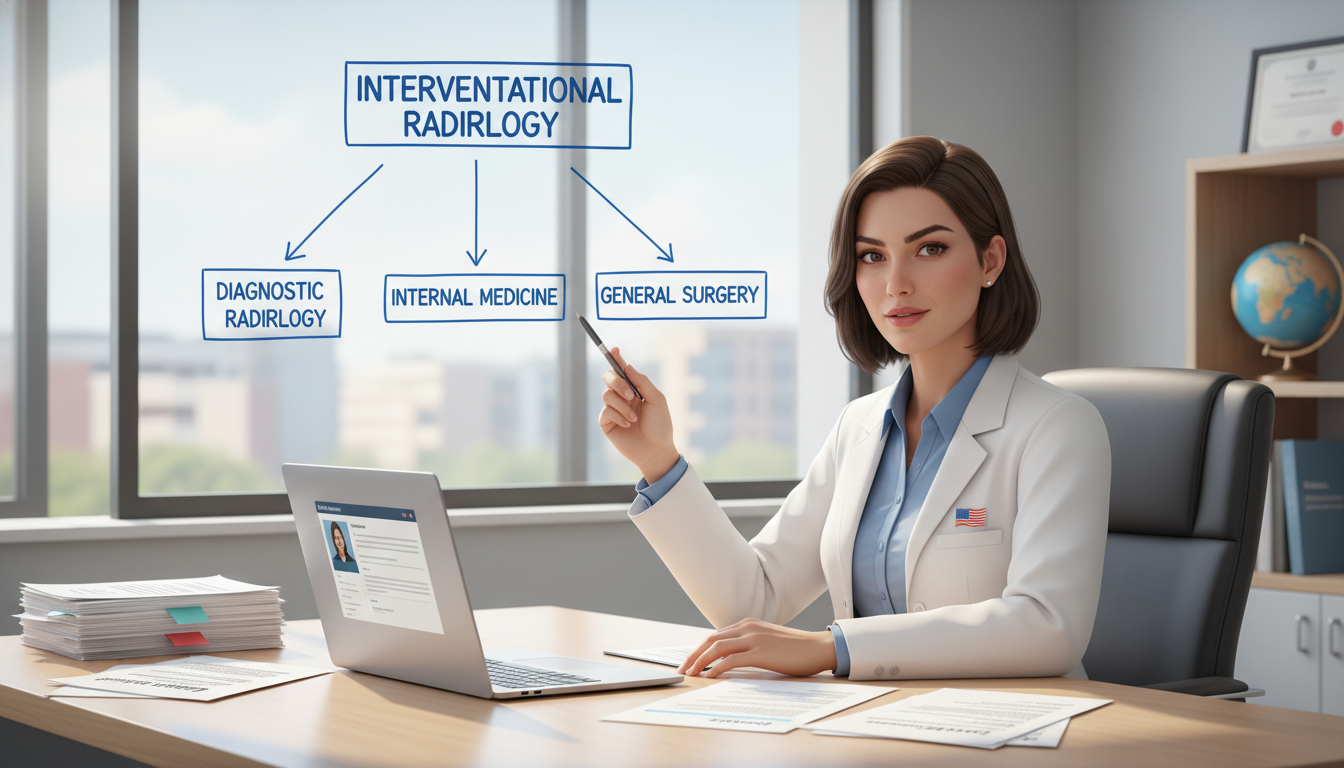
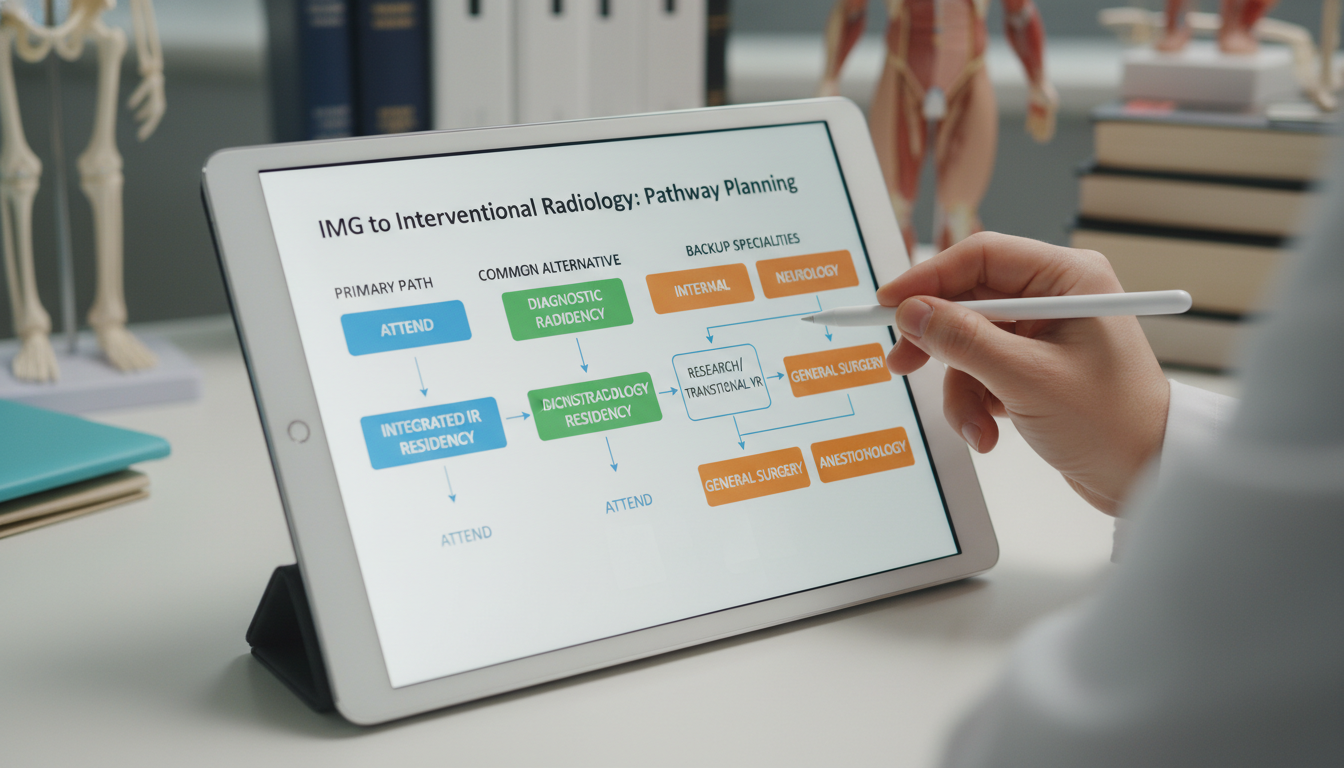
As an IMG, your IR match plan should align with one of these broad strategies:
- Primary focus: Integrated IR + serious, realistic backup specialty
- Primary focus: Diagnostic Radiology with IR interest + backup specialty
- Primary focus: Another specialty with IR options later (e.g., vascular surgery, neurology, internal medicine with interventional subspecialties), plus long-term IR-adjacent career planning
Your risk tolerance, profile competitiveness, and visa situation will determine which strategy is most appropriate.
How to Think About Backup Specialties as an IMG Aiming for IR
Core Principles of Good Backup Planning
A smart backup specialty plan should satisfy four criteria:
Realistic match probability
- The specialty must have significantly higher match chances for an IMG than integrated IR.
- Look for fields where IMGs are routinely accepted.
Acceptable long-term career satisfaction
- You might end up doing this specialty for life.
- Don’t pick a backup you would actively dislike “just to be in the U.S.”
Option to stay close to procedures or imaging (if important to you)
- Many IR-focused applicants care about procedural work and imaging.
- Strong plan B specialties often let you keep some of those elements.
Synergy with your current application strengths
- Re-use or adapt your:
- USCE (U.S. clinical experience)
- Research and publications
- Letters of recommendation
- Avoid splitting yourself so much that you become mediocre for both fields.
- Re-use or adapt your:
Levels of Backup Strategy for IR-Focused IMGs
Think of backup planning in three “layers”:
Low-risk, conservative
- Apply predominantly to Diagnostic Radiology (DR) plus a moderate number of integrated IR programs.
- DR is still competitive, but more accessible than integrated IR and more IMG-friendly at some institutions.
Moderate-risk, diversified (true “dual applying”)
- Apply to Integrated IR + DR + one additional, more achievable specialty such as Internal Medicine, Neurology, or Transitional Year/Preliminary Medicine alongside DR/IR.
- This is dual applying residency in a real sense, maybe even “triple applying” depending on structure.
High-risk, IR-only or IR+DR with no realistic backup
- Recommended only for extremely strong candidates who are okay with going unmatched.
- Not advisable for most IMGs due to visa and time constraints.
Backup Specialty Options for the IR-Minded IMG
Not all plan B specialties are equally helpful. Below are common options with pros, cons, and the type of IMG applicant they might fit.
1. Diagnostic Radiology (DR): The Most Natural Backup
Why it’s a strong option
- Directly connected to IR—DR is the feeder pathway for independent IR.
- You still work with imaging all day and can stay plugged into IR departments.
- Some DR programs are more open to IMGs than integrated IR programs.
Pros
- Keeps future IR options open (independent IR residency/fellowship, hybrid DR/IR roles, image-guided procedures).
- Your IR-focused CV (research, electives, letters) is still very relevant.
- Allows you to test your affinity for radiology in general, not only IR.
Cons
- DR is itself competitive, especially at strong academic centers.
- Still requires high USMLE scores and a strong application.
- Matching into DR does not guarantee an IR position later. You will still face another competitive selection.
Who DR is best for
- IMGs with:
- Strong exam scores (above-average Step 2)
- Radiology or IR research
- Strong letters from radiologists/IR faculty
- Comfort with the idea of being a general diagnostic radiologist if IR does not work out
2. Internal Medicine (IM): Broad, Flexible, and Procedure-Friendly
Why IM is a common backup
IM is relatively IMG-friendly compared to IR and DR.
Extremely broad career options: hospitalist, primary care, subspecialist.
Some subspecialties include procedure-heavy paths that might satisfy your procedural interest:
- Interventional cardiology (after cardiology)
- Gastroenterology with advanced endoscopy
- Pulmonology with bronchoscopy and ICU procedures
- Hematology/oncology with interventional approaches (less image-based but still procedural)
Pros
- Improves your overall chance of matching in the U.S. at all.
- Many IM programs sponsor visas.
- You can still stay close to acute care and procedures.
- Strong foundation for academic careers, quality improvement, and research.
Cons
- Much less imaging-focused than IR.
- The culture, workflow, and career identity are quite different from radiology.
- Requires you to fully embrace internal medicine as a potential lifelong specialty.
Who IM is best for
- IMGs who:
- Value clinical patient interaction and longitudinal care.
- Are open to pursuing procedural subspecialties after IM.
- Want a robust safety net in the IR match without giving up procedures.
3. Neurology: A Growing, IMG-Friendly Specialty With Neuro-Interventional Options
Why neurology can be attractive
- Many IMGs match into neurology.
- Growing demand and expanding subspecialties.
- Neurointerventional radiology / endovascular neurology offers an IR-adjacent, procedure-heavy pathway for some neurologists.
Pros
- Opportunity to stay in the vascular and neuro-procedure world.
- Satisfies interest in acute, high-stakes care (e.g., stroke interventions) through further training.
- Often more IMG-welcoming than radiology.
Cons
- The path to neurointerventional practice as a neurologist is complex and may be more competitive than expected.
- Daily life as a general neurologist is not procedure-heavy.
- Still a substantial shift away from broad-body IR.
Who neurology is best for
- IMGs fascinated by neurovascular disease, stroke, and CNS pathology.
- Those open to neurology as a career but wanting some procedural potential down the line.
4. General Surgery: For Those Who Love Procedures Above All
Why some IR-minded students consider surgery
- Procedural intensity is similar to IR—OR time, interventions, acute care.
- Long-term, you can subspecialize into vascular surgery or other procedural fields.
- Strong alignment with hands-on procedural identity.
Pros
- High procedural volume and tangible physical interventions.
- Opportunity to remain near vascular and endovascular work.
- Satisfies those who enjoy the atmosphere of acute interventions and surgery.
Cons
- General surgery is physically and emotionally demanding.
- Some programs may be less IMG-friendly and visa policies can be restrictive.
- Culture and lifestyle are very different from radiology.
- Not imaging-focused; you interact more with surgeons than radiologists.
Who surgery is best for
- IMGs who:
- Prioritize procedures over imaging interpretation.
- Are realistically willing to become full-time surgeons if IR is no longer an option.
- Can tolerate longer, more intense training hours and call.
5. Transitional Year (TY) or Preliminary Medicine/Surgery as “Soft Backup” – With Caution
Some applicants think of TY or preliminary year positions as a “backup” option.
Reality check:
- These positions are one-year programs, not a full residency specialty.
- You still need to match into a categorical residency later.
- They’re most useful as a bridge if you think you can significantly strengthen your profile in one year and re-apply.
Pros
- Keeps you in the U.S. clinical system.
- Gives you more time for research, networking, and improving your application.
- Some TY/prelim programs are attached to institutions with radiology or IR departments.
Cons
- Does not guarantee a categorical spot later.
- Visa continuity might be complicated.
- You might be back in the match in a highly stressful position.
Who this fits
- High-risk takers with decent profiles who strongly believe they can upgrade their application in a year and accept the uncertainty.

How to Execute a Dual Applying Strategy as an IR-Focused IMG
Once you’ve identified your primary and backup specialties, the next step is execution. Dual applying residency is logistically and psychologically challenging. You must stay organized and coherent across specialties.
Step 1: Decide Your Primary and Your True Backup
Be very explicit with yourself:
- “My primary field is: Integrated IR and/or DR”
- “My backup specialty is: [e.g., Internal Medicine or Neurology]”
This matters because:
- Your main research and letters should align with your primary field, while still being acceptable to your backup.
- You need to prioritize where you do away rotations/USCE and how you present yourself.
Step 2: Build an Application That Can Be Reframed
You don’t need two completely different lives. You need one coherent profile that can be explained differently to each specialty.
Example: Research
- If your primary research is in IR (e.g., embolization techniques, interventional oncology):
- For IR/DR programs: Emphasize the technical and imaging aspects, plus your passion for radiology.
- For IM programs: Emphasize the clinical questions, patient outcomes, and multidisciplinary care aspects.
Example: Clinical Experience
- An ICU or emergency medicine rotation with many critically ill patients:
- For IR/DR: Focus on the need for rapid imaging, image-guided interventions.
- For IM/Neurology: Focus on clinical reasoning, longitudinal care, and managing complex patients.
Step 3: Letters of Recommendation (LORs)
Plan your letters smartly:
At least 2 letters directly relevant to IR/DR
- From radiologists or interventional radiologists.
- Emphasize your analytical skills, imaging aptitude, procedural interest.
1–2 letters from your backup specialty or broadly respected fields (e.g., IM, ICU)
- Show you’re strong clinically and a good team player.
- These letters can be used for both IR/DR and your backup specialty (e.g., IM or neurology) if worded broadly.
You can then assign different combinations of letters through ERAS to each specialty.
Step 4: Personal Statements and ERAS Content
You should almost always write separate personal statements:
IR/DR personal statement:
- Emphasize your passion for imaging, minimally invasive therapies, and the diagnostic/procedural combination.
- Mention your IR experiences, research, and mentors.
Backup specialty personal statement (e.g., IM):
- Emphasize patient-centered care, long-term relationships (for IM), or neuro interest (for neurology), etc.
- You can briefly mention interest in procedures without centering IR as the main goal.
Avoid telling the backup specialty that they are your “backup.” Instead, frame it as a different but genuinely meaningful interest.
Step 5: Program Selection and Application Volume
As an IMG, especially in a field as competitive as IR, you need to be generous with application numbers.
A typical range (this is not one-size-fits-all, just an illustrative example):
- Integrated IR: 20–40 programs (depending on your competitiveness)
- DR: 40–80 programs (focusing on IMG-friendly and visa-offering programs)
- Backup specialty (e.g., IM, Neurology): 60–100 programs, depending on competitiveness and visa needs
Use tools like:
- Fellowship and residency program websites
- NRMP “Charting Outcomes in the Match”
- Specialty-specific IMG forums and spreadsheets
- Institutional policies on J-1/H-1B visas
Focus more heavily on community and mid-tier academic programs for your backup specialty, since these often accept more IMGs.
Step 6: Interview Strategy and Communication
On interviews:
For IR and DR interviews:
- Be clear that your primary professional identity is in radiology and/or IR.
- If asked why radiology vs. other interests, stay focused on imaging, procedures, and your IR exposures.
For backup specialty interviews (IM, neurology, etc.):
- Talk about the aspects of that field you genuinely value.
- You can say you like procedural or acute care aspects, but do not center IR or imply you wish you were elsewhere.
- Emphasize that if you join their program, you will be fully committed to excellence in that specialty.
If directly asked about dual applying:
- It’s often best to be honest but tactful:
- “I am applying to both interventional/diagnostic radiology and internal medicine. I’m very drawn to radiology’s combination of imaging and minimally invasive procedures, but I also deeply value longitudinal, patient-centered care, which is why I’m also seriously considering internal medicine. If I match into your program, I’m prepared to invest fully in becoming an excellent internist.”
Risk Management, Mindset, and Long-Term Planning
Know Your Profile Honestly
You can’t plan a rational backup strategy until you have a realistic view of your competitiveness:
- Step 2 score
- Attempt history (any fails?)
- Research productivity
- Quality and depth of USCE
- Visa status
- Time since graduation
For some IMGs, DR as a backup to integrated IR might already be high risk. For others, DR as the main goal and IM as backup is the right level of safety.
Consider the Long-Term Landscape of IR Adjacent Roles
Even if you never become an IR attending, you can:
- Become the go-to imaging expert in a procedural IM subspecialty (e.g., image-guided biopsies in pulmonary, ultrasound-guided procedures in nephrology).
- Work in fields that frequently interact with IR (e.g., oncology, vascular surgery, neurology stroke services), keeping you in the same ecosystem.
- Use your IR research and background to build an academic or QI niche.
The point: your work building an IR-focused profile is rarely “wasted.” It can shape your career even outside of formal IR training.
Prepare Emotionally for Different Outcomes
Three realistic outcomes:
Match into Integrated IR or DR with IR track
- Excellent; pathway to IR is open.
- Continue to build your IR portfolio; keep up performance in residency.
Match into DR alone
- Solid win; you have a realistic chance at independent IR or an imaging-focused career.
- Network with IR faculty early; pursue electives, IR call, and research.
Match into your backup specialty
- Also a success; you are in the U.S. system, training in a respected field.
- Use your strengths (procedures, imaging interest, acute care) to carve out a meaningful career.
- Decide over time whether to pursue IR-adjacent fellowships (e.g., neurointerventional) or stay in that specialty.
None of these outcomes are “failures.” The real failure is not planning and ending up unmatched with no strategy.
FAQs: Backup Specialty Planning for IMGs in Interventional Radiology
1. As an IMG, is it realistic to apply only to Integrated IR without a backup?
For most IMGs, this is very high risk. Integrated IR has few positions and high competition, and many programs rarely take IMGs. Unless you have exceptional scores, strong IR research, multiple U.S. IR letters, and no visa needs, it’s usually safer to apply to DR plus IR at minimum, and strongly consider a plan B specialty as well.
2. If I match into Diagnostic Radiology, how hard is it to get into IR later?
It’s competitive but more realistic than jumping straight into integrated IR for many IMGs. Your success will depend on:
- Performance in DR residency
- Strength of your IR mentorship and networking
- IR electives and call experience
- Research productivity in IR
- Availability of independent IR positions at your institution or elsewhere
It’s not guaranteed, but DR keeps the IR door open more than almost any other field.
3. Which backup specialty is “best” for IR-focused IMGs?
There is no universal “best” plan B specialty. Common and reasonable choices include:
- Diagnostic Radiology (strongest IR-adjacent path)
- Internal Medicine (broad, IMG-friendly, procedural subspecialty options)
- Neurology (especially if interested in neurointerventional paths)
- General Surgery (for those who love procedures more than imaging)
The best option depends on your interests, competitiveness, and willingness to accept that specialty as a possible permanent career.
4. Will dual applying hurt my chances in IR or my backup specialty?
If done carefully, dual applying residency does not have to hurt your chances. Common pitfalls to avoid:
- Using the same personal statement for both specialties.
- Revealing openly to one specialty that they are “backup.”
- Spreading yourself so thin with research and letters that you look unfocused.
If your application is coherent and you present convincing, specialty-specific motivations on interviews, dual applying can actually protect your overall match success without significantly weakening your chances in IR or your backup specialty.
Thoughtful backup specialty planning is one of the most powerful tools an international medical graduate can use when aiming for interventional radiology. By understanding the IR match landscape, selecting a realistic plan B specialty, and executing a well-structured dual-application strategy, you can both honor your IR ambitions and protect your long-term career in the U.S. healthcare system.