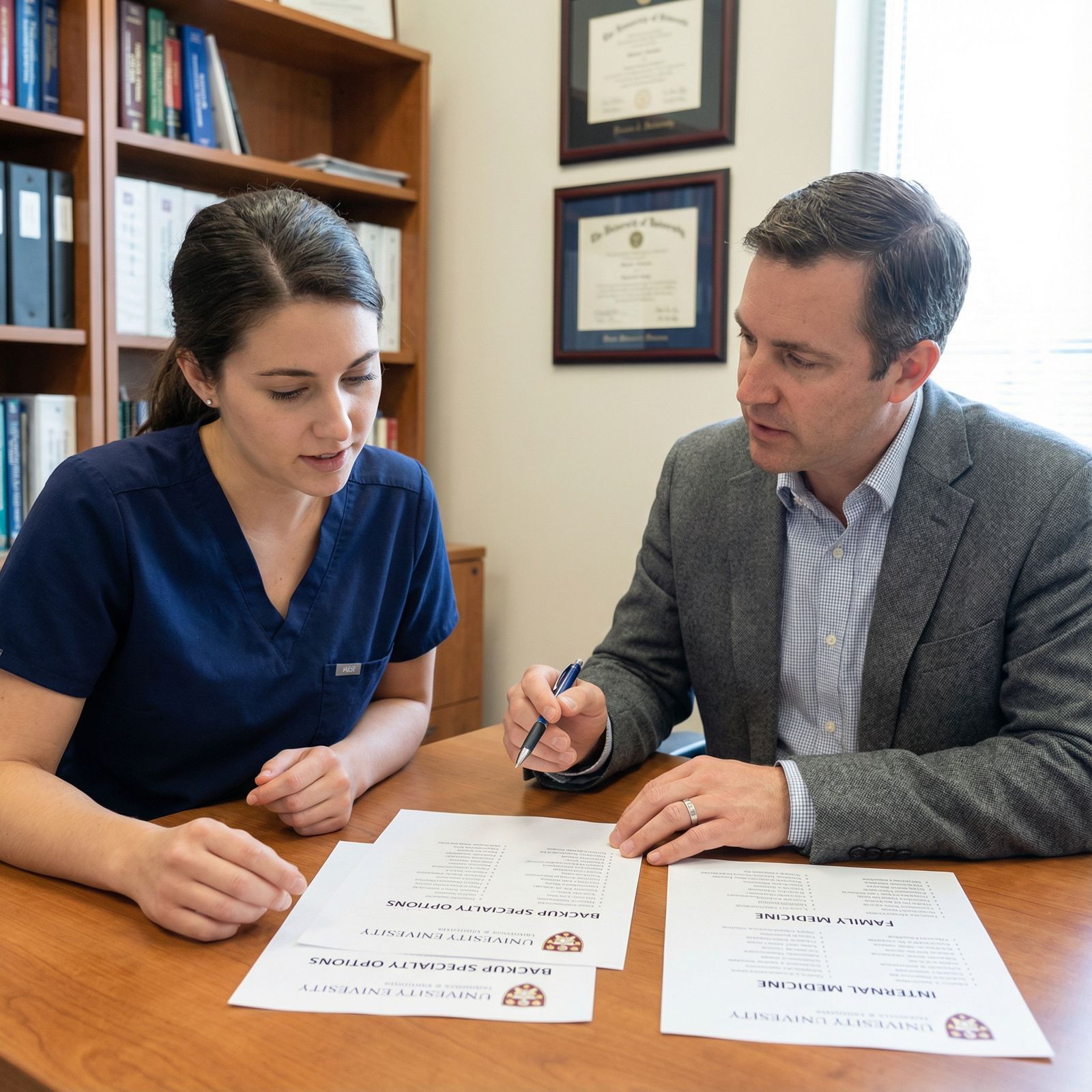
Why Every Aspiring Cardiothoracic Surgeon Needs a Backup Plan
Cardiothoracic surgery is one of the most competitive and demanding training pathways in medicine. As an MD graduate entering the residency match, you face:
- Limited cardiothoracic surgery residency positions
- Highly distinguished applicant pools (AOA, research-heavy, high Step scores)
- Varied program structures (integrated vs traditional pathways)
Even outstanding applicants can experience an unsuccessful allopathic medical school match in this field. A strategic, well-thought-out backup specialty plan is not about “settling”—it’s about protecting your long-term career in heart surgery training or in a closely related, fulfilling field.
In this guide, you’ll learn how to:
- Understand the training pathways to a cardiothoracic surgery career
- Identify realistic, aligned backup specialties
- Decide whether dual applying in residency is right for you
- Tailor your application strategy for primary and backup specialties
- Build a long-term path that keeps cardiothoracic surgery (or related work) on the table
This article is specifically tailored to MD graduate residency applicants with a primary interest in cardiothoracic surgery.
1. Understanding the Cardiothoracic Surgery Pathways and Risks
Before you can plan a backup, you need to be crystal clear on the primary path.
1.1 Integrated vs Traditional Cardiothoracic Surgery Routes
In the U.S. allopathic system, there are two main routes to become a cardiothoracic surgeon:
1. Integrated 6-year (I-6) Cardiothoracic Surgery Residency
- Direct entry from medical school
- 6-year program combining general surgery and cardiothoracic surgery training
- Highly competitive, very limited spots
- Attractive because it shortens training and focuses earlier on heart surgery training
2. Traditional Path via General Surgery (5 + 2/3)
- Step 1: Match into a 5-year general surgery residency
- Step 2: After completion, apply for a 2- or 3-year cardiothoracic surgery fellowship
- Historically the main pathway (and still the majority route)
- Also competitive, but more positions exist at the general surgery level than I‑6 spots
1.2 Why a Backup Plan is Essential
Even qualified MD graduates may not match into:
- I‑6 cardiothoracic surgery residency on first attempt
- A “top-tier” or geographically ideal general surgery program with strong CT exposure
- A CT fellowship later, even after completing general surgery
Risk factors that increase the value of a robust backup specialty or plan B specialty include:
- Mid-range or lower USMLE/COMLEX scores relative to CT applicants
- Limited research in cardiothoracic or surgical fields
- Late discovery of interest in cardiothoracic surgery (few CT letters, limited exposure)
- Gaps in training or red flags on the application
- Strong geographic limitations
A thoughtful backup does not mean you’re less committed to CT; it means you understand how competitive the field is and you’re committed to securing a stable, meaningful surgical or procedure-based career.
2. Strategic Approaches to Backup Specialty Planning
You have several ways to structure your backup strategy as an MD graduate in this space. Think of them as levels of contingency.
2.1 Main Models of Backup Planning
Model A: Primary I‑6, Backup General Surgery (Same NRMP Match)
- Apply to:
- I‑6 cardiothoracic surgery residency programs (primary goal)
- A substantial list of categorical general surgery programs as a backup
- Rank list:
- Rank all I‑6 programs at the top
- Then rank general surgery categorical programs
- Rationale: Traditional CT pathway via general surgery is still a strong route to a CT career.
Model B: Primary General Surgery, Backup “Adjacent” Surgical Specialties
- Apply mostly to general surgery programs (with CT volume and fellowship connections)
- Add a few programs in related specialties if your profile supports them (e.g., vascular, thoracic, integrated vascular, etc.)
- Focus on building a strong profile for later CT fellowship
Model C: Dual Applying Residency in Surgery + Non-Surgical Backup
- Primary focus: I‑6 and/or general surgery
- Backup: A non-surgical but procedure-heavy or critical care–oriented plan B specialty
- Examples: Anesthesiology, interventional radiology (if background supports it), internal medicine with critical care focus
- This model has more complexity and requires careful narrative management.
2.2 Key Principles for Choosing a Plan B Specialty
When choosing a backup specialty:
Alignment with Interests and Skills
- Do you enjoy the OR, procedures, acute care, and team-based decision-making?
- Are you drawn more to ICU physiology, imaging, or longitudinal care?
Preserving Future CT Options (If Desired)
- Some pathways keep doors more open to CT or CT-adjacent work than others.
- General surgery is the closest in terms of future CT opportunities.
Competitiveness vs. Your Application Strengths
- A backup specialty should be less competitive than your primary target, or at least more within reach based on your metrics and experiences.
Lifestyle and Long-Term Satisfaction
- Cardiothoracic surgery is demanding; some MD graduates consider backup specialties that offer more predictable hours or different types of satisfaction.

3. Best Backup Specialty Options for Aspiring Cardiothoracic Surgeons
This section focuses on realistic, commonly chosen options for an MD graduate who primarily wants a cardiothoracic surgery residency but needs a solid plan B specialty.
3.1 General Surgery: The Most Direct Backup
Why it’s the classic backup for CT:
- It is the traditional gateway to cardiothoracic surgery fellowship.
- Nearly all CT fellowship positions require completion of an ACGME-accredited general surgery residency.
- You gain broad operative skills, exposure to critical care, and familiarity with complex cases.
Pros:
- Preserves your candidacy for future CT fellowship.
- Excellent preparation in operative skills, perioperative care, and decision-making.
- Many general surgery programs have faculty who are cardiothoracic surgeons or have strong CT affiliations.
Cons:
- General surgery itself is fairly competitive, especially at top academic centers.
- Training length is still long (5+2/3 if you eventually do CT fellowship).
- Some general surgery programs have limited CT exposure, so you’ll need to choose carefully.
Actionable Tips:
- Identify general surgery programs with:
- High-volume CT rotations
- Affiliated CT fellowships
- Faculty mentors in cardiothoracic surgery
- In your application and interviews, it’s acceptable to say you’re interested in general surgery with a potential future subspecialty in CT; this is a familiar narrative to most PDs.
3.2 Thoracic Surgery–Adjacent Surgical Paths
While many of these are not direct pipelines to classic CT practice, they can offer overlapping skill sets and may partially satisfy your interest in cardiothoracic anatomy and procedures.
Potential options:
Vascular Surgery (Integrated or Traditional)
- Heavy focus on major vessels, endovascular techniques, and open vascular surgery
- Significant overlap with cardiovascular physiology and perioperative management
- Competitive, but in many markets slightly less competitive than I‑6 cardiac CT
Trauma and Acute Care Surgery (via General Surgery)
- You still need general surgery, followed by fellowship
- You’ll manage critically ill patients, major chest trauma, and emergent thoracic procedures
Surgical Critical Care (via General Surgery or Anesthesiology)
- Focus on ICUs with cardiac and thoracic patients
- Gives deep understanding of cardiopulmonary physiology and post-op management
These are often second-step decisions after you have already chosen general surgery as your residency.
3.3 Anesthesiology: A Strong Non-Surgical, OR-Based Backup
For MD graduates whose application is solid but not top-tier for CT, anesthesiology can be a very rational backup specialty:
Overlap with CT Interests:
- Daily presence in the OR, including complex cardiac cases
- Pathway to cardiac anesthesia fellowship
- Close collaboration with CT surgeons; you remain at the heart of heart surgery training, but on the other side of the drape
Pros:
- Competitive but generally more accessible than CT I‑6
- Provides procedures (lines, regional blocks, TEE for cardiac anesthesiologists)
- Offers better lifestyle flexibility in many practice settings
Cons:
- You step away from being the primary operative surgeon
- Transition from “surgical identity” to perioperative specialist can be psychologically challenging for some
Who should consider this?
- MD graduates who love the OR environment and critical care, but are open to a non-surgeon role
- Those with strong performance in physiology, pharmacology, and acute care rotations
3.4 Internal Medicine with a Cardio-Critical Focus
For some, the backup may be internal medicine (IM), especially if you:
- Enjoy cardiology, heart failure, and ICU medicine
- Appreciate longitudinal patient care and complex medical management
Pathways from IM that stay within the “cardio-thoracic” sphere:
- Cardiology → Interventional cardiology (coronary interventions, structural heart)
- Pulmonary and Critical Care (ICU management of cardiac/thoracic patients)
- Advanced heart failure and transplant cardiology
Pros:
- IM is broad and relatively accessible at many institutions
- Multiple fellowships allow you to remain very close to the heart and lung disease domains
- Significant career flexibility in academic, community, or hybrid practices
Cons:
- You won’t be the one performing open heart surgery
- More clinic and longitudinal patient relationships, which may or may not align with your preferences
3.5 Radiology and Interventional Radiology: Highly Selective but CT-Adjacent
Some MD graduates intrigued by imaging and procedures consider diagnostic radiology with a later interventional radiology (IR) focus.
Potential alignment with CT interests:
- Detailed understanding of thoracic and cardiovascular imaging
- Endovascular and image-guided procedures, including some overlapping with vascular surgery
However:
- Integrated IR is itself highly competitive and not necessarily a “backup” in the traditional sense.
- The identity and training environment differ significantly from surgery.

4. How to Execute a Dual-Applying Residency Strategy
If you’re strongly committed to cardiothoracic surgery but realistic about risk, dual applying residency is a powerful strategy—when done carefully.
4.1 Clarify Your Primary Goal and Backup Hierarchy
Before ERAS opens, define:
- Primary goal: e.g., I‑6 cardiothoracic surgery
- Secondary track: e.g., categorical general surgery
- Tertiary backup: e.g., anesthesiology or internal medicine (if used)
Write this out for yourself:
“If I match into I‑6 CT, I will take it.
If not, I would be happy with general surgery at a strong CT-exposure program.
If neither is realistic, I’ll pursue anesthesiology at programs with robust cardiac exposure.”
Having this clear internally helps ensure consistent messaging.
4.2 Tailoring Your ERAS Application for Multiple Specialties
Common Elements (Shared Across Specialties):
- Core clinical grades
- Class rank or AOA status
- Board scores
- Core research and leadership
Specialty-Specific Elements:
Personal Statements
- Create separate statements for each specialty (CT I‑6, general surgery, anesthesiology, etc.)
- All should be truthful but tailored.
- Do not submit a single generic statement that mentions multiple specialties; it dilutes your commitment.
Letters of Recommendation
- Aim for at least 2–3 surgery letters from active operative faculty (ideally CT and general surgery).
- For a non-surgical backup (e.g., anesthesiology), secure at least one specialty-specific letter if possible.
- Use ERAS’s flexibility to assign different letters to different programs.
Experiences Section
- Emphasize CT-related experiences for I‑6 and general surgery programs.
- For anesthesiology or IM, highlight ICU work, perioperative care, and critical care projects.
4.3 Managing the Interview Season
When you are dual applying:
- Track your interviews by specialty and tier (reach/target/safety).
- If you see heavy interest from general surgery and minimal I‑6 traction, be mentally prepared to center your final rank list around your more realistic options.
- Avoid discussing your dual-apply plans with interviewers unless:
- They ask directly, and
- You can answer honestly without undermining your apparent commitment.
Key principle:
Program directors want residents who are genuinely interested in their specialty and program. It’s possible to be honestly enthusiastic about multiple closely related fields without seeming unfocused.
5. Building a Long-Term CT-Adjacent Career, Even if You Don’t Match CT
Not matching directly into a cardiothoracic surgery residency—especially the I‑6 pathway—does not mean losing your identity as a “heart and chest” doctor. You can be deeply embedded in cardiothoracic care through other avenues.
5.1 If You Match Into General Surgery
You can still:
- Pursue a CT fellowship after residency (the classic route).
- Strengthen your profile by:
- Seeking CT sub-internships and electives
- Requesting CT rotations early and often
- Participating in CT research and QI projects
- Asking CT faculty for mentorship and letters
Even if you don’t ultimately match CT fellowship, you can shape a career in:
- Vascular surgery
- Thoracic or foregut surgery
- Trauma and critical care with strong thoracic components
5.2 If You Match Into Anesthesiology
You can:
- Apply for a cardiac anesthesia fellowship
- Focus your residency on rotations with cardiac cases and ICUs
- Build expertise in transesophageal echocardiography (TEE)
You’ll be at the center of heart surgery training—monitoring, supporting, and optimizing patients during the most complex operations—even if you are not performing the incisions and anastomoses.
5.3 If You Match Into Internal Medicine or Another Cognitive Specialty
You can:
- Chart a path to interventional cardiology or structural heart disease work
- Focus on advanced heart failure and transplant cardiology
- Work closely with CT surgeons in multidisciplinary programs (e.g., valve clinics, LVAD programs, transplant selection committees)
Your identity can still revolve around the management of cardiac and thoracic disease at a high level.
6. Practical Timeline and Action Plan for MD Graduates
To make this concrete, here’s a suggested action checklist for MD graduates planning a cardiothoracic surgery career with a robust backup strategy.
6.1 MS3 / Early MS4 (or PGY-0 Gap Year for MD Graduates)
- Clarify your primary and backup specialty hierarchy (e.g., CT I‑6 → general surgery → anesthesiology).
- Seek mentorship from:
- A cardiothoracic surgeon
- A general surgeon
- If relevant, an anesthesiologist or cardiologist
- Arrange sub-internships:
- One in CT surgery (if available)
- One in general surgery at an institution with CT exposure
- Optional: An elective in anesthesiology or ICU
6.2 Application Year (ERAS Season)
- Draft separate personal statements for each specialty.
- Secure strong, specialty-appropriate letters:
- CT or general surgery attendings for your surgical applications
- Specialty-specific letters for anesthesiology or IM if dual applying
- Build a balanced application list:
- A mix of reach, target, and safety programs in each chosen specialty.
- Avoid listing only top-tier I‑6 programs without adequate general surgery backup.
6.3 Interview and Ranking Phase
- Use each interview to gauge:
- Program culture and operative exposure
- CT faculty presence and fellowship match history (for general surgery programs)
- For ranking:
- Place your dream I‑6 CT programs at the top if they genuinely remain your priority.
- Follow them with your best-fit general surgery programs.
- Insert non-surgical backups (e.g., anesthesiology) where they truly align with your preferences; don’t rank programs you would not be comfortable attending.
6.4 After Match Day—Adapting Your Plan
If you match CT I‑6:
- Focus on thriving and staying open to mentorship, research, and subspecialty interests within CT.
If you match general surgery:
- Early on, identify courts of CT exposure and mentors.
- Build your CT fellowship candidacy methodically.
If you match into another backup specialty:
- Lean in fully. Seek the most CT-adjacent experiences within that field.
- Remember you can still shape a meaningful cardiothoracic-focused career in many roles.
FAQs: Backup Specialty Planning for Aspiring Cardiothoracic Surgeons
1. If I really want cardiothoracic surgery, should I apply only to I‑6 programs and skip general surgery?
This is usually risky. I‑6 spots are very limited and competitive. Unless your application is exceptionally strong (top scores, robust CT research, excellent letters, and strong mentorship), most advisors recommend applying to both I‑6 and categorical general surgery programs. General surgery preserves your pathway to CT fellowship and is the most realistic backup if your ultimate goal is to perform heart surgery.
2. Does choosing a backup specialty make me look less committed to cardiothoracic surgery?
Not if you manage it thoughtfully. You should tailor each application to the specific specialty and avoid mixed messages. Program directors understand the competitiveness of CT and other surgical fields; they generally respect applicants who are realistic and professional about backup planning, as long as you demonstrate genuine enthusiasm for the program to which you’re applying.
3. What is the best plan B specialty if I want to stay as close as possible to heart surgery training?
For an MD graduate whose primary goal is cardiothoracic surgery, the best plan B specialty is almost always general surgery, especially at a program with strong CT exposure and fellowship connections. Beyond that, anesthesiology with a plan for cardiac anesthesia, or internal medicine with a path to cardiology or critical care, keeps you very close to cardiothoracic care even if you’re not in the role of surgeon.
4. Can I switch to cardiothoracic surgery later if I start in another specialty like anesthesiology or internal medicine?
Switching directly into CT surgery residency from non-surgical fields is rare and structurally difficult. Most CT programs require completion of general surgery training. However, you can absolutely build a cardio-thoracic–focused career in anesthesiology (cardiac anesthesia), cardiology (interventional or structural heart), pulmonary/critical care, or other adjacent paths. If you’re certain you want to be a surgeon, your best chance remains starting in general surgery.
Thoughtful backup specialty planning allows you to aim high for cardiothoracic surgery while securing a realistic, fulfilling path if the allopathic medical school match doesn’t go exactly as planned. As an MD graduate, your goal isn’t just to match—it’s to build a long-term career in which your skills, interests, and values are well aligned, whether that’s as a cardiothoracic surgeon or in a closely connected specialty.