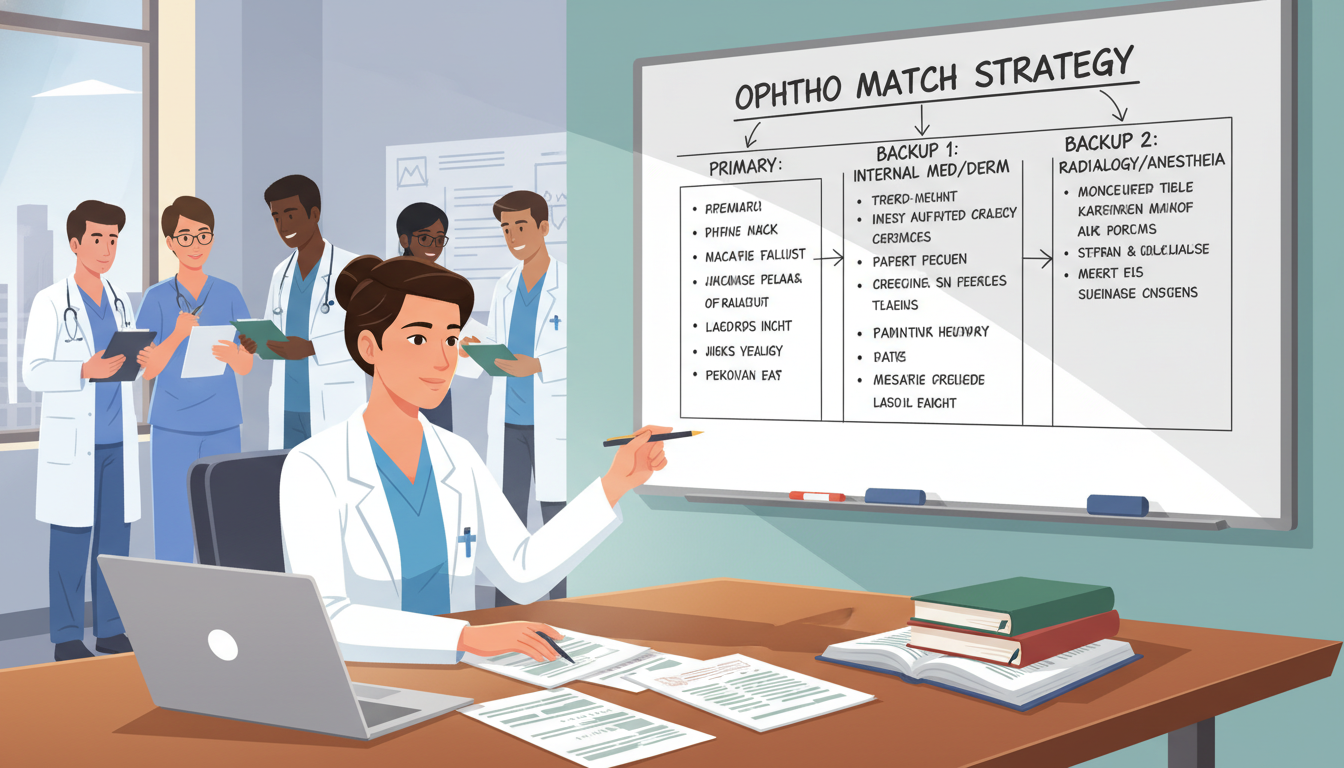
Understanding Backup Specialty Planning in Ophthalmology
Applying to ophthalmology residency is uniquely high-stakes. The specialty is small, highly competitive, and operates through a separate early match (SF Match), which means you must make big decisions earlier than applicants in most other fields. That’s where backup specialty planning becomes essential: thinking through what you will do if the ophtho match does not go your way.
For many applicants, this conversation feels uncomfortable—almost like admitting defeat before you begin. In reality, planning a backup is a sign of strategic thinking, not lack of confidence. It allows you to protect your future, reduce anxiety, and often strengthens your primary ophthalmology application in the process.
This guide walks you through how to approach a backup specialty for ophthalmology residency, including whether you should dual apply, how to choose a plan B specialty, timelines, and how to protect your chances in the ophtho match without closing doors elsewhere.
Why Ophthalmology Applicants Need a Backup Strategy
1. The Competitive Landscape
Ophthalmology has:
- A limited number of residency positions each year
- A separate application system (SF Match) and earlier interview season
- A strong emphasis on academic metrics, research, and letters of recommendation
Even strong candidates can go unmatched due to:
- Limited spots in certain geographic regions
- Overly narrow rank lists (too few programs ranked)
- Underestimating competition or overestimating their application strength
Without a plan B, you may face:
- An unplanned gap year with limited structure
- Rushed or last-minute applications to other specialties
- Increased stress and uncertainty during a critical period of training
2. Backup Planning Is Risk Management, Not Surrender
Backup specialty planning is exactly that—planning. It does not mean:
- You are abandoning ophthalmology
- You “secretly” don’t want ophtho enough
- Programs will automatically see you as less committed
Instead, it means you are:
- Realistic about probability and competition
- Protecting your long-term career, financial stability, and training timeline
- Giving yourself options instead of forcing an all-or-nothing outcome
Residents, program directors, and advisors who have watched multiple ophtho match cycles usually recommend some level of backup planning, especially for borderline or at-risk applicants (lower scores, limited research, red flags, visa issues, etc.).
Step One: Honestly Assessing Your Ophthalmology Competitiveness
Before you can decide on a backup specialty—or whether to dual apply—you need a realistic assessment of your chances in the ophtho match.
Key Factors to Review
USMLE/COMLEX Scores
- Are your Step 2 CK and/or COMLEX Level 2 at or above the average for matched ophthalmology applicants?
- Any exam failures or significant score drops?
Clinical Performance
- Strong clerkship grades, particularly in medicine, surgery, and ophtho electives?
- Any failed or remediated rotations?
Ophthalmology-Specific Exposure
- Completed at least one home or away ophthalmology rotation?
- Positive evaluations and strong relationships with faculty?
Research and Scholarly Work
- Any ophthalmology-related posters, abstracts, or publications?
- If not, strong research in another area can still help, but ophtho-focused work is a plus.
Letters of Recommendation
- At least two letters from ophthalmologists, ideally well-known or strongly supportive?
- Any department chair or program director letters?
Red Flags
- Leaves of absence, professionalism issues, course remediations, test failures
- Need for visa sponsorship (for IMGs/FGs)
- Late career transition or non-traditional path without clear narrative
Getting an Objective Opinion
Do not rely solely on your own impression. Seek input from:
- Your home ophthalmology program director or clerkship director
- An ophthalmology advisor familiar with your institution’s match outcomes
- A trusted faculty mentor who will be honest, not just supportive
Ask directly:
- “If I apply only to ophthalmology, what do you think my risk of not matching is?”
- “Would you advise dual applying? If so, to which backup specialty?”
Use this feedback to categorize yourself:
- Low risk: Strong metrics, strong ophtho letters, solid research, no red flags
- Moderate risk: Mixed application—some strengths, some weaknesses
- High risk: Multiple red flags, weaker metrics, or late/limited ophtho exposure
Your risk category will shape how aggressively you plan a backup.

Choosing a Backup or Plan B Specialty
Once you understand your position in the ophtho match, you can start thinking about what makes sense as a backup. “Any specialty that will take me” is not a plan—it’s a recipe for dissatisfaction. You need a structured way to choose a plan B specialty that fits your interests, skills, and lifestyle priorities.
Guiding Principles for Selecting a Backup
Alignment With Your Interests and Strengths
- What parts of ophthalmology appeal to you most?
- Precision procedures?
- Longitudinal patient care?
- Anatomy, imaging, or diagnostics?
- Look for specialties with overlapping appeal (e.g., other procedure-heavy fields, other visual/anatomy-focused disciplines).
- What parts of ophthalmology appeal to you most?
Competitiveness vs. Your Profile
- Don’t choose a backup specialty that is just as competitive as ophthalmology (e.g., dermatology, plastics) if your main concern is risk of not matching.
- Choose something where your current metrics place you at or above the average competitiveness.
Training Structure and Future Options
- Does the backup specialty allow subspecialization that might partially satisfy your interest in eyes, microsurgery, or imaging (e.g., ENT with oculoplastic overlap, neurology with neuro-ophthalmology)?
- Is there potential to circle back to ophthalmology later (e.g., via research, prelim years, or reapplying)?
Lifestyle and Practice Reality
- Ophthalmology is often described as a “lifestyle specialty”: generally good work–life balance, clinic-based practice, and elective surgeries.
- If lifestyle is a major reason you chose ophtho, ensure your backup specialty isn’t wildly misaligned (unless you’ve consciously decided that job security takes priority).
Common Plan B Specialties for Ophthalmology Applicants
Below are frequently considered backup specialties for ophtho applicants, with pros and cons from a strategic match perspective.
1. Internal Medicine
Why it’s common as a backup:
- Large number of positions and broad range of program competitiveness
- Relatively flexible about applicant backgrounds
- Can lead to subspecialties with procedural or imaging focus (cardiology, GI, pulmonary, rheumatology, etc.)
Pros:
- Higher probability of matching compared with ophtho for most applicants
- Accepts many applicants who previously aimed for competitive specialties
- Strong generalist foundation that keeps many doors open
Cons:
- Day-to-day work is very different from ophthalmology
- Less procedural for many general internists (unless you pursue a procedural subspecialty)
- Lifestyle and call schedules can be more intense than expected, depending on practice type
Best fit for: Applicants who like complex diagnostics, longitudinal care, and keeping many subspecialty options open.
2. Neurology
Why it appeals:
- Overlap with neuro-ophthalmology concepts (visual pathways, cranial nerves)
- Growing field with expanding imaging and interventional components
Pros:
- Increasing demand and expanding subspecialties
- Strong overlap with visual pathways and neuro-ophthalmology for those who loved that aspect of ophtho
- Typically less competitive than ophthalmology
Cons:
- Clinical pace and disease trajectory (e.g., neurodegenerative disease) can be very different from ophtho’s primarily outpatient, often reversible-pathology environment
- Fewer procedures unless you pursue interventional subspecialties
Best fit for: Applicants drawn to visual and neurologic anatomy, complex diagnostics, and less focused on surgery.
3. Family Medicine
Why it’s considered:
- Heavily primary care focused, very high match rates
- Relatively lower competitiveness
Pros:
- Very high likelihood of matching if you apply broadly
- Broad scope of practice, strong continuity of care
- Potential for outpatient-focused lifestyle
Cons:
- Very different from procedural and imaging-focused eye care
- May not satisfy those primarily drawn to surgical precision or ocular anatomy
Best fit for: Applicants genuinely interested in primary care and community medicine who primarily saw ophtho as one of several appealing outpatient fields.
4. Preliminary/Transitional Year With Plan to Reapply Ophthalmology
Some applicants:
- Do a preliminary internal medicine or transitional year
- Use that year to improve their application (research, ophtho rotations, networking)
- Reapply to ophthalmology in the next cycle
Pros:
- You keep your long-term goal of ophthalmology alive
- Gain clinical experience and maturity
- Can sometimes leverage strong evaluations and new letters
Cons:
- Reapplying is emotionally and logistically taxing
- No guarantee of matching the second time
- Some prelim programs may not be supportive of reapplication plans
Best fit for: Strongly ophtho-committed applicants who narrowly missed matching and receive encouraging feedback that a reapplication could be successful.
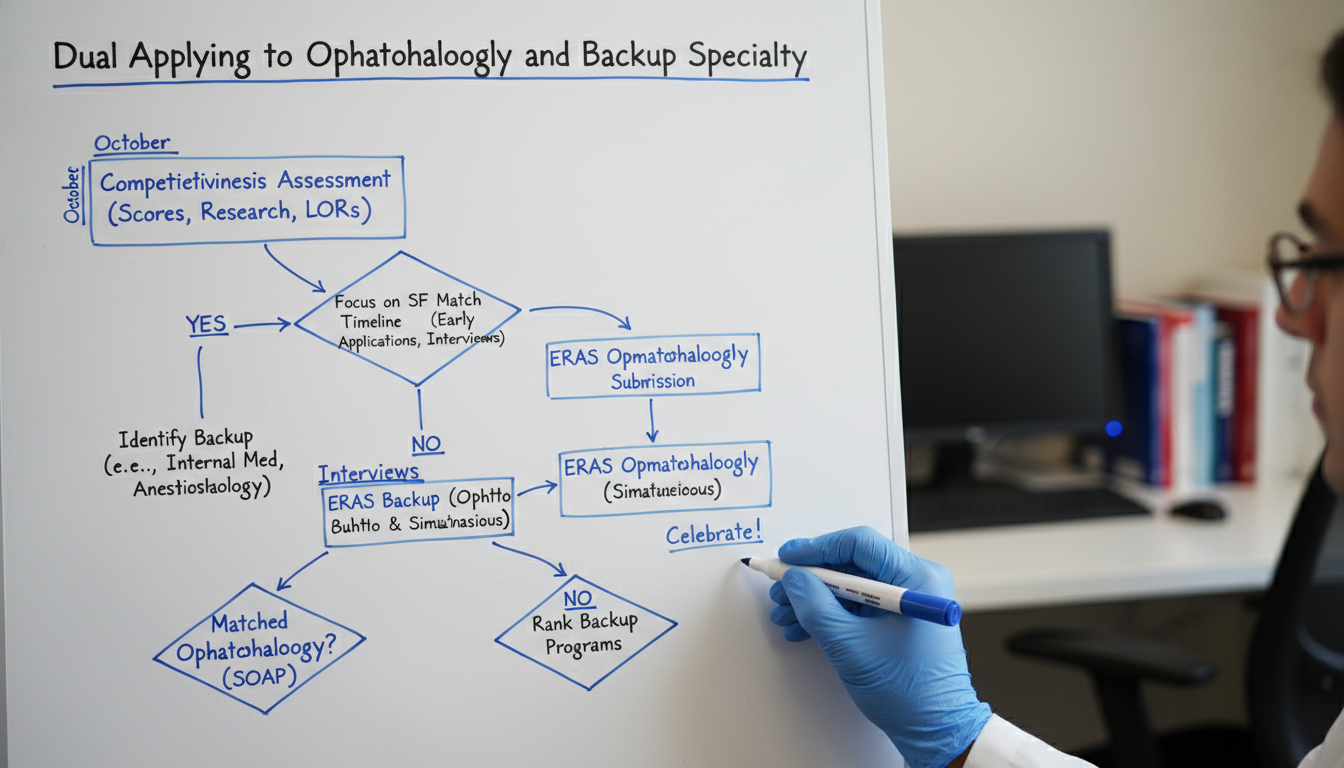
Dual Applying: Strategy, Timelines, and Pitfalls
“Dual applying residency” refers to applying to two specialties in the same cycle, often ophthalmology plus a backup specialty through ERAS/NRMP. This is a major decision because ophtho uses the SF Match (early), while your backup will use the regular match.
How the Timelines Interact
SF Match (Ophthalmology)
- Applications typically open: late summer/early fall (exact dates change yearly)
- Interview season: roughly October–December
- Rank list due: usually early January
- Match day: mid-January
ERAS/NRMP (Most Other Specialties)
- Application submission: typically mid-September
- Interview season: roughly October–January
- Rank list due: February
- Match day: mid-March
You’ll often be submitting ERAS before you know your ophtho match outcome. That’s the key reason you must think about backup specialty planning early and not wait until January.
Models of Dual Applying
Model 1: Full Dual Application
- Apply to a robust set of ophthalmology programs via SF Match
- Simultaneously apply to a significant number of backup specialty programs via ERAS
- Interview in both fields through the fall and early winter
Pros:
- Maximizes your chances of matching into some residency in your graduation year.
- Gives you real options if the ophtho match doesn’t go your way.
Cons:
- Time-consuming and logistically intense (more personal statements, letters, interviews).
- Financial cost: multiple application fees and travel (though virtual interviews help).
- Risk of diluting your perceived commitment if not handled carefully in your messaging.
Who might consider this: Moderate- to high-risk applicants who can’t afford an unmatched year for financial, visa, or personal reasons.
Model 2: Contingent Backup (Limited ERAS Application)
- Apply fully to ophthalmology via SF Match
- Submit a smaller, more targeted ERAS application to a limited number of backup programs in a less competitive field
- If you match ophtho in January, you withdraw from the backup process; if not, you are still in the running for those backup programs
Pros:
- Less time and money than full dual applying
- Still preserves a realistic safety net
Cons:
- Fewer backup interviews, so you must choose programs carefully
- Higher anxiety if you’re not getting the volume of backup interviews you hoped for
Who might consider this: Borderline applicants with some risk who want a backup but still want to focus energy primarily on ophtho.
Model 3: Ophtho-Only, Then React If You Don’t Match
- Apply only to ophthalmology
- If unmatched in January, scramble to plan a research year, prelim year, or late backup specialty application (to fields that still have unfilled spots)
Pros:
- Maximizes your time and focus on ophthalmology applications
- Avoids sending any mixed signals to programs
Cons:
- You are highly vulnerable if you don’t match—options may be limited and rushed
- You may end up forced into a gap year or into a field/program that was not thoughtfully chosen
Who might consider this: Low-risk applicants with very strong applications and advisor support, or those who are willing to accept the risk of a delayed training start.
Protecting Your Ophthalmology Application While Dual Applying
The primary concern with dual applying is whether ophthalmology programs will question your commitment. In practice:
- Many PDs understand the competitiveness of the ophtho match.
- They care more about whether:
- Your ophtho letters are strong and personalized
- You’ve done meaningful ophthalmology exposure
- You articulate a clear, authentic interest in the field
Key strategies:
Tailored Personal Statements
- Write a primary ophtho personal statement that is clearly ophthalmology-focused.
- For your backup specialty, write a separate statement that is genuine but does not mention ophthalmology heavily or sound like they are an “afterthought.”
Letter Management
- Use ophthalmology-specific letters only for SF Match.
- Use more general or specialty-specific letters (e.g., internal medicine, neurology) for ERAS.
- Avoid sending ophtho-heavy letters to your backup specialty if they make you look “undecided.”
Consistent Storytelling in Interviews
- In ophthalmology interviews: Speak authentically about your passion for eye care, surgery (if applicable), and why ophtho is your first choice.
- In backup interviews: Emphasize what genuinely attracts you to that field—patient population, problem types, procedures, lifestyle—without overtly stating that it’s your “plan B,” but without lying about having considered another field.
Communication With Mentors
- Be transparent with trusted faculty about dual applying. They can help shape your application strategy and keep your narrative coherent.
Practical Steps to Build a Smart Backup Plan
1. Create a Personal Risk Profile
Write down:
- Your exam scores and any failures/remediations
- Your clinical evaluations and honors
- Research output in ophthalmology or related fields
- Any visa or personal constraints
Then classify yourself (low, moderate, high risk) based on advisor feedback.
2. Rank Your Priorities
Clarify your non-negotiables:
- Is matching into some residency immediately more important than waiting to pursue ophthalmology at all costs?
- Is lifestyle more important than specialty name?
- Are you okay with reapplying after a gap year or prelim year?
This will determine how aggressively you dual apply.
3. Shortlist 1–2 Potential Backup Specialties
For each candidate plan B specialty, ask:
- What aspects of this specialty would I genuinely enjoy day-to-day?
- Do my metrics fit reasonably well with this field’s competitiveness?
- Can I envision a satisfying long-term career in this specialty if ophthalmology never happens?
If you cannot honestly say “yes” to that last question, it’s not a good backup.
4. Get Exposure Early
If you are considering a backup like internal medicine or neurology:
- Do a rotation or elective in that field before applications if possible.
- Request a letter from a faculty member who can speak to your performance.
- Use the experience to refine your opinion: Is this truly a workable alternative?
5. Build Two Parallel but Coherent Narratives
You need:
Ophthalmology narrative:
- When and how you discovered ophthalmology
- What you love about caring for patients with visual problems
- Your experiences in clinic/OR, research, and mentorship in ophtho
Backup specialty narrative:
- What draws you to that specialty independently (not “because it’s a backup”)
- Experiences that demonstrate interest: rotations, patients, reading, or research
- How your skills and values fit that field
Neither narrative has to mention the other specialty; they must each stand on their own and be truthful.
6. Plan for All Outcomes
By the time you submit your SF Match rank list, have a written plan for:
If you match ophthalmology:
- Withdraw respectfully from any backup interviews or applications
- Thank your backup mentors and letter writers and update them
If you do not match ophthalmology but have backup interviews in progress:
- Continue through the ERAS/NRMP process with full commitment
- Work with advisors to frame your previous ophtho interest in a positive, growth-oriented way
If you do not match ophthalmology and have few/no backup options:
- Meet urgently with advisors to consider:
- Research or fellowship positions in ophthalmology or related fields
- Prelim or transitional year spots
- Reapplication strategy and timeline
- Meet urgently with advisors to consider:
Having these options mapped out in advance significantly reduces panic and impulsive decisions.
FAQs: Backup Specialty Planning for Ophthalmology Applicants
1. Will ophtho programs know that I’m dual applying?
Ophthalmology programs do not automatically receive information about your ERAS/NRMP applications. They may infer you are dual applying if:
- Your backup specialty is commonly used as a plan B, or
- You volunteer this information in conversation.
Most PDs assume that some applicants are dual applying; it usually does not hurt you if:
- Your ophthalmology application is clearly strong and focused
- Your letters and personal statement demonstrate genuine interest and commitment
2. Is it better to reapply to ophthalmology or commit to a plan B specialty?
It depends on:
- How close you were to matching (e.g., many interviews vs. very few)
- The feedback you receive from mentors and PDs on your application’s weaknesses
- Your personal tolerance for risk, delay, and uncertainty
If advisors believe you are highly likely to match with targeted improvements (more research, another away rotation, higher Step 2 score), a reapplication might make sense. If your profile has multiple structural weaknesses that are hard to change, committing to a plan B specialty you like can be more stable and psychologically healthier.
3. What if I match into my backup specialty but still dream of ophthalmology?
Some physicians complete residency in one specialty and later transition to ophthalmology, but this is uncommon and logistically difficult due to funding and training slot limitations. More realistically, you might:
- Incorporate aspects of eye care into your practice (e.g., primary care screening, neurology with neuro-ophthalmic focus)
- Pursue related imaging or procedural interests through that field
- Build a fulfilling career that draws on what attracted you to ophtho, even if not in an ophthalmology department
It’s important to enter any backup specialty willing to fully commit; going in with one foot out the door can lead to dissatisfaction and poor performance.
4. How many programs should I apply to in my backup specialty?
The number depends on:
- Your competitiveness in that backup specialty
- The field’s overall competitiveness
- Your geographic flexibility
As a rough guide:
- Moderately competitive backup (e.g., neurology, categorical internal medicine): many dual applicants apply broadly—often 20–40+ programs.
- Less competitive backup (e.g., family medicine, some community IM): you may be able to apply to fewer programs if your metrics are strong.
Work with advisors who know your profile and your chosen backup field’s landscape in the current year; they can give you program-number ranges tailored to your situation.
Thoughtful backup specialty planning for the ophtho match doesn’t diminish your commitment to eye care. Instead, it positions you to move forward confidently—whether as an ophthalmology resident or in another specialty where you can build a meaningful, sustainable career.