
Introduction: Why Backup Specialties Matter in the Residency Application
As the residency application season approaches, many medical students wrestle with a familiar tension: “I know what I really want to do—but what if I don’t match?” In a highly competitive environment where some specialties have far more applicants than positions, relying solely on a single-choice strategy can be risky.
Thoughtful backup specialties are not a sign of doubt or failure; they are a strategic part of a mature Residency Application plan and sound Career Guidance. A well-chosen backup can:
- Protect you from going unmatched
- Preserve alignment with your skills, values, and long-term Medical Career goals
- Keep open pathways to later subspecialty training or niche practice areas
This guide will walk you step-by-step through how to pick smart, realistic, and personally satisfying backup specialties for residency. By the end, you should have a structured framework to:
- Honestly assess your competitiveness and preferences
- Identify reasonable and meaningful backup specialties
- Integrate those choices into a coherent and authentic application strategy
Understanding the Role of Backup Specialties in Residency Match Strategy
The Reality of the Residency Match
The residency match is not purely a meritocracy; it’s a complex system influenced by:
- Specialty competitiveness (applicants per position, fill rates)
- Program priorities (geography, institutional ties, Step scores, research, diversity)
- Applicant factors (exam scores, clerkship grades, research, letters of recommendation, interview performance)
- Random variation (how many similar applicants apply in your year, how programs construct rank lists)
Some specialties consistently have higher unmatched rates, especially for U.S. seniors aiming for:
- Dermatology
- Plastic Surgery
- Neurosurgery
- Orthopedic Surgery
- Otolaryngology (ENT)
- Integrated Vascular or Cardiothoracic Surgery
- Interventional Radiology
Even excellent applicants can go unmatched in these fields in a given year. That reality makes structured backup planning an important risk-management tool.
Why Backup Specialties Increase Your Match Chances
Having one or more backup specialties can substantially improve your odds of securing a residency position by:
Diversifying Your Application Portfolio
Applying only to a single competitive specialty concentrates risk. Adding less competitive but still appealing specialties spreads that risk across multiple programs and fields.Maximizing the Value of Your Existing Experiences
Many clinical, research, and leadership experiences are transferable. A backup specialty that leverages your current profile (e.g., strong internal medicine rotations, research in neuro, leadership in primary care projects) lets you repurpose your accomplishments effectively.Creating Multiple Acceptable Futures
Rather than viewing your future as “my dream specialty or bust,” backup planning encourages you to design several future career pathways you’d be genuinely okay with. This reduces anxiety and decision paralysis.Aligning Your Life Outside of Medicine
Certain backup specialties may offer more predictable hours, geographical flexibility, or better alignment with personal or family goals—factors that often become more important over time.
Conducting an Honest Self-Assessment: Foundations for Choosing Backup Specialties
Thoughtful backup specialties begin with thoughtful self-knowledge. Before you can select alternatives, you need clarity on who you are as a clinician, learner, and person.
1. Reflecting on Your Clinical Interests and Enjoyment
Ask yourself:
Which rotations energized you most?
Think beyond prestige or lifestyle reputation. Where did you genuinely enjoy the workday? What kinds of patient problems interested you enough that you wanted to read more after hours?What kind of clinical environment suited you?
- High-acuity, fast-paced (e.g., ED, ICU)?
- Longitudinal outpatient relationships (e.g., Family Medicine, Pediatrics)?
- Procedure-heavy with time in the OR or procedure suite?
- Diagnostic, puzzle-solving focus (e.g., Internal Medicine, Neurology, Pathology)?
Which patient populations resonated with you?
Children, older adults, underserved populations, patients with chronic mental illness, cancer patients, trauma patients, etc.
Make a short list of “clinical must-haves” and “deal-breakers.” For example:
- Must-have: regular procedures, team-based acute care
- Deal-breaker: primarily office-based longitudinal care
These criteria will filter which backup specialties are worth exploring.
2. Evaluating Your Skills and Strengths
Different specialties value different strengths. Consider:
Cognitive strengths
- Pattern recognition and quick decision-making?
- Deep analytical thinking and complex problem-solving?
- Comfort with uncertainty vs desire for clear endpoints?
Technical and procedural aptitude
- Do you enjoy and pick up manual skills quickly?
- Do you like using imaging or devices (e.g., scopes, ultrasound, interventional tools)?
Interpersonal and communication style
- Are you energized by frequent, intensive patient/family conversations?
- Do you prefer more limited patient interaction but detailed analytic work?
- Do you thrive in large, interprofessional teams?
Emotional resilience and coping
- How do you handle frequent death, trauma, or emotionally intense scenarios?
- Do you prefer more controlled and scheduled clinical environments?
Write down 3–5 core strengths and 2–3 areas of struggle. Use these to assess “fit” for both your dream and backup specialties.
3. Clarifying Long-Term Career and Life Goals
Backup specialties are not just a short-term strategy; they shape your entire Medical Career trajectory. Reflect on:
Desired career mix
- Mostly clinical care vs significant research/academic work
- Interest in teaching or medical education
- Desire for leadership, administration, or systems work
Lifestyle and work-life integration
- Preferred weekly hours and call burden
- Tolerance for night shifts and weekends
- Desire for predictable schedules vs flexible, variable work
Geographic priorities
- Do you need or want to live in certain regions (near family, partner, specific states)?
Some specialties are more concentrated in academic centers; others are widely available in community settings.
- Do you need or want to live in certain regions (near family, partner, specific states)?
This step turns your backup choice from “anywhere but unmatched” to “deliberate and sustainable career path.”
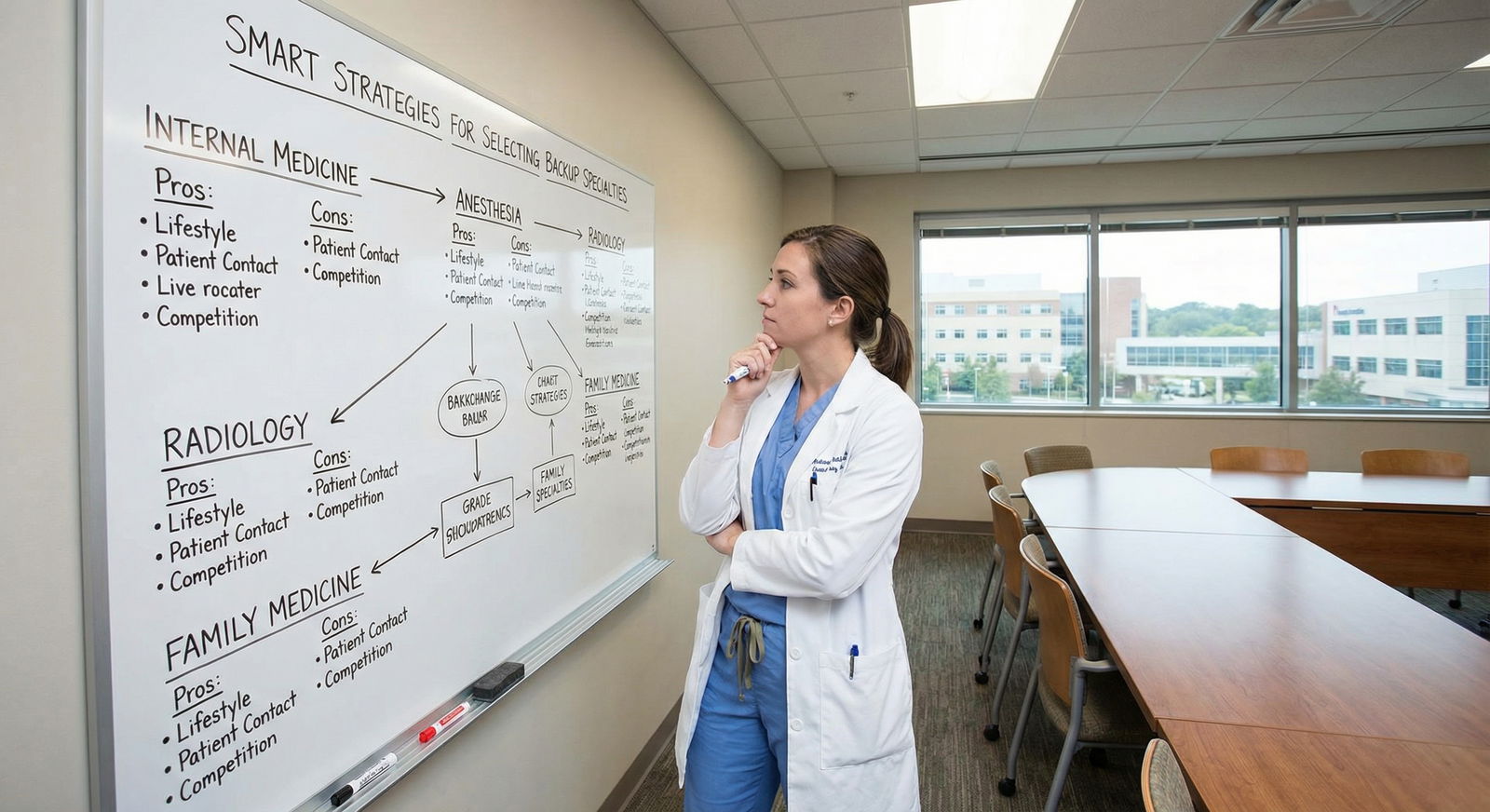
Strategic Categories of Backup Specialties: How to Think Beyond “Plan B”
When selecting backup specialties, a random list is not enough. It’s more helpful to think in structured categories that relate to your primary choice and overall goals.
1. Closely Related or Overlapping Fields
These are specialties that:
- Share similar patient populations or pathology
- Involve overlapping skills or procedures
- Often collaborate in daily practice
Choosing such a backup can make your training feel coherent, even if it isn’t your first choice.
Examples:
If your first choice is General Surgery or Surgical Subspecialties (e.g., Ortho, ENT, Urology)
Consider:- Anesthesiology – OR-based environment, acute physiology, procedural; heavy team collaboration with surgeons
- Emergency Medicine (EM) – resuscitation, trauma, acute management, procedures; fast-paced and hands-on
- Interventional Radiology (for some) – image-guided procedures; but note: IR is also competitive and not always a true “backup”
If your first choice is Family Medicine
Consider:- Internal Medicine – broader focus on adult medicine, inpatient and outpatient pathways
- Pediatrics – child and adolescent care, developmental focus
All maintain continuity of care and holistic patient management.
If your first choice is OB/GYN
Consider:- Family Medicine with OB focus – some programs offer robust maternity care training
- Internal Medicine with Women’s Health focus – possible later specialization in women’s health clinics, primary care for reproductive-age women
The benefit: your letters, rotations, and personal statement experiences can often be reframed convincingly for these related fields.
2. Complementary but Distinct Specialties
These fields may not mirror your primary choice but align with major aspects of your interests or skills.
Examples:
If your first choice is Dermatology
Consider:- Pathology – strong interest in morphology, pattern recognition, and disease classification
- Internal Medicine with Allergy/Immunology fellowship in mind – focus on immune-mediated skin and systemic disease
If your first choice is Psychiatry
Consider:- Neurology – brain and nervous system disorders with cognitive and behavioral overlap
- Internal Medicine – gateway to consult-liaison psychiatry, addiction medicine, or primary care with mental health emphasis
If your first choice is Radiology
Consider:- Internal Medicine – strong foundation for many imaging-heavy subspecialties
- Pathology – another diagnostically oriented specialty with pattern recognition and image-based decision-making
These complementary options preserve alignment with your cognitive style or patient interests while broadening your possibilities.
3. Alternative Pathways with Overlapping Outcomes
Sometimes you can reach similar end goals through different residency routes. This is especially useful when your dream field is ultra-competitive.
Examples:
Sports Medicine / Musculoskeletal Focus
- Primary choice: Orthopedic Surgery
- Backup: Physical Medicine & Rehabilitation (PM&R) or Family Medicine/Internal Medicine with a Sports Medicine fellowship
Palliative Care / Serious Illness Care
- Primary choice: Oncology or certain subspecialties
- Backup: Internal Medicine, Family Medicine, or Neurology with later Palliative Care fellowship
Rural or Underserved Care
- Primary choice: ENT, Ortho, or another procedure-heavy specialty
- Backup: Family Medicine, Internal Medicine, or General Surgery with a plan to practice broad-spectrum care in underserved areas
In these scenarios, you focus less on the residency title and more on the kind of practice you want after training.
4. Realistic but Meaningful “Safety Net” Specialties
Some fields generally have more positions relative to applicants and may be more accessible for applicants with academic challenges, USMLE/COMLEX concerns, or non-traditional backgrounds. These often include:
- Family Medicine
- Psychiatry (though becoming more competitive in some regions)
- Pediatrics (in many but not all locations)
- Internal Medicine (particularly community-based programs)
Choosing one of these as a backup does not mean “settling”; many physicians find deep fulfillment in these specialties. The key is ensuring they align with your values and that you can authentically explain your interest.
Doing the Homework: Researching and Reality-Checking Your Backup Choices
Once you’ve identified potential backup specialties, you need to validate them with real data and real-world perspectives.
1. Investigate Competitiveness and Training Structure
Look up objective numbers and program characteristics for each specialty you’re considering.
- Match data and competitiveness
- NRMP “Charting Outcomes in the Match” reports
- NRMP “Results and Data” for overall match rates
- Specialty-specific organizations (e.g., AAMC, specialty societies)
Key factors to examine:
Percentage of U.S. MD/DO seniors who match in that field
Average Step/COMLEX scores for matched applicants
Typical number of programs applied to and interviews attended
Proportion of categorical vs preliminary positions
Training length and structure
- 3 years (FM, IM, Peds, EM) vs 4–5+ years (Surgical specialties, some combined programs)
- Need for prelim/transitional years (e.g., advanced specialties like Anesthesia, Radiology, Derm, PM&R in some cases)
Fellowship options and post-residency flexibility
- Does the backup specialty still allow access to your desired niche (e.g., sports medicine, palliative care, hospital medicine, academic career)?
2. Talk to People in the Field
Numbers are important, but lived experiences matter equally.
Attending physicians
- Ask about the day-to-day reality, common stressors, types of patients, and how the field is changing
- Inquire how different personality types fare in their specialty
Current residents and fellows
- Ask, “What surprised you about this field after starting residency?”
- Ask about work-hours, call, culture, and educational support
- For those who switched from another specialty, ask why and how they made that decision
Program directors or clerkship directors (when appropriate)
- If you’re uncertain whether you are competitive, seek honest feedback
- Ask how they view applicants applying with this field as a backup
3. Use Career Guidance Resources at Your Institution
Most medical schools offer:
- Office of Career Guidance / Academic Affairs
- Specialty-specific advisors
- Workshops on specialty selection, CV building, and personal statement writing
- Data on where past graduates matched and in what specialties
Bring your self-assessment and proposed list of primary and backup specialties to a trusted mentor. Ask:
- Does this backup list seem realistic based on my application?
- Are these specialties coherent with my stated long-term goals?
- Are there specialty-program combinations (e.g., academic vs community, geographic regions) that might better match my profile?
Making and Implementing Your Backup Specialty Decisions
Once you’ve gathered information, you need to turn it into a concrete plan.
1. Ranking and Shortlisting Your Backup Specialties
Create a structured comparison:
- For each specialty (primary and backups), list:
- Alignment with clinical interests (1–5)
- Fit with your skills and personality (1–5)
- Lifestyle and geographic flexibility (1–5)
- Competitiveness relative to your profile (1–5)
- Access to desired fellowships/niches (1–5)
Rank specialties based on total score and your gut reaction. Ideally, you end up with:
- 1 primary specialty (or 1–2 if they are tightly linked)
- 1–2 true backup specialties that you would genuinely be willing to train in
2. Tailoring Your Application Strategy
Your backup plan affects how you approach the Residency Application as a whole:
ERAS application and personal statements
- Use separate, specialty-specific personal statements
- Articulate a coherent, authentic interest in each specialty—never sound like it’s obviously “just a backup”
- Emphasize overlapping themes (e.g., patient-centered care, love of procedures, interest in a particular patient population) while tailoring examples to each field
Letters of recommendation
- Aim for at least 2–3 strong letters in your primary specialty
- For each backup specialty, secure at least 1–2 letters from faculty in that field or in closely allied areas
- Ask letter writers who know you well and can comment on attributes important in that specialty (e.g., teamwork, critical thinking, empathy, technical skill)
Interview messaging
- Be prepared to explain why you are interested in that specialty specifically
- Avoid framing it as “I couldn’t get into X, so I’m applying here”—instead, describe positive reasons and genuine interests
- If asked about applying to multiple specialties, be honest but strategic: emphasize your broad interests and the overlap in skills and values
3. Maintaining Flexibility Through the Process
Even with a plan, be open to new data:
- A late, transformative rotation may shift your rankings
- Feedback from mentors might reveal a better fit than you initially realized
- Specialty competitiveness can change year to year
Revisit your plan periodically, especially:
- Before submitting ERAS
- After interview invitations start coming in
- When constructing your rank list
Your goal is not rigid adherence to your original idea, but a thoughtful, evolving strategy.

Frequently Asked Questions About Picking Backup Specialties for Residency
1. Do I really need a backup specialty if I’m a strong applicant?
Even very strong applicants in highly competitive fields can go unmatched due to factors beyond their control—program preferences, geographic limitations, or simply an unusually strong applicant pool. If:
- Your chosen specialty has historically high unmatched rates
- You are geographically restricted
- You have any significant application weaknesses (exam scores, leaves, professionalism concerns, late specialty decision)
…then having at least one backup specialty is prudent. Think of it as good risk management, not a reflection of your confidence or worth.
2. How can I tell if a backup specialty is truly a good fit and not just “the thing I think I can get”?
Ask yourself:
- Could I see myself practicing this field for decades without chronic resentment?
- Do I find at least some aspects of the patient population, clinical work, or intellectual content genuinely interesting?
- Have I spoken to people in the field and heard things that resonate with my values and personality?
- Can I write a sincere, specific personal statement explaining my interest?
If the answer is “no” to all of the above, that specialty is probably not a good backup, even if the match numbers look favorable.
3. How many specialties is it reasonable to apply to?
In most cases, applying to one primary specialty plus one thoughtfully chosen backup is sufficient. More than two specialties can:
- Dilute the strength and focus of your application
- Create logistical challenges for rotations, letters, and personal statements
- Make your narrative seem unfocused to program directors
Exceptions exist (e.g., prelim vs categorical strategies, internal medicine plus a separate preliminary year for an advanced specialty), but as a rule, aim for focus with flexibility, not scattershot applications.
4. Won’t programs be suspicious if they know I’m applying to another specialty?
Many program directors recognize that applicants—especially to competitive specialties—may apply to more than one field. What matters most is:
- That your application to their specialty feels intentional, informed, and sincere
- That you demonstrate understanding of the field and what training entails
- That you can articulate why you’d be a good fit for their specialty and program
If directly asked, you can acknowledge that you explored multiple related fields because of broad interests and competitiveness, while emphasizing why you are enthusiastic about their specialty specifically.
5. Can my backup specialty eventually become my primary focus or lead back to my dream field?
Yes, in several ways:
- Many physicians discover during residency that their backup choice is actually a better fit than their original plan.
- Some subspecialties are accessible from multiple residency pathways (e.g., sports medicine, palliative care, addiction medicine, clinical informatics).
- In certain situations, residents may reapply to their original dream specialty after a year or more in another field—though this path is complex and should be undertaken only with strong mentorship and realistic expectations.
The key is choosing a backup specialty that you would be reasonably content to stay in, even if your original plan never materializes.
Thoughtful backup specialty planning is not about giving up on your dreams; it’s about designing several futures you’d be proud to live. With honest self-assessment, careful research, and good Career Guidance, you can navigate the Residency Application process in a way that maximizes your chances of matching while preserving what matters most to you—in medicine and in life.