

The idea that only “hardcore” rotations count is a lie that stresses students out and helps exactly no one.
You’re not the only one freaking out that your best evaluation came from what everyone on your campus calls a “fluffy” elective. I’ve watched people spiral over this. You do an easy-ISH ambulatory elective or lifestyle-y subspecialty, you click with the attending, they write you a glowing evaluation… and then your brain goes:
“Cool. So the one person who thinks I’m competent watched me on the least impressive month I did.”
Let’s unpack that. Honestly. No sugarcoating, but no catastrophizing either.
What does “fluffy” even mean — and does it matter?
“Fluffy” is med-student slang, not an ACGME category.
People usually mean:
- Lighter hours
- Less scut, more talking, less call
- More outpatient, less “I haven’t peed in 12 hours”
- Attendings are nicer, more likely to give honors
- Reputation among students as “chill” or “easy A”
Stuff like: dermatology consult month, lifestyle medicine, outpatient rheum, integrative medicine, some community private-practice electives, maybe radiology, maybe an “advanced physical diagnosis” elective where you see three patients a day and drink good coffee.
The fear is:
“If my top evaluation and strongest letter come from this kind of elective, program directors will think I picked the easy path and can’t handle real work.”
Here’s the reality I’ve seen over and over:
- Program directors are way more worried about bad comments than good ones from an easy month.
- They don’t sit there with a red pen circling “ambulatory elective” and writing “fluffy = fake.”
- They care about patterns. Trajectory. Fit. Red flags.
One great evaluation from an easy-ish rotation does not ruin anything. The problem would be if your only good feedback in the entire file came from a clearly low-demand month and everything else said “unprofessional,” “needs constant supervision,” “poor fund of knowledge.” Then yeah. People raise eyebrows.
But that’s not you, right? You’re not failing everything else. You’re anxious because your very best, most over-the-top praise came from that elective. That’s different.
How program directors actually look at evaluations and letters
Let me be blunt: no one is reading your entire evaluation history like it’s a novel. They’re skimming.
Most programs are doing some version of this mental flowchart:

| Step | Description |
|---|---|
| Step 1 | Open Application |
| Step 2 | Look at Transcript and MSPE |
| Step 3 | Dig into Comments |
| Step 4 | Glance at Strengths |
| Step 5 | Skim Key Letters |
| Step 6 | Decide Interview |
| Step 7 | Any Red Flags |
What actually matters to them:
- Are you safe with patients?
- Are you a pain to work with?
- Do your strengths match the specialty?
- Are there any giant red flags they’d be dumb to ignore?
Now, here’s where your “fluffy” elective fits in:
A glowing evaluation from that elective can do a few useful things:
- Show you can build strong relationships with attendings (huge for fit and professionalism).
- Highlight communication, empathy, patient rapport — all core, not fluff.
- Give specific, human-sounding praise that stands out.
Where it doesn’t hurt you: no PD is rejecting someone because “their best comments came from an outpatient elective instead of trauma surgery.” They don’t care that much about which month the nice evaluation came from. They care what the evaluation actually says and how that compares with everything else.
If your file looks like this:
| Rotation Type | Overall Strength | Tone of Comments |
|---|---|---|
| Core IM | Solid | Mostly positive |
| Surgery | Mixed | Some constructive notes |
| Psych | Solid | Good engagement |
| Fluffy outpatient elective | Outstanding | Very enthusiastic |
| Sub-I in target field | Solid to strong | Good team member |
That’s not a problem. That’s literally normal. Almost everyone has one rotation where they just clicked, the stars aligned, and it looks amazing.
The worst-case scenarios you’re imagining (and what’s actually true)
Let’s drag your internal catastrophes into the light for a second.
Fear #1: “They’ll think I cherry-picked an easy elective to get a fake-good letter.”
Could one cranky PD somewhere think that? Sure. There’s always one. But most are not sitting there assigning a “difficulty multiplier” to each letter.
Here’s what they actually see:
- Timing: You took an elective; the attending liked you; they wrote you a glowing thing. Very normal.
- Content: Are the comments specific, or just “great student, pleasure to work with”?
- Context: Do your other evaluations show a basically competent person? Then the elective just looks like a strength.
If you’re really worried, you can make the elective less fluffy-looking by how you talk about it in your application or interviews:
- Emphasize what you actually did: complex patients, continuity, procedures, teaching roles.
- Tie it to your specialty interest: communication, chronic disease management, outpatient follow-up, whatever fits.
They can’t read your mind. They only see what’s on paper and what comes out of your mouth.
Fear #2: “My sub-I or core clerkships weren’t as strong. Will they think I can’t handle real work?”
Let’s say your sub-I evaluation was good but not poetry. And your amazing, life-affirming evaluation is from a “lighter” elective. That’s not ideal for your anxiety, but it’s also not some death sentence.
Program directors know:
- Sub-Is are often higher pressure; not every attending gushes.
- Some evaluators just don’t write enthusiastic comments, ever.
- Some services are chaotic, and no student shines.
They look at consistency:
- Do your sub-I and core rotations say you’re safe, reliable, teachable?
- Does the narrative summary (MSPE) show progress, not disaster?
- Do you have at least one letter from a “serious” rotation in your specialty or close enough?
The best move is usually:
Use the “fluffy” rotation plus a more “legit” core/sub-I letter. Let the nice one show how great you can be in the right environment. Let the core/sub-I prove you can work in the trenches.
If your sub-I letter is weak or generic, the elective letter might actually save you by giving programs a reason to think, “OK, when conditions are decent, this person is excellent.”
Fear #3: “What if they assume the attending inflates everyone and my letter means nothing?”
Yes, some electives and some attendings are known for grade inflation. Most PDs have learned to mentally discount that a little.
But here’s the key: they discount vague praise, not specific stories.
A fluffy-sounding letter:
“Student was a pleasure to work with. Showed up on time, was kind to patients, and will be an asset in residency.”
A fluffy elective but strong letter:
“On our busy Monday clinic, they independently saw 6 complex rheumatology follow-ups, presented concisely, and updated plans safely. By the end of the month, they were running a full room without needing me in the room each time.”
Same rotation. Totally different weight.
If your best evaluation has specific, behavior-based praise, it holds more value. Even from an “easy” elective. If it’s just generic nice words, then yeah, it’s not going to single-handedly carry your application—but it’s also not hurting you.
How to actually use that “fluffy” rotation to help your residency application
Instead of hiding from it, you can lean into it strategically.
1. Decide if that letter should be one of your primary LORs
Ask yourself:
- Is it detailed and specific?
- Does it comment on things PDs care about: work ethic, teamwork, clinical reasoning, communication, ownership of tasks?
- Is the writer respected in their field or well-known at your home institution?
If yes, that’s a real letter. You can absolutely use it, especially if you pair it with:
- A letter from your sub-I in your target specialty (even if it’s a bit more reserved), and
- A letter from a core clerkship or related specialty that shows you’re solid under typical ward pressure.
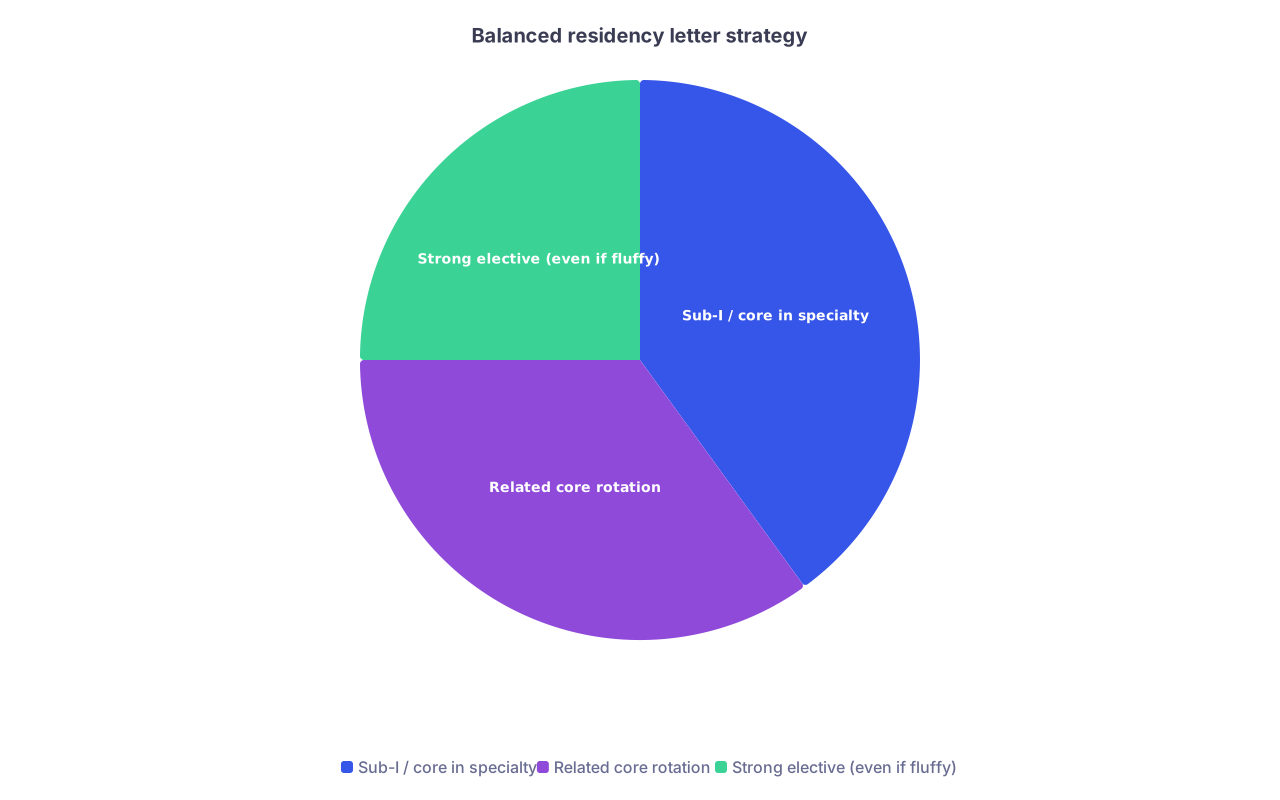
| Category | Value |
|---|---|
| Sub-I / core in specialty | 40 |
| Related core rotation | 35 |
| Strong elective (even if fluffy) | 25 |
That mix doesn’t scream “they can only function on easy electives.” It looks like: “Here’s how I perform across different settings.”
2. Use the elective in your personal statement or ERAS experiences (carefully)
If this elective genuinely shaped how you think about patient care, you can mention it:
- Focus on a meaningful patient encounter
- Highlight skills: longitudinal care, motivational interviewing, complex chronic disease, interdisciplinary teamwork
- Connect it to why you’re drawn to the specialty
What you don’t do is:
“I liked this elective because it had better lifestyle and nicer hours.” Even if that’s half-true. You are not on trial for thought crimes, but don’t hand them ammo.
3. If you’re asked about it in interviews, own it
Sometimes a PD or faculty interviewer will say:
“I see this really strong comment from your [name of elective]. Tell me about that rotation.”
This is not a trap. This is them handing you a softball.
You say something like:
“I really appreciated that elective because it pushed me to take more ownership in an outpatient setting. I was seeing my own patients, calling them with results, coordinating care. It was also the first time I felt the attending trusted my clinical reasoning enough to let me run with an assessment and plan. That feedback meant a lot because it showed me I could really grow into that level of responsibility.”
That answer makes the “fluffy” rotation sound like exactly what it was: a place where you thrived and grew. No one hears that and thinks, “Ah yes, this person is weak.”
When should you actually be worried?
There are a few red-flag patterns where I’d say: yeah, I’d be nervous too.
- You have one ecstatic letter from a very easy elective
- Everything else (cores, sub-I, MSPE) has lukewarm to negative comments about professionalism, work ethic, or judgment
- No strong letter from your own field or a related heavy-hitter rotation
If that’s your situation, then the problem isn’t that your best evaluation came from a fluffy rotation. The problem is your overall clinical performance and reputation. That’s a bigger conversation: remediation, maybe a research year, strategic specialty choice.
But for most people asking this question, the situation is more like:
- Mostly solid evaluations (some great, some mediocre, nothing catastrophic)
- One “wow” evaluation from a lighter or outpatient elective
- Anxiety projecting all of your self-doubt onto that one outlier
If that’s you, then the right move is not to hide that rotation—but to frame it well and make sure you’re not relying on it alone to prove you’re ready.
If you could go back, should you have picked a “harder” elective?
You’re probably torturing yourself with this one.
“If I really cared, I should’ve done another ICU month, or trauma, or something more impressive. Now it just looks like I wanted easy street.”
Be honest with yourself: you were tired. Burned out. Curious about something different. Or scheduling was a mess and that’s what fit. None of those are moral failings. Residents and attendings schedule “lighter” blocks all the time. It’s called survival.
Programs aren’t building some character indictment from one outpatient elective. They care way more about:
- Your Step 2 / COMLEX 2
- Your sub-I performance
- Your letters from core rotations in your field (or adjacent fields)
- Whether people liked working with you
The elective you chose in October of M4 because you needed to stop waking up at 3:45 AM is not the hinge upon which your entire life turns. It feels that way right now. It won’t in three years.
Quick reality check: what you can do right now
If this is gnawing at you, here’s how to calm the part of your brain running disaster simulations:
Re-read the “fluffy” evaluation or letter. Circle every specific behavior or skill it praises. Those are real.
Look at your other evaluations. Are they mostly “competent,” “reliable,” “good team player”? That’s what programs want.
Make sure your final letter set includes:
- At least one from a core or sub-I in your chosen specialty (or very close).
- One from someone who knows you well and can speak to your character and work ethic.
- Optionally, the “fluffy” elective writer if they go to bat for you with real detail.
Prepare a 2–3 sentence way to talk about that elective in interviews that makes it clear it was meaningful, not just easy.
Then stop doom-scrolling your brain about it. You gain nothing by re-running “what if they secretly hate fluffy electives” on a loop.
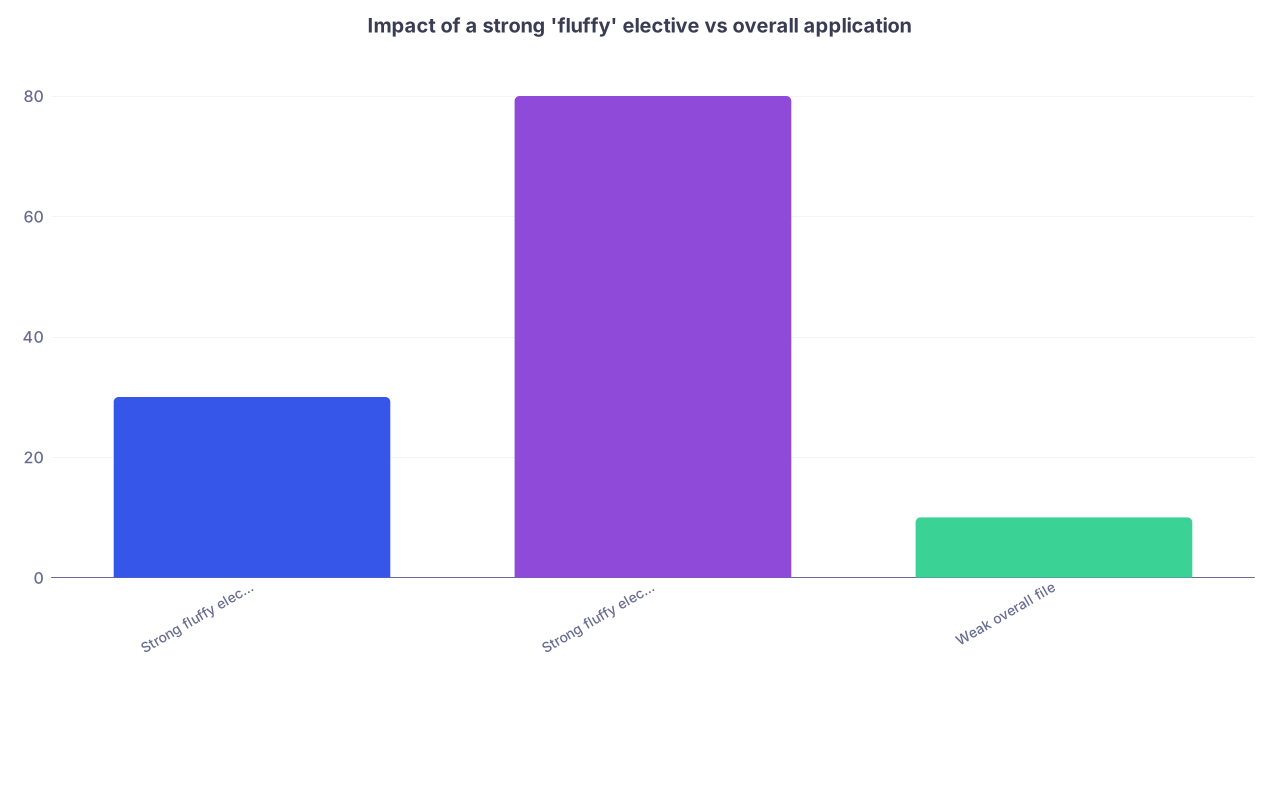
| Category | Value |
|---|---|
| Strong fluffy elective alone | 30 |
| Strong fluffy elective + solid cores | 80 |
| Weak overall file | 10 |
FAQs
1. Should I not use a letter from a “fluffy” elective at all?
Use it if it’s one of your strongest, most specific letters and you can balance it with at least one from a core or sub-I in your chosen specialty (or a closely related one). The danger isn’t “fluffy elective.” The danger is having no letters from real bread-and-butter rotations in your field.
2. Will program directors judge me for having my best comments from an outpatient or lifestyle elective?
Most won’t. They’ll see that as: this is where you really clicked. They know some rotations are more nurturing than others. They care more about whether your other evaluations are at least solid. If the rest are okay and that one is stellar, it just looks like a highlight, not a red flag.
3. Should I address the “easy” reputation of the elective in my application?
No. Don’t bring up that it’s considered easy or fluffy. They may not even know or care. Talk about what you did and what you learned. Focus on concrete skills: continuity of care, communication, managing chronic conditions, patient counseling, whatever fits the rotation.
4. What if my sub-I evaluation is weaker than my elective one?
That’s common. Sub-Is are intense and expectations are higher. Still include your sub-I letter (especially if it’s in your target specialty) because it shows you can function at near-intern level. Pair it with the strong elective letter to show your full range. If something concerning is in the sub-I letter, talk to your dean or advisor about strategy.
5. Do I need to explain why I chose that elective if it wasn’t obviously related to my specialty?
Only if you’re asked. If you are, keep it simple and honest without self-sabotage: you were interested in that patient population, wanted more outpatient experience, or wanted to explore an area that could complement your specialty (e.g., rheum for IM, derm for peds). You don’t need to confess “I heard it was chill.” You’re not under oath.
Key points: One standout evaluation from a “fluffy” elective doesn’t tank your residency chances. Programs care about patterns and red flags, not punishing you for one lighter month. Use that strong evaluation or letter alongside solid core/sub-I letters, frame the elective as meaningful experience, and stop letting this one rotation carry all your anxiety.


